Is there still a chance to save the CLARITY Act?
By: Christina Comben
Compiled by: Chopper, Foresight News
The crypto industry, lobbying groups, and members of Congress have spent the past year trying their hardest to get the CLARITY Act passed, yet now there’s a sense of helplessness akin to being surrounded by water with no drop to drink. After countless rounds of negotiations, revisions, and political maneuvering, parties still failed to advance the bill through the Senate.
The CLARITY Act faced a major hurdle in the Senate this week, but it hasn’t been declared dead; it’s merely limping along. This digital asset market framework bill still has a chance to gather the 60 votes needed to pass in the Senate.
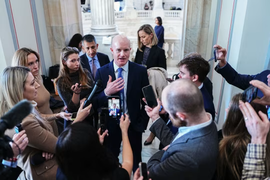
Republican Senator Thom Tillis flipped his vote from support to opposition at the last minute, a move driven by procedural considerations. While it appeared to be a defection against the bill, it was actually a parliamentary maneuver: through this move, he could file a motion to reconsider, preserving the opportunity for the bill to return to the Senate floor for a vote.
Ryan Eagan, Chief of Federal Affairs at the Crypto Council for Innovation (CCI), told our publication in an interview: “Senator Tillis’s motion to reconsider allows for a cloture vote on the CLARITY Act to be reopened at any time during this Congress. The exact timeline for the next steps remains unclear, but keeping that possibility alive is partly due to the progress made in negotiations over the past week.”
However, time is running out for the bill in the Senate. Democrats and Republicans still have significant disagreements over the ethics provision concerning President Trump. Even supporters of the bill admit that more bipartisan, collaborative negotiations are required now.
So, is there still a chance for the CLARITY Act to stage a comeback? If so, how much would it need to be amended to make it through?
The CLARITY Act Isn't Dead, But the Window Is Closing
The failure of this cloture vote (a procedural vote aimed at ending debate and moving to final passage) does not mark the end of the CLARITY Act’s journey through Congress. The bill’s vote on Tuesday resulted in 49 yes votes and 50 no votes, falling short of the 60-vote threshold.
Tillis’s motion to reconsider means a new vote can be initiated during this Congressional session, but the bill faces a practical hurdle: little time remains.
The Senate plans to adjourn on October 2 and will only reconvene after the midterm elections; the House is already in its election recess. Getting the bill fully processed by both chambers before the year ends has become significantly harder.
Democratic Representative Shri Thanedar, who supported the CLARITY Act during a July 2025 House vote, stated that the timeline is a major obstacle to reaching an agreement: “This Congress has only 20 legislative working days left, all scheduled after the midterm elections. Regrettably, the probability of reaching a compromise within 2026 is very low.”
A low probability does not equal impossibility. The crypto sector can look to the precedent set by the GENIUS Stablecoin Act: that bill failed its cloture vote 48-49 in May 2025, but just 11 days later passed a second vote 66-32, officially passing the Senate the following month.
However, Kyle Chassé, founder of crypto investment firm MV Global, noted: “The GENIUS Act’s turnaround 11 days after its initial failure was predicated on the fact that all parties had already negotiated an agreement. Right now, the CLARITY Act only has time pressure and lacks the votes to back it up. If we miss the January 3 milestone next year, everything starts from scratch in 2027, when the House will likely be controlled by Democrats.”
The post-November midterm election session theoretically offers one more opportunity for the CLARITY Act, but that doesn’t mean a consensus-ready proposal is currently prepared.
The 60-Vote Threshold Is Essentially a Negotiation Challenge
All 49 affirmative votes came from the Republican caucus, with zero Democratic members supporting to open debate, Chassé pointed out.
While the outlook isn’t optimistic, it doesn’t mean Democrats have completely abandoned the bill. On Wednesday, seven Democratic senators who voted against advancing the bill on Tuesday stated they remain committed to pushing the legislation forward. This includes Senator Angela Alsobrooks, who supported the bill’s passage out of the Banking Committee in May but voted against it in this cloture vote. She said, “Now is indeed the time to establish regulatory rules for digital assets,” and expressed willingness to continue negotiating around the ethics provisions.
“Until the moment before the vote, we were ready to reach a deal and kept the talks going. But when it became clear the bill was poised to pass, Republican leadership halted negotiations at the eleventh hour.”
Tillis stated on Wednesday that he now hopes to “persuade Democrats to join the supporting side” and “pressure Democrats to take responsibility for the legislation.” His procedural maneuver to change his vote on the fly was precisely to keep negotiations possible. “I firmly believe this is an unregulated market, and we must establish guardrails.”
The point of contention is no longer whether Congress should legislate for the crypto industry, but whether the current version of the bill can garner enough cross-party support.
Although Representative Thanedar supports the current version, he acknowledged that Tuesday’s result shows the draft needs further bipartisan refinement: “Tuesday’s setback on the CLARITY Act indicates that a bipartisan co-drafting approach would make it more likely to build a bipartisan supermajority coalition to advance the bill into law.”
If Saving the Bill Requires a Rewrite, What Can Be Kept?
Chassé believes the issue has moved beyond the policy text itself, shifting focus to President Trump’s crypto holdings and the related ethics provisions: “This is no longer a question of drafting bill text. Six weeks before the election, the vote essentially became a referendum on the President’s crypto assets, making it impossible for the current provisions to pass.”
Before Tuesday’s vote, Republicans had already implemented 126 substantive revisions based on Democratic demands, including tightening restrictions on public officials profiting from crypto projects and authorizing state attorneys general to enforce certain ethics provisions.
Even with these concessions, Thanedar said Democrats still want to further restrict the “President leveraging his official position for personal gain.” He noted that Trump reported at least $1.4 billion in crypto earnings in his 2025 annual financial disclosure form, adding, “Establishing safeguard mechanisms serves both to oversee the President and to maintain the long-term health of the digital asset market.”
Ethics provisions are not the only sticking point. Chassé argues the industry shouldn’t dig in its heels on this single issue. Regarding stablecoin revenues, he points out that “capping yields or implementing circuit breakers is likely a necessary cost to secure the backing of banking senators and a large bloc of Democratic lawmakers,” while also strengthening provisions related to illicit finance and state-level enforcement.
He posits that self-custody and developer protection clauses are the bottom lines the crypto industry must firmly defend. Throughout the negotiation process, lawmakers and industry groups have fiercely debated the extent to which the bill should protect non-custodial software developers from financial and anti-money laundering compliance obligations.
Congressional Legislative Stalemate Won't Halt Crypto Regulation
Even if the CLARITY Act remains stuck at the congressional level, the advancement of US crypto regulation will not stall. Eagan stated that the Securities and Exchange Commission (SEC) and the Commodity Futures Trading Commission (CFTC) are “continuously working to reduce industry uncertainty” through regulatory guidance, rulemaking, no-action letters, and exemption provisions.
“CCI expects that regardless of the ultimate fate of the CLARITY Act, regulators will aggressively push forward their crypto-related agendas.” He added that the Treasury Department and banking regulators are still rolling out companion implementation measures for the GENIUS Act.
Michael Saylor, Executive Chairman at MicroStrategy, also pointed out that the SEC, CFTC, and Treasury Department can continue issuing regulatory rules based on existing laws: “Regulatory progress does not need to wait for congressional legislation.”
That said, agency rulemaking and the formal passage of the CLARITY Act are fundamentally different things. Administrative regulatory guidance can be overturned during a change in administration, whereas congressional legislation is far more difficult to modify or repeal.
The CLARITY Act still holds a slim chance of returning to the Senate floor for a vote, but whether lawmakers can muster 60 affirmative votes without substantially altering the bill’s core provisions remains to be seen.
Join TechFlow official community to stay tuned
Telegram:https://t.me/TechFlowDaily
X (Twitter):https://x.com/TechFlowPost
X (Twitter) EN:https://x.com/BlockFlow_News
 @Cointelegraph