The failure of CLARITY has nothing to do with how well or poorly the crypto industry is doing.
By Liu Honglin
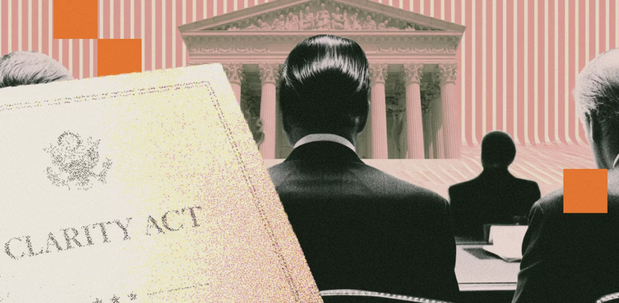
The failure of CLARITY this time has little to do with whether the crypto industry itself is thriving or struggling.
It yielded on 126 Democratic amendments, expanded the text from 300 pages to 635 pages, and even accepted 80% of Trump’s ethics proposal—in the end, it still fell short by 11 votes, and not a single vote came from Democrats.
This wasn’t about “not conceding enough.” It was like someone desperately raising their bid, without ever asking what the other party actually wanted to buy.
As Han Feizi notes in "The Difficulties of Persuasion": The greatest challenge in persuasion lies in understanding the mind of the one being persuaded.
The reason CLARITY failed this time is precisely that it failed because of this principle.
I. Political Dimension: This Isn’t About Vote Counts
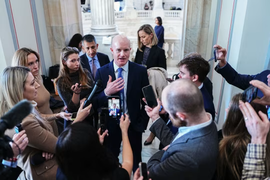
49 votes in favor, 50 against—falling short of the 60-vote threshold; all 49 yes votes came from Republicans, with zero support from Democrats or independent senators.
Passed by the House in July 2025 at 294 to 134, and by the Senate Banking Committee in May 2026 at 15 to 9. After more than a year of negotiations, it stalled at the final procedural hurdle.
A detail here is widely misread: North Carolina Senator Tillis switched his vote from yes to no during the proceedings. This wasn’t a flip-flop, but a Senate procedural tactic—joining the majority side preserves the right to later file a motion to reconsider, which he submitted immediately after the vote concluded. Therefore, the claim that “Republicans lost four votes” is inaccurate. Excluding his strategic switch, the bill still fell short of 60 votes by roughly 10.
Republicans consistently assumed Democrats wanted stricter ethics provisions. So they kept overcompensating: banning officeholders from issuing or sponsoring digital assets, requiring divestment of major financial interests, imposing profit disgorgement and fines for violations, and removing the original sunset clause that would have halted liability after a president left office.
In the revised text, only the Attorney General retains direct authority to initiate civil enforcement against the President. State attorneys general are granted a narrow avenue—limited to suing the AG for inaction—and even that door closes if the relevant ethics agency issues an opinion stating the conduct isn’t prohibited.
In an old idiom, this is using a man’s own spear to pierce his own shield.
If a law is filled with prohibitions yet delegates enforcement power to those close to the banned, it doesn’t write bans—it writes procedures.
Democrats have never opposed the clauses themselves; they oppose the mechanism. The former is a technical issue open to negotiation; the latter is a trust deficit that cannot be negotiated away.
Before the vote, Warren dubbed these new provisions a “pallid fig leaf.” Her point was direct: no matter how meticulously restrictions are written down, if enforcement remains in the hands of those being restricted, it’s merely decorative.
This is why 635 pages couldn’t buy a single vote.
II. Industry Dimension: This Isn’t “Crypto Losing”
The essence of the CLARITY bill isn’t whether Bitcoin is legal, but whether on-chain dollars can be recognized under U.S. law as an operable clearing system.
That’s also why traditional financial institutions are so keen on it.
The dollar’s true strength lies in the same place: not merely in its printing privilege, but in whether the world is willing to settle transactions within its network.
In the past, this network lived inside bank accounts, correspondent banking, SWIFT messages, and banking hours. It is highly mature, but it was never designed for the internet age’s small-scale, high-frequency, 24/7 global capital flows. What stablecoins truly accomplish is enabling dollar-denominated assets to be transferred in real-time like internet-native assets for the first time—strictly speaking, USDC isn’t the dollar itself; it’s an on-chain dollar claim backed by reserve assets with a promised 1:1 redemption rate, much closer to an “internet-based dollar money market fund share.”
This is no longer a niche market. By September 2026 metrics, USDT’s circulating supply stands at roughly $183 billion, while USDC reaches about $74 billion; Tether alone holds over $140 billion in U.S. Treasuries, exceeding the reserves of many sovereign states. Its profits derive almost entirely from interest on these reserves—Circle reported approximately $1.7 billion in revenue in 2024, with 99% coming from reserve interest, while simultaneously paying out around $1 billion to distribution partners like Coinbase.
For the United States, this represents a new pillar: the larger the stablecoin ecosystem, the greater the demand for short-term U.S. Treasuries behind it, and the broader the use cases for the dollar. CLARITY aimed to outfit this pillar with its own legal skeleton—bringing issuance, reserves, disclosures, and intermediary access firmly within the U.S. domestic legislative framework.
Failing to secure this legislative pass now doesn’t mean this pillar will halt. The trajectory has simply shifted: from Congressional legislation toward regulatory agencies, state-level frameworks, and compliance infrastructure built independently by market participants.
Visa’s stablecoin settlement pilot has expanded across nine blockchains, reaching an annualized settlement volume of $7 billion; Stripe went further by outright acquiring the stablecoin infrastructure firm Bridge.
None of these moves waited for CLARITY.
Viewed as a chessboard, the picture becomes clearer: CLARITY’s failure reflects a temporary impasse in domestic American politics, while the on-chain dollar clearing network is already advancing along an alternative path.
III. Regulatory Dimension: Stablecoins Already Have Legal Grounding
A easily overlooked fact here must be noted: CLARITY’s failure does not mean there are no rules for stablecoins in the United States.
In July 2025, the U.S. signed the GENIUS Act, establishing a federal regulatory framework specifically for payment-focused stablecoins. Through 2026, the Treasury Department and the Office of the Comptroller of the Currency (OCC) have been rolling out detailed implementation rules, including admission pathways reserved for foreign issuers.
Thus, America’s current posture is fractured: stablecoins have legal statutes in place, but the market structure hasn’t caught up yet.
CLARITY was intended to solve a different problem—whether a token qualifies as a security or a commodity, how intermediaries should register, and where the jurisdictional boundary between the SEC and CFTC lies. That question remains unanswered today, yet it sits at the very origin of every litigation and enforcement dispute from the past few years.
XRP serves as the clearest reminder. The SEC v. Ripple case concluded in August 2025 when both parties withdrew their appeals, with Ripple paying a $125 million fine. The case closed, but the issue didn’t: the same asset can yield entirely different legal conclusions depending on whether it involves institutional sales or secondary market trading. CLARITY aimed to codify such distinctions into forward-looking regulations—it failed to achieve this objective this time.
For Asian teams, another pathway is already open. In April 2026, Hong Kong issued its first batch of stablecoin issuer licenses to a joint venture led by HSBC and Standard Chartered; by August, stablecoins from licensed entities were live online. This isn’t a future blueprint—it’s an operating system.
As for mainland-based entities, the boundaries have always been clear.
A ten-department notice in 2021 already classified virtual currency-related business activities as illegal financial operations; the February 2026 Yin Fa [2026] No. 42 directive further clarified handling protocols for scenarios involving RMB-pegged stablecoins, mainland-controlled offshore entities issuing virtual currencies, and the tokenization of real-world assets.
Therefore: If your entity, clients, employees, revenues, and expenses are all domestically based, this round of Washington’s maneuvering has nothing to do with you. Everyone should simply continue doing what they’re supposed to be doing.