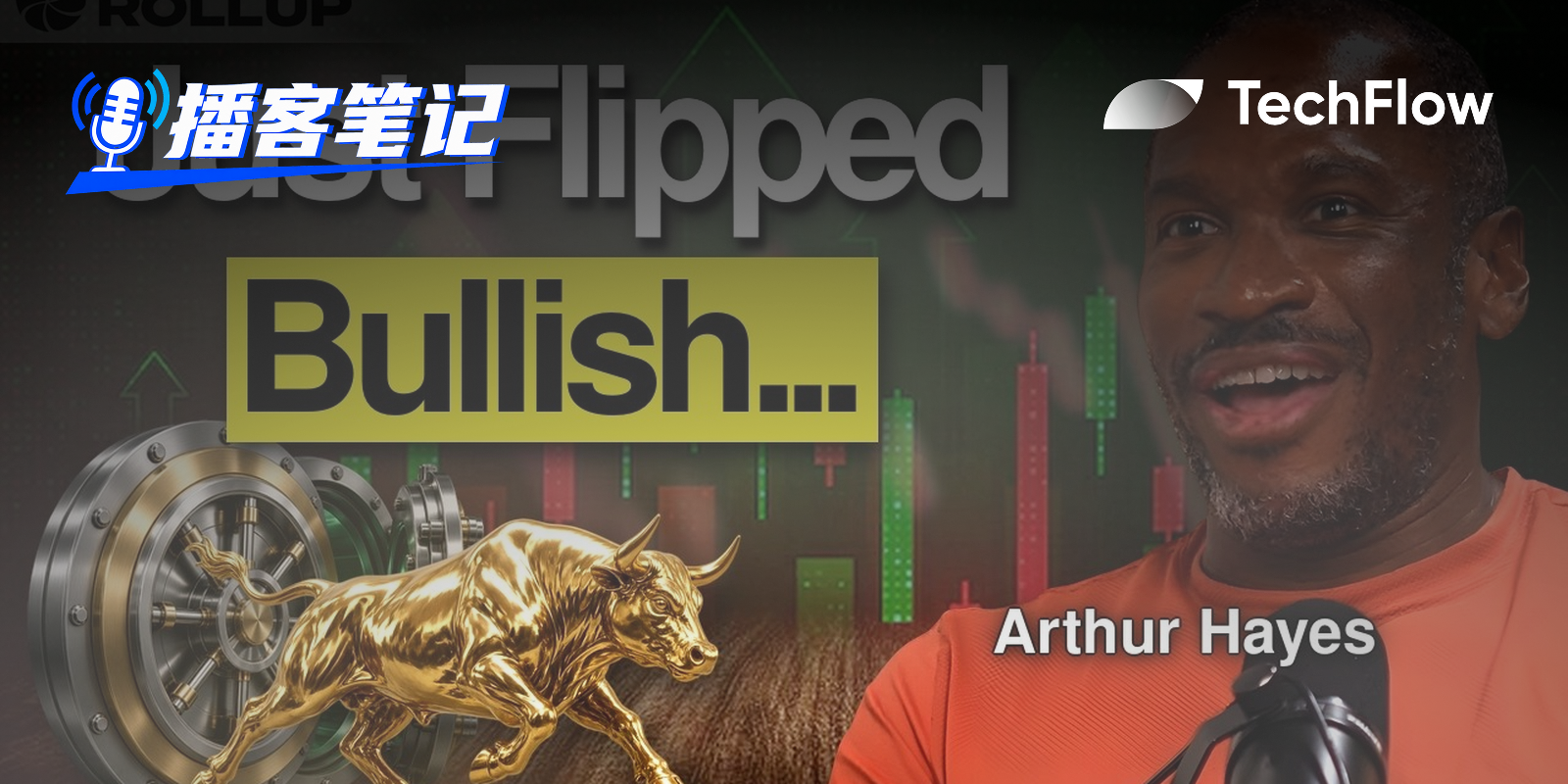
Podcast Notes | Arthur Hayes: When the Fed Raises Rates, I Have Extra Cash to Buy Bitcoin
Editing & Compilation: TechFlow
TechFlow Guide: Against the backdrop of intensifying games between the crypto market and macrofinance, BitMEX co-founder and CIO of Maelstrom, Arthur Hayes, joined The Rollup podcast for an in-depth conversation with hosts Rob & Andy. Addressing recent market anxiety over the 10-year and 30-year U.S. Treasury yield breaking through 5% alongside the Federal Reserve's continuous rate hikes, Hayes proposed a highly disruptive macroeconomic analysis framework, stating bluntly that "nominal U.S. Treasury yields are entirely reasonable, and rate hikes are essentially a reverse form of large-scale liquidity injection."
Hayes detailed how rate hikes channel approximately $22.5 billion in interest income directly into the financial system and high-net-worth individuals every time the Fed raises rates by 25 basis points, driven by the Fed's $3 trillion in excess reserve interest and $7 trillion in short-term Treasuries. This risk-free return will ultimately not only fail to suppress prices but instead flood into inflation-hedging hard assets like Bitcoin and core real estate with ferocious buying pressure. Drawing on historical evidence from Brazil in the 1980s, Hayes deeply revealed the underlying logic of heavily indebted economies experiencing "more hikes, more money, and higher asset prices."
Guest: Arthur Hayes (Co-founder of BitMEX, Chief Investment Officer at Maelstrom)
Hosts: Rob & Andy (Hosts of The Rollup)
Podcast Source: The Rollup (https://www.youtube.com/watch?v=W1j_1_DjwYw)
Original Title: Arthur Hayes: The Fed Just Handed Bitcoin Its Next Leg Up (Rate Hike Trade)
Air Date: November 14, 2026
Key Takeaways
- Nominal U.S. Treasury Yields Are Reasonably Priced: Arthur Hayes pointed out that nominal Treasury yields represent the sum of real economic growth and inflation expectations. With current U.S. nominal GDP growth ranging between 5% and 6%, a 10-year Treasury yield hitting 5% to 6% falls well within a highly reasonable valuation range. Market panic over a Treasury collapse or hyperinflation is completely detached from fundamental realities.
- The Hunger Games of Capital Competition: Finite global capital is locked in fierce competition. At the peak of the pyramid sits the AI sector, which disregards borrowing costs. To build omnipotent machines, AI firms willingly shoulder interest rates of 10%, 15%, or even 20%, squeezing out sovereign debt. Below them is the U.S. government with its unlimited borrowing privilege. Under this dual squeeze, peripheral sovereign nations like France—characterized by high deficits, energy shortages, and Eurozone constraints—will become the gravest casualties.
- Money Quantity Trumps Money Price: Mainstream investors and media often overfocus on "money prices" like policy rates and Treasury yields. However, for cryptocurrencies and scarce assets, the fundamental variable determining price trends is "total fiat supply." Rate hikes have not tightened the real faucet of the financial system; instead, they have injected massive incremental fiat currency back into the economy through government debt interest expenditures.
- Interest Pumping Mechanism of Rate Hikes Equates to Easing: Every time the Fed raises rates by 25 basis points, interest payments on the $3 trillion in excess reserves held by commercial banks increase by $7.5 billion annually; simultaneously, $7 trillion in outstanding short-term Treasuries require roughly $17.5 billion in additional annual interest. This means each 25 bp hike effectively injects a net ~$22.5 billion of fresh liquidity into the financial system out of thin air.
- High-Net-Worth Interest Spillover Drives Bitcoin Higher: This massive influx of new interest liquidity does not reach ordinary citizens at the bottom but is concentrated among commercial banks and high-net-worth asset holders. Wealthy individuals holding vast amounts of short-term Treasuries, upon receiving hefty interest payouts from the Fed, do not increase daily consumption. Instead, they directly dump their capital into hard assets like Bitcoin, premium real estate, luxury watches, and fine wine, pushing Bitcoin into an independent surging rally.
- Inflation Paradox of Rate Hikes in Heavily Indebted Economies: Reviewing the empirical economics of 1980s Brazil, in highly leveraged economies reliant on short-term borrowing, fighting inflation via rate hikes causes interest expenses to spiral out of control, inadvertently creating more liquidity and driving inflation higher. Modern Fed policymakers are overly obsessed with manipulating interest rate prices, completely ignoring the fundamental logic of the Paul Volcker era, which directly targeted credit and total money supply.
Key Quotes
- "U.S. nominal GDP growth sits between 5% and 6%, so a 5% to 6% yield on 10-year Treasuries is perfectly reasonable. The U.S. government will borrow every single dollar it needs. Panics over Treasury default or hyperinflation will never materialize. The U.S. government is completely fine."
- "In the 'Hunger Games' for global finite capital, AI stands at the top. AI companies believe they are creating 'God,' and God is infinite. Therefore, whether borrowing costs are 10%, 15%, or 20%, they simply don't care how much interest they pay. Massive computing power financing is systematically crowding out sovereign debt."
- "France is the unluckiest party. Their government overspends, relies on German and Japanese capital subsidies, is held hostage by the Eurozone system, lacks independent energy, and faces daily street riots, yet still wants to offload 10-year Treasuries at 4.5% to 5%. They are the ones completely trapped in a dead end."
- "Too many people obsess over the price of money, constantly staring at Fed rates and Treasury yields. But for crypto investors and scarce asset holders, what truly matters has never been price—it's understanding exactly what is happening to the global quantity of fiat money."
- "Every time the Fed hikes rates by 25 basis points, it's equivalent to injecting an extra $22.5 billion into the financial system. This money isn't handed to grassroots civilians; it goes straight to banks and wealthy individuals holding large batches of short-term Treasuries."
- "I hold a massive pile of short-term Treasuries. Fed rate hikes are essentially a huge raise for me. I don't need to buy an extra meal or anything like that. What do I do with this extra interest? Naturally, I go buy Bitcoin, mansions, luxury watches, and fine wine—any hard asset that preserves value."
- "History has long proven this: in short-term high-liability economies, when you think you're fighting inflation with rate hikes, you're actually just printing more cash out of thin air through massive interest payments. That is precisely why Bitcoin surges counter-trend whenever the Fed raises rates."
Full Transcript
The Hunger Games of Capital Markets: Reasonably Priced Treasury Yields, AI vs. Sovereign Debt Competing for Finite Liquidity
Rob & Andy: Your current positions remain heavily concentrated in Bitcoin, clearly leaning toward the hard and scarce asset end of your barbell strategy. Last year, one quote from you on our podcast stuck with me: Politicians have only one choice, which is to spend money. They technically could choose not to spend, but that would mean getting voted out of office immediately. So in reality, their only option is to continue massive spending.
Rob & Andy: Looking at the current macro bond market, both 10-year and 30-year U.S. Treasury yields have climbed to 5%, and even above 5.5%. In your view, does this imply cracks have formed within the financial system that require repair? And does fixing these systems inevitably mean accelerating money printing?
Arthur Hayes: First, we must clarify concepts: nominal government bond yields combine real economic growth with inflation expectations. When bond yields rise, you first need to investigate the root cause behind it and determine exactly what the country's current nominal GDP is.
Arthur Hayes: Taking the United States as an example, current U.S. nominal GDP growth hovers around 5% to 6%. Against this backdrop, a 10-year Treasury yield reaching 5% to 6% is actually highly reasonable and healthy, aligning perfectly with the nominal growth level of the American economy. The core question is simply: Of this nominal growth, how much represents actual growth, and how much is pure inflation?
Arthur Hayes: To understand current bond yields, they must be viewed through the lens of macro capital competition. My fund investor and derivatives trading veteran, David Dredge, once coined a very precise term: the "Hunger Games" of capital. The pool of capital across the entire market is finite, and all governments, sovereign entities, and large corporations globally are fighting tooth and nail to secure borrowed capital.
Arthur Hayes: At the pinnacle of this capital competition pyramid sits the rapidly expanding AI industry. AI companies firmly believe they are creating an omniscient, omnipotent "technological deity," whose business returns are boundless. Therefore, whether borrowing costs are 10%, 15%, or 20%, AI giants don't care at all. Even if bubbles form later, there's an expectation of bailouts. They are aggressively crowding out sovereign debt with extreme capital expenditure.
Arthur Hayes: In the next tier ranks the U.S. government. There is absolutely no doubt that the U.S. government can borrow every single dollar it needs to spend. Thus, collective market anxiety over unsold Treasuries or hyperinflation will never materialize. Anyone willing to buy 10-year U.S. Treasuries at a 10% coupon will ultimately receive their due principal and interest as promised. The U.S. government itself remains as solid as Mount Tai.
Arthur Hayes: The true crisis lies entirely with other sovereign nations, with France being the most typical example. Why would anyone buy French government bonds today? France is currently the most vulnerable sovereign link. The French government squanders fiscal spending, covers deficits relying on German and Japanese savings, is trapped in a Eurozone system unable to independently adjust exchange rates, lacks independent energy supplies, and faces constant street protests, yet arrogantly tries to peddle 10-year bonds at a cheap 4.5% to 5% yield. They are the ones completely boxed into a corner, while the U.S. government has zero reason to worry.
Rate Hikes Equal Easing: How the Fed Injects Massive Liquidity Into the Financial System Through Interest Subsidies
Rob & Andy: Recently, Fed officials announced rate hikes, yet bond yields not only didn't fall but continued to soar sharply. The cryptocurrency market surged in tandem, a phenomenon many institutions jokingly call "bullish rate hikes." In the eyes of many mainstream investors, since rate hikes failed to suppress yields and instead triggered asset rebounds, it seems the entire financial system has completely spiraled out of control. From your investment perspective, what is the fundamental driver behind this?
Arthur Hayes: I believe the vast majority of people make a fundamental cognitive error: they wrongly assume that the "price of money" is more important than the "quantity of money."
Arthur Hayes: Bond yields merely reflect the price of money—the cost of borrowing funds. The public and media always overfocus on the Fed's federal funds rate or where the 10-year yield has reached. Admittedly, borrowing rates do impact discount rate models in asset pricing, but as a long-term investor in cryptocurrencies and scarce assets, what truly dictates the bull or bear markets is: exactly how much new fiat currency has entered the world? How is total liquidity actually expanding?
Arthur Hayes: Let's carefully calculate the real arithmetic of a rate hike. Suppose the Fed announces a 25 basis point hike, or 0.25%. Is this extracting liquidity, or pouring more water into the financial system?
Arthur Hayes: First, look at reserve interest. Commercial banks sit on a staggering $3 trillion in excess reserves within the Fed system. To anchor policy rates within target ranges, the Fed must pay interest on these excess reserves. Each time the Fed raises rates by 25 basis points, it effectively hands Wall Street banking institutions an extra $7.5 billion in interest income annually for free.
Arthur Hayes: Second, look at short-term Treasuries. Roughly $7 trillion in short-term Treasury bills circulate throughout the financial market. Their yields are directly tied to the federal funds rate, essentially functioning as interest-bearing fiat cash. When rates rise by 25 basis points, this $7 trillion in short-term Treasuries generates approximately $17.5 billion in additional annual interest for holders.
Arthur Hayes: Putting it all together, every seemingly tightening 25 basis point hike by the Fed actually directly pumps an additional ~$22.5 billion in fresh liquidity into the entire financial system annually.
Inflation Paradox and Bitcoin's Surge: The Backlash of Rate Hikes in Heavily Indebted Economies and the Truth About Money Quantity
Arthur Hayes: Most critically, this massive new liquidity amounting to tens of billions annually does not flow to ordinary people barely managing daily survival. Instead, it flows precisely into the hands of commercial banks, high-frequency financial institutions, and high-net-worth wealth groups.
Arthur Hayes: With this massive interest revenue, commercial banks can either expand their balance sheets to buy more financial assets or distribute it as high dividends to wealthy shareholders. For someone like me, who holds substantial short-term Treasury bills and enjoys abundant risk-free returns, Fed rate hikes are essentially handing us direct, hefty salary increases.
Arthur Hayes: After receiving this new interest income, we obviously don't need to buy extra loaves of bread or drink more milk; basic living consumption is already saturated. So where does this massive pool of fiat money go? We will inevitably invest it entirely into scarce financial assets, such as Bitcoin, prime real estate, top-tier luxury watches, and rare wines. Any quality vehicle that can outpace the depreciation of fiat purchasing power will become a black hole absorbing capital.
Arthur Hayes: This is the inflation paradox of rate hikes in heavily indebted economies. When a national government carries an astronomically high total debt burden, and most borrowing needs are highly concentrated in the short term, policymakers intend to curb inflation by raising rates. Yet the realistic outcome is: because short-term debt interest expenses are too colossal, every rate hike sprays newly created money onto the market exponentially, inadvertently accelerating the surge of inflation and asset prices.
Arthur Hayes: Economic scholars have conducted in-depth empirical studies on 1980s Brazil. Back then, Brazil was also mired in a quagmire of massive sovereign debt, with debt maturities heavily skewed toward the short term. The Central Bank of Brazil repeatedly hiked rates drastically to tame inflation, but historical data clearly shows that as rates continually rose, the country's inflation rate soared in tandem. Because excess reserves and short-term debt interest spontaneously generated enormous fiat supply, this is the core truth behind why Bitcoin immediately surges dramatically the moment the Fed acts during a hiking cycle.
Rob & Andy: By this logic, don't the Fed and other central banks, which manage the global financial nexus, realize they are actually using money quantity to fight money price? Everyone is screaming over bond yields. What is the ultimate lever central banks actually use to regulate the economy?
Arthur Hayes: It entirely depends on the monetary philosophy of decision-makers. Tracing back to the Paul Volcker era from 1979 to 1982, the Fed's strategy was highly aggressive and visionary: Paul Volcker explicitly abandoned rigid intervention in "money prices" (discount rates) and instead boldly throttled the valves of total credit and money supply at the source. By directly restricting overall liquidity, he ultimately succeeded in taming runaway interest rates and inflation.
Arthur Hayes: However, today's Fed is completely obsessed with "money prices." Officials spend their days patching up a few key policy benchmark rates, attempting thereby to precisely manipulate a massive, complex modern economic system. Although they may launch quantitative easing and preach about money quantity during crises, in routine rate hike decisions, they completely ignore how much incremental fiat currency rate changes will pump back into the market through massive interest payments. In my view, the actual quantity of money is the sole truth governing the fate of global assets.
Join TechFlow official community to stay tuned
Telegram:https://t.me/TechFlowDaily
X (Twitter):https://x.com/TechFlowPost
X (Twitter) EN:https://x.com/BlockFlow_News
 深潮TechFlow