Революция новых активов: всесторонний обзор RWA и анализ инвестиционных возможностей
Автор: Pharos Research
Аннотация
Токенизация реальных активов (RWA) стала центральным нарративом текущей фазы криптоцикла. Её цель заключается в выведении миллионов триллионов долларов традиционных финансовых активов в блокчейн для создания финансовой инфраструктуры нового поколения, которая свяжет реальную экономику с децентрализованными финансами (DeFi). Несмотря на колоссальный рыночный потенциал (прогноз Boston Consulting Group предполагает достижение объема в 16 трлн долларов к 2030 году), развитию отрасли по-прежнему препятствуют три структурных барьера: регуляторное соответствие, отображение активов и ликвидность вторичного рынка.
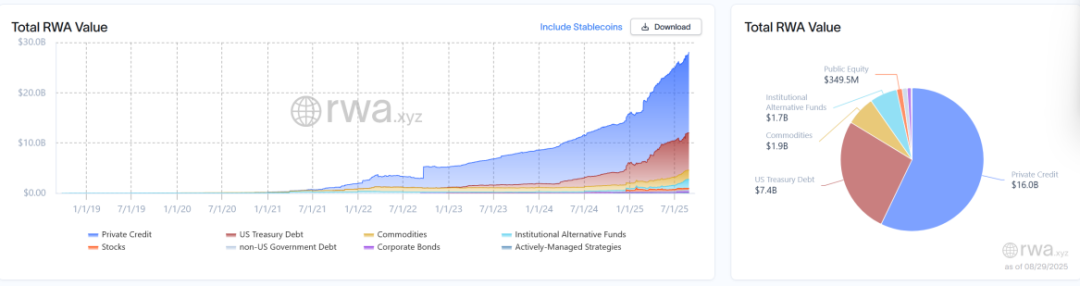
По состоянию на конец августа 2025 года совокупный объем глобального рынка RWA (исключая стейблкоины) составляет около 28 млрд долларов, демонстрируя годовой рост на 114%. Структура рынка формируется долговыми инструментами: приватное кредитование (Private Credit) занимает безусловное лидирующее положение с объемом 16 млрд долларов (около 56%), за ним следуют государственные облигации США (7,5 млрд долларов) и сырьевые товары (2,4 млрд доллара). В настоящее время именно Ethereum выступает основной сетью для размещения RWA.
Данный отчет посвящен углубленному анализу трех ключевых направлений:
•Приватное кредитование: как самое крупное направление по объему в RWA, его основная ценность заключается в повышении эффективности и прозрачности традиционных кредитных процессов. Однако проверка заемщиков до выдачи кредита, контроль рисков и процедура обработки дефолтов по-прежнему сильно опираются на оффчейн-правовую базу. Рынок переходит от ранних экспериментальных этапов к фазе институциональной диверсификации с участием таких игроков, как Maple и Figure.
•Сырьевые товары: рынок контролируется двумя ведущими проектами по токенизации золота — PAXG и XAUT, которые занимают более 75% доли. Ликвидность в данном сегменте преимущественно сосредоточена на централизованных биржах (CEX), а интеграция с экосистемой DeFi остается низкой. Будущие точки роста связаны с расширением пула эмитентов и разнообразием базовых активов (помимо золота и серебра — другие драгоценные металлы, сельскохозяйственная продукция и т.д.).
•Акции: данное направление находится в самом начале своего развития. Совокупная капитализация (около 360 млн долларов) ничтожно мала по сравнению с фондовыми рынками реального мира, ликвидность крайне низка, но потенциал роста огромен. Рынок движется по двум траекториям: во-первых, «стены садов» (walled garden) по модели Robinhood, где жертвуют композитабельностью ради максимальной регуляторной безопасности; во-вторых, «мосты открытого финансирования» по модели xStocks, нацеленной на глубокую интеграцию с DeFi. Вхождение крупных игроков вроде Ondo Finance, обладающих полным набором лицензий, свидетельствует о нарастающей конкуренции в этом секторе.
Вывод: отрасль RWA переходит от технического «первого тайма» ко «второму тайму», определяемому институциональным спросом и регуляторными требованиями. Долгосрочная ценность RWA заключается не в краткосрочной спекуляции, а в стабильном росте ончейн-активов, эффективном углублении ликвидности вторичного рынка и надежном совершенствовании правовых и технологических основ. RWA создадут финансовую инфраструктуру нового поколения, соединяющую реальную стоимость с ончейн-пространством, что станет мощным драйвером формирования новой, более прозрачной, эффективной и инклюзивной глобальной финансовой системы.
Ключевые слова: RWA; токенизация; регуляторное соответствие; финансовая инфраструктура
01 Введение
По мере того как крипторынок покидает эпоху иллюзорной доходности на высоких плечах и переходит к устойчивому росту, тесно связанному с реальной экономикой, токенизация реальных активов (Real World Assets, RWA) становится самым многообещающим центральным нарративом текущего цикла. Она открывает широкие каналы для извлечения ценности из реального мира в ончейн-пространство и предоставляет многомиллионному массиву традиционных финансовых активов путь к цифровой миграции с более высокой эффективностью и ликвидностью. По сути, RWA выступают ключевым «коннектором» для построения финансовых рынков будущего, а степень их зрелости напрямую определит, сможет ли технология блокчейн выйти за пределы замкнутого криптогенного цикла и интегрироваться в глобальную экономику.
Несмотря на то что институции, такие как Boston Consulting Group (BCG), прогнозируют потенциальный объем рынка более чем в $10 трлн[1], путь «вывода активов в блокчейн» далеко не ровный. От грандиозных видений к реальной коммерческой практике RWA необходимо преодолеть три структурных барьера: регуляторное соответствие, отображение активов и рыночная ликвидность. Как обеспечить единообразие юридической силы между ончейн-сертификатами и оффчейн-правами? Как создать эффективную ликвидность вторичного рынка, соблюдая при этом требования комплаенса? Это фундаментальные проблемы, над которыми активно работают участники индустрии.
Чтобы всесторонне представить эту сложную и динамичную область, данный отчет будет последовательно раскрывать тему от макроуровня к микроуровню. Сначала мы обобщим ландшафт индустрии RWA, включая размеры рынка, драйверы роста и ключевые ограничения; затем сфокусируемся на трех наиболее динамично развивающихся направлениях — приватном кредитовании, сырьевых товарах и акциях — проведем глубокий анализ конкурентной среды, бизнес-моделей и ведущих проектов каждого сектора. Цель этого отчета — предоставить читателям четкую карту текущего положения RWA, будущих тенденций и потенциальных возможностей.
02 Обзор индустрии и общие тенденции
2.1 Определение RWA
Реальные мировые активы (Real World Assets, RWA) — это активы, существующие в реальном мире и обладающие экономической ценностью, которые конвертируются в обращающиеся в цифровом виде ончейн-документы через эмиссию, отображение, залож или дробление. Ключевая логика заключается в использовании смарт-контрактов и протоколов открытых финансов для обеспечения эффективного использования, прозрачного функционирования и гибкой композиции активов непосредственно в блокчейне.
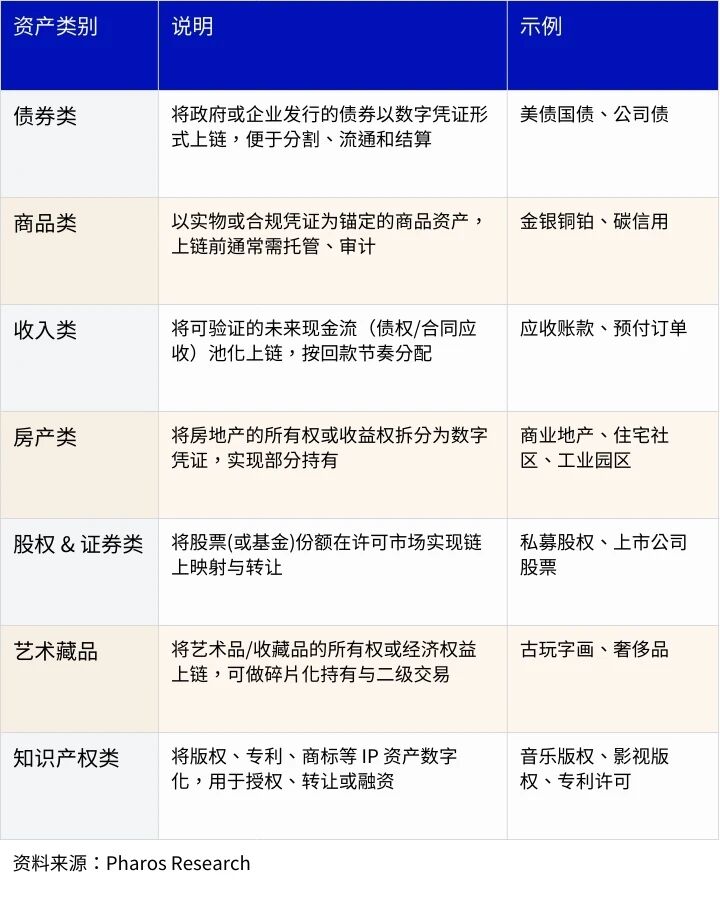
В настоящее время охват RWA достаточно широк и практически включает основные категории традиционных финансов и материальных активов. Правительственные и корпоративные облигации, сырьевые товары, недвижимость, акции, искусство и интеллектуальная собственность могут быть токенизированы для установления прав собственности, дробления и торговли в блокчейне.
Преимущества вывода RWA в блокчейн проявляются главным образом в трех аспектах: ликвидность, прозрачность и экономия затрат. Во-первых, вывод в сеть повышает глобальную оборачиваемость активов и скорость расчетов, значительно снижая издержки, связанные с посредниками. Во-вторых, отслеживаемость блокчейна и механизм смарт-контрактов делают процессы торговли и управления активами более прозрачными. Кроме того, после перевода в ончейн RWA могут глубоко интегрироваться с экосистемой DeFi, создавая новые сценарии использования и модели доходности, что также породило концепцию «RWAfi».
Стоит отметить, что некоторые продукты RWA уже добились прорывных применений, предоставив инвесторам доступ к классам активов, труднодоступным на традиционных рынках. Например, продукт Goldfinch Private Debt FoF имеет базовую конфигурацию в виде активов частных долгов крупных фондов, таких как Ares. В традиционной финансовой системе порог входа в подобные продукты крайне высок, однако на платформе Goldfinch инвесторы могут участвовать всего с $100. Аналогично, продукты вроде USDY, обеспеченные государственными облигациями США, эффективно решают проблему для инвесторов из некоторых стран, которым законодательные ограничения затрудняют прямую покупку гособлигаций США.
2.2 Размеры рынка и потенциал роста
2.2.1 Размер рынка
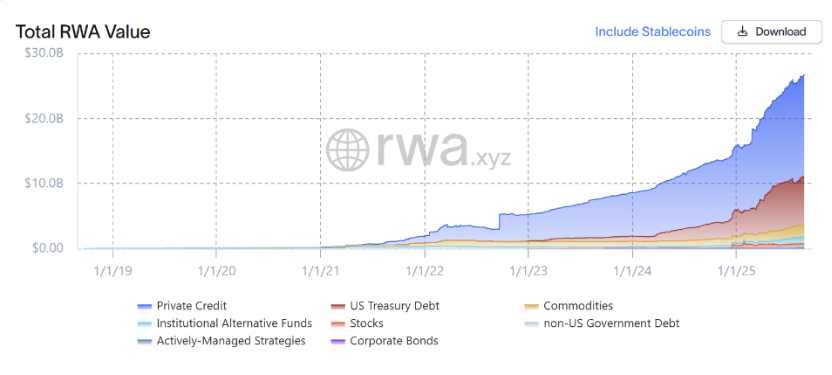
По состоянию на конец августа 2025 года общий объем глобального ончейн-рынка RWA (исключая стейблкоины) составил около 28 млрд долларов, продемонстрировав годовой прирост почти 114%, а среднегодовой темп роста (CAGR) за последние три года достиг примерно 111%. Основным драйвером выступают долговые RWA, представленные государственными облигациями США и приватным кредитованием, чьи показатели CAGR за три года составили колоссальные 1523% и 104% соответственно.
Источник: Pharos Research, RWA.xyz
С точки зрения распределения по сетям, Ethereum по-прежнему остается центральной платформой для RWA, занимая около 53,3% доли рынка с объемом под управлением в $8,31 млрд; ZKsync Era занимает второе место с долей 15,4% и объемом около $2,4 млрд.
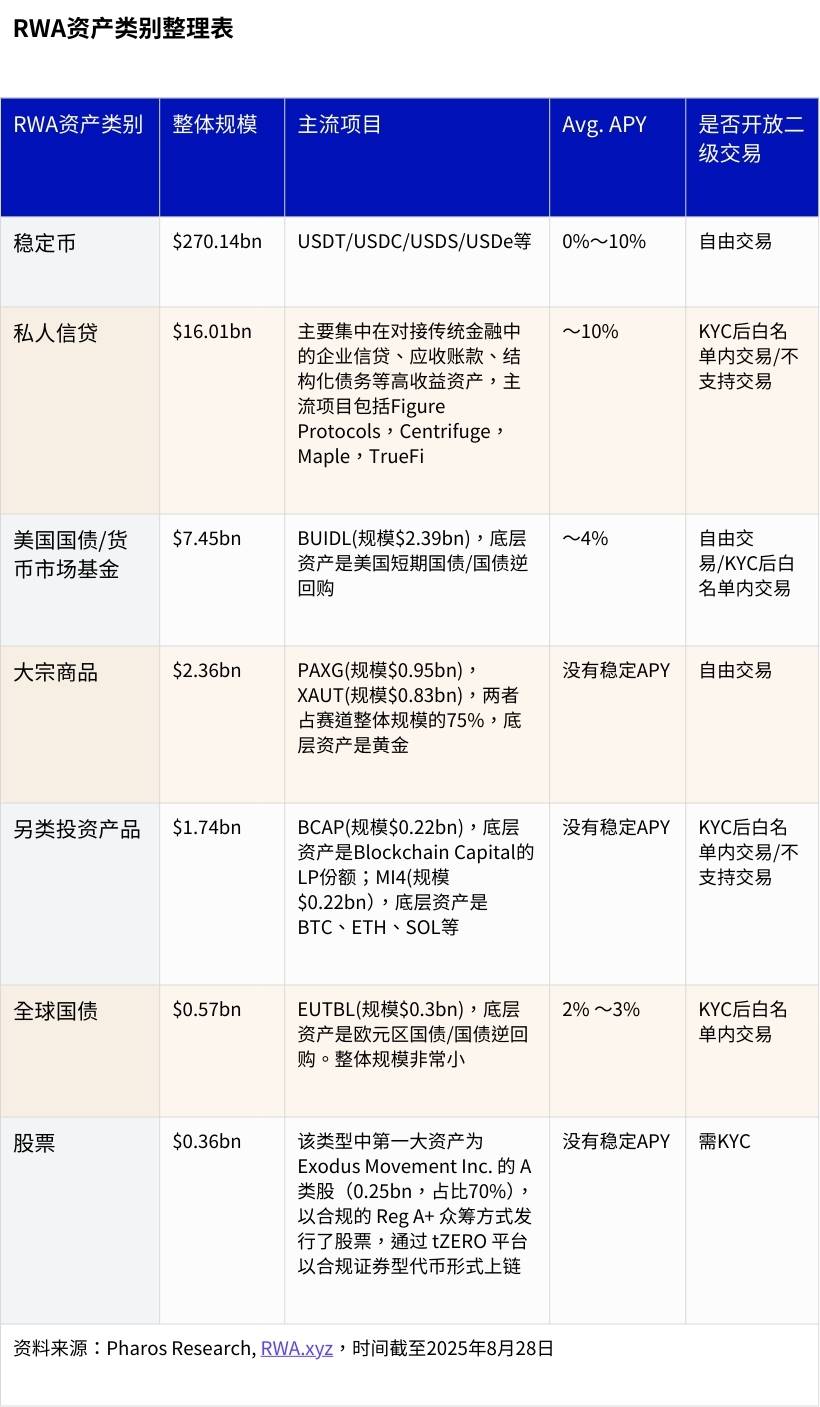
Примечание: платформа RWA.xyz сталкивается с проблемой несогласованности методологии учета данных по разделу «Товары»: существуют данные на $1,9 млрд, однако после тщательной проверки были выбраны данные на $2,36 млрд.
При детальном анализе по категориям активов: три крупнейших сегмента RWA в блокчейне — Private Credit, US Treasury Debt и Commodities — имеют текущие объемы 16 млрд, 7,5 млрд и 2,4 млрд долларов соответственно, занимая примерно 56%, 27% и 9% рынка. Private Credit в основном ориентирован на высокодоходные активы, такие как корпоративные кредиты, дебиторская задолженность и структурированный долг. Представители включают Figure Protocols, Centrifuge, Maple и TrueFi; типичный продукт американских гособлигаций — BUIDL (объем $2,39 млрд), обеспечивающий краткосрочными облигациями и обратными РЕПО; сегмент товаров в основном формируется PAXG и XAUT, вместе занимающими 75% рынка токенизированного золота.
Примечание: источники вышеприведенных данных — RWA.xyz, обработано Pharos Research
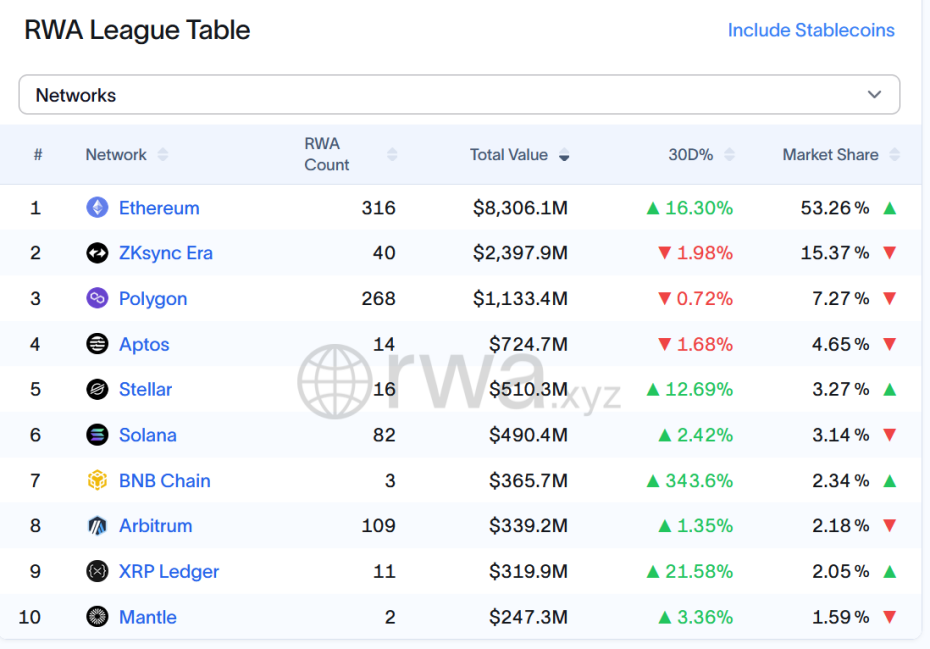
Источник: Pharos Research, RWA.xyz
2.2.2 Пространство для роста
Судя по прогнозам, потенциал расширения рынка RWA пока не достиг пределов. Согласно совместному исследованию Boston Consulting Group (BCG) и платформы цифровых акций ADDX от июля 2022 года («Relevance of On-Chain Asset Tokenization in ‘Crypto Winter’»), совокупный объем глобальных токенизированных активов к 2030 году может достичь 16 трлн долларов, что оставляет более чем 600-кратное пространство для роста по сравнению с текущим уровнем[1].
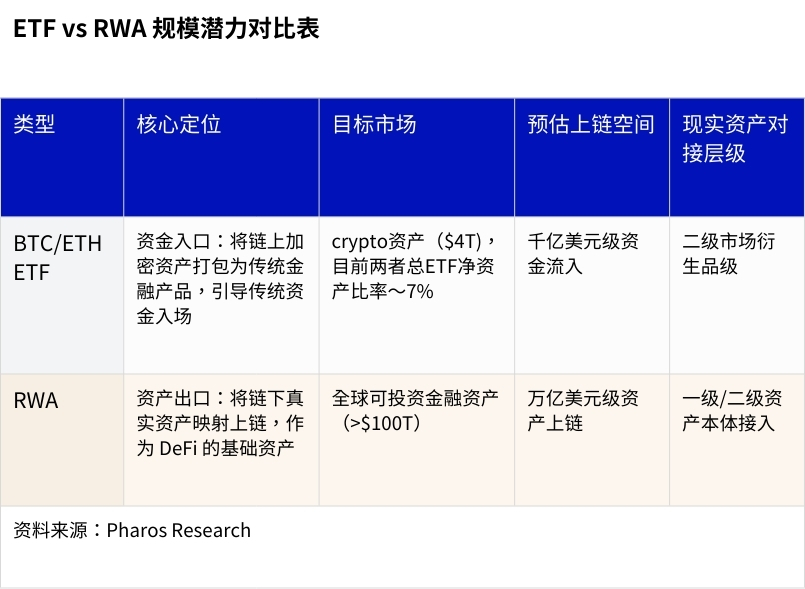
Важным ориентиром служит развитие криптовалютных ETF. По состоянию на закрытие торгов 27 августа 2025 года совокупный объем BTC ETF составил $144,6 млрд, ETH ETF — $32,6 млрд, что в сумме примерно в 6,6 раза превышает объем рынка RWA без стейблкоинов. С точки зрения структурной логики существует явное различие в позиционировании этих инструментов на финансовом рынке: ETF скорее выступают в роли «входных ворот для капитала», упаковывая ончейн-криптоактивы в традиционные финансовые продукты для привлечения институциональных средств; в то время как RWA выполняют роль «экспортного канала активов», отображая реальные оффчейн-активы в блокчейн и формируя новую рыночную базу для экосистемы DeFi.
С другой стороны, значение ETF заключается в создании регуляторных каналов и признании на публичном уровне, однако их инвестиционные объекты ограничены BTC и ETH, удовлетворяя в основном спекулятивные и хеджированные потребности. Преимущество RWA заключается в широте охвата активов и поддержке реальной доходностью. Облигации, золото, недвижимость, корпоративный кредитный рейтинг и другие активы могут стать базовой конфигурацией ончейн-активов, позволяя протоколам DeFi нести более богатую реальную стоимость. По сравнению с этим ETF по своей сути остаются лишь переупаковкой существующих криптоактивов, тогда как RWA с большей вероятностью обеспечат глубокую структурную интеграцию с традиционными финансами. Благодаря смарт-контрактам и ончейн-системе счетов, RWA могут быть внедрены в залоговое кредитование, агрегаторы доходности, стабилизацию stablecoins и множество других приложений DeFi, способствуя формированию новой архитектуры финансовых рынков.
Таким образом, с точки потенциала масштаба, развитие ETF ориентировано в основном на привлечение капиталов уровня сотен миллиардов долларов, тогда как потолок RWA соответствует более чем 100 трлн долларов глобально инвестируемых финансовых активов. Первое ближе к уровню деривативов традиционных рынков, а второе направлено непосредственно на подключение базовых активов первичных и вторичных рынков. Путь развития RWA более сложен, но его долгосрочное значение и глубина экосистемной интеграции несравнимо превышают показатели ETF.
2.3 Драйверы индустрии
Силы, поддерживающие дальнейший рост проникновения RWA, проявляются в трех ключевых направлениях: процентные циклы, выход институциональных игроков и прогресс в регулировании.
2.3.1 Повышение процентных циклов: реальная процентная ставка становится якорем ончейн-распределения
Начиная с 2022 года мир погрузился в среду высоких процентных ставок, особенно базовая ставка ФРС США длительное время держалась выше 5%, что значительно повысило привлекательность традиционных активов, таких как гособлигации США и денежно-рыночные фонды. Одновременно с этим, по мере перехода крипторынка через бычьи и медвежьи фазы, деградации рычагов и снижения толерантности к риску выявились проблемы падающей безрисковой ставки в традиционном DeFi и внутренней конкуренции гомогенных стратегий доходности. Ускорился спрос инвесторов на инструменты с «стабильной и предсказуемой» доходностью. Роль RWA в этой ситуации идеально совпадает: путем отображения гособлигаций США, облигаций и различных верифицированных凭证 доходов в блокчейн, ончейн-капитал получает альтернативное распределение с «низкой волатильностью + реальной процентной ставкой», восстанавливая связь между ончейн-доходностью и базовым уровнем оффчейн-ставки.
2.3.2 Участие лидеров отрасли: предложение активов и кредитное плечо одновременно выходят в блокчейн
Начиная с 2023 года BlackRock, Franklin Templeton, WisdomTree, JPMorgan Chase, Citibank и другие глобальные финансовые гиганты начали осваивать RWA. Пути включают выпуск ончейн-паев инвестиционных фондов, токенизированные продукты гособлигаций США и токенизированные фонды активов, пытаясь достичь «нативного вывода в блокчейн» базовых активов, а не простой бридж-конверсии. Таким образом, с одной стороны, база строится на суверенном и институциональном кредите, с другой — на ончейн-расчетах и композитабельности. Комбинация доверия и эффективности значительно повысила принятие RWA рынком и устойчивость интереса к ним. К типичным практикам относятся: выпуск Franklin Templeton фонда американских деньговых рынков BENJI Token на Polygon и Stellar; инвестиции BlackRock в Securitize и планы по выпуску токенизированного фонда на Ethereum; продвижение Citibank пилотных программ ончейн-расчетов по некоторым депонированным облигациям. Эти шаги совместно расширяют ончейн-предложение регулируемых активов и укрепляют рыночные ожидания благодаря участию крупных институций.
2.3.3 Формирование регуляторных рамок: маржинальное открытие регуляторных каналов
В отличие от бесконтрольного расширения периода ICO, RWA обычно соответствуют строгим регуляторным требованиям (ценные бумаги, облигации, фонды) и должны продвигаться в рамках существующих правовых и лицензионных систем. В последние годы несколько юрисдикций постепенно уточнили правовую основу для вывода активов в блокчейн, выпуска токенов и прав держателей, обеспечив институциональную поддержку для пилотных запусков и масштабирования.
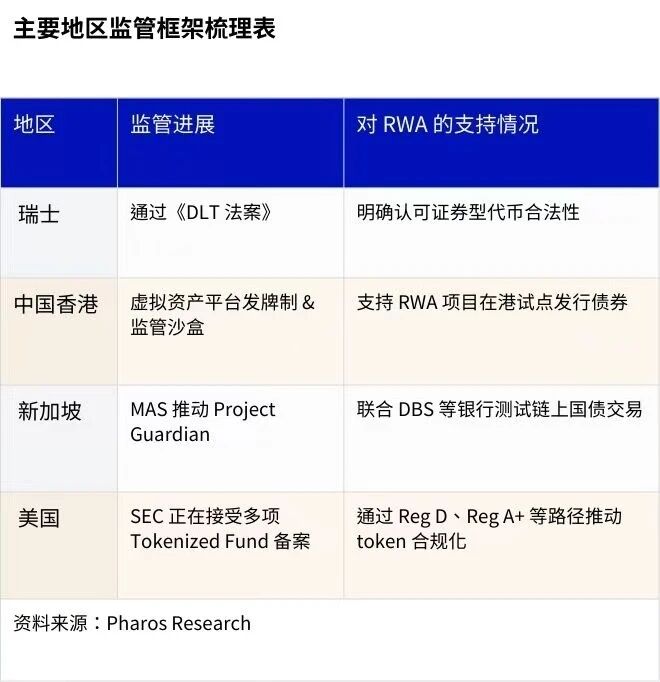
Примечание: Reg A+ — это механизм «легкого регулирования» публичного предложения согласно Закону о ценных бумагах США, позволяющий эмитентам выпускать акции или токены для обычных инвесторов без условий IPO, с ежегодным лимитом сбора средств в $75 млн. Exodus Movement, INX и tZERO успешно завершили выпуск активов на этой базе.
В части практического внедрения швейцарский банк Sygnum уже выпустил токенизированные облигации, позволяющие инвесторам участвовать в корпоративном финансировании через блокчейн. В Гонконге также поддержан выпуск 200 млн гонконгских долларов токенизированных зеленых облигаций China Construction Bank, который считается одним из первых в Азии проектов токенизированных облигаций, поддержанных правительством. Вышеуказанные исследования показывают, что при ясности правовой определенности и прав держателей, продуктовизация и масштабирование RWA обладают воспроизводимым путем.
2.4 Основные игроки индустрии
Вокруг полной цепочки «актив — эмиссия — торговля — данные» экосистема RWA условно делится на четыре типа участников: эмитенты активов, провайдеры инфраструктуры, приложения уровня доступа и сервисы по данным. Различные роли формируют взаимодействие в комплаенсе, депонировании, расчетах и контакте с пользователями.
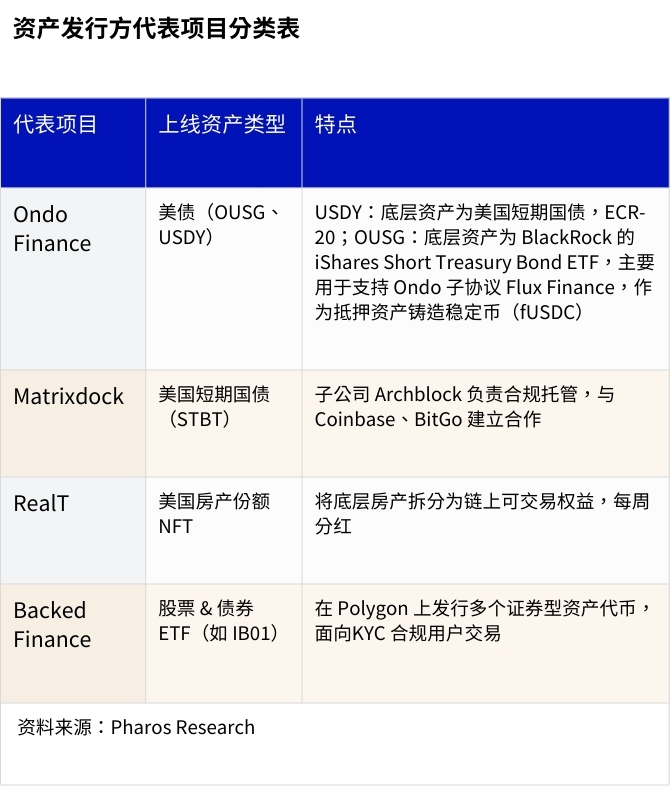
2.4.1 Эмитенты активов (Token Issuers)
Эмитенты активов призваны конвертировать реальные активы (такие как гособлигации США, золото, недвижимость) в циркулирующие в сети凭证, беря на себя ключевые обязанности по структуре комплаенса, распределению доходности и мониторингу депонирования.
2.4.2 Провайдеры инфраструктуры (RWA Infra & Issuance Chains)
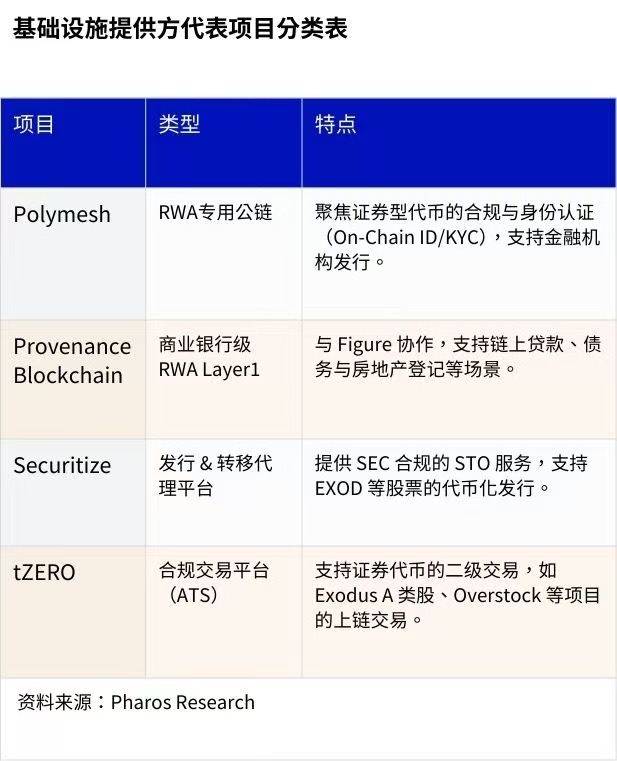
Провайдеры инфраструктуры предоставляют базовые возможности для эмиссии, идентификации, поддержки комплаенса и депонирования активов. Часто представлены специализированными публичными цепями, разрешительными блокчейнами или платформами регулируемой эмиссии.
2.4.3 Приложения уровня доступа (Access Products & User Protocols)
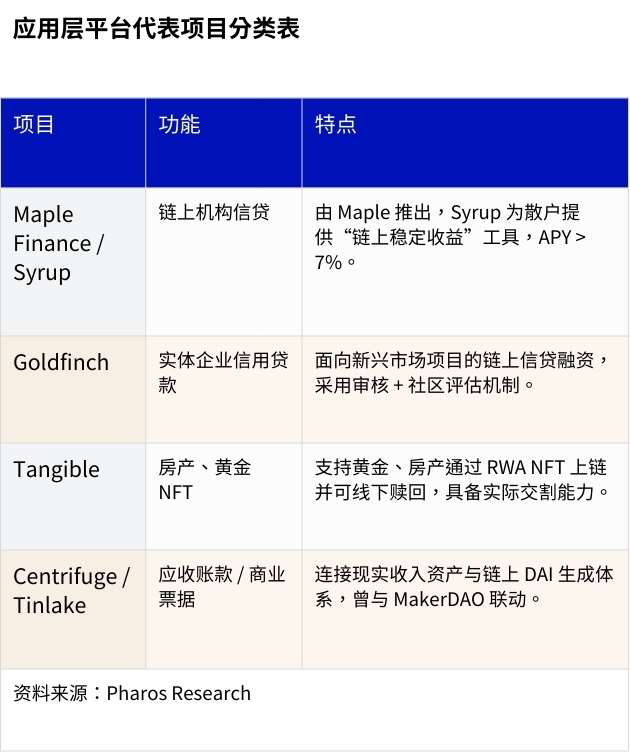
Приложения уровня доступа предоставляют пользователям входные точки для инвестиций и управления портфелем, часто интегрируются с модулями DeFi, связывая розничных инвесторов с ончейн-RWA.
2.4.4 Провайдеры данных и индексных метрик (Oracles & Indices)
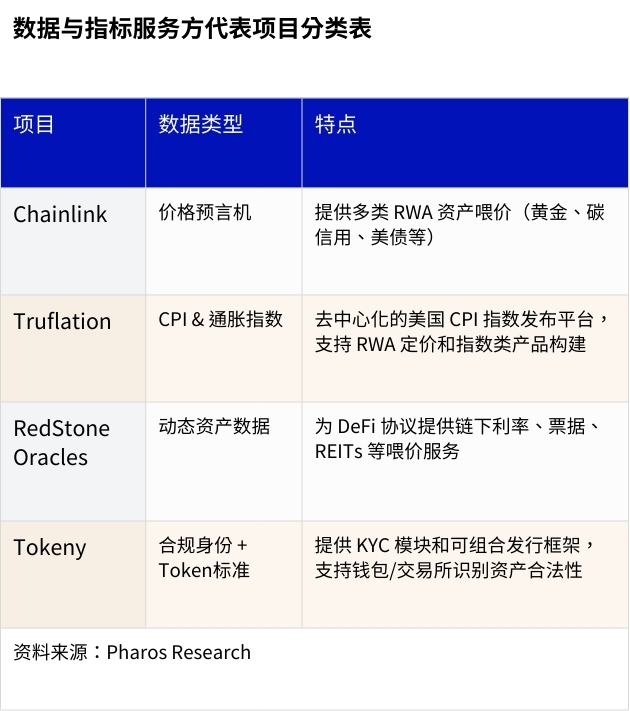
Провайдеры данных и индексных метрик предоставляют ончейн-протоколам информацию о ценах, индексах и эталонных ставках, выступая мостом между оффчейн-информацией и ончейн-контрактами.
2.5 Узкие места индустрии
В краткосрочной перспективе масштабирование RWA ограничено не單一 технологическим барьером, а рядом глубоких структурных ограничений. Эти ограничения проявляются в динамике изменения бизнес-форматов, внутренних ограничениях рыночной ликвидности и фундаментальных проблемах регуляторных рамок и отображения активов, что в конечном итоге формирует уникальную структуру аудитории и рыночный ландшафт.
2.5.1 Динамичное изменение бизнес-моделей: высокая стоимость зрелости проектов и проверки информации
Большинство проектов в текущем направлении RWA все еще находятся на этапе исследования и тестирования бизнес-моделей. Частая смена ключевых продуктов и стратегического позиционирования приводит к значительному временному разрыву и расхождениям в содержании между внешней публичной информацией и фактическими операциями проекта. Типичный феномен: материалы или пресс-релизы месячной давности уже не могут точно отражать текущий фокус бизнеса, например, проекты вроде Credix перешли от нарратива ранних кредитных платформ к продуктовой матрице PayFi. Такой частый бизнес-итерации безусловно добавляют высочайшую стоимость верификации информации и сложности оценки для внешних организаций.
2.5.2 Структурные бутылочные горлышки рыночной ликвидности: торговля по принципу допуска остается основным механизмом
С точки зрения структуры торгов, циркуляция большинства текущих продуктов RWA строго ограничена. Будь то LP-документы приватного кредитования или популярные токенизированные продукты гособлигаций, их торговля и перевод, как правило, ограничиваются адресами в whitelist. Категории активов, способные свободно обращаться на вторичном рынке без разрешения, остаются единичными и в основном集中在两类:(1)базовые активы высокой стандартизации(например,золото);(2)продукты гособлигаций США,выпущенные в特定合规框架 institutions如Ondo Finance(如$USDY),обладающие более широкой циркуляцией。Такая рыночная структура с преобладанием системы допуска резко подавляет эффективное ценообразование активов и эффективность выхода инвесторов。
2.5.3 Фундаментальный вызов комплаенса и отображения активов: преодоление разрыва в кросс-юрисдикционном управлении еще предстоит
Суть RWA заключается в построении надежного отображения между ончейн-цифровыми сертификатами и оффчейн-юридическими правами,實體资产。Текущие основные решения используют «гибридную архитектуру»:спринтовые правила (SPV) или регулируемые депозитарии проводят комплаенс-проверку оффчейн (KYC/AML),а затем выпускают стандартизированные токены (например,bTokens) для обращения в блокчейне。Однако в условиях разных регуляторных политик в разных юрисдикциях и отсутствия ончейн-систем идентичности устойчивость этой модели под вопросом。Конкретные проблемы следующие:
•Регуляторный арбитраж и политика риска: Значительная часть проектов не получила разрешений на выпуск ценных бумаг в своей юрисдикции,а вместо этого использует изощренные структурные схемы для избегания юридического определения «ценной бумаги»。Эта деятельность в серой зоне делает их постоянными объектами риска ужесточения политики。При изменении регуляторной среды возможен кризис комплаенса и принудительное закрытие бизнеса。
•Хрупкость верификации активов и защиты прав: Вопрос сохранения точного и надежного соответствия между ончейн-токенами и реальными оффчейн-активами является ключевой заботой инвесторов。В настоящее время пользователи в основном полагаются на односторонние аудиторские отчеты или подтверждения активов от эмитентов или депозитариев。Эти документы не имеют единых стандартов и юридической обязательной силы。Более того,когда базовые активы сталкиваются с дефолтом,преждевременным выкупом или банкротством SPV,права heolders ончейн-токенов и процесс ликвидации крайне непрозрачны。Смарт-контракты не способны автоматически обрабатывать сложные оффчейн-правовые процедуры。Примером служит инцидент Maple Finance,где部分借款方违约导致 LP无法赎回,最终需回归链下法律途径解决。
•Правовые трудности интеграции с DeFi: Интеграция RWA в качестве залога в протоколы DeFi-кредитования или AMM повышает прикладную ценность,но порождает новые вопросы определения правового статуса。Существующие правовые рамки плохо определяют природу таких гибридных продуктов,подвергая эмитентов и пользователей риску обвинений в «незаконном выпуске ценных бумаг»或«трансграничных торговых нарушениях»。
Вышеуказанные проблемы ставят под сомнение грандиозный нарратив «отображения активов»,显著增加了合规和监管的不确定性。在具体市场的案例中也有对此的回应:Backed Finance以确保合规,主动选择仅限白名单交易,牺牲了资产的潜在流通性;RealT的链上产权代币,其价值的最终兑现仍高度依赖于美国实体的KYC验证机制。
综上所述,考虑到存在以上制约因素,目前RWA的市场定位上显示出“夹层效应”。一方面,传统机构对链上操作风险与合规不确定性抱持高度审慎的态度;另一方面,追求高波动与短期收益的加密原生用户(Crypto Degen)则认为RWA的收益率缺乏吸引力。因此,当前RWA的核心目标客群,主要落在了寻求稳健资产配置的传统金融散户(TradFi Retail)与链上大额资金持有者(Whales)身上——从地域上看,这一需求在全球高通胀国家(如拉美、东南亚)则表现得尤为突出。
03 Core Sector Analysis: Private Credit
3.1 Overview of the Market
Among various forms of RWA (excluding stablecoins), Private Credit consistently leads in volume and share. With an Active Outstanding Loans balance of $16.0B (loans issued by protocols but not yet repaid), it accounts for approximately 56% in this sector.
Source: Pharos Research, RWA.xyz
As a key branch of private finance, the private credit market has developed into a mature asset class since it was pioneered by giants like Blackstone and KKR in the 1980s and 1990s. Especially after the 2008 financial crisis, as traditional commercial bank credit policies tightened, private credit quickly filled the market gap, becoming a crucial financing channel for small and medium-sized enterprises (SMEs). By 2023, its global market size exceeded $1.6 trillion. These assets primarily provide non-publicly traded loans to SMEs that cannot obtain financing from public markets or banks for various reasons.
The operational structure of private credit can be clearly divided into off-chain and on-chain levels: At the off-chain level, the source of the assets remains real and legally binding loan contracts, typically held and managed by a Special Purpose Vehicle (SPV); at the on-chain level, protocols encapsulate the claims held by the SPV into standardized digital tokens using technical standards like ERC-20 or NFT.
The core characteristics of private credit are manifested in several aspects: First, high investment barriers, with participants usually being qualified investors such as family offices and professional private equity funds, aiming for high fixed returns. Second, natural limitations in asset liquidity due to low information transparency, often considered a "black box," and longer loan terms making early exit difficult. Despite this, private credit features standardized fixed-income structures with clear interest rates, repayment schedules, and maturity dates, and relies on compliance frameworks like SPVs and KYC, increasingly aligning disclosure and audit standards with institutional practices. Common underlying assets include SME loans, invoice and accounts receivable financing, trade finance, consumer loans, and real estate mortgages.
3.2 Value and Limitations of Tokenization Models
The core value of on-chain private credit lies in reshaping and optimizing traditional business processes using blockchain technology. It connects capital providers and borrowers directly through protocols and utilizes smart contracts to transform previously manual steps like asset custody, fund transfers, repayment management, and interest distribution into automated, visible, and traceable on-chain processes. For investors, this model simplifies their investment behavior to subscribing to tokens, which directly represent clear revenue rights to the underlying loan principal and interest. Ultimately, the efficiency and transparency of the entire asset processing are significantly improved.
It is important to emphasize that tokenization does not change the offline nature and dependency of the assets. Borrower acquisition, pre-loan review, collateral management, repayment, and default handling all occur in the offline world. The on-chain layer is mostly a digitized credential and settlement layer—so if offline default occurs, on-chain tokens cannot automatically exercise rights and still rely on traditional legal and compliance frameworks. Therefore, the SPV essentially acts as an off-chain compliance intermediary, meaning investors do not directly hold loan assets but indirectly hold claims through the SPV. Its registration, operation, auditing, and default procedures all fall within the offline legal system; borrower admission, KYC, credit assessment, and risk control are controlled by centralized entities, making it difficult to match openly like algorithmic models such as Aave.
3.3 Key Players
Since its rise in 2021, the total issuance scale of on-chain private credit (including repaid portions) has exceeded $29 billion, with over 2,500 cumulative loan projects launched. The current average annual percentage rate (APR) in the market is 9.75%. [2] The market landscape is gradually clarifying, with a group of top participants emerging due to their stable operations and high Total Value Locked (TVL), including Maple, Goldfinch, Figure, Centrifuge, PACT, and Tradable.
3.3.1 Maple: A Stable Institutional On-Chain Credit Market
Project Website:
https://maple.finance/
Official X Account:
https://x.com/maplefinance
Maple Finance is positioned as an institutional-grade credit platform, initially focusing on unsecured lending. After the Orthogonal Trading default incident, the platform shifted its strategic focus to more robust overcollateralization (requiring a 150% collateral ratio) and tri-party agreement models. In this model, independent third-party institutions monitor collateral values, while Maple focuses on executing smart contracts. If collateral prices fall below preset thresholds and borrowers fail to top up within 24 hours of receiving a margin call, a third party executes liquidation to protect lenders' interests. As of late August 2025, Maple Finance's Assets Under Management (AUM) exceeded $3.3 billion, with cumulative lending exceeding $8.9 billion. [3]
Source: Pharos Research, Maple Finance, Tiger Research
Source: Pharos Research, Maple Finance
The platform's core product lines are divided into "Permissioned Access" and "Open Access" categories to meet the needs of institutional and retail investors respectively.
The "Permissioned Access" product series is designed for institutional clients, featuring KYC certification and a minimum investment threshold of $100,000, providing private-banking-style 24/7 "white-glove" service with one-on-one support for solution design, fund management, and issue resolution. This series includes three products:
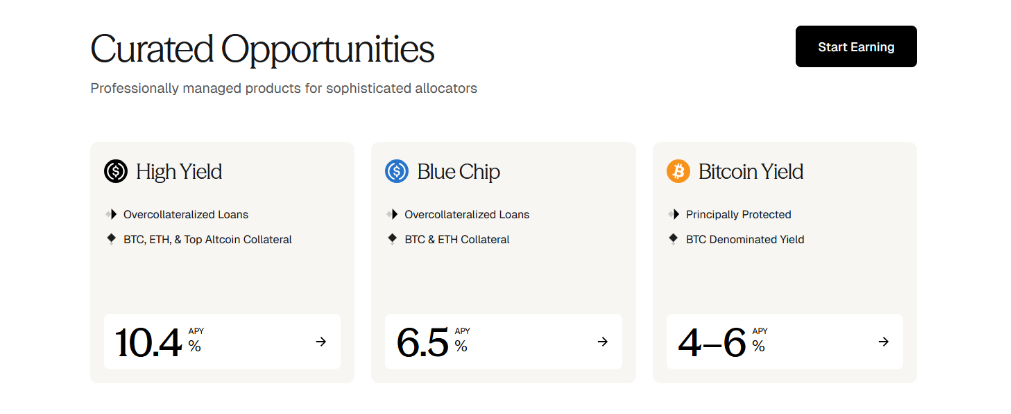
•Blue Chip Lending Pool: Targets risk-averse investors, only accepting mature crypto assets like Bitcoin and Ethereum as collateral, investing in high-credit-rating loan projects, offering an approximate 6.5% annual yield.
•High Yield Lending Pool: Aimed at investors seeking higher returns and willing to accept corresponding risks. Its core strategy amplifies returns through asset staking or re-lending rather than passive collateral holding, with an annual yield reaching 10.4%.
•Bitcoin Yield Product: Aligning with growing institutional demand for Bitcoin allocation, this product leverages the Dual Staking mechanism provided by Core DAO. Institutional clients can deposit their Bitcoin with institutional custodians like BitGo or Copper and earn 4-6% staking rewards by committing to not sell the assets during the lock-up period.
Source: Pharos Research, Maple Finance
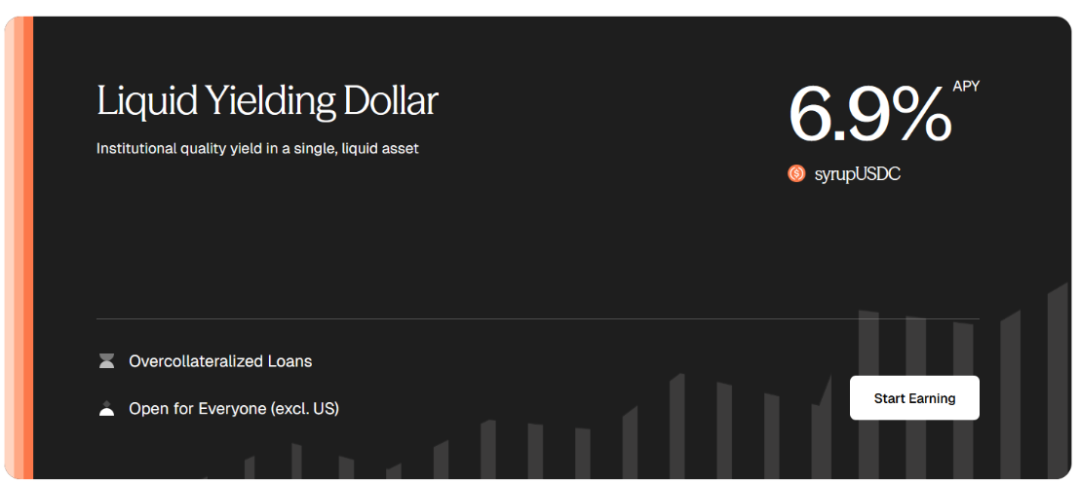
To allow ordinary retail investors to participate, Maple Finance launched Syrup series Liquidity Provider (LP) Tokens in the second half of 2024. As of late August 2025, SyrupUSDC's TVL exceeded $2.2 billion, and SyrupUSDT exceeded $152 million, both offering approximately 6.9% annual yields. [4] Funds raised through Syrup are lent to institutional borrowers from the platform's Blue Chip and High Yield pools, with loan interest distributed directly to Syrup depositors. Although sharing similar underlying asset structures with institutional pools, its risks are independently isolated.
Although Syrup's direct yield is slightly lower than institutional products, Maple introduced a "Drips" reward system to incentivize long-term participation. This system calculates additional compound rewards in points every four hours. At the end of each quarter, users can redeem these points for the platform's governance token, SYRUP. Staking SYRUP itself generates a 2.98% annual return, while the platform allocates 20% of its lending fee revenue (ranging from 0.5% to 2%) to buy back and distribute to SYRUP stakers on the open market.
Furthermore, to enhance the liquidity and composability of its assets, SyrupUSDC has been integrated into several top DeFi protocols, including:
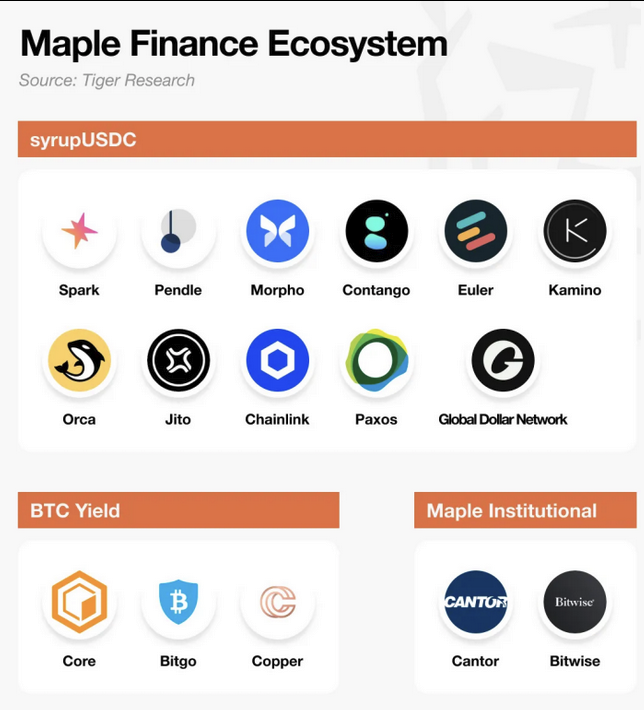
•Spark: As a sub-DAO of the Sky ecosystem, Spark has injected $300 million into the SyrupUSDC pool to provide yield sources for its stablecoin.
•Pendle: Users can trade the principal and yield portions of SyrupUSDC on Pendle (PT-SyrupUSDC and YT-SyrupUSDC), gaining a 3x multiplier on Drips rewards.
•Morpho / Kamino: In these lending protocols, SyrupUSDC and its derivatives serve as eligible collateral for borrowing other assets like USDT or USDC.
3.3.2 Goldfinch: An On-Chain Unsecured Credit Protocol Focused on Emerging Markets
Project Website:
https://www.goldfinch.finance/
Official X Account:
https://x.com/goldfinch_fi
In the on-chain private credit sector, Goldfinch has attracted significant attention due to its unique market positioning focusing on "unsecured credit." The protocol's core business model is providing financing to fintech companies and lending institutions in emerging markets, with borrowers widely distributed across Latin America, Southeast Asia, and Africa. The underlying assets of these loans mainly consist of consumer credit, education loans, and micro-finance, such as supporting India's EV company Greenway and Nigeria's consumer lending platform QuickCheck. To date, Goldfinch has facilitated over $160 million in loan disbursements. [7]
Source: Pharos Research, Goldfinch Finance, Curve
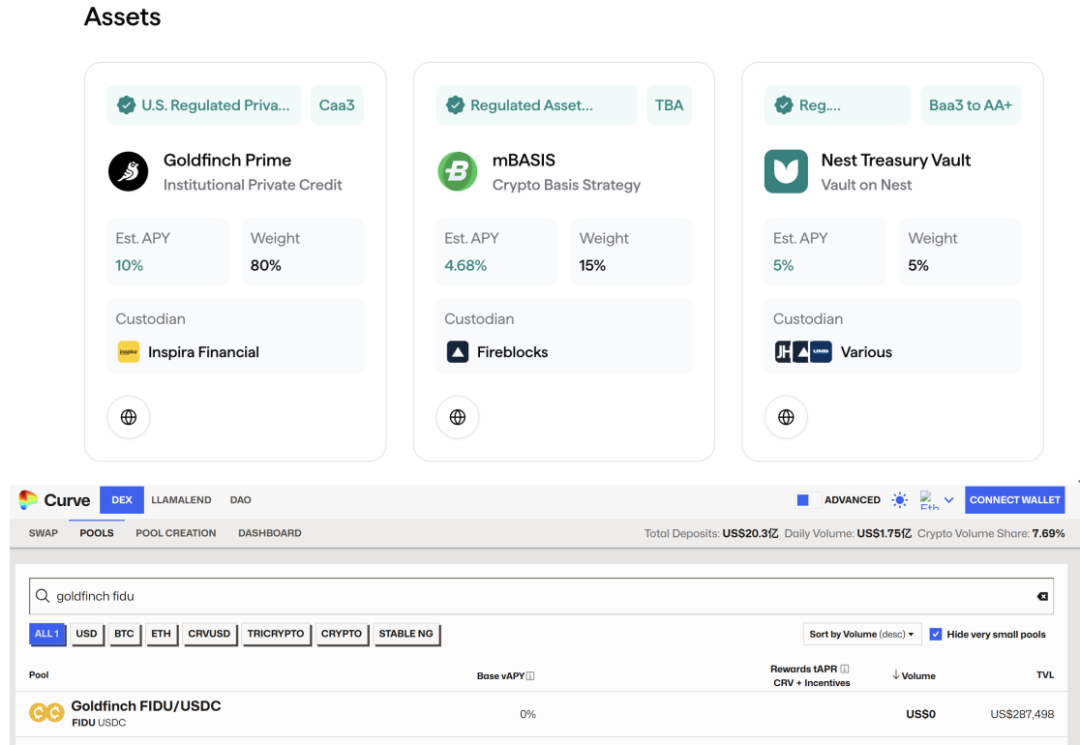
The protocol's structural design revolves around a main Senior Pool and multiple independent Borrower Pools. In typical loan transactions, the Senior Pool provides about 90% of the funding, automatically allocated by the protocol's smart contracts. The remainder is provided by "Backers," whose role resembles mezzanine/subordinated investors in traditional finance, accessible only to qualified investors. Ordinary investors acting as Liquidity Providers (LP) can deposit USDC into the senior pool to receive FIDU tokens. FIDU represents their claim share across all loan projects and brings monthly or quarterly paid interest. This investment channel is open to retail investors outside the US and qualified investors within the US, with a minimum investment threshold of $100. Although theoretically FIDU tokens could gain extra GFI token incentives via liquidity pools on the Curve platform, their secondary market liquidity is currently extremely limited.
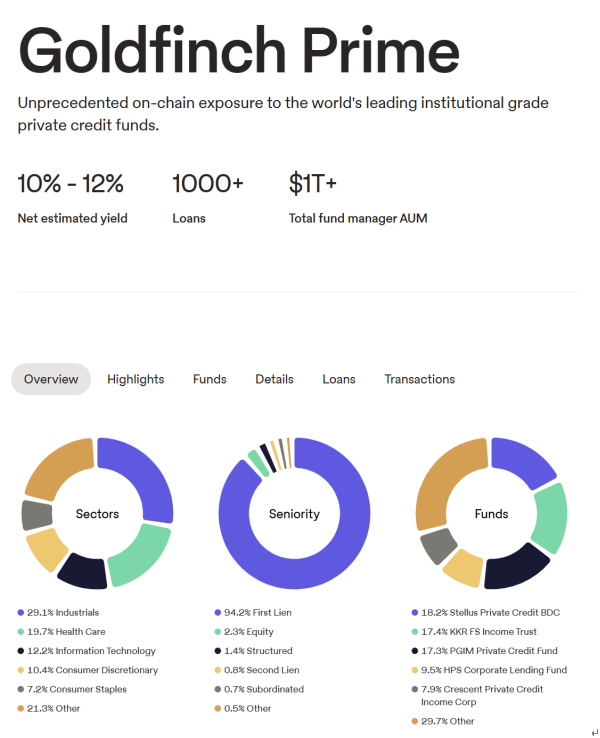
Additionally, to expand institutional business, Goldfinch launched a private credit asset pool named Goldfinch Prime. This product bundles assets from top private equity firms like Apollo, Ares, Golub, and KKR onto the blockchain, and through integration with Plume-supported Nest Vaults, allows retail users to deposit USDC for approximately 7% annual yield. However, this pool features a 10-day redemption lock-up period, and its current total AUM (TVL) of $440,000 is relatively small.
Source: Pharos Research, Goldfinch Finance
3.3.3 Figure: Building an Institutional Credit Ecosystem on a Permissioned Blockchain
Project Website:
https://www.figure.com/
Official X Account:
https://x.com/Figure
As a representative force in the US private credit RWA ecosystem, Figure has become one of the largest entities in on-chain loan issuance. Its business scope covers multiple categories including Home Equity Lines of Credit (HELOC), refinancing loans, and consumer loans, with cumulative loan issuance scaling past $16 billion. [5] Unlike Goldfinch, Figure's underlying assets are primarily secured loans, lending against real-world properties or qualified credit.
Figure's core operating mechanism relies on its self-developed Provenance blockchain. The protocol establishes Special Purpose Vehicles (SPVs) to hold and manage offline loan assets, issuing corresponding tokenized securities on the Provenance chain. These tokens are not publicly available but specifically reserved for institutional subscription by funds and asset management companies. Asset repayment and yield distribution follow strict offline compliance processes, ensuring the legality of the entire procedure.
Figure's ecosystem exhibits highly closed characteristics. Provenance is a permissioned blockchain built on Cosmos SDK. Whether running validator nodes, deploying smart contracts, or circulating assets, strict whitelisting and compliance audits are required. This characteristic means RWA assets within the Figure ecosystem currently cannot freely compose with the broader DeFi system, nor do they offer direct on-chain investment entry points for retail investors. Benefiting from its compliance framework, Figure has established deep partnerships with multiple traditional financial giants, including Franklin Templeton, Apollo Global Management, Jefferies, and Hamilton Lane. Market expectations suggest these institutions may utilize the Provenance blockchain to issue their own tokenized private credit products in the future.
3.3.4 Centrifuge: Strategic Evolution from Market Pioneer to Compliance Infrastructure
Project Website:
https://centrifuge.io/
Official X Account:
https://x.com/centrifuge
As an early explorer in the on-chain private credit RWA field, Centrifuge successfully issued multiple real-world asset-backed pools through its Tinlake framework, covering diversified assets like real estate mortgages (New Silver), logistics accounts receivable (ConsolFreight), and microcredit (Branch). These pools were isolated through independent SPVs and innovatively adopted a tranching structure, issuing DROP tokens representing senior, stable-yield positions and TIN tokens representing subordinated, high-risk/high-reward positions. This model achieved significant success between 2021 and 2023 and once became the benchmark project for minting DAI through real-collateral debt within the MakerDAO protocol. Currently, this architecture has completed its historical mission; the Tinlake frontend has been integrated into the new Centrifuge App, and related asset pools have entered repayment and exit phases.
Source: Pharos Research, Centrifuge
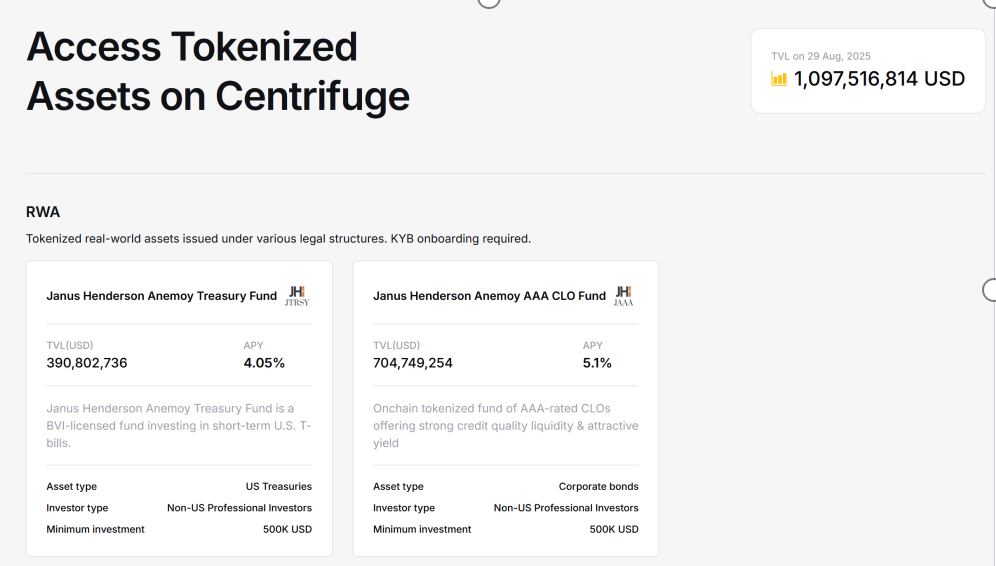
Currently, Centrifuge offers investors two primary products: first, tokenized US Treasury products issued by renowned fund house Janus Henderson; second, structured AAA-rated Collateralized Loan Obligation (CLO) shares. CLOs are financial products that bundle multiple floating-rate, lower-credit-grade loans, structurally tranch them via SPVs to cater to different risk appetites. Both investment products are exclusively available to qualified investors and issued on the Ethereum network.
Moreover, recent moves clearly indicate Centrifuge's strategic重心 has fully shifted toward compliance scenarios and permissioned blockchains. In May 2025, the project announced joining Converge, a compliance-focused RWA dedicated chain jointly pushed by Securitize and Ethena, as a launch partner. In June 2025, Centrifuge partnered with S&P Dow Jones Indices to explore developing a "Proof-of-Index" mechanism. Shortly after in July, Centrifuge V3 officially launched, integrating the Wormhole cross-chain architecture to achieve multi-chain unified RWA infrastructure across six mainstream EVM chains, significantly enhancing cross-chain liquidity and asset management capabilities.
3.3.5 Tradable: A High-Performance Institutional Credit Platform Based on ZK Technology
Project Website:
https://www.tradable.xyz/
Official X Account:
https://x.com/tradable_xyz
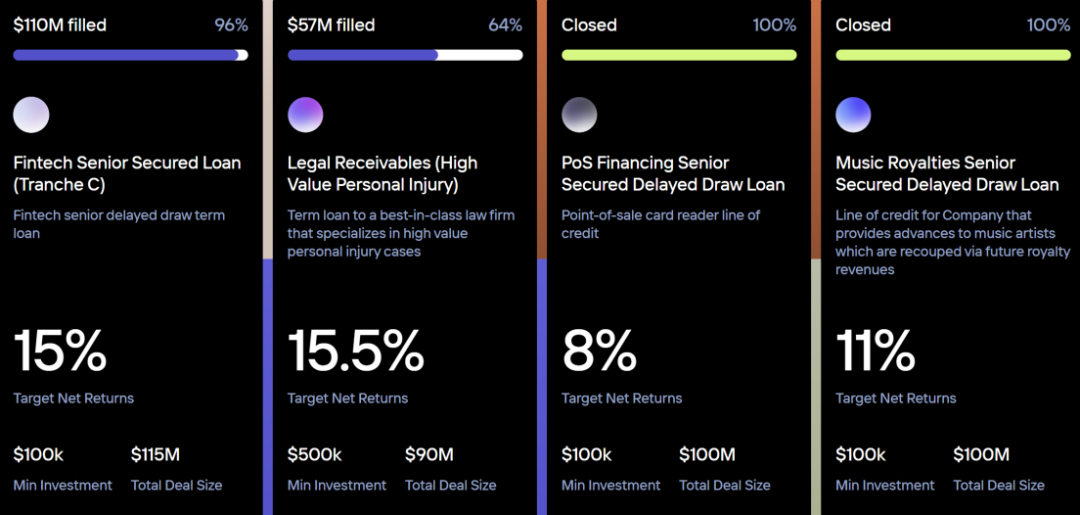
Tradable currently focuses on bringing institutional-grade private credit assets onto the blockchain, achieving significant scale in this domain. The platform has cumulatively processed over $2.1 billion in on-chain private credit assets, completed 37 independent transactions, and provided investors with an average annual yield exceeding 11%. [6] The core of its business is providing a high-performance, compliant tokenized credit investment channel for institutional participants.
To unify high performance with compliance, Tradable chose to build upon a permissioned blockchain based on ZkSync Era (ZK Stack) technology while maintaining compatibility with the Ethereum ecosystem. Its underlying smart contract system embeds strict preset regulatory mechanisms, including KYC/AML verification, qualified investor certification, and asset transfer restrictions. This architecture determines its service target is primarily institutions and qualified investors; ordinary retail investors currently cannot participate directly. All prospective investors must first open an account and pass comprehensive compliance review processes to gain investment qualifications. Additionally, the platform sets high participation thresholds per transaction, typically requiring no less than $100,000.
Source: Pharos Research, Tradable
3.3.6 PACT: Diversified Credit Solutions Incubated in the Aptos Ecosystem
Project Website:
https://pactfoundation.com/
Official X Account:
https://x.com/pactconsortium
Supported and incubated by the Aptos Foundation, the PACT protocol aims to provide diverse financing solutions for emerging markets and specific regions through tokenized private credit products. To ensure the legal validity of its on-chain assets, PACT adopts an innovative compliance framework: storing encrypted Personally Identifiable Information (PII) off-chain while verifying it via hashes on-chain, a design compliant with the US Uniform Electronic Transactions Act (UETA). All participants (both borrowers and investors) must pass KYC/AML checks before conducting on-chain activities like loan applications, NFT issuance, and lending contract trades.
In PACT's ecosystem, each loan is represented by a dynamically updatable NFT. This NFT records loan terms and repayment status while carrying its circulation rights. Through cooperation with BitGo, these债权-representing NFTs support resale and trading on secondary markets. Simultaneously, to solve large-scale RWA data secure storage issues, PACT partnered with the Shelby protocol (jointly launched by Aptos Labs and Jump Crypto), leveraging its high-performance, low-latency decentralized storage capabilities.
To date, the PACT platform has cumulatively matched over $1 billion in loans. Its product portfolio demonstrates high regional and risk diversity; selected representative products are introduced as follows:
•BSFG-EM-1: As its flagship product, this pool targets individual consumers and micro-business owners in emerging markets, providing short-term microloans. With a scale exceeding $160 million, its loan interest rate reaches a striking 64.05%.
•BSFG-EM-NPA-1/2: These are specialized asset pools targeting non-performing or defaulted loans, with a combined scale of $184 million, accessible only to qualified investors, with undisclosed specific yields.
•BSFG-CAD-1: Backed by Canadian residential property, this pool totals $44.51 million and adopts a senior/subordinated tranching structure. Its low interest rate of 0.13% likely corresponds to the lower-risk senior portion, but liquidity is restricted due to asset lock-ups.
•BSFG-AD-1 & BSFG-KES-1: These two pools serve UAE micro-businesses and Kenya's retail credit market respectively, with scales of $20.05 million and $6.39 million. Their interest rates reflect the high-growth and high-risk characteristics of their respective markets, standing at 15.48% and 115.45%.
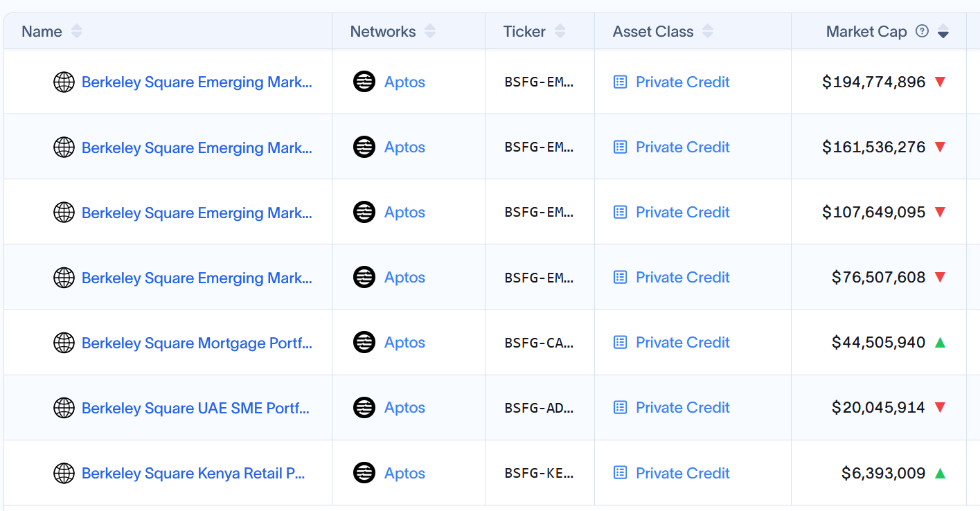
Above content sourced from: Pharos Research, PACT Foundation
Source: Pharos Research, RWA.xyz
Looking ahead, PACT plans to integrate with mainstream DeFi protocols, aiming to bring its credit tokens into broader decentralized finance scenarios such as revolving lending, leverage strategies, and liquidity mining, expected to provide investors with 6% to 15% annual yields.
3.4 Trends and Future Outlook
The on-chain private credit track is transitioning from an early exploratory phase to a scaled expansion period based on compliance and led by institutions. Although top asset management institutions have already taken the lead, the next phase of exponential market growth will depend on the breadth and depth of broader institutional participation—expanding from a few pioneers to comprehensive entry by numerous small and medium financial institutions. The true ignition point for future market scale will be the thorough "institutionalization" wave on both the asset and funding sides. This profound structural transformation is expected to reshape the track's landscape from three perspectives:
First, capital institutionalization inevitably demands mature regulatory frameworks. "Compliance-first" and "permissioned" environments will become industry standards, replacing previous "wild growth" models.
Second, built upon this compliance foundation, the track's ultimate value will be released through deep integration into the DeFi ecosystem, transforming from mere yield-providing "asset islands" into efficient, composable assets usable as collateral by mainstream lending protocols.
Third, to meet increasingly complex institutional demands, underlying assets will continuously innovate from standardized loans toward more diversified products like Real Estate Investment Trusts (REITs) and Collateralized Loan Obligations (CLOs), collectively shaping a more mature, integrated, and expansive on-chain credit landscape.
These three trends interlock, outlining a clear path for on-chain private credit toward maturity. The future market will no longer be mere on-chain mapping but a深度融合 combining the asset depth and regulatory rigor of traditional finance with the efficient clearing and composability of decentralized finance. At that time, on-chain private credit is expected to shed its early high-risk, high-volatility label and truly evolve into the "stable yield cornerstone" of the entire on-chain economy, providing the digital asset world with sustainable, low-correlation cash flows originating from the real economy.
04 Core Sector Analysis: Commodities
4.1 Market Overview and Operating Mechanisms
Within the细分赛道 of RWA (excluding stablecoins), tokenized commodities are a不可忽视的重要组成部分. This category currently ranks third with an asset scale of $2.4 billion, accounting for 8.6% of the total market. Particularly noteworthy is its strong growth momentum year-to-date, with asset size recording an increase of approximately 136%.
The issuance mechanism for this type of RWA generally follows a standardized process containing three core links: physical custody, on-chain mapping, and redeemability, thereby constructing a complete closed loop. First, issuers deposit physical assets like gold into professionally regulated custodial institutions, ensuring every unit of on-chain token is backed by real physical assets. Subsequently, via smart contracts on the blockchain (primarily Ethereum), tokens anchored 1:1 to the physical assets are issued. Finally, users can redeem their held tokens for corresponding physical assets subject to compliance requirements. Although minting and burning these tokens in the primary market generally require users to complete KYC认证, as standard ERC-20 tokens, they can circulate freely in secondary markets. Their on-chain holder count (approximately 83,000) and monthly trading volume (approximately $1.13 billion) significantly exceed other RWA categories like tokenized stocks, though trading activity currently remains concentrated on centralized exchanges.

Source: Pharos Research, RWA.xyz
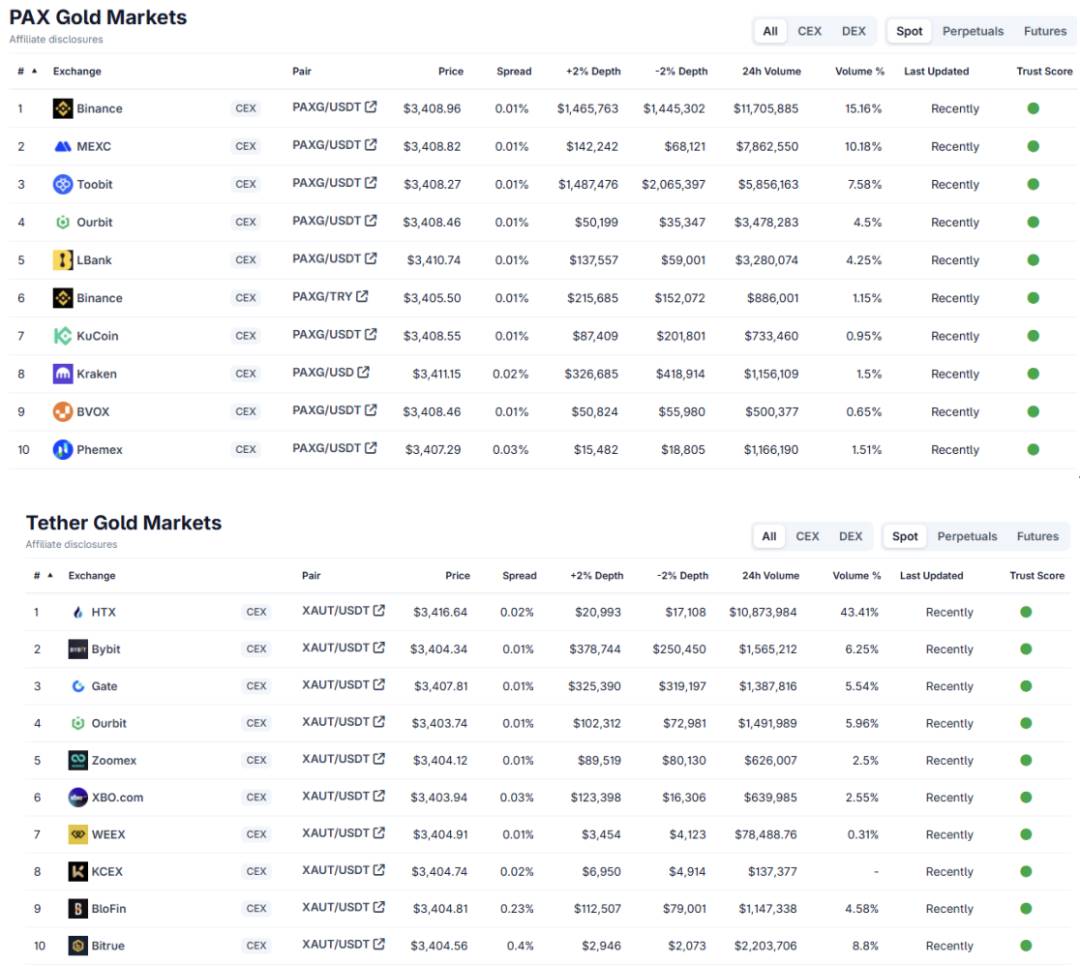
Source: Pharos Research, CoinGecko
4.2 Market Landscape
Currently, the tokenized commodities market presents a highly concentrated duopoly landscape. Most products currently have underlying assets in gold. Paxos's PAXG (market cap $960 million) and Tether's XAUT (market cap $840 million) occupy 40.7% and 35.6% market shares respectively, collectively controlling over 75% of the market.
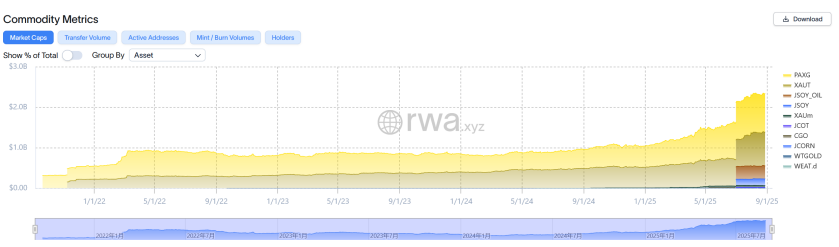
Source: Pharos Research, RWA.xyz
However, despite possessing massive market caps and trading volumes, PAXG and XAUT exhibit extremely limited integration into Decentralized Finance (DeFi) protocols. Currently, no mainstream lending protocols support these assets as collateral. The Aave protocol briefly listed PAXG for collateral functions but eventually removed it due to low liquidity. Although related liquidity pools exist on decentralized exchanges like Uniswap and Curve, their Total Value Locked (TVL) is generally small, and trading depth is severely insufficient. This means users can hardly utilize these assets for borrowing, yield aggregation, structured derivatives, and other core DeFi modules beyond providing liquidity to earn trading fees. Their composability advantages as RWA assets remain largely undeveloped.
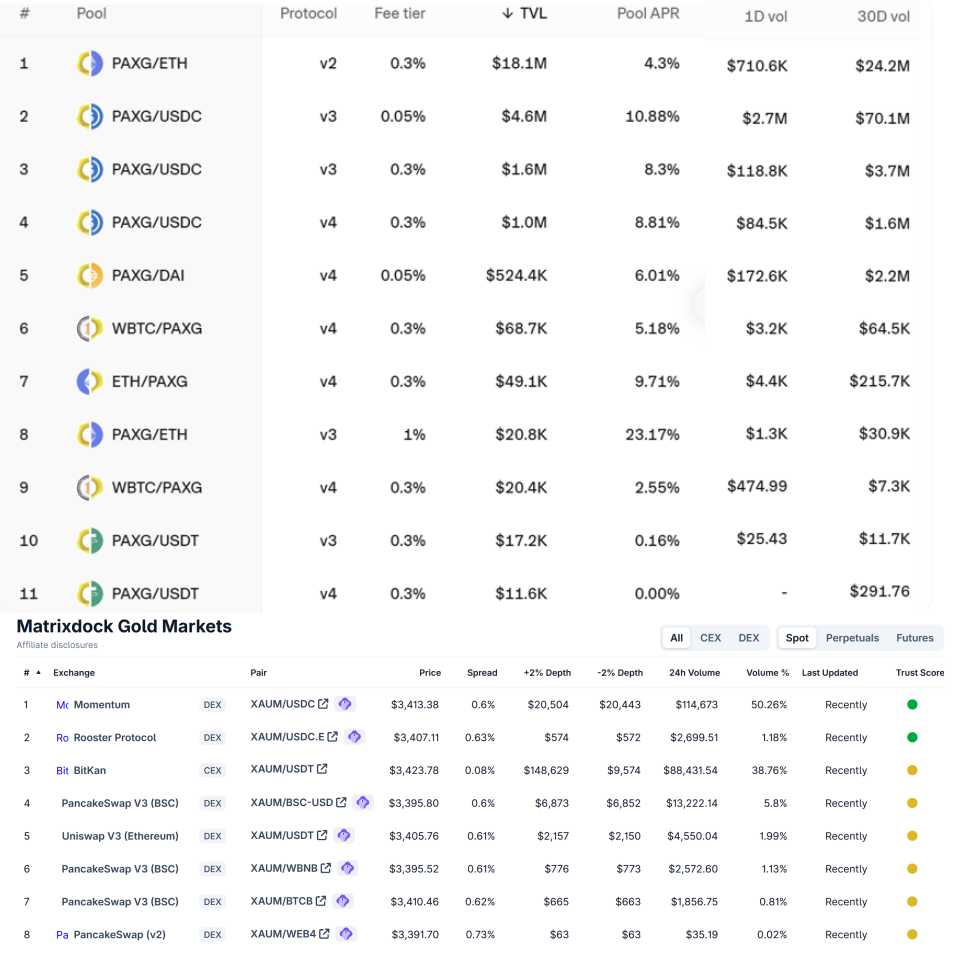
Source: Pharos Research, CoinGecko
4.3 Trends and Future Outlook
Although currently dominated by a few leading projects, a clear trend is the increasing diversification of issuers, expanding from crypto-native institutions to broader traditional publicly listed companies and financial entities. Matrixport's Matrixdock has launched its tokenized gold product, and more significantly, NASDAQ-listed company Blue Gold Limited (NASDAQ: BGL) announced plans to issue the BGC token. Its underlying asset is not traditional physical gold but forward contracts for future delivery of gold, marking an important step in complexity and innovation for tokenized commodities in financial products.
Looking forward, the boundaries of tokenized commodities will extend from precious metals to broader fields, and tech stack selections will also present a multi-chain coexistence landscape. For example, Singaporean agricultural commodity trading company Davis Commodities Ltd. plans to construct an on-chain trading platform to introduce bulk agricultural products like white sugar and rice into the tokenized world for the first time. Additionally, the cross-industry collaboration between US medical device company BioSig and Streamex plans to issue gold tokens on the Solana blockchain, foreshadowing that future asset issuance will no longer be confined to Ethereum. The entry of these new players is expected not only to inject new vitality into the market but also fundamentally break the existing duopoly, initiating a brand-new development stage with more diverse asset types and broader participant bases.
05 Core Sector Analysis: Stocks
5.1 Market Overview
Tokenized Stocks, serving as a bridge connecting traditional finance with the digital asset world, hold infinite potential within the future RWA industry. Its market participants can mainly be categorized into three groups: emerging market retail investors seeking US stock investment channels, traditional finance practitioners (or high-net-worth individuals) intending to conduct position management, and quantitative trading institutions looking to uncover spread opportunities.
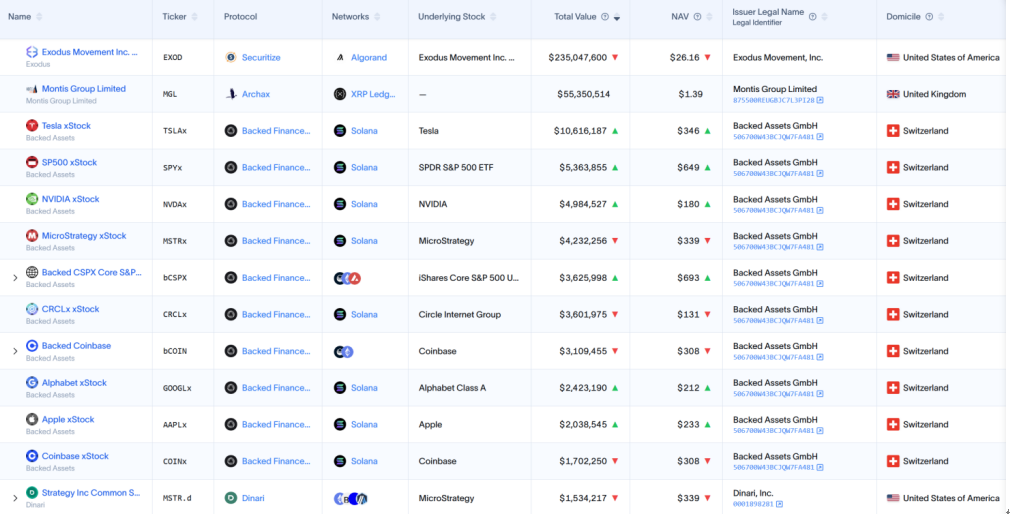
Compared to NVIDIA's (NASDAQ: NVDA) single stock market cap of $4.4 trillion, the total market cap of all current tokenized stocks is only $359 million. This highlights that the track is still in its very early stages, boasting immense imaginative space and huge potential. Conversely, it also reveals industry challenges: limited participants and severely deficient liquidity.
Source: Pharos Research, RWA.xyz
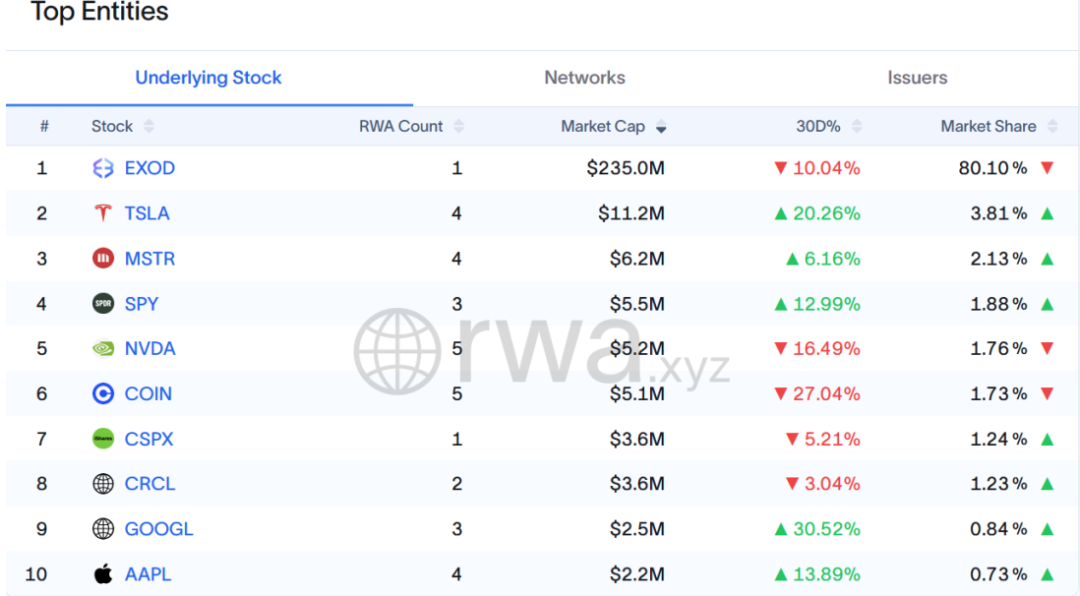
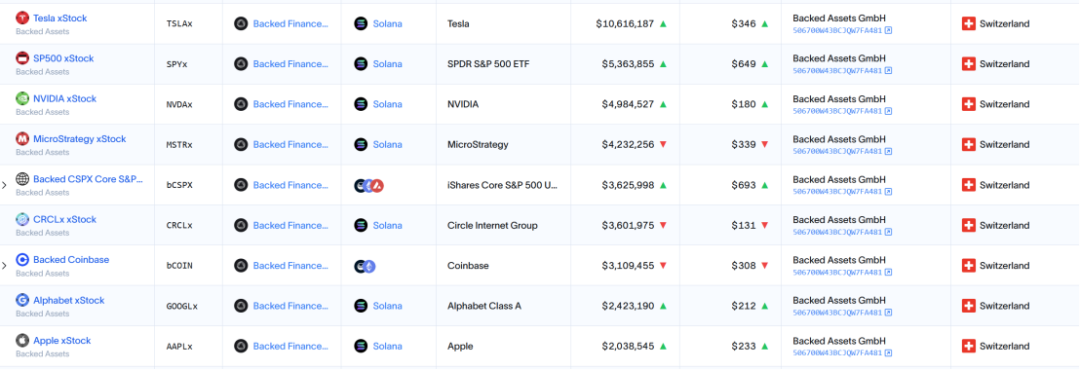
Deconstructing the existing market scale reveals its somewhat special composition. The number one ranked EXOD (over $235 million) belongs to on-chain native equity under compliance frameworks in 2021, differing from mainstream stock mapping models; meanwhile, MGL ranked second is an experimental product within the UK regulatory sandbox, unable to circulate freely. Excluding these two special categories, the current active tokenized US stock market landscape presents high concentration. Products issued by Backed Finance's xStocks series occupy absolute dominance, additionally receiving certain market attention from Dinari and Swarm's tokenized products.
Source: Pharos Research, RWA.xyz
In terms of underlying asset types, current tokenized targets on the market show clear strategic preferences, mainly concentrating on two categories: one is globally renowned high-tech enterprise stocks like the "Magnificent Seven"; the other is publicly listed companies highly correlated with the crypto market like Coinbase (NASDAQ: COIN) and MicroStrategy (NASDAQ: MSTR). Among them, Tesla's (NASDAQ: TSLA) tokenized product is the only target exceeding the tens of millions of dollars level; the market sizes of other products mostly sit in the millions, indicating overall market depth remains shallow.
5.2 Market Operating Model Analysis
In terms of realization paths, current mainstream tokenized stock issuance models on the market can broadly be classified into three types, with different models exhibiting significant differences in supported assets and investor rights.
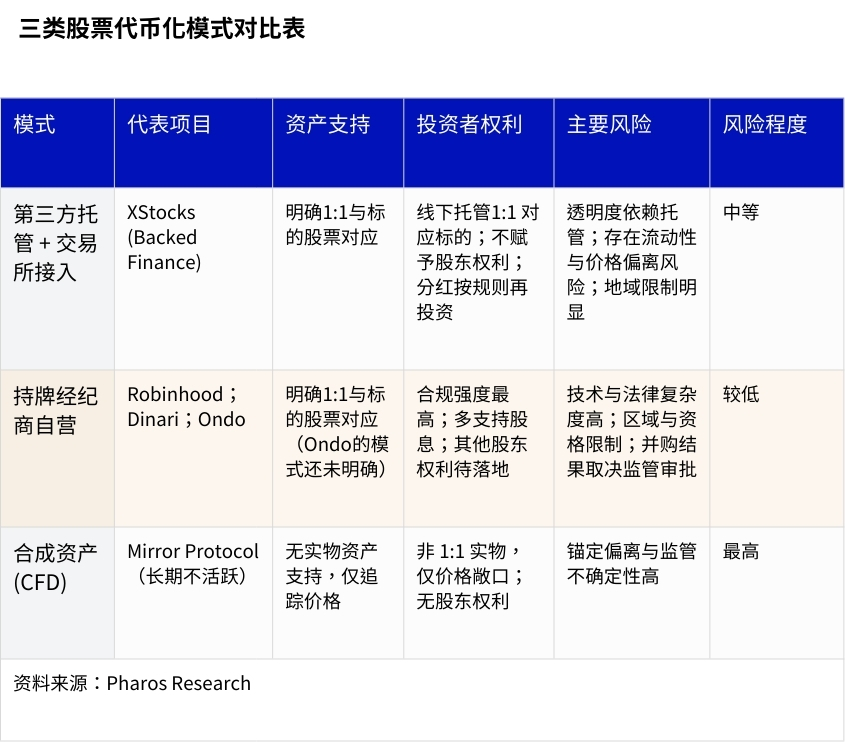
•Third-Party Custody and Exchange Integration Model: Represented by xStocks, its issuer Backed Finance holds real stocks through Special Purpose Entities (SPVs), with asset guarantees provided by independent off-chain custodians. Ultimately, products serve users through centralized exchanges like Kraken and Bybit. According to platform disclosures, xStocks aims to reflect the price and behavior of underlying stocks, granting no shareholder rights (voting, residual asset claims, etc.), with dividends auto-reinvested into the same token balance per rules. This model anchors prices via oracles, but its transparency and asset authenticity heavily depend on the custodian's reputation.
•Licensed Broker-Dealer Self-Operated Model: This path involves self-operated issuance and settlement closed loops by entities possessing securities business qualifications. For example, Robinhood utilizes its broker-dealer license to provide a complete closed loop of issuance, trading, and settlement directly on the blockchain (currently Arbitrum, with proprietary L2 planned for the future). Similarly, projects like Ondo Finance and Dinari obtained SEC-recognized Broker-Dealer licenses through acquisition or registration, qualifying them to legally issue and settle tokenized securities. This path possesses the highest compliance strength but accompanies significant technological and legal complexities.
•Contract for Difference (CFD) Model: Represented by the now-defunct Mirror Protocol. Users obtain synthetic derivatives linked to stock prices, not 1:1 on-chain mappings of physical stocks, thus lacking shareholder rights. This path relies on feeds and market makers, easily affected by pricing deviations and regulatory uncertainty, leaving platforms facing enormous regulatory pressure and asset decoupling risks.
Notably, the aforementioned issuance models (especially the first two) are not distinct in practice but exhibit significant overlap and dynamic evolution tendencies. On one hand, licensed issuers usually combine third-party custody and external exchange integration strategies to enhance asset transparency and market liquidity. On the other hand, unlicensed project parties actively seek broker-dealer qualifications through application or acquisition, moving closer to self-operated models. Strictly speaking, currently only Robinhood truly achieves end-to-end vertically integrated self-operation among issuers. Even Dinari, having obtained key broker-dealer licenses, is still in early stages regarding independent self-operated system construction,现阶段仍需依赖第三方托管来支撑其核心业务。
5.3 Key Compliance Licenses Analysis
In the United States, tokenizing and providing trading services for securities like stocks constitutes highly regulated financial activity, mandated to operate within the framework of the Securities and Exchange Commission (SEC) and Financial Industry Regulatory Authority (FINRA). Any project wishing to construct an end-to-end, fully compliant tokenized stock ecosystem typically requires obtaining the following three critical licenses.
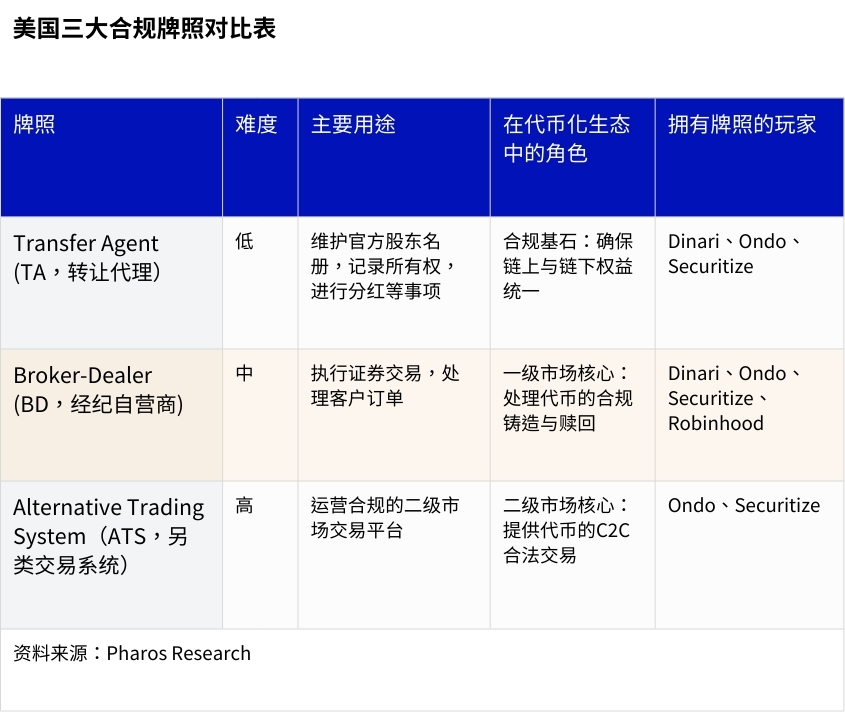
These three licenses collectively form a complete business closed loop. Their acquisition difficulty roughly sorts as: Transfer Agent (TA) < Broker-Dealer (BD) < Alternative Trading System (ATS).
•The core function of a Transfer Agent (TA) serves as the official "shareholder registry steward" for security issuers, responsible for precisely tracking and recording ownership attribution. In tokenized business, the TA's role becomes particularly critical; it is the cornerstone ensuring precise mapping between on-chain digital credentials and off-chain legal rights. The TA maintains the authoritative legal registry of token holders, meaning regardless of how on-chain wallet addresses circulate, the ultimate legal beneficial owner of assets is confirmed. This function is vital for resolving ownership disputes and guaranteeing accurate distribution of dividend rights, forming the trust foundation of the entire asset tokenization compliance system.
A Broker-Dealer (BD) license is the passport to engaging in all securities business, authorizing entities to execute securities purchases and sales on behalf of others or for their own accounts. In the context of tokenized stocks, this license is the legal prerequisite for platforms to legally handle user primary market operations. Specifically, whether users purchase tokens with fiat currency or stablecoins (i.e., "minting") or sell tokens to retrieve funds (i.e., "redeeming"), these must be executed by entities holding BD licenses to trade and settle underlying stocks. Thus, the BD license constitutes the core compliance hub connecting investors with primary issuance of tokenized assets.
•An Alternative Trading System (ATS) license authorizes entities to operate a regulated secondary market trading platform, providing lawful matching services for securities not listed on national exchanges. For tokenized stocks, the ATS license is the key unlocking their true liquidity. If a platform only holds the first two licenses, it can only handle asset issuance and redemption but cannot allow peer-to-peer legal trading between users. Only by obtaining the ATS license can a platform construct a compliant secondary market, achieving effective price discovery, improving asset turnover efficiency, and ultimately solving the long-standing liquidity dilemma facing tokenized assets.
Based on the above core license framework, the market currently shows two noteworthy points regarding compliance path selection:
First, it is necessary to clearly distinguish the license boundaries between securities business and money transmission services. The aforementioned TA/BD/ATS constitute the indispensable "orthodox" compliance path for conducting tokenized stock business in the US. MSB (Money Services Business) licenses mentioned by some project parties in marketing govern fund transfer businesses, not securities licenses, and cannot replace their legal functions in any form.
Second, precisely due to the extremely high compliance thresholds in the US market, industry pioneers exhibit a clear converging strategy: bypassing the US and establishing operational foundations in European jurisdictions with clearer regulations. For example, Robinhood leverages Lithuanian licenses to issue derivatives under the EU MiFID II framework; Backed Finance (xStocks) operates from Switzerland according to its DLT Act. Although legal paths vary, their strategic objectives align—in prioritizing compliance, taking broad non-US markets as core business targets.
5.4 Key Players
5.4.1 xStocks (Backed Finance): Compliant On-Chain Stock Price Tracking Instruments
Project Website:
https://xstocks.com/
Official Twitter Account:
https://x.com/xstocksfi
xStocks, issued by Swiss compliant asset tokenization platform Backed Finance, is the representative product of the open-type model in the tokenized stock sector (Backed Finance also issues btokens, tracking publicly traded securities like ETFs, stocks, and government bonds).
Starting June 30th this year, xStocks series products have sequentially listed on mainstream exchanges including Bybit, Kraken, and Gate.io (some supporting leverage and short selling mechanisms). Its core operating model entrusts 1:1 corresponding real stocks to regulated third-party institutions like InCore Bank, and after initially landing on the Solana public chain, further expanded issuance networks to BNB Chain and TRON, demonstrating a clear multi-chain development strategy. Currently, the Backed Finance platform provides over 60 tokenized US stocks, with its popular products occupying absolute dominance in the active tokenized US stock market.
Source: Pharos Research, RWA.xyz
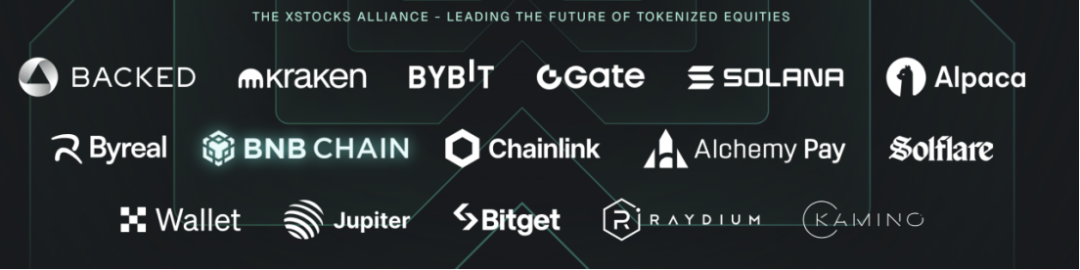
The ecosystem building of xStocks demonstrates clear strategic hierarchy. Its market access is first propelled by core issuer Backed Finance and top distribution channels Bybit and Kraken, the latter providing crucial initial liquidity and user reach. On this basis, xStocks actively integrates into its native public chain Solana's DeFi ecosystem, collaborating with top DEX aggregators Jupiter, automated market maker Raydium, and lending protocol Kamino Finance to打通 on-chain trading and mortgage lending core scenarios. Ultimately, partnering with payment gateway Alchemy Pay broadens user entry points, and joint listing with African crypto exchange VALR demonstrates its globalization vision toward emerging markets.
Source: Pharos Research, Backed Finance
(1) Market Liquidity Performance
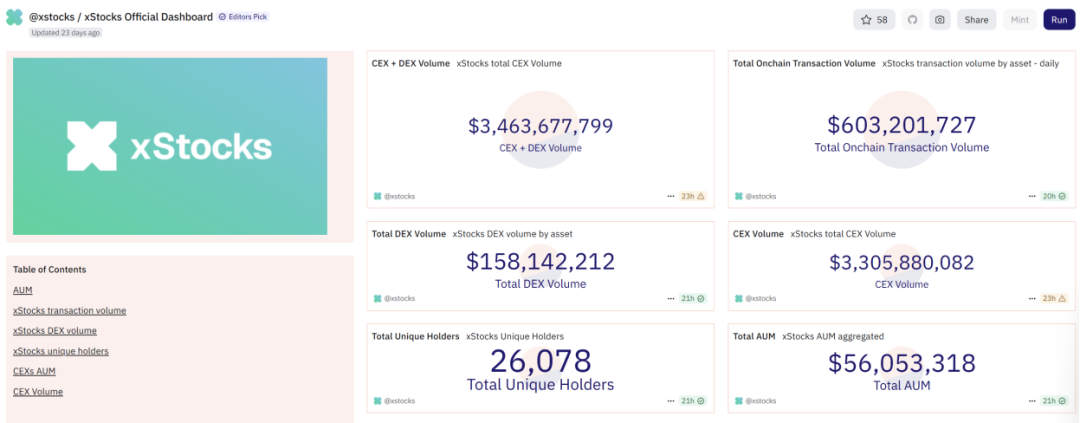
From market liquidity data, xStocks exhibits mixed results. According to Dune data, current on-chain total trading volume for xStocks is $600 million, exchange trading volume is $3.46 billion (with CEX volume占比 exceeding 95%). Its on-chain trading concentrates mainly on Raydium, but core trading pair pool depth and volume are severely insufficient compared to major pairs like SOL/USDC, indicating low capital efficiency in on-chain market making. Nevertheless, its spot trading volume on centralized exchanges far exceeds on-chain; estimated overall spot trading volume might rival some mid-cap altcoins. Regardless, whether on-chain or off-chain, insufficient liquidity depth remains its core challenge, resulting in low user execution efficiency, with overall trading experience still showing obvious gaps compared to traditional financial platforms.
Source: Pharos Research, Dune
(2) Issuance and Custody Mechanism
xStocks' issuance process constructs a complete closed loop linking traditional financial markets with blockchain. According to public information parsing, its operating flow is as follows: First, registered parent company in Switzerland instructs its Jersey-based entity (Backed Assets) to purchase corresponding stocks in the US stock secondary market through Prime service channels of mainstream brokers like Interactive Brokers. Subsequently, these stocks are transferred and deposited in segregated accounts within Clearstream's depository institution under Deutsche Börse. Once stocks are securely deposited, this action triggers smart contracts deployed on the Solana chain to mint (Mint) corresponding xStocks tokens (e.g., TSLAx) at a 1:1 ratio. Finally, these tokens can be directly listed and traded on exchanges like Kraken or Bybit. Conversely, investors holding sufficient tokens can apply to Backed Finance to redeem tokens for real stocks.
(3) Token Essence: Corporate Bonds Tracking Stock Prices
According to mainstream views within the industry, xStocks is not an equity token in legal structure; its essence is a corporate bond tracking underlying asset prices. This ingenious design brings several key characteristics: First, the issuing entity (usually an SPV) does not require custody qualifications; distribution is handled by entities possessing corresponding licenses (like Kraken's Bermuda subsidiary). Second, due to its bond attribute, dividend distribution simplifies to directly airdropping more tokens to holders, avoiding complex corporate actions like voting rights. Most importantly, as bearer bonds, on-chain transfer of ownership requires no registration, thereby avoiding stamp duties in traditional equity trading, achieving frictionless on-chain circulation. However, this model has limitations; its wider bid-ask spreads and transaction fees determine its current core value remains停留在为用户提供美股价格敞口,距离真正的机构级应用尚有距离。
(4) Main Risks and Controversies: Founding Team Background
A notable risk point facing xStocks lies in its founding team's past background. According to disclosures within the crypto community, Backed Finance's core founding team previously served as co-founders of DAOStack. After raising approximately $30 million via ICO in 2018, DAOStack basically ceased operations by 2020, with its GEN token nearing zero value. This historical situation brings一定的 uncertainty to Backed Finance's long-term credibility, constituting reputational risk that potential investors and partners need to assess cautiously during due diligence.
5.4.2 Robinhood: Seamlessly Bringing Zero-Commission US Stock Trading On-Chain
Famous internet broker Robinhood chose a fundamentally different model from open paths in the tokenized stock sector, dedicated to building a vertically integrated closed ecosystem. Leveraging compliance licenses obtained in Lithuania as a foothold for entering the EU market, it has already provided users with over 200 tokenized US stock and ETF products, planning expansion to thousands by the end of 2025. Technically, its tokens initially operated on the Arbitrum network, with plans to eventually migrate to its self-developed Arbitrum-based Layer 2 to improve efficiency. For users, this model provides highly attractive convenient experiences: 24/5 trading, zero commissions, and dividends credited directly.
However, in terms of asset essence, these "stock tokens" are not traditional equities. Its CEO Vlad Tenev has explicitly clarified they are blockchain-based derivative contracts designed to track underlying asset prices, but investors do not enjoy shareholder rights like voting rights (however, they do receive shareholder dividends)—although Robinhood claims maintaining 1:1 asset reserves backing such derivatives. Furthermore, Robinhood's strategy extends beyond mature stocks; its more pioneering move involves布局另类资产,率先推出了针对 OpenAI 和 SpaceX 等非上市公司的代币化衍生品( OpenAI 官方已澄清未参与合作),为用户提供了接触高门槛 Pre-IPO 资产的独特渠道。

Source: Pharos Research, Robinhood
The most fundamental difference between the Robinhood model and open paths like xStocks lies in its extreme pursuit of compliance and the resulting strategic trade-offs. Robinhood's stock token contracts embed strict compliance restrictions; every on-chain transfer must pass approval by an approved wallet registry (i.e., KYC/AML whitelist). Any transfers to non-whitelisted addresses will be automatically blocked by smart contracts.
The direct consequence of this design is that its token assets completely sacrifice composability interacting with permissionless DeFi protocols. But this simultaneously constitutes its core moat: By constructing a fully controllable, highly compliant closed-loop ecosystem, Robinhood can minimize regulatory risk, attracting mainstream user groups and CeFi partners demanding extreme compliance. This is a clear strategic choice—abandoning open financial flexibility in exchange for larger-scale compliant market access.
5.4.3 Dinari: A Security Token Platform Holding Critical US Licenses
Project Official:
https://dinari.com/dshares
Official X Account:
https://x.com/DinariGlobal
In the tokenized stock sector, Dinari positions itself as a compliance-centric underlying infrastructure service provider, potentially paving the way for issuance and trading of tokenized stocks within the US, leveraging its acquired "Broker-Dealer" license. Its core product dShares™ already covers over 100 US stocks and ETFs, deployed on Arbitrum and Ethereum mainnets, possessing strong circulation capabilities.

Source: Pharos Research, Dinari
(1) Regulatory Compliance and License Advantages
Dinari's most core competitive advantage stems from its powerful regulatory compliance edge. Its subsidiary successfully obtained the US Financial Industry Regulatory Authority (FINRA) "Broker-Dealer" license in June 2025, making it the first project-specific platform specializing in this business to secure this key qualification. Additionally, its parent company Dinari, Inc. is also registered as a "Transfer Agent" with the US SEC.
(2) Product Analysis: 1:1 Asset Support and Rights Structure
Dinari's core product line consists of tokenized securities dShares™ and yield-bearing stablecoin USD+. dShares™ is defined internally within mainstream opinion as "security tokens"; its operating model is rigorous and transparent: an independent Special Purpose Entity (SPV) genuinely purchases corresponding stocks or ETF assets in the US market, subsequently issuing tokens on the blockchain at a 1:1 ratio. All underlying assets are held by third-party institutions and audited. Regarding shareholder rights, dShares™ holders are entitled to receive corresponding stock dividends but currently lack complete shareholder identity including voting rights.
Controversy has always existed regarding dShares™'s product nature. In EU compliance documents (PRIIP KID), dShares are described as "OTC derivative contracts pegged 1:1 to underlying assets"; Dinari consistently refers to them externally as Tokenized Securities. However, considering its provision of dividends and efforts to satisfy shareholder权益 facts, the market generally defines them as security products, though compliance expressions (derivative contracts/tokenized securities) vary slightly due to jurisdictional differences.
In market expansion, Dinari announced cooperation with Gemini exchange in August 2025, marking its business formally stepping from primary market subscription/redemption to compliant centralized secondary markets, beginning serving European investors, and innovatively introducing night trading sessions. However, initial market liquidity and scale remain its main challenges. According to RWA.xyz data, even its hottest tokenized MicroStrategy (NASDAQ: MSTR) stock MSTR.d currently commands a market cap of only about $1.5 million, indicating the market remains in early cultivation stages.
5.4.4 Ondo Finance: RWA Giant Entering the Tokenized Stock Market
Project Website:
https://ondo.finance/
Official X Account:
https://x.com/OndoFinance

Source: Pharos Research, Ondo Finance
As the recognized leader in the tokenized US Treasury field, Ondo Finance marked its determination to进军代币化股票市场 by acquiring US stock broker Oasis Pro in July 2025, obtaining full stock licensing. It plans to launch the on-chain US stock trading platform "Ondo Global Markets" on the ETH network on September 3rd, initially providing tokenized products for 100 stocks, with a medium-to-long-term goal of expanding to thousands. Leveraging its proven execution capabilities in the RWA field and powerful brand reputation, Ondo's entry will pose a formidable challenge to the existing market landscape.
Ondo's strategic layout demonstrates clear "DeFi Native" orientation and powerful ecosystem building capabilities. In terms of products, its platform plans to provide 24/7 stock trading for non-US users, explicitly stating its tokenized stocks will be usable as collateral in DeFi protocols, fundamentally different from Robinhood's closed-loop model path. In the ecosystem layer, Ondo spearheaded establishing the "Global Markets Alliance," initial members including Solana Foundation, institutional-grade custodian BitGo, and top DEX aggregator Jupiter, among other key participants, aiming to jointly establish industry standards for RWA and construct a powerful cross-domain collaborative network.
Ondo's core advantage lies in its established compliance moat and market reputation. By completing acquisition of Oasis Pro in July 2025, Ondo obtained a complete set of licenses including Transfer Agent (TA), Broker-Dealer, and Alternative Trading System (ATS), laying a solid foundation for compliant operations within the US. Powerful brand reputation, top-tier ecological alliances, and solid compliance licenses jointly constitute Ondo Finance's core competitiveness, making it the most potential giant in the tokenized stock sector.
5.5 Arbitrage Logic and Opportunity Analysis for Tokenized Stocks
The close connection and significant efficiency differences between the tokenized stock track and traditional stock markets spawn enormous arbitrage opportunities. Specifically, these opportunities arise from two aspects of efficiency disparities:
First, massive liquidity chasm: According to RWA.xyz data, as of August 28, 2025, the total market cap of all stock tokens is approximately $359 million, a fraction far smaller than NVIDIA's (NASDAQ: NVDA) single stock market cap of $4.4 trillion. This severe liquidity deficiency makes token prices more prone to volatility facing slightly larger trades. Second, mismatched trading hours: Crypto markets offer uninterrupted 7×24 hour trading, whereas traditional stock markets have fixed opening and closing times.
These two core factors collectively cause temporary deviations between token prices and underlying stock prices across different platforms and time periods, providing professional institutional practitioners and individual investors with two distinct approaches.
5.5.1 Core Arbitrage Strategies for Institutions
Large-scale and effective arbitrage strategies often demand exceptionally high requirements for technology, capital, and information acquisition speed, thus better suited for institutions or professional quantitative teams to execute. Specifically, there are three common arbitrage logics below.
•Cross-Market Hedging Arbitrage: This strategy exploits price spreads between tokens and spot stocks. When both markets are open simultaneously, if token prices significantly exceed spot, arbitrageurs buy spot stocks and simultaneously short corresponding tokens in the token market. When the spread converges, reversing operations locks profits. This strategy is highly sensitive to trading slippage and fees, requiring low-latency, high-frequency automated execution capabilities.
•Cross-Platform Spread Arbitrage: This is a classic arbitrage pattern in crypto markets, buying tokens on platforms with lower prices and rapidly transferring to sell on platforms with higher prices. Success depends on on-chain transfer speeds, exchange deposit/withdrawal limits, and trading pair depths. Often requires arbitrageurs to pre-stores liquidity across multiple platforms and coordinate via quantitative programs.
•Time-Difference Information Arbitrage: This is the most distinctive strategy on the tokenized stock market, core lying in exploiting time zone differences between two markets. Non-trading periods for traditional stock markets (weekends, pre/post-market) are often release windows for major news (company earnings, macro policies). Since stock tokens trade 24/7, their prices react to this information ahead of spot markets. Arbitrageurs deploy high-performance news monitoring systems to capture major messages during non-trading hours, predict impact on stock prices, and establish positions early in the token market (long for bullish, short for bearish news), closing positions once traditional markets open and prices realize expectations. These arbitrage windows are extremely brief, often measured in minutes or seconds, placing extreme demands on information acquisition speed and automated trading response capabilities.
Notably, issuing platforms themselves typically deploy corresponding anti-arbitrage mechanisms to maintain asset stability. The most common strategy strictly anchors token minting and redemption in primary markets to actual transaction prices and times of physical stocks in platform custodial accounts. This mechanism effectively prevents direct counterparty arbitrage targeting the issuing platform, preventing systemic spread-induced asset loss. Therefore, above arbitrage strategies, especially "information arbitrage" demanding highest timeliness, find most viable application scenarios not in competing with platforms via primary market minting/redemption operations, but within platforms' own DEXs or other secondary markets supporting free circulation of said tokens.
5.5.2 Core Value Proposition for Retail Investors
Although complex arbitrage strategies aren't ordinary investors' home turf, the emergence of tokenized stocks fundamentally improves retail experience participating in global quality asset investments. Its core value propositions manifest in three aspects below:
•Lowering Investment Thresholds (Fractionalized Investing): Traditional US stock markets typically use whole shares as minimum trading units. For expensive stocks like Google or Tesla, ordinary investors face high entry barriers. Tokenization technology enables "fractionalizing" stocks, allowing users to buy 0.1 shares or even 0.001 shares, achieving true "fractional holding," drastically enhancing investment inclusivity.
•Improving Market Accessibility (All-Weather Trading): Breaking free from traditional stock market opening time constraints, 7×24 hour trading mechanisms grant retail investors unprecedented flexibility. Investors can enter or exit markets anytime, react immediately to突发事件 in any global timezone, flexibly configure cross-timezone, multi-asset portfolios, effectively规避 regional risks.
•Improving Settlement Efficiency and Capital Efficiency (T+0 Settlement): Traditional securities trading follows T+2 settlement cycles, requiring two working days for funds and securities to complete delivery, occupying substantial capital and bringing settlement risks. Tokenized stocks based on blockchain achieve near real-time (T+0) atomic settlement; trading equals final delivery. This model drastically improves capital utilization efficiency and fundamentally lowers counterparty risk in clearing processes, showcasing structural advantages over traditional finance's underlying architecture.
However, regarding whether tokenized stocks can fundamentally改善地域流动性 of traditional equity assets, the market maintains cautious views. Although theoretically stock tokenization breaks geographical limits enabling global circulation of quality assets like US stocks,现阶段其对股票市场本身的流动性贡献依然有限。这主要源于两个核心现实:
其一,当前能够熟练参与链上投资的用户,其知识门槛与操作能力往往也足以使其通过其他渠道直接投资美股,两个投资者群体高度重叠。其二,更为关键的是两个市场存在巨大的规模差异——全球股市数百万亿美元的市值,远非当前加密市场所能比拟,这意味着流动性的传导目前是单向的,即传统资产为加密世界带来价值,而非相反——当然,这一不对称的格局,未来或将随着数字资产市场的演进而发生改变。
综合以上内容,代币化股票通过实现“零碎化持有”、“全天候交易”与“低成本流转”,系统性地解决了散户投资者在传统市场中面临的资金门槛、时间限制与交易摩擦三大痛点,本质上是对个人投资权利的一次深刻赋能。
5.6 Trend Outlook for Stock Tokenization
Looking forward, the tokenized stock track evolves along two overlapping but potentially long-term parallel paths, sharing the increasingly strict compliance framework as common bedrock.
The first path is the "compliant walled garden" model represented by Robinhood. Its vision is: relying on the issuer's own broker-dealer license, providing vertically integrated services from issuance, trading, to settlement within self-built or controllable blockchain environments (like L2). Its core advantage maximizes ensuring procedural compliance by embedding KYC/AML into smart contract layers, constructing a closed but safe environment easier accepted by mainstream users and regulators. However, the cost is sacrificing composability with the broader DeFi world; token assets cannot freely circulate in permissionless protocols.
The second path is the "open financial bridge" model represented by xStocks (Backed Finance). This model chooses to issue standardized tokens on high-performance public chains like Solana, aiming to leverage blockchain's native advantages, deeply integrating with DeFi modules like decentralized exchanges (DEX) and lending protocols to maximize releasing asset liquidity and capital efficiency. Although this path aligns more closely with the open spirit of the crypto world, it faces greater regulatory uncertainty at present stages, often needing to circumvent potential legal risks via geographical restrictions (e.g., excluding US users).
Ultimately, regardless of path, solving insufficient liquidity depth remains the core challenge for future development across the entire track. Only when market scale sufficiently supports institutional-level depth and trading slippages can its value as an efficient trading medium be fully realized. Simultaneously, product innovation will continuously deepen, gradually expanding from current blue-chip stocks to Pre-IPO company derivatives, structured products, and even more diverse alternative assets, providing global investors with an unprecedented all-weather value circulation network.
06 Conclusion
Through in-depth analysis of core RWA sectors, a clear industry blueprint coexisting grand narratives and structural challenges has emerged. Currently, debt assets represented by private credit and US Treasuries drive absolute market growth through clear cash flows and yield structures. However, regardless of asset category, they collectively face three fundamental bottlenecks: bridging the "mapping gap" between on-chain digital credentials and off-chain legal rights, pervasive "liquidity dilemmas" in secondary markets, and persistent "regulatory framework" uncertainties.
These challenges collectively push the RWA track from a technology-driven "first half" into a "second half" defined by institutional demand and regulatory compliance. Consequently, the market exhibits a clear "dual-track evolution" landscape: one end features "walled garden" models prioritizing compliance at the expense of composability, aiming to attract and serve traditional finance participants; the other embraces open finance, seeking deep integration with DeFi ("bridge" models), cautiously exploring edges of regulatory gray areas.
Ultimately, we must recognize RWA's true value isn't short-term speculation tools, but long-term construction concerning next-generation financial infrastructure. Its success or failure won't hinge on fleeting token price fluctuations, but on steady growth of on-chain asset scales, effective deepening of secondary market liquidity, and solid perfection of legal and technological frameworks. This path undoubtedly brims with challenges, but its destination—a more transparent, efficient, inclusive global financial system—determines it remains the most worthwhile starry sea for the entire industry's investment.
Присоединяйтесь к официальному сообществу TechFlow
Telegram:https://t.me/TechFlowDaily
X (Twitter):https://x.com/TechFlowPost
X (Twitter) EN:https://x.com/BlockFlow_News