Ethena’s Synthetic Dollar Business: How a Stablecoin Without Bank Backing Offers 5% Yields and Still Draws Standard Chartered’s Endorsement?
Author: 🦊 A Fox in Web3
Compiled by: TechFlow
TechFlow Summary: Ethena has created a synthetic dollar backed by “crypto assets + hedging” that doesn’t require traditional banking approval, yet continues to distribute yields—a rarity in the stablecoin sector. What’s even more noteworthy is that Standard Chartered Bank has just begun covering it, predicting its supply could grow eightfold by 2028. This article breaks down its mechanism, revenue sources, and the significance of its recent tokenomics reforms for investors.
Synthetic Dollar in Crypto
Ethena’s USDe is a “synthetic dollar” that maintains its peg through crypto assets and hedging rather than holding dollars in traditional banks, currently offering an annual yield of around 5%.
Major UK bank Standard Chartered has just begun publishing research reports on Ethena, forecasting that USDe’s supply could grow eightfold by 2028, reaching $40 billion.
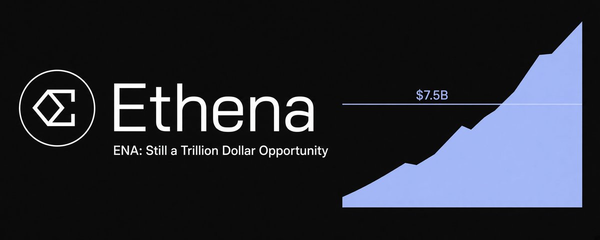
The ENA token will receive buybacks supported by Ethena’s revenue, triggered once USDe’s supply surpasses $7.5 billion, and scaled up as supply grows.
Since the crash last October, USDe has shrunk by two-thirds, but it falls outside the jurisdiction of the GENIUS Act, which prohibits regular stablecoins from paying yields—a factor that could aid its recovery.
Ethena is a project that has been active in crypto since early 2024, creating a quite unique synthetic stablecoin, USDe, using a novel mechanism involving hedging. Because of how distinctive it is, I’ve wanted to write about it for a long time.
With recent updates to ENA’s tokenomics and a major token unlock happening this week on October 5th, I think today might be the right time to write an article about Ethena, the USDe stablecoin, and the ENA token. If you want to learn more, read on.

Most people in the crypto space know USDC and USDT, the two largest stablecoins. For every token minted, they hold an equivalent $1 in cash or U.S. Treasuries somewhere within the TradFi system.
Ethena’s USDe operates differently. Instead of parking dollars in banks, it holds crypto assets alongside a hedging position designed to offset price fluctuations in those crypto assets. This is why Ethena calls it a “synthetic dollar,” even though most people simply treat it as another stablecoin.
Ethena launched on Ethereum in February 2024, founded by Guy Young, with early backers including crypto investment firms like Dragonfly and Galaxy Digital, BitMEX co-founder Arthur Hayes, and traditional asset management company Franklin Templeton.
One of the biggest differences is that, unlike USDC or USDT, USDe actually pays you yields. If you stake your USDe, you receive sUSDe, which currently offers an annual yield of around 4.8%.
Recently, major UK bank Standard Chartered began publishing research on Ethena. Large banks employ analysts to regularly publish reports and price forecasts on companies and assets their clients might invest in, so Standard Chartered starting this for a DeFi project is a big deal for the protocol!
Standard Chartered predicts USDe’s supply could grow approximately eightfold, rising from the current ~$5 billion to $40 billion by the end of 2028. This aligns with the stablecoin growth narrative we’re witnessing as TradFi and the crypto world continue to converge.

How It Works
Suppose someone deposits $100 worth of ETH to mint $100 of USDe. Ethena immediately opens an equally sized short position on ETH on a crypto exchange using perpetual futures. If you want to learn more, check out my previous discussion on perpetuals linked below.
Perpetual Futures and Leverage
If ETH’s price halves, ETH is now worth $50, but the short position earns $50, so the underlying collateral still totals $100. If ETH doubles, the opposite happens, and the total value remains $100. Regardless of ETH’s direction, the positions offset each other, keeping the dollar value constant!
Yields come from two sources:
Staking rewards generated from the underlying ETH.
Funding rates. In perpetual markets, when most traders bet on price appreciation, they periodically pay a small fee to the opposing side. Ethena sits on that opposing side, allowing it to collect these payments during bull markets.
This means the yield is genuine revenue generated from trading, and USDe is backed by real on-chain collateral, which you can verify directly on their website.
Holding USDe is simply holding dollars, while staking it into sUSDe gives you those dollars plus a share of the yield from the two sources above. Currently, about 60% of USDe is staked and earning yields.

However, yields fluctuate with market conditions. Funding rates averaged around 11% annually in 2024, but sit at roughly 5% now, which is why sUSDe’s yield dropped from double digits in its first year. Even today, 5% remains a solid yield.
Staking USDe into sUSDe is straightforward. Open the interface at app.ethena.fi, click the “Savings” tab, and you’ll see clear Stake or Unstake options to switch between USDe and sUSDe.
ENA is Ethena’s governance token. The total supply is 15 billion tokens, currently trading around $0.25.

For a while, ENA faced the same problem as many other tokens. Early investors were selling, and monthly token unlocks added further selling pressure. Holders also couldn’t see how the protocol’s revenue would actually flow back to them.

However, in August months ago, the Ethena Foundation announced a comprehensive overhaul to address this:
The foundation buyouts all the locked tokens held by the primary seed investors who have been dumping ENA since the October 2025 high.
Protocol ownership and the value it generates are transferred to the ENA-governed foundation, rather than remaining with Ethena Labs’ shareholders.
A “fee switch” activated once USDe’s supply exceeds $7.5 billion. From that point onward, a portion of Ethena’s revenue will be used to buy back ENA, starting at 5% and gradually increasing to 25% once supply surpasses $25 billion.
Monthly investor unlocks will be terminated. Instead, all remaining investor tokens are unlocked in a single batch on October 5th, leaving only about 12% of the supply still locked, including team, ecosystem, and foundation tokens.
By the way, if you’re not yet familiar with how token buybacks work and the incentives they create, I discussed that in a previous article here.

Token Buybacks
Ethena’s own projections show that assuming a 6% yield, annual buybacks would reach roughly $22.5 million when supply hits $7.5 billion, and rise to $135 million when supply reaches $15 billion. The $15 billion figure roughly corresponds to the peak level USDe reached last year. Ethena states the plan aims to support a return to that peak, with their ultimate goal of pushing USDe supply past $100 billion within five years!
While USDe is Ethena’s core business, the company also allows other protocols to issue their own stablecoins using its infrastructure. Just this week, EtherFi announced the launch of a stablecoin powered by Ethena. EtherFi is a crypto platform holding over $300 million in stablecoin deposits and over 100,000 active crypto debit cards.

Jupiter, MegaETH, and Sui have previously done the same. Once the fee switch flips, revenue generated from these additional stablecoins will also be funneled into buybacks.
This is why Standard Chartered’s price targets for ENA rely so heavily on USDe regaining momentum. The bank projects ENA will hit $0.42 by year-end, $1.10 in 2027, and $2.00 by the end of 2028.
The catch is that buybacks haven’t started yet. With USDe supply currently hovering around $5 billion, it needs to grow by roughly half before the fee switch activates. Ethena also stopped paying ENA incentives to USDe holders as of September 30th, meaning any future supply growth must come purely from organic yield growth, not token emissions.
Risks and the Crash
Ethena’s greatest risk is embedded within USDe’s yield. That yield relies on most traders betting on price appreciation, but in prolonged bear markets, funding rates can turn negative. When that happens, Ethena owes fees rather than collecting them, which is why it maintains a reserve fund specifically for such periods.
Ethena also relies on centralized exchanges, as all its hedging positions are held there. If a major exchange collapses or freezes withdrawals, some of Ethena’s hedged positions could become trapped.

Furthermore, when yields drop, capital tends to flee, supply contracts, and the narrative around the ENA token weakens accordingly.
The moment that dealt the biggest blow to USDe’s reputation occurred during the crash on October 10th last year, which I covered in a previous article here.
Cascading Liquidations
USDe plummeted to $0.65 on Binance while trading near $1 on other exchanges. The issue was entirely contained within Binance. It priced USDe using its own thin order book instead of deeper external markets, and because Binance users could use USDe as collateral, that artificially suppressed price triggered a wave of liquidations.
Two other tokens, BNSOL and Binance’s own WBETH, experienced identical price deviations on Binance.
Binance rolled out a fix for its pricing system ahead of schedule and paid out $283 million to compensate affected users. Ethena continued operating as intended, maintaining overcollateralization throughout and continuously redeeming every redeemed USDe at $1.
But none of that prevented the headlines from damaging sentiment.
Seeing a synthetic dollar drop to $0.65 was enough to shake confidence, leading to roughly $3 billion in redemptions. The post-crash market downturn exacerbated this, as dropping funding rates slashed yields and leveraged sUSDe positions across DeFi were simultaneously unwound. USDe supply has since fallen from its $14.8 billion peak to around $5 billion today.
Nevertheless, Ethena did exactly what it was supposed to do during its toughest test to date, honoring billions in redemptions at $1 per token for a crisis that wasn’t even caused by them.
Yield-Paying Stablecoins
The GENIUS Act is the U.S. stablecoin legislation passed last year, which prohibits regulated stablecoin issuers from paying interest to holders. This forced Circle and Coinbase to restructure USDC’s incentive model.
Stablecoin yields were precisely the focal point of the battle banks ignited during recent CLARITY negotiations, as they don’t want crypto firms competing for consumers’ deposits. This was also one of the reasons behind CLARITY’s failure, which I explained a few weeks ago.
But USDe isn’t a GENIUS stablecoin; because it’s a synthetic dollar as previously mentioned, it can legally continue paying yields!
Under current regulations, this is a genuine advantage; but if lawmakers decide to close this loophole, it also presents a tangible risk.
My assessment is that Ethena has already survived the stress tests critics expected to knock it out, and a dollar that pays market-rate yields is something legally regulated stablecoins cannot provide.
A dollar that natively produces yield is a hotly debated topic in TradFi banking circles, but it feels like a crucial component of where on-chain money is headed, and Ethena stands out today as the clearest example delivering exactly that.
Now that they’ve upgraded their tokenomics and a major bank is betting on their resurgence, I wouldn’t bet against them!
Join TechFlow official community to stay tuned
Telegram:https://t.me/TechFlowDaily
X (Twitter):https://x.com/TechFlowPost
X (Twitter) EN:https://x.com/BlockFlow_News
 @afoxinweb3