Ethena's Stablecoin Economics Gives Pay Neobank a Decisive Head Start
Authors: Alea Research
Edited by: TechFlow
TechFlow Insight: Ethena enters the neo-banking space with its native stablecoin USDe, where backing yield directly subsidizes user rewards, creating an additional moat in its economic model compared to competitors relying on USDC and third-party yields. Crucially, the ENA fee switch vote has passed. With USDe scale recovering and Pay introducing consumer scenarios, the token buyback mechanism now has a clear anchor.

Ethena enters the neo-banking sector as the issuer and backing asset manager for dollars held in accounts. This gives Pay a distinct economic advantage. Backing revenue funds the rewards, while payments give customers another reason to hold USDe. The approved ENA fee switch vote adds a clear buyback schedule as the dollar base expands.

Chart: Daily closing prices of ENA from August 1 to September 4, 2026, highlighting the August 27 fee switch proposal and September 1 Pay announcement. Source: CoinGecko; Event dates from Ethena.
Pay allows a mature dollar issuer to establish a direct relationship with customers, reducing reliance on partners to distribute USDe.
Users receive self-custody accounts, virtual IBANs, and card payment capabilities, with promotional balance rewards of up to 6% and cashback of up to 5%. Tiered caps and qualified transaction conditions apply.
USDe supply reached $4.33 billion on September 4, increasing by $436 million over 30 days, or +11.2%. Pay adds a consumer-facing channel to the recovering dollar base.
The ENA fee switch vote passed with 17.79 million votes in favor and zero against, comprising 88 total votes. The first revenue tier kicks off at a $7.5 billion USDe supply.
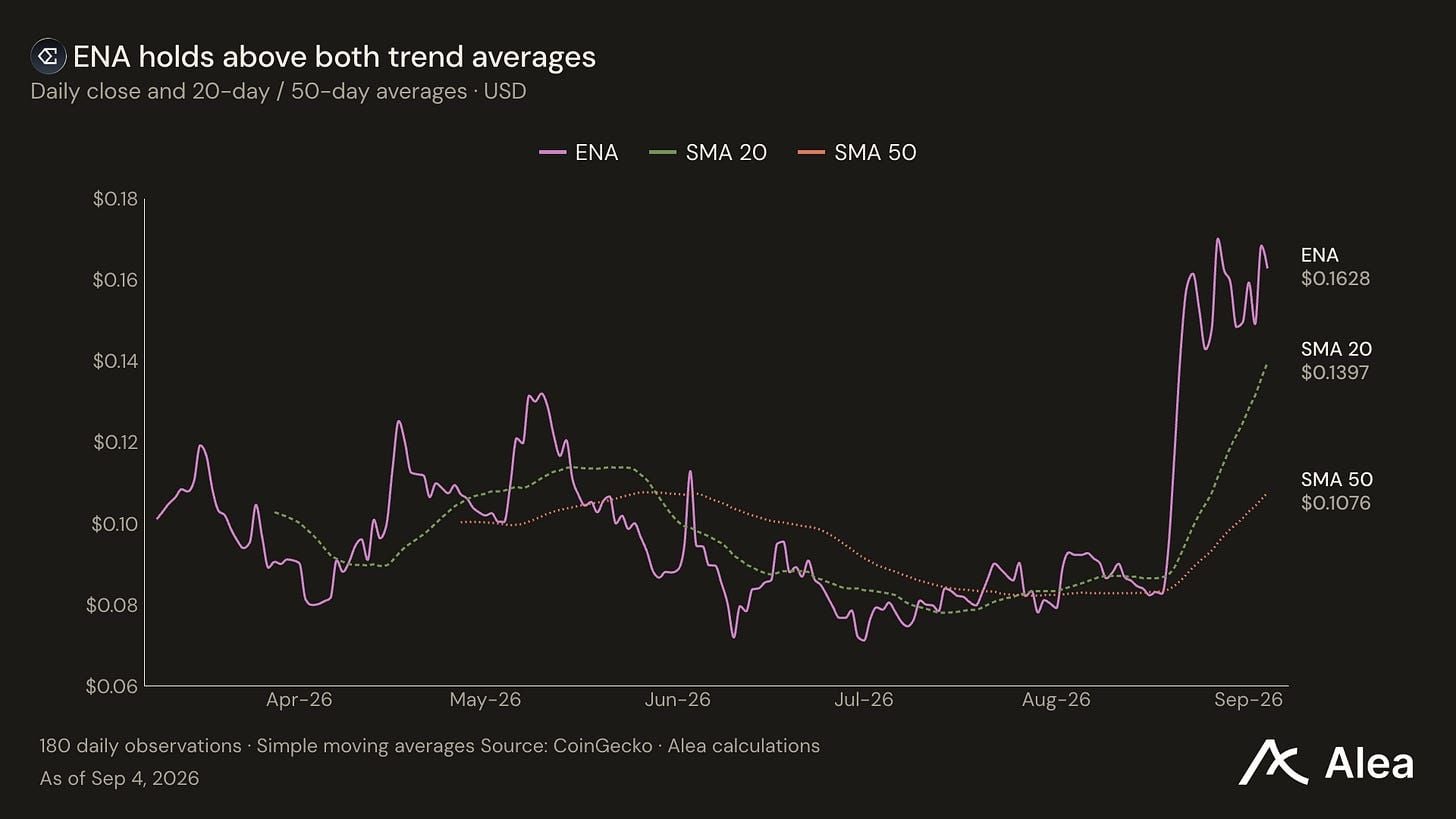
Chart: Daily closing prices of ENA as of September 4, 2026, alongside 20-day and 50-day simple moving averages. Source: CoinGecko; Calculations by Alea.
Ethena Controls the Economic Foundation Behind the Account
Ethena Pay launched its iOS version in nearly 50 countries. It integrates a self-custody wallet, virtual IBAN, card payment capabilities, and instant peer-to-peer transfers. Ethena plans to expand to Android, the United States, the European Union, and multi-currency support in September.

Chart: Official diagram of Ethena Pay, showing example account balances and deposit and send operations. Source: Ethena launch announcement, viewed September 5, 2026.
Every deposit into Pay converts to USDe. Ethena allocates its backing assets across stablecoin liquidity, DeFi lending, hedged crypto positions, institutional borrowing, and tokenized credit. On September 5, Ethena reported $4.37 billion in backing assets plus $62.1 million in reserves, covering 101.97% of the USDe supply.

Chart: USDe backing allocation as of September 5, 2026: Liquid stablecoins 30.3%, DeFi lending 30.3%, Crypto basis 16.7%, Tokenized credit 11.6%, Institutional borrowing 11.2%. Source: Ethena collateral breakdown. Reserves excluded separately.
No competitor in the crypto neo-banking space issues its own underlying stablecoin. Most rely on USDC or USDT, as well as third-party protocols for yield generation. Ethena, however, retains its own dollar-related backing revenue and decides how much to allocate toward customer rewards and acquisition.
Ethena has published promotional tiers. Balance rewards include a base yield plus promotional bonuses. AVAX cashback starts at 4% on the first $2,500 of monthly spending for the Standard tier, 4.5% on the first $8,000 for Pro, and 5% on the first $20,000 for VIP. Cashback rates are lower for subsequent spending brackets.

Chart: Annual promotional balance rewards for Ethena Pay as of September 5, 2026: Standard tier offers up to 5% on balances up to $5,000; Pro up to 6% on balances up to $15,000; VIP up to 6% on balances up to $50,000. Requires monthly qualified card spending. Source: Ethena pricing.
Pay Provides a Consumer Use Case for USDe
The monthly supply recovery of +11.2% comes after a significant contraction. USDe remains down 65.6% year-over-year and 70.8% below its October 2025 peak of $14.82 billion. As circulating volume rebounds, Pay introduces a fresh consumer use case.

Chart: USDe supply from March 2025 to September 4, 2026, highlighting the October 2025 peak and the $7.5 billion first fee tier. Source: Ethena.
Dollars received, held, and spent within Pay serve a different purpose than balances shifted between yield-generating activities. The opportunity lies in recurring transactional balances outside of investment demand. Transfers of existing USDe merely change distribution, while net new inflows expand issuance.
Equity Perpetual Contracts Expand the Yield Engine
The Ethena Risk Committee released an equity basis framework on August 28: holding tokenized equities and shorting their corresponding perpetual contracts. This extends the hedging model beyond crypto prices and funding rates. HIP-3's equity market broadens the scope of tradable venues, advancing alongside liquidity development.
The framework tallied $2.9 billion in one-way equity perpetual open interest across four venues as of August 26. Initial screenings identified 17 Binance tickers and 3 OKX tickers. Actual position caps are determined by the tightest constraint among open interest, trading volume, token float, and two-leg executable depth.

Chart: Illustration of equity basis depth caps for 20 hypothetical non-overlapping positions. Assuming single-position depths of $500k, $2M, and $10M respectively, the total caps under half-depth constraints would be $5M, $20M, and $100M, excluding other restrictions. Source: Ethena Risk Committee sizing rules; Alea scenario inputs.
Deeper matching markets expand the capacity of this strategy. At a 7% annualized spread, deploying $100 million contributes $7 million before costs. The Binance basket spread narrowed from 18% in late July to approximately 7% on August 26, a relative decline of 61%. Additional venues diversify opportunities; liquidity and spreads dictate their economic scale.
ENA Linkage Approved
The fee switch vote concluded on September 2, passing with 17.79 million votes in favor and zero against, comprising 88 total votes. The approved plan allocates 5% of protocol revenue to ENA when USDe supply hits $7.5 billion, rising to 10% at $10 billion, 15% at $15 billion, and 20% at $20 billion. Upon activation, the foundation will commit 95% of qualified net revenue to ENA buybacks.
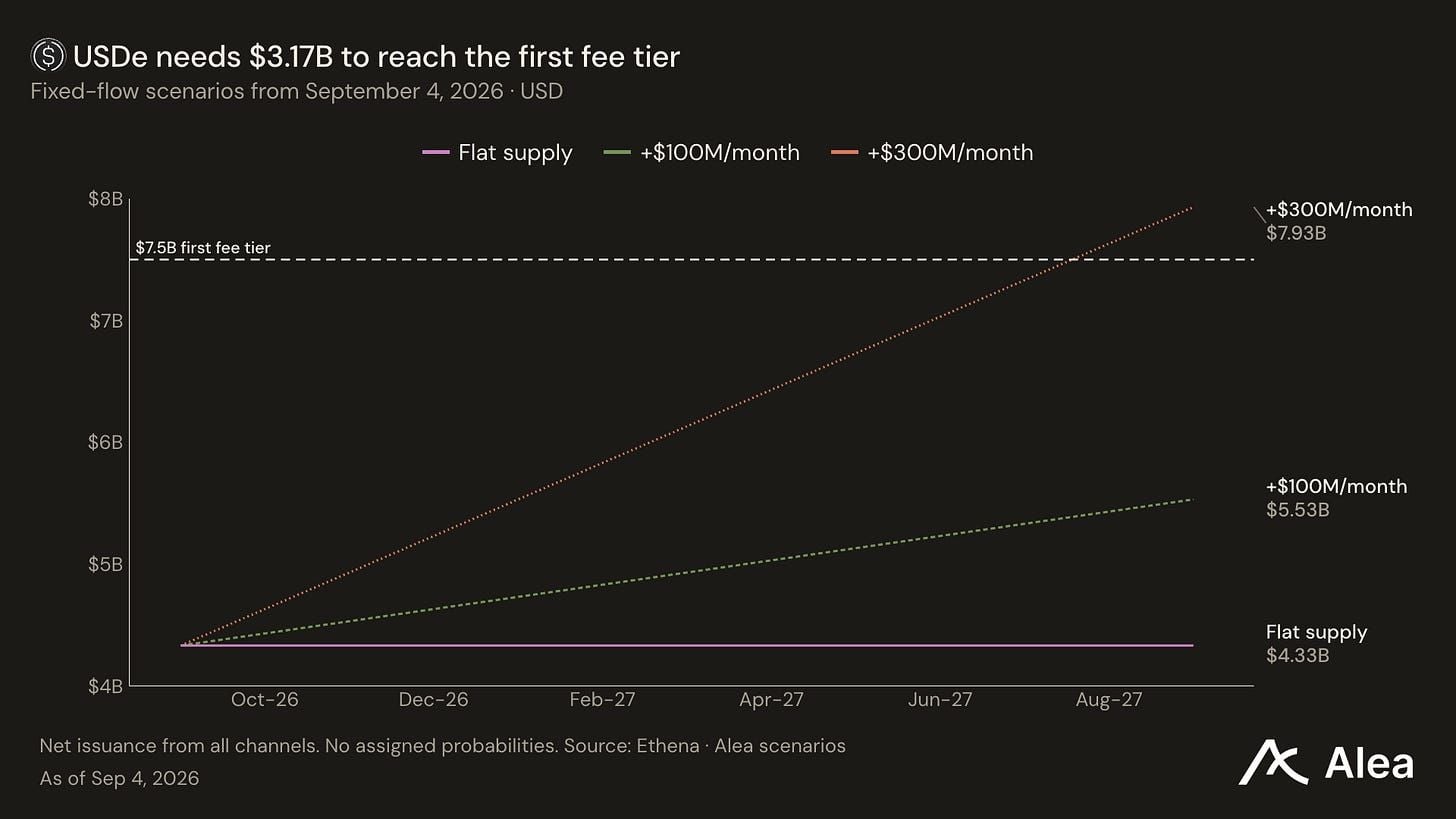
Chart: USDe supply path scenarios benchmarked at September 4's $4.33 billion: flat supply, $100M monthly net issuance, $300M monthly net issuance. Highlights the $7.5 billion first-tier fee threshold. Source: Ethena; Alea scenario analysis.
With ENA's circulating market cap at $1.6 billion against $4.33 billion in USDe, the ratio of dollar supply to token value stands at 2.71x. At the $7.5 billion first-tier fee threshold, a 4.6% underlying yield implies $345 million in annual total revenue and a $17.25 million foundation allocation.
Holding ENA's market cap constant, annualized underlying yields of 3%, 4.6%, and 6% correspond to foundation annual allocation multiples of 142x, 93x, and 71x, respectively. Higher profitability compresses these multiples without requiring a rise in token price.
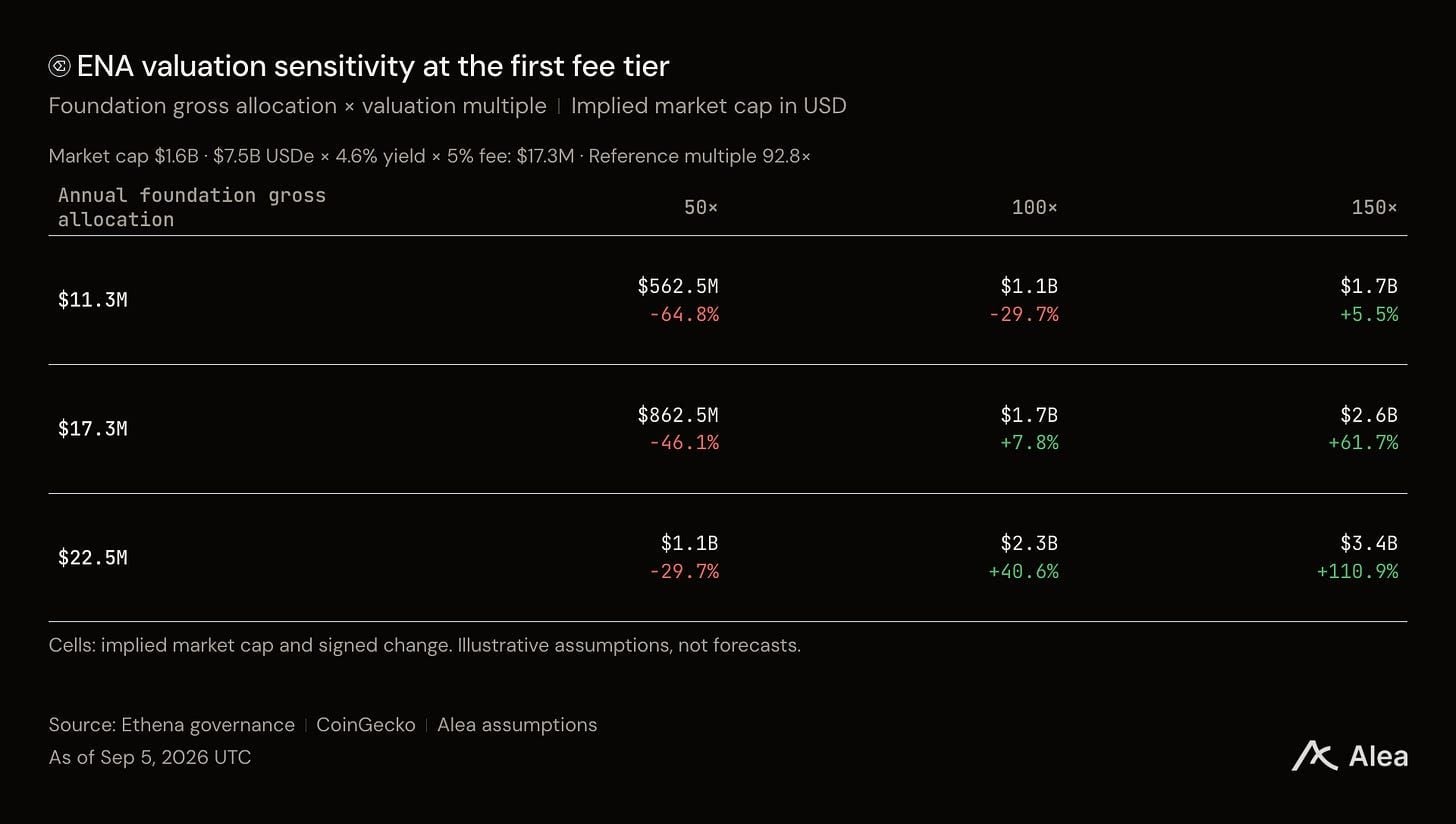
Chart: Valuation sensitivity for ENA under $7.5 billion USDe supply. Total annual foundation allocations of $11.25M, $17.25M, and $22.5M multiplied by assumed valuation multiples of 50x, 100x, and 150x. Table compares implied market cap to ENA's $1.6 billion reference market cap. Source: Ethena governance, CoinGecko, and Alea assumptions.
Underlying revenue flows to the protocol first. The fee table allocates a portion to the foundation; buybacks utilize 95% of post-deduction qualified net revenue. Total allocations do not constitute cash flow for token holders.
Pay provides Ethena with a customer acquisition budget backed by its own dollar revenue and a direct channel for balance retention. This combination strengthens its position relative to third-party stablecoin distributors. More recurring balances expand the yield base, and the approved fee table provides a clear pathway from this growth to ENA buybacks.
Join TechFlow official community to stay tuned
Telegram:https://t.me/TechFlowDaily
X (Twitter):https://x.com/TechFlowPost
X (Twitter) EN:https://x.com/BlockFlow_News
 @AleaResearch