JPMorgan Research Report Analysis: SpaceX Targets 13-GW Computing Power, Eyes 500 Billion ARR
By Rita
SpaceX (SPCX) reported Q3 revenue up 161% year-over-year and 87% quarter-over-quarter. The rated compute target was raised from 5 to 10 gigawatts to 13 gigawatts. Capex for 2027 increased from approximately $200 billion to approximately $300 billion. In its report dated October 21, 2026, JPMorgan raised its price target from $240 to $500. This move addresses a key bet: whether compute expansion and Vera Rubin commercialization can support annual recurring revenue (ARR) of $500 billion to $1 trillion by the end of 2027.
JPMorgan maintains a bullish long-term outlook while acknowledging execution conditions. The report raises the total revenue forecast for 2027 to $254 billion, corresponding to approximately $400 billion in year-end ARR. Management's target is $500 billion to $1 trillion. JPMorgan's forecast sits below management's upper bound but above previous models.
The realization of this bet hinges on four key drivers: compute expansion, commercialization value, capital expenditure, and aerospace and connectivity businesses.
Compute Target Raised to 13 Gigawatts
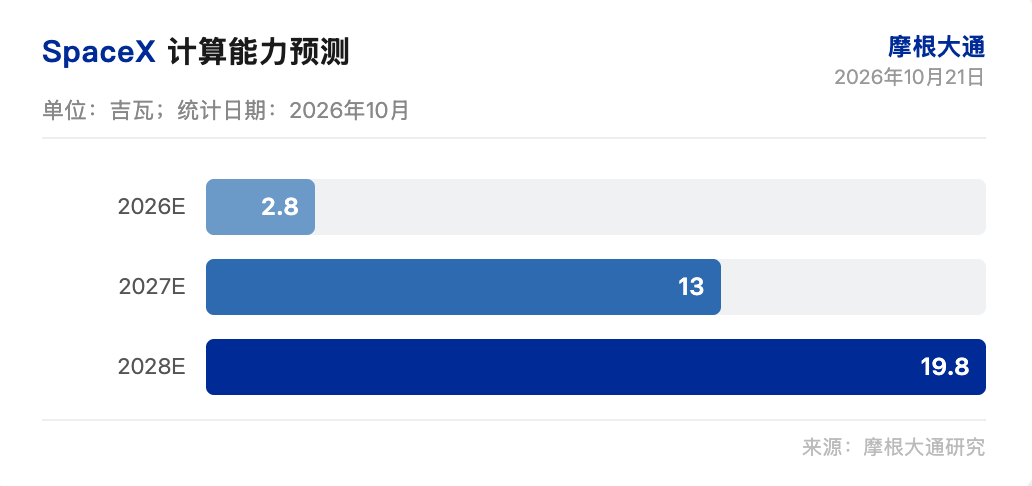
At the end of Q3 2026, SpaceX's rated compute stood at 1.7 GW. It rose to 2.2 GW by late October, reaching 2.5 to 3.0 GW by year-end. JPMorgan forecasts 2.8 GW at year-end. An additional 10 GW will be added in 2027, almost entirely utilizing the Vera Rubin architecture. Total rated compute will hit 13 GW by the end of 2027, and 19.8 GW by the end of 2028.
Around 200,000 new GPUs will be added monthly through the remainder of 2026, with approximately 600,000 GPUs added in Q4. Q4 will bring 1.1 GW of capacity online. By the end of Q2 2027, 440,000 Vera Rubin GPUs will be deployed. Musk described this cluster as "the world's most powerful training cluster."
Power and cooling infrastructure could scale up to 20 GW, with a small fraction converted into compute power. Musk emphasized that the company's advanced casting technology for gas turbine blades and guide vanes enables faster grid connection than industry peers. SpaceX is also considering wind and solar energy, alongside modular compute deployment solutions.
Vera Rubin Premium Drives Monetization
The commercialization value of Vera Rubin is approximately 40% higher than the top-tier GB300 systems. Current commercialization value per GW ranges from $30 billion to $50 billion. Management believes compute pricing is slightly above the high end of the $30 to $50 per watt range, attributing a premium to the Vera Rubin architecture. Short-term new cloud contract pricing exceeds $50 per watt.
SpaceX aims to allocate 50% of compute internally and 50% externally, with the ratio adjustable to 60/40. At compute costs slightly above $50 per watt, newly deployed computing resources break even within one year. There is still profit margin when customers renew contracts. Management noted that if it accepts all requests, the company can reuse its compute capacity multiple times. Compute demand does not pose a constraint.
The goal of $500 billion to $1 trillion in ARR by the end of 2027 depends on rapid compute deployment and efficient Vera Rubin commercialization. JPMorgan forecasts total revenue of $254 billion for 2027, with year-end ARR reaching approximately $400 billion.
Capital Expenditure Rises to $300 Billion
Q4 2026 capex is expected to be between $35 billion and $40 billion, compared to the prior estimate of $19 billion. 2027 capex rises from approximately $200 billion to approximately $300 billion. JPMorgan's practical calculation projects 10 GW by the end of 2027, below management's 13 GW target. Construction costs exceed $30 billion per GW, while competitors exceed $50 billion per GW. Cost savings primarily come from data center construction rather than GPUs.
The investment cycles for Starship, Starlink, and the compute business from 2026 to 2030 will result in over $300 billion in negative free cash flow. Positive free cash flow is only expected starting in 2031. The company already has over $85 billion in IPO proceeds and $25 billion in debt financing. Management explicitly stated it does not consider equity financing. Debt funding has multiple channels, and operating cash flow will play a larger role as commercialization improves.
Power, cooling, and infrastructure constraints are more severe than chip constraints. SpaceX targets achieving 20 GW of power capacity by the end of 2027.
Starship and Starlink Provide Support
Starship Flight 15 will attempt to simultaneously capture both the Super Heavy booster and the upper-stage Starship. The mission will likely execute in November. While SpaceX has successfully recovered the Super Heavy booster three times, capturing the Starship itself is a first. This is a key milestone for fully reusable rockets. Starship flight frequency will reach once per week in the first half of 2027, and once every two weeks in the second half.
Starlink added 1.6 million users in Q3, bringing the total to 13.6 million. Consumer ARPU reached $69, up 5% quarter-over-quarter. V5 terminal mass production is accelerating, leading to increased activations in Q4. JPMorgan forecasts net additions of 2.2 million consumer broadband users in Q4 with an ARPU of $66. User net additions are projected at 11.5 million for 2027, with ARPU dropping to $55.42.
Mobile Starlink service is set to launch in early 2028, with satellite deployment being the primary constraint. Following SpaceX's acquisition of Grain Corp.'s 800MHz low-band spectrum, satellite deployment has become the main obstacle to rolling out services in the U.S. Ground macro bases remain necessary to compete with the three major legacy carriers. Flight 14 carried 26 V3 satellites, and management expects the number of satellites per Starship mission to double over time.
JPMorgan maintains an Overweight rating with a $500 price target, based on a 20x valuation multiple applied to 2028 GAAP EPS of $24.41. The upward revision from $240 reflects higher earnings forecasts and lower valuation multiples. The $500 billion ARR target materializes only if the three variables—13 GW compute, Vera Rubin premium, and $300 billion capex—are all realized simultaneously.

Disclaimer
This article is compiled and interpreted by Chaoxiang Research based on third-party brokerage research reports (JPMorgan, October 21, 2026), combined with public market information. The ratings, price targets, earnings forecasts, and related judgments cited herein represent the views of the brokerage's analysts, solely reflecting their institutional stance, and do not represent the views of Chaoxiang Research, nor do they constitute any investment advice.
Markets carry risks; decisions must be independent. This article should not serve as the basis for buying or selling any securities.
Join TechFlow official community to stay tuned
Telegram:https://t.me/TechFlowDaily
X (Twitter):https://x.com/TechFlowPost
X (Twitter) EN:https://x.com/BlockFlow_News
 @chaoxiangooo