ArkStream Capital: Гид по возрождению крипто-венчура — почему так сложно обогнать BTC
Как давно вы не слышали слово «Web3»? Откат от нарратива «Web3» к нарративу «криптовалют», и институциональные инвесторы криптовалютного рынка переживают масштабную перетасовку. Мы были прямыми свидетелями всего этого.
Результатом «отката нарратива» стало то, что биткоин и Ethereum постоянно обновляют исторические максимумы, а сезон альткоинов так и не наступает. Держание монет в ожидании роста может быть лишь красивым желанием. Более суровая реальность такова: начиная с 2022 года тотальное снижение доходности инвестиций на первичном рынке непрерывно бьет по венчурным капиталистам и инвесторам, исповедующим «теорию винтажного финансирования». В этой статье мы систематизируем данные о финансировании и рыночные структурные изменения за период с начала 2022 года по второй квартал 2025 года, чтобы раскрыть глубинные причины резкого перехода криптопервичного рынка от пикового процветания к сокращению доходности.
Мы пытаемся ответить на два ключевых вопроса:
1. Какие трудности сейчас испытывают крипто-VC?
2. Как инвестиционным фирмам следует участвовать на этом рынке в рамках новой циклической логики?
В качестве долгосрочных участников первичного рынка ArkStream Capital мы наблюдаем следующее: с пика 2022 года рынок пережил резкое сокращение капитала и охлаждение активности по привлечению финансирования, достигнув дна в 2023 году. Несмотря на некоторое восстановление общих объемов финансирования в первом квартале 2025 года, прирост был сосредоточен на немногих сверхкрупных раундах. Исключив эти аномальные случаи, можно заметить, что активность рынка остается низкой.
Параллельно происходит изменение стратегий и предпочтений венчурного капитала:
-
Инвестиционные стадии смещаются от ранних к поздним, а склонность к риску заметно снижается: данные показывают, что доля ранних этапов финансирования (Seed и PreSeed) длительное время в период с 2022 по третий квартал 2023 года поддерживалась на высоком уровне свыше 60% (с пиком до 72,78%), но затем начала колебаться вниз. К первому кварталу 2025 года доля количества сделок раннего финансирования впервые с 2022 года упала ниже 50%, составив 47,96% .
-
Нарративы сместились с таких применений, как Social / NFT / Game, в сторону акцента на полезность и долгосрочную ценность в областях DeFi, инфраструктуры и RWA. Сравнение второго квартала 2022 и второго квартала 2025 годов показывает обвальное падение финансирования NFT / Games / Social со 129 сделок до 15; в то же время инфраструктура / DeFi / CeFi во втором квартале 2025 года уже совместно занимали 85,8% всех траншей финансирования (97 из 113), став абсолютным ядром рынка.
-
Модель высокой FDV подвергается опровержению рынком: анализ 75 сделок показал, что количество проектов с доходностью выше 10x от пиковых значений обрушилось с 46 случаев до всего 6; одновременно текущая оценка 24 сделок (32%) и 18 проектов (42,85%) уже опустилась ниже цены приватной сделки.
-
Даже «эффект листинга» Binance теряет силу, «резкий скачок с последующим падением» становится нормой: данные показывают, что хотя в 2024 году все еще 25 проектов показали первый дневной рост более чем в 10 раз, к 2025 году количество проектов, чья цена после листинга упала ниже цены размещения через 7 дней, резко возросло до 42. Это свидетельствует о том, что модель драйва оценки исключительно за счет поддержки топ-бирж больше не работает.
-
Несмотря на удлинение цикла от привлечения финансирования до TGE, это не приводит к повышению вероятности успеха: данные показывают, что среди более чем 17 000 активов, записанных в Coingecko, торговый объем активов, находящихся вне топ-1500, практически равен нулю, а даже уровень провала проектов, профайнancedых топовыми VC, такими как Polychain Capital, достигает 26,72% .
-
Логика инвестиций VC в криптопервичный рынок перестала работать: в суровой реальности, когда 77% проектов не выпускают токены, лишь 5,5% топовых проектов выходят на Binance. Однако средняя доходность этих топовых проектов составляет всего 2–5x, что далеко недостаточно для покрытия убытков от других 94,5% провалившихся инвестиций и даже не достигает минимально требуемой модели возврата в 4,3x, делая портфель математически нерентабельным.
Примечание: Результаты соответствующего анализа данных основаны на примерах инвестиций топ-крипто-VC из США и Европы на ведущих биржах. Выбранная выборка репрезентативна, но не охватывает всю отрасль подробно, см. далее.
Мы считаем, что эта волна снижения доходности является не только результатом ликвидности в цикле повышения процентных ставок, но и отражает фундаментальный сдвиг парадигмы первичного крипторынка: переход от стимулирования оценки к стимулированию стоимости, от стратегии «распыления удара» к акценту на определенность, от следования нарративам к ставке на исполнение. Понимание и адаптация к этим изменениям парадигмы, вероятно, станут необходимым условием для достижения избыточной доходности в будущих циклах.
Обзор данных первичного рынка: Эволюция популярности и циклов
Общий обзор финансирования глобального первичного крипторынка
Данные о финансировании на первичном рынке являются стандартом измерения того, готов ли рынок платить за инновационные идеи. Чем выше показатели финансирования, тем больше рискованного капитала готов инвестировать в будущее развитие этой отрасли. Будь то комбинаторный LEGO децентрализованных финансов (DeFi), или видение Web3, пропагандирующее данные, которые можно «читать, записывать и владеть», или инфраструктура, постоянно совершенствующаяся в области защиты конфиденциальности, распределенного хранения и масштабируемости — все они зависят от непрерывных ставок рискованного капитала на этот рынок. Наряду с рискованным капиталом приходит приток талантов, и расцвет первичного рынка часто проявляется именно в непрерывном потоке людей, которые создают инновации и предприятия в этой отрасли.
Эти данные достигли пика в первом квартале 2022 года, когда объем финансирования за квартал составил внушительные 12,4 миллиарда долларов США при 588 сделках. Однако после этого рынок стремительно развернулся вниз, войдя в продолжительный нисходящий цикл, где как общий объем финансирования, так и активность начали снижаться. К четвертому кварталу 2023 года объем финансирования за квартал упал до 1,9 миллиарда долларов США, а количество сделок сократилось до 255, достигнув дна цикла. Несмотря на небольшой подъем в 2024 году, весь рынок по-прежнему остается на низком уровне.
Финансовые данные первого квартала 2025 года визуально демонстрируют признаки восстановления: общий объем финансирования за квартал вырос до 5,2 млрд долларов США, а количество сделок увеличилось до 271. Однако это «восстановление» трудно выдержать при детальном анализе. Стратегическая инвестиция суверенного фонда Абу-Даби MGX в Binance (около 2 млрд долларов США) в этом квартале составила более 40% от общего объема, представляя собой выброс, обусловленный одним событием. Кроме того, ICO проекта World Liberty Financial на 550 млн долларов также значительно подняло общие показатели. Если исключить указанные сверхкрупные раунды, фактический объем финансирования крипто-проектов в первом квартале составил всего около 2,65 млрд долларов США. Во втором квартале 2025 года тенденция к снижению продолжалась. Финансирование таких проектов, как SharpLink, BitMine, Digital Asset и World Liberty Financial, требует отдельного рассмотрения и не должно восприниматься как норма крипто-венчурного рынка. Можно увидеть, что начиная с первого квартала 2025 года между крипто-венчурным капиталом и капиталом традиционных финансов возник явный раскол: крипто-венчурный капитал продолжает сокращаться, тогда как традиционные финансовые институты активно входят в рынок, широко реализуя свои интересы на рынке акций. За видимым ростом скрывается ускоренное сосредоточение капитала в проектах с низким аппетитом к риску, и общая активность венчурных инвестиций на рынке все еще не восстановилась по-настоящему.
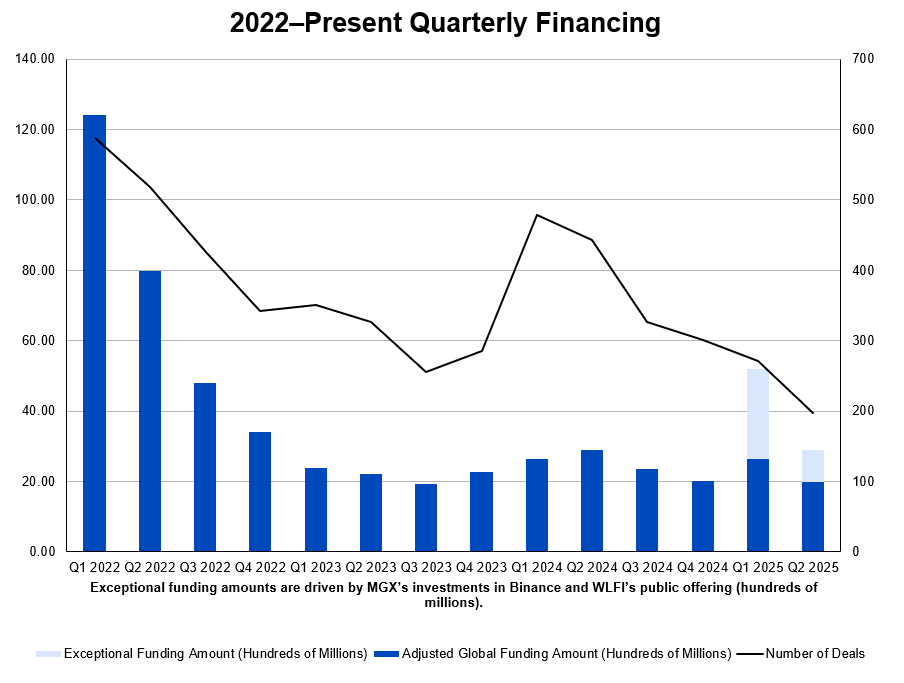
Рис.: Ежеквартальное финансирование 2022 г. – настоящее время
Источник данных: панель данных RootData о финансировании
Такая тенденция к снижению имеет четкую отрицательную корреляцию с долей биткоина на рынке. Биткоин пережил значительный рост с начала 2023 года, однако активность финансирования на первичном рынке не отразила этот синхронный подъём, нарушив установленную в прошлых циклах закономерность, согласно которой рост цены BTC приводил к разогреву венчурного капитала.
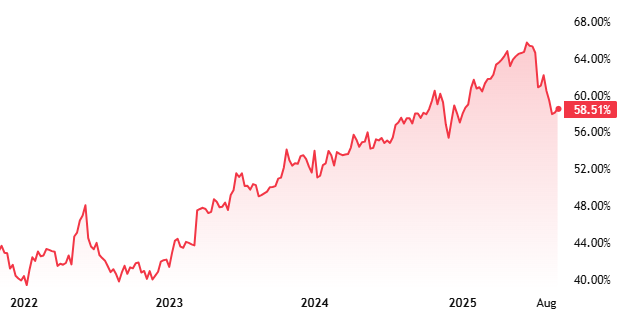
Рис.: Доля капитализации Bitcoin (Dominance) с 2022 года по настоящее время
Это означает, что изменение теплового фона рынка альткоинов больше не управляется исключительно ценой биткоина. Напротив, по мере роста капитализации BTC уверенность рынка в альткоины непрерывно теряется. Падение 2022 года отражало макроэкономическое отступление, а дно 2023 года символизировало крах рыночной уверенности. Восстановление в первом квартале 2025 года было движимо скорее отдельными проектами со стратегической ценностью или надежной финансовой защитой, что знаменует переход первичного рынка в новую стадию «избранной концентрации». Эпоха «буйного цветков» осталась позади, волна с маяком в виде нарратива «Web3» уходит в прошлое.
Для VC это означает, что эпоха стратегии «распыления удара» уходит. Переоценка определенности, усиление фильтрации по фундаментальным показателям и оценка путей выхода становятся новой парадигмой. На фоне общего снижения доходности, роста биткоина и отсутствия притока сопутствующего капитала, VC больше не могут полагаться на естественный подъем макроэкономического бычьего рынка. Вместо этого фокус должен быть смещен на технологические барьеры, устойчивость бизнес-модели и реальную пользовательскую ценность, чтобы удовлетворить более высокие требования инвесторов к стабильной доходности.
Анализ активности инвестирования ведущих институциональных фондов
На фоне общей среды, не соответствующей ожиданиям, чтобы выжить, VC, продолжающие работу на крипто-рынке, вынуждены менять тактику, переходя от «множества дорог, ведущих к Риму» к поиску более предсказуемых, фиксированных моделей действий.
Во-первых, предпочтения в раундах инвестирования смещаются от ранних стадий к более поздним проектам. В первом квартале 2025 года доля ранних раундов впервые упала ниже 50%, что стало первым поворотным моментом с 2022 года. Это изменение свидетельствует о том, что в условиях все более неопределенных путей выхода и доминирования крупных проектов над ресурсами, предпочтения институций к «определенности» заметно выросли. Они всё чаще направляют средства в зрелые проекты с подтвержденным продуктом и понятными источниками доходов. При этом доля сделок на этапах PreSeed и Seed снижается, хотя остается в относительно здоровом диапазоне, что указывает на сохранение ранней entrepreneurial активности, но при значительно повышенных порогах для сбора средств.
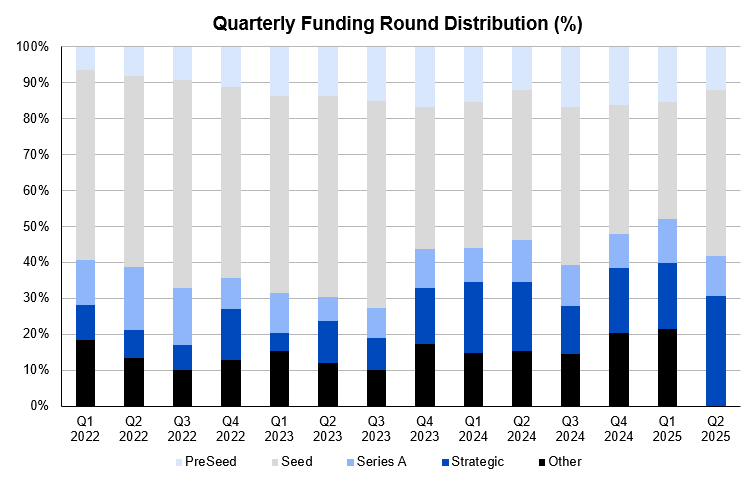
Рис.: Распределение раундов финансирования по кварталам (%)
Источник данных: записи о финансировании из базы RootData, сгруппированные по кварталам и раундам
Во-вторых, предпочтения в секторах инвестирования становятся более сфокусированными. Начиная с первого квартала 2024 года, доля проектов в таких крипто-нефинансовых приложениях, как Social, Games, NFT и DAO, впервые упала ниже 50%, что ознаменовало закат нарративов, driven «концепциями». Им на смену вернулась доминация секторов DeFi и инфраструктуры, которые делают больший акцент на практическую ценность протоколов и способность генерировать устойчивую выручку. Внимание капитала смещается с ToC нарративов в сторону платформенных проектов с ToB бизнес-моделью. При этом сектор CeFi, несмотря на низкую заметность в текущих рыночных нарративах, по-прежнему удерживает высокие объемы финансирования, что отражает постоянное одобрение капитала для бизнеса, интенсивно потребляющего денежный поток.
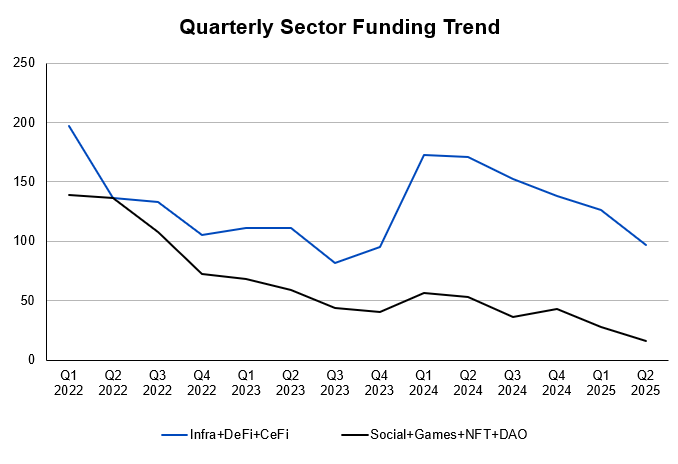
Рис.: Тренд финансирования по секторам (по кварталам)
Источник данных: количество траншей по секторам из базы RootData
Еще одним следствием смены инвестиционных предпочтений стало резкое сужение спектра доступных путей для предпринимателей. Если раньше创业 в крипто-индустрии напоминало открытый экзамен, то теперь это похоже на письмо по заданному вопросу, где доступны лишь варианты Infra, DeFi и RWA. Финальным состязанием становится способность пробиться сквозь красный океан уже устоявшихся бизнес-моделей.
Для VC эта тенденция означает необходимость строго согласовать систему исследований рынка с изменениями в структуре отрасли, динамически перераспределяя время и ресурсы, и отдавая приоритет проектам, способным к глубокому захвату стоимости, а не к сбору краткосрочного трафика.
Анализ жизненного цикла проекта и окон выхода
TGE проекта и FDV
Описание данных по проектам: Данный анализ базируется на примерах инвестиций топ-крипто-VC из США и Европы на ведущих биржах, включая такие институты, как a16z, Coinbase Ventures, Multicoin Capital, YZi Labs, OKX Ventures, Polychain Capital, Paradigm и Pantera Capital. (Исходные данные см. в прилагаемой таблице VC Investments, VC-Backed Listings on Binance: Spot Returns, VC-Backed Listings on Binance: Spot Returns Pivot)
Критерии отбора данных:
-
Приоритет по количеству сделок: Один и тот же проект может пройти несколько раундов финансирования, при этом оценки на разных этапах существенно различаются, напрямую влияя на возврат инвестиций. Поэтому разные раунды финансирования одного проекта рассматриваются как независимые транши инвестиций для более точного отражения деятельности.
-
Приоритет проектов на Binance: Будучи одной из крупнейших в мире бирж, Binance обладает широкой ликвидностью и рыночным покрытием. Для более полной картины рыночной динамики в качестве «звездных» проектов учитываются только те, которые вышли на спотовую торговлю на Binance.
-
Точность данных: Инвестиции, раскрытые после выпуска токенов, классифицируются как OTC (внебиржевые сделки) и не включаются в категорию венчурного капитала для обеспечения точности и согласованности статистики.
-
Исключение недостаточных измерений: Проекты, не раскрывшие суммы инвестиций и оценки, исключены из расчета из-за отсутствия необходимых измерений.
В криптопервичном рынке система оценки стоимости проектов является ключевой переменной, влияющей на коэффициент возврата для VC. Особенно показательна рыночная динамика цены токена после TGE (Token Generation Event — событие генерации токенов), ставшая главным индикатором эффективности выхода. Однако в текущем цикле механизм融资 через оценку проекта или FDV (Fully Diluted Valuation — полная разводненная оценка), который десятилетиями доминировал в крипто-индустрии, перестал быть эффективным. Это превратило инвестиции, способные ранее принести десяткособ или даже соткособную账面收益 в ultimately marginal.
Тем временем провал проектов остается нормой как для традиционных, так и для крипто-VC. Для венчурных фондов достаточно, чтобы несколько «звездных» проектов обеспечили высокую доходность, чтобы значительно поднять общую прибыль фонда. Поэтому внешний стандарт оценки работы VC определяется не成功率 успешных инвестиций, а способностью захватить именно те самые звёздные проекты.
Анализируя данные проекта после листинга, начальную FDV, максимальную FDV и текущую FDV, а также сопоставляя их с открытой информацией о первоначальных затратах институциональных инвесторов, мы дополнительно рассчитали результаты возврата инвестиций этих фондов.
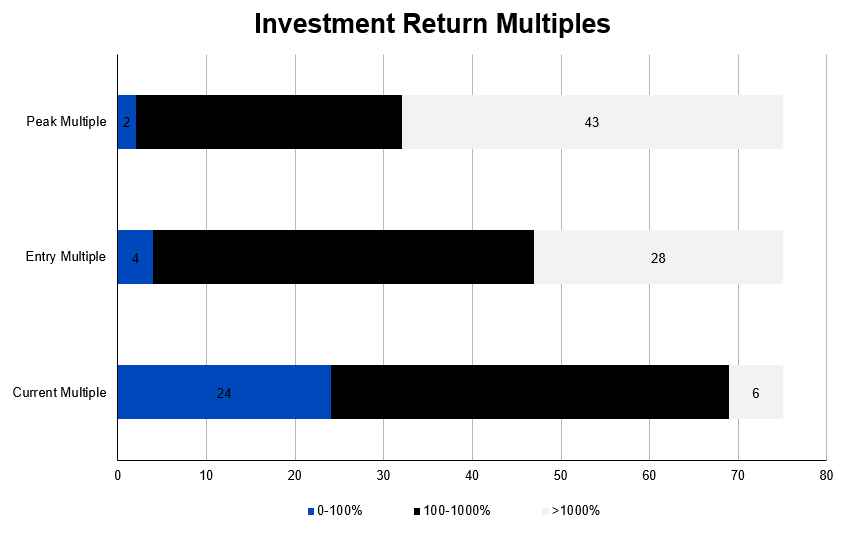
Рис.: Множители возврата инвестиций
График выше демонстрирует рыночную производительность проектов основных VC после выпуска токенов, вскрывая серьезность текущей ситуации с доходностью инвестиций. Подсчет соотношений Начальная FDV / Оценка приватной сделки, Максимальная FDV / Оценка приватной сделки и Текущая FDV / Оценка приватной сделки ясно показывает, что相当数量的投资案例对应项目当前FDV已低于,甚至远低于私募估值. Одновременно количество проектов с сверхдоходами (относительно начальной и максимальной FDV) демонстрирует резкое снижение с течением времени.
Статистические результаты показывают, что среди 75 инвестиционных траншей и 42 проектов (подробные данные см. в приложении):
-
71 транш / 40 проектов имеют соотношение Начальная FDV / Приватная оценка выше 100%, из которых 28 траншей / 18 проектов показали доходность Начальной FDV свыше 1000%;
73 транша / 41 проект имеют соотношение Максимальная FDV / Приватная оценка выше 100%, из которых 46 траншей / 29 проектов показали доходность Максимальной FDV свыше 1000%.
Однако в настоящее время лишь 6 инвестиционных траншей и 4 проекта превысили 1000% по соотношению Текущая FDV / Приватная оценка, в то время как 24 транша и 18 проектов уже опускаются ниже 100%, составляя 32% и 42,85% соответственно. Это означает, что почти треть инвестиционных траншей и более двух пятых проектов сегодня демонстрируют рыночную производительность, которая даже не соответствует ожидаемой оценке этапа приватной сделки.
Примечательно, что даже некоторые «звездные» проекты, листингуясь на самой ликвидной бирже Binance, не могут обеспечить рыночную производительность, сопоставимую с высокими оценками этапа приватной сделки. Этот феномен отражает жесткие вызовы, которые текущая рыночная среда представляет для оценки проектов, и подчеркивает давление на снижение дохода инвесторов.
Кроме того, учитывая общепринятый на ведущих биржах период замещения «1+3» (один год блокировки с линейной разблокировкой в течение трех лет), итоговая сумма, которую VC смогут вывести, будет весьма ограничена. Это дополнительно доказывает, что, несмотря на высокие рыночные оценки некоторых проектов на ранних этапах, их последующая производительность не способна поддержать ожидаемые доходы инвесторов.
Такое «пузырение账面估值» особенно распространено на криптопервичном рынке: проектные команды используют высокое ценообразование FDV на ранних раундах融资 ради лучшей оценки и условий, но一旦进入 TGE流通阶段,市场需求不足、代币供给持续解锁,往往难以支撑原有估值预期,导致价格迅速回落。数据显示,大量项目的实际流通市值甚至长期低于私募轮的入场估值,直接压缩了 VC 的退出倍数。本质上,高 FDV 通常掩盖了两个核心问题:缺乏真实市场流动性支撑的“账面财富”,难以在二级市场实现兑现;代币释放计划与市场需求严重脱节,导致 TGE 后迅速形成卖压,进一步压制价格。对于 VC 来说,如果在一级市场投资中仍将 FDV 作为核心定价锚点,可能会显著高估项目的可实现流动性回报,从而高估投资组合的账面价值。因此,在当前市场周期下,对项目估值的判断必须回归基本面:包括代币经济模型的内在闭环设计、供需动态平衡、锁仓释放节奏,以及 TGE 后真实买方流动性的支撑。我们认为,FDV 不应被视为“估值上限”,而更像是“风险天花板”。FDV 越高,意味着兑现难度越大,投资回报折扣的风险也越高。将重心从“高 FDV 的纸面溢价”转向“可退出流通价值的真实实现”,是 VC 当前阶段投资方法论的必要演进。
Performance of Projects Listed on Top Exchanges
In the primary crypto market, listing on top exchanges was once considered a hallmark of project success and an exit window for VC. However, this "endorsement effect" is noticeably weakening.
An analysis of price fluctuations for projects listed on various exchanges from January 2022 to June 2025 reveals significant differences in listing performance across platforms. Nevertheless, a pervasive trend emerges: the vast majority of projects experience sharp price retracements shortly after listing, often falling below their issuance prices. This underscores the diminishing pricing empowerment效应 of exchanges on token values.
The chart below illustrates the statistical price changes since 2022 for spot-listed projects on Binance up to Q2 2025.
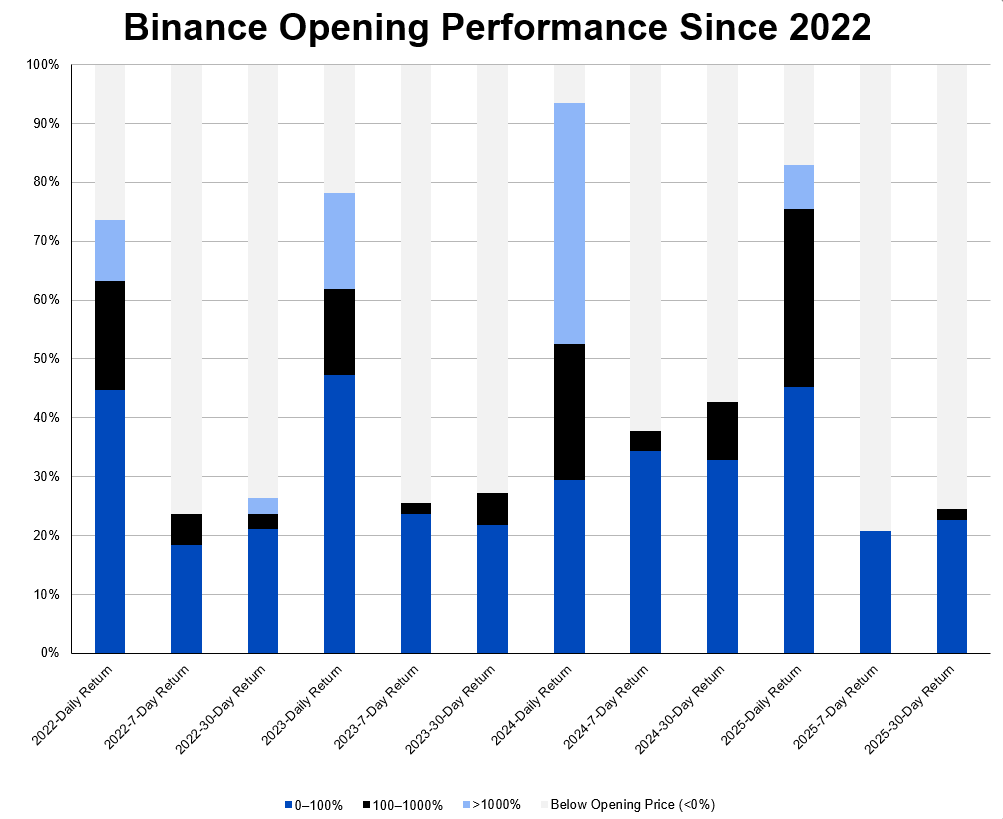
Рис.: Производительность открытия на Binance с 2022 года
This phenomenon of "rapid spike followed by decline" largely stems from over-incentivization prior to listing and artificially manufactured liquidity frenzies. Some projects rapidly boosted TVL and user attention through large-scale airdrops or "points mining," while simultaneously introducing massive sell pressure in the early TGE phase. Take this year's Berachain project, for instance: user retention plummeted shortly after TGE, causing the token price to crash significantly.
More importantly, exchange listing has ceased to be the "terminal event" for closing a project's valuation loop, instead becoming a continuous test of its market performance. In 2025, Binance adjusted its listing logic by launching the Alpha platform as an early-stage showcase channel and introducing stricter tracking mechanisms. These focus heavily on assessing the activity, liquidity quality, and price stability of listed projects. Teams that fail to sustain real user growth and long-term narrative粘性 risk being marginalized or even delisted, even after securing a listing opportunity.
This trend signifies that primary market liquidity exit windows are shifting from "node-driven" to "process-driven." Reliance on mere listing to create short-term valuation recycling windows is failing. For VCs, this necessitates longer-term post-investment accompaniment and value-capture logic. Projects must rely on solid product power and market validation to continuously support token performance in secondary markets, rather than depending on single-event-driven "valuation realization."
Funding-to-TGE Cycle and TGE Success Rates
Project Data Description: This analysis uses samples of top-tier crypto VC investments from Europe, North America, and major exchanges, including institutions such as Coinbase Ventures, Multicoin Capital, YZi Labs, OKX Ventures, Polychain Capital, and Pantera Capital. (See Appendix Table: VC Portfolio Failure & Non-Listing Rate for source data).
Data Selection Criteria:
-
Investment Count Priority: The same project may undergo multiple funding rounds, with valuations differing significantly between stages, directly impacting returns. Therefore, different funding rounds for the same project are treated as independent investment counts to more accurately reflect investment activity.
-
Binance Project Priority: As one of the world's largest exchanges, Binance offers extensive liquidity and market coverage. To fully capture market performance, only projects that launched spot trading on Binance were selected as star projects.
-
Data Accuracy: Investments disclosed after token generation are classified as OTC (Over-The-Counter) and excluded from venture capital categories to ensure statistical accuracy and consistency.
-
Exclusion of Insufficient Dimensions: Projects lacking disclosed investment amounts and valuations were excluded due to insufficient dimensions for calculation.
As observed in the previous section, the ultimate performance of star projects is often disappointing. So how do the majority of other projects fare? Are they able to redeem the face of crypto VCs? In this bottom-up industry, could the eventual winners be the previously obscure "potential stocks" whose value only crystallized over time? The answer is not optimistic. The greater likelihood is that investors simply cannot find suitable exit pathways.
In traditional VC, seed financing typically takes 6–12 months, Series A requires 9–18 months. In the crypto industry, however, the flexibility of token financing mechanisms (e.g., rapid deployment of ERC-20 or BEP-20) initially led to extreme models where funding could be completed in days and TGE in weeks. However, facing increased regulatory pressure and a cooling market, project teams began prioritizing product polishing and user growth. Consequently, the average cycle from funding to TGE in crypto projects has extended significantly.
Although the extended cycle helps project teams prepare more thoroughly, it hasn't fundamentally improved project quality. Data shows that since 2021, Coingecko has recorded 17,663 crypto assets, yet coins ranked outside the top 1,500 have negligible trading volumes, indicating a severe lack of actual value and sustained vitality among numerous projects in the market.
Even more concerning is that high failure rates aren't limited to grassroots projects; they are equally prevalent in institutionally backed ventures. Data indicates that as of 2024, approximately 20.8% of VC-backed projects have ceased operations, with top-tier institutions not spared. For instance, the failure rate for projects backed by Coinbase Ventures stands at 21.6%, while Polychain Capital reaches a staggering 26.72%. This phenomenon highlights that the current market screening mechanism for crypto projects still requires refinement, and institutional investment success rates urgently need improvement.
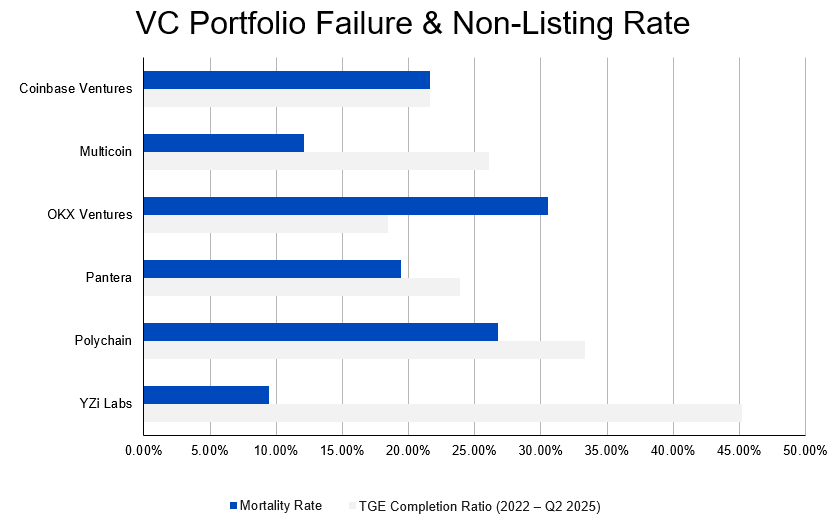
Рис.: Уровень выбывания портфеля VC и непроцентирования
Furthermore, despite a significant positive correlation between funding size and project survival rates, many star projects with over $50 million in funding have still shut down. Examples include Mintbase ($13.5M), MakersPlace ($30M), and Juno ($21M), all of which have stopped operations. This proves that ample capital is not a sufficient guarantee of success; market conditions, operational capability, and product competitiveness remain critically important.
These shifts place higher demands on VC investment strategies. Transitioning from the past accelerated model of "TGE first, build later" to a calmer cycle of "polish first, list later" means projects require a longer verification period before listing. Investors must conduct deeper assessments of technical implementation capabilities, team execution, and product-market fit to enhance post-investment survival and exit feasibility.
Declining Returns in the Primary Market
Structural Analysis of Declining Returns
The significant downturn in investment returns on the crypto primary market is not merely a liquidity outcome of interest rate hikes, but the result of multiple structural factors acting in concert. These changes have profoundly impacted market operational logic, presenting new challenges to investment firm strategies.
The Siphon Effect of Bitcoin and the Predicament of Altcoins
In recent years, fund flow divergence has become increasingly pronounced. Bitcoin's market dominance rose from roughly 40% in early 2023, repeatedly surpassing highs above 55% in 2024, establishing absolute dominance over market liquidity. Simultaneously, following the approval of U.S. spot Bitcoin ETFs in January 2024, they attracted over $100 billion in Assets Under Management (AUM), with net inflows exceeding $30.7 billion.
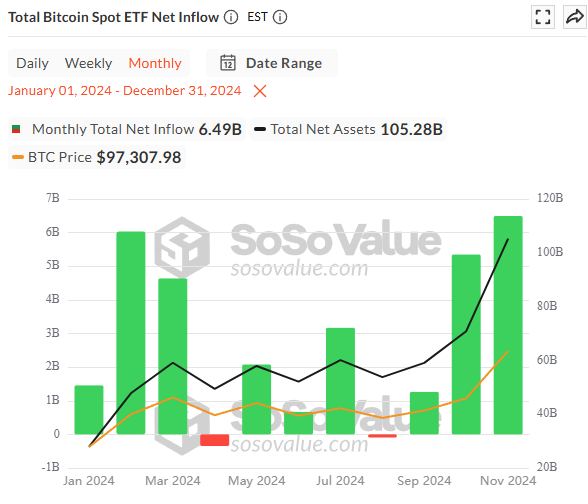
Рис.: Чистый приток средств в спотовые ETF Биткоина в 2024 году
In stark contrast lies the stagnation of the crypto primary market. Total annual funding in 2024 amounted to just $9.897 billion, vastly lower than the $28.6 billion at the same point in 2022. The historical linkage pattern of "Bitcoin rises, followed by altseason" has been broken. Capital has concentrated intensely into Bitcoin, leaving the altcoin market in a state of hemorrhage.
Underlying this phenomenon are the risk preferences of traditional finance. Compliance capital brought by ETFs, managed by institutions like BlackRock and Fidelity, primarily aims to meet client demand for low-risk asset allocation. These institutions view Bitcoin as "digital gold" rather than an entry gateway to "Web3," directing almost zero flow toward riskier altcoins and early-stage projects.
Meanwhile, the "Web3" narrative is receding. Previously hyped sectors like GameFi and SocialFi lost appeal due to economic model collapses and user attrition. Markets have refocused on Bitcoin, which has proven its store-of-value function. This structural shift cemented Bitcoin as the primary capital destination, rendering the altcoin market unable to support its massive supply of projects and valuation systems.
Contraction and Concentration in Sector Selection
The marked shift in crypto investment preferences reflects VCs' pursuit of "certainty." In Q1 2025, the share of early-stage funding dropped below 50% for the first time, signaling a preference for mature projects. Behind this lies the grim reality that 68.75% of projects failed to list, with some top-tier institution-backed projects seeing unlisting rates approaching 80%. Exit difficulties forced VCs to reevaluate capital efficiency, prioritizing projects with clear business models and moats.
Sector choices are also concentrating. Since Q1 2024, concept-driven tracks like Social, Games, and NFTs have faded, making way for a resurgence in DeFi and infrastructure, where VCs shifted emphasis toward practical application value and sustainable revenue streams.
This trend transformed the entrepreneurial path from an "open-book exam" to a "prompt-based essay," leaving only select tracks like Infra, DeFi, and RWA competitive. Ultimately, success hinges on who can break through within red oceans. This market concentration exacerbates fund divergence and compresses overall returns, forming a key reason for declining VC profitability. VCs must dynamically adjust research systems, focusing on deep value capture to meet the market's demand for certainty.
High Project Failure Rates and Inefficient Capital Conversion
Although the elongated market cycle provides projects more preparation time, fundamental quality hasn't drastically improved. Data shows that among the 17,663 crypto assets tracked by Coingecko since 2022, countless coins ranked below #1,500 exhibit near-zero trading volume, reflecting widespread lack of tangible value and lifeblood.
Even more alarming is the persistently high failure rate among mainstream institution-backed projects. As of 2024, approximately 20.8% of VC-backed projects had halted operations. Top-tier firms fared little better, with Coinbase Ventures and Polychain Capital reporting failure rates of 21.6% and 26.72%, respectively. This demonstrates that access to capital and resources does not effectively mitigate failure risks.
Even star projects with substantial fundraising sizes haven't escaped shutdowns, such as Mintbase ($13.5M raised) and MakersPlace ($30M raised), which both ceased operations.
This cycle cleared the market through high elimination rates, imposing higher demands on investors: shifting from "TGE first, build later" to "verify first, list later." Only by deeply mining a project's technical execution, team resilience, and market fit can true survivors be filtered out under dual pressures of capital and cycles.
Listing Does Not Equal Success: Valuation Bubbles and Exit Dilemmas
Listing on top exchanges was once the hallmark of crypto project success and investor exits, but this effect is losing potency. Data indicates that 32.89% of investment tranches and 42.85% of projects currently have FDVs below private placement valuations. Furthermore, zero projects have achieved ratios exceeding 1000%, underscoring harsh market challenges against high FDV valuations.
Projects previously created paper premiums via high FDV financing, but misaligned token release schedules and weak market demand triggered sell-offs, forcing rapid price declines. Some projects ignited liquidity frenzies through airdrops or incentive programs but failed to sustain user retention or long-term narratives, leading to token crashes.
Moreover, exchange listing has transitioned from a "valuation realization node" to a "long-term performance test." Leading exchanges like Binance raised listing standards, requiring projects to maintain genuine growth and price stability, facing delisting otherwise. This invalidates short-term valuation recycling windows, making investment exits increasingly dependent on long-term market performance.
This predicament exposes the inherent risks of high FDVs: masking insufficient liquidity and flawed tokenomics, thereby compressing investment return space. VCs must return to fundamentals, focusing on internal tokenomic closed-loop designs and real market demand. Only robust product power and market validation can sustain long-term project value, preventing paper wealth from devolving into exit illusions.
Macroeconomic Pressure and Risk Capital Retreat
Since March 2022, the Federal Reserve consistently hiked interest rates, lifting the federal funds rate to a peak of 5.25%-5.50% within a year and a half. Simultaneously, the 10-year U.S. Treasury yield breached 4.5% in late 2023, significantly boosting the attractiveness of risk-free assets and increasing the opportunity cost of investing in risky assets. During this window, global capital market risk appetite notably declined, and funding support for high-risk areas like crypto projects drastically shrank.
The high-rate environment profoundly impacted crypto project valuations and investment returns. Firstly, higher rates increased discount rates for future earnings, meaning expected returns relying on long-term growth or token value depreciate due to increased discount costs, directly compressing secondary market valuations. Simultaneously, with risk-free assets (like U.S. Treasuries) yielding over 4.5%, investors favored low-risk, high-yield allocations, reducing capital inflows into high-risk crypto ventures. This capital flow shift further weakened the financing capabilities of crypto startups, leaving many struggling to secure adequate funding. Additionally, low secondary market valuations and reduced funding made high-return exits difficult. Shrinking returns not only affected VC fund profits but also undermined confidence in the crypto sector.
The VC Survival Line: Can "Home Run" Returns Cover Massive Losses?
Project Data Description: This analysis utilizes samples of top-tier crypto VC investments from North America/Europe and major exchanges, covering institutions such as a16z, Coinbase Ventures, Multicoin Capital, YZi Labs, OKX Ventures, Polychain Capital, Paradigm, and Pantera Capital. (Source data detailed in Appendix Tables: VC Investments, VC-Backed Listings on Binance: Spot Returns, VC-Backed Listings on Binance: Spot Returns Pivot).
Data Screening Criteria:
-
Investment Tranche Priority: The same project may undergo multiple funding rounds, with valuations varying significantly across stages, directly impacting returns. Thus, different rounds for one project are treated as independent investment tranches for more accurate reflection of activity.
-
Binance Listing Priority: As one of the world's largest exchanges, Binance possesses broad liquidity and market reach. To comprehensively capture market performance, only projects launched for spot trading on Binance are selected as star projects.
-
Data Accuracy: Investments disclosed post-token generation are categorized as OTC (Over-The-Counter) and excluded from venture capital classification to ensure data accuracy and consistency.
-
Exclusion of Insufficient Dimensions: Projects lacking disclosed investment amounts and valuations are excluded from statistical calculations due to insufficient data dimensions.
In the VC field, high failure rates are the norm. A VC fund's success doesn't hinge on avoiding project failures, but on whether its portfolio produces one or two "home runs." These successful ventures must deliver at least 10x or higher returns to offset the losses of numerous zeroed-out projects and ultimately realize overall fund profitability.
In the current crypto market, successfully listing on Binance spot has become the golden standard for measuring whether a project has truly "broken out." Thus, evaluating primary market investment returns pivots from "will the project die?" to: What proportion of the invested portfolio will eventually list on Binance? Do these projects' return multiples suffice to cover the massive losses of those that failed to list?
Let's examine this cruel funnel-style selection process from investment to Binance listing using macro data across two dimensions: "investment tranche count" and "project count":
Considering a portfolio comprising 1,026 investments corresponding to 757 unique projects, its overall performance unfolds as follows:
Most investments remain dormant (No TGE)
-
Out of all investments, a staggering 747 tranches (72.8%), corresponding to 584 projects (77.1%), failed to complete their TGE (Token Generation Event and subsequent exchange listing). This implies over 70% of investments and projects remain at the book-value stage, not yet circulating publicly, facing extreme uncertainty.
Few succeed in "issuing tokens" (Completing TGE)
-
Only 279 tranches (27.2%), corresponding to 173 projects (22.9%), successfully achieved TGE, entering secondary market circulation. While this marks the initial step allowing early investors to exit, it remains distant from true "success."
The Final Narrow Bridge (Listing on Binance)
-
At the apex of the pyramid, only 76 tranches, corresponding to 42 projects, ultimately succeeded in listing on Binance Spot.
-
This means even among already "token-issued" projects, only roughly a quarter (24.3% by project count, 27.2% by tranche count) manage to touch Binance, this top liquidity hub.
-
If viewed from the portfolio's starting point, success rates are minuscule:
-
Calculated by investment tranches, the final proportion listing on Binance is merely 7.4%.
-
Calculated by project count, the final proportion listing on Binance drops to a dismal 5.5%.
For any crypto fund, the probability of its investment hits landing on Binance is roughly only 5.5%. This implies over 94.5% of invested projects cannot generate top-tier returns.
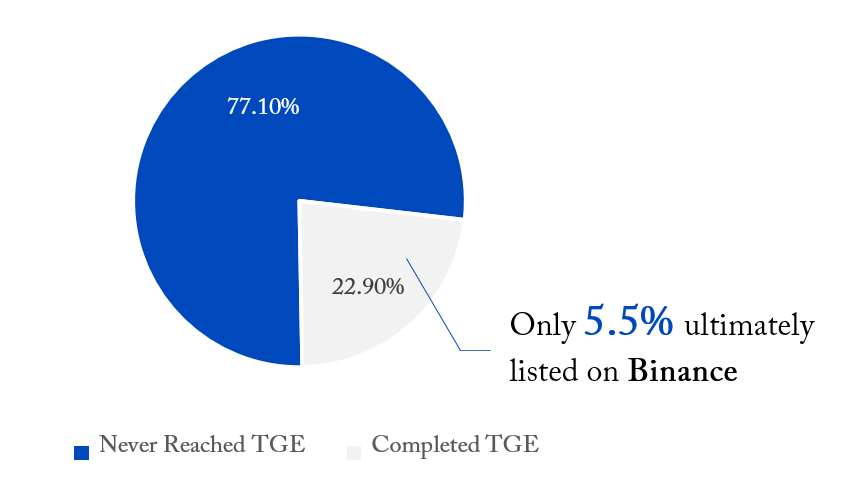
Now let's inspect how this 5.5% "chosen few" perform. Below are estimated average returns for top-tier institution-backed projects after successful Binance spot listings:
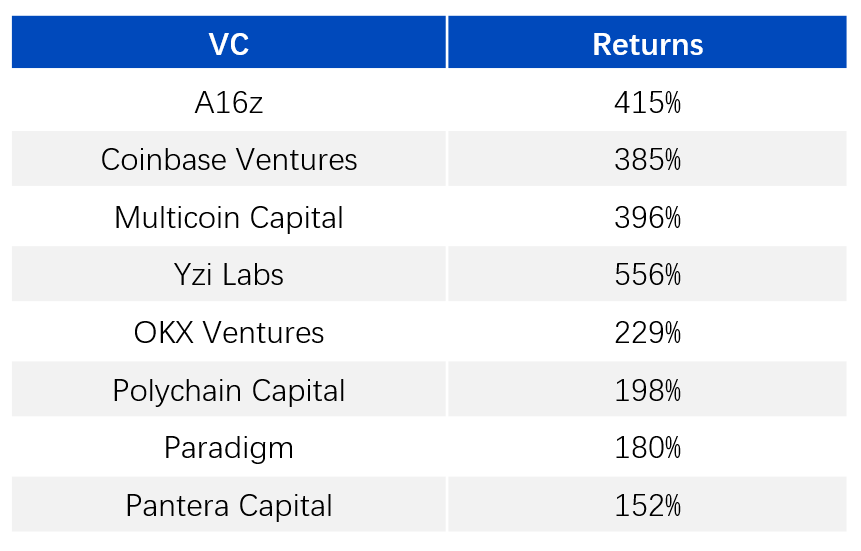
Notably, even globally premier VCs see average return multiples for Binance-listed projects clustering between 2x and 5x, far short of the mythical "10x" required to cover losses.
Let's run the numbers. Assuming a fund needs to break even, an extremely simplified model dictates: If 77% of projects go to zero, the remaining 23% must generate at least a 4.3x average return (1 / 0.23 ≈ 4.3) just to break even.
Yet, reality shows:
-
Listing probabilities on Binance are too low: Only 5.5% of projects achieve top-tier liquidity.
Return multiples post-Binance listing aren't high enough: An average 2-5x return is grossly insufficient to cover the failure losses of the other 95.5% of projects. Even worse for those missing Binance entirely and listing only on smaller exchanges, whose returns and liquidity degrade further.
The brutal reality is that even for top-tier funds, viewing all invested projects collectively, current Binance listing rates and post-listing return multiples simply cannot cover the losses generated by the massive number of failing projects elsewhere in their portfolios.
This ultimately forces primary market investment institutions to confront three mountainous hurdles: absolute return decline, lowered listing multiples, and liquidity drought. The industry's investment logic is forcibly transitioning from a "spray-and-pray, bet on hits" model to a deeper evaluation focused on intrinsic project value, team execution, and market fit.
Returning to Fundamentals as the "Web3 Revolution" Waters Recede
The preceding sections clearly exposed the market's "effect"—the total downturn of primary market returns and the失效 of the 2017-2022 Crypto Vintage investment logic. However, to truly grasp this drastic shift, we must probe its "cause." We believe the current predicament faced by crypto VC isn't merely a cyclical adjustment, but a profound paradigm revolution. At its core, this revolution marks the crypto industry's transition, after a轰轰烈烈的全民探索 phase, from the grandiose narrative of "Web3" back to its authentic core value: a disruptive force building next-generation financial infrastructure.
Pointed Skill Trees: The Bankruptcy of Web3 Narratives and the End of Growth
For the past several years, the entire industry drowned in the "Web3" dream. This vision painted a decentralized internet where users owned their data sovereignty, standing toe-to-toe with Web2 giants. Within this narrative, VC logic remained simple and clear: hunt for the next exponentially growing SocialFi, GameFi, or NFT platform, capturing trillion-dollar markets through disruptive application-layer innovations.
Ultimately, however, this path proved misguided.
The Ceiling of Growth: User Bottlenecks in Web3 Narratives
Every disruptive application-layer story rests on the premise of exponential user growth. Reality tells us otherwise: crypto industry user growth has hit a bottleneck. Complex wallet interactions, unintuitive private key management, and scarce real-world use cases prevented crypto applications from breaking niche circles and reaching mainstream audiences. Once the user growth myth shattered, the high-valuation models built atop it collapsed. Sectors once hyped now litter the ground with feathers.
Misaligned Value: When "Revolution" Deviated from Core Strengths
The blockchain's core advantage lies in its financial attributes: highly efficient asset creation, permissionless global distribution, and programmable automated interactions. Fundamentally designed to reshape production relations—especially financial asset production and circulation—blockchain struggled to adapt when nearly less than 20% of early "Web3" projects actually targeted this core. The rest blindly tried forcing non-financial nails (social, gaming) using blockchain as a "financial hammer." This value mismatch caused rampant resource wastage and failed explorations. Though VC-driven social experiments yielded unsatisfactory results, their value was immense—they verified with hard cash which paths lead nowhere.
Returning to the Core: The Essence of Crypto is Building Next-Gen Financial Infrastructure
If the Web3 door temporarily won't open toward the future, where lies crypto's true value outlet? The answer grows ever clearer: Return to technical origins, focusing exclusively on constructing a brand-new, highly efficient, global financial infrastructure.
Unlike pursuing a "build-from-scratch" Web3 revolution, constructing financial infrastructure adopts pragmatic, foundational goals. It doesn't seek to create virtual worlds detached from reality, but leverages blockchain technology to provide superior "rails" and "traffic rules" for moving real-world assets and value flows.
This precisely explains the trends observed in earlier data:
-
Resurgence of DeFi & Infrastructure: These constitute the new financial "rails" themselves—the bedrock of value circulation, inherently paramount.
RWA (Real World Assets) Emergence: Crucial for allowing real-world "cargo" (bonds, real estate, credit) to traverse these new rails, bridging virtuality and reality to empower the实体 economy via blockchain efficiency.
Sustained CeFi Funding Capacity: Acting as interchange hubs and primary gateways between old and new financial systems, its cash-flow-intensive nature garners intense capital favor as markets rationalize.
Shifting the development trajectory from "Web3 Apps" to "Financial Infrastructure" fundamentally alters the entire evaluation framework. Past valuation models relying on vague narratives and user growth projections are discarded, replaced by value assessment frameworks closer to traditional infrastructure, emphasizing systemic stability, transaction efficiency, asset security, and sustainable business models. This constitutes the root cause behind the overall downward adjustment in valuation systems.
Changing Participants: From "Believers" to "Rational Actors"
Early phases of any emerging industry are dominated internally by idealistic "believers." Embracing risks, creating/spreading new narratives, willing to pay for high-risk, high-reward dreams.
However, post-Bitcoin ETF approvals, crypto irreversibly transitions from niche geek circles into mainstream financial markets. Participant structures undergo fundamental shifts:
-
Funding Sources Evolve: Traditional financial behemoths like BlackRock and Fidelity enter with compliant capital. Seeking not hundred-fold speculative myths but stable asset allocation, they view Bitcoin as "digital gold," not tickets to Web3.
Investor Mindsets Shift: Brutal bear market洗礼 transforms狂热 speculators into prudent "rational actors." Attention pivots to fundamentals and intrinsic value rather than blind hot-topic chasing.
This evolution from "believers" to "rational actors" mirrors classic precedents in Web2 history: the Dot-com bubble circa 2000.
During bubble peaks, "believers" firmly believed "eyeballs conquer all." Profits mattered not; buyers paid solely for click-through rates and grand narratives. Classic example: Pets.com. Possessing a revolutionary online pet-supply sales story and successfully IPOing/fundraising, it ignored astronomical logistics costs and basic commercial logic, going bankrupt rapidly after burning investment cash. Pets.com didn't fail because internet visions were wrong; it failed possessing only "believer" fervor without "rational actor" commercial cores.
Post-bubble, capital dried up, markets rationalized. Investor core questions shifted from "What's your user growth?" to the simplest "How do you make money?" Within this "rational actor"-dominated market, true giants emerged. Amazon survived stock plunges by building offline warehousing/logistics ("heavy asset") moats. Google conquered via AdWords—a clear, highly profitable monetization model, IPOing successfully in 2004 to usher in a new era.
Historical mirrors vividly reflect today: Today's failed Web3 projects suffering unclosed economic models mirror yesterday's Pets.com. Current capital-favored DeFi, infrastructure, and RWA projects resemble当年的亚马逊和谷歌. Their value roots lie in verifiable, sustainable commercial logic—not merely pretty stories.
This participant shift represents the inevitable path toward industry maturation. As dominant market forces transition from "believers" to "rational actors," high-valuation bubbles built upon faith and consensus inevitably squeeze out. Only projects delivering genuine, measurable value secure reasonable valuations and market recognition within new value systems.
In summary, current primary market困境 constitutes an industry course-correction along its developmental path. It marks an era's end—one driven by grandiose narratives and boundless imagination; signaling a new dawn—one dictated by tangible utility, sustainable commercial models, and rational capital. For身处其中的 VC, comprehending and adapting to this underlying logical shift proves key to traversing cycles and winning the future.
Investment Logic Transformation Under Value Reassessment
The market has most brutally announced: A commercial model reliant solely on "listing on Binance" as an exit pathway isn't investing—it's gambling. With secondary market liquidity premiums evaporating and primary market valuation bubbles punctured, the entire industry's value chain undergoes painful yet necessary reassessment.
Yet this absolutely isn't grounds for pessimistic exits. Conversely, precisely this constitutes prime moments for premier investors recalibrating stances, capturing genuine value rigorously and patiently. Targets no longer chase subsequent wave hype tokens, but invest/nurture "Stripe or Uber of the crypto world."
From a VC perspective, post-AI era diminishes capital marginal effects, decreasing capital intensity effects. Historically funded costs for hiring/market expansion/R&D decrease alongside AI development. Hence, VC value transcends mere capital injection, becoming endorsements and billboards. Consequently, mid/lower-tier VCs passively trailing passive investments shall perish, incapable of proactively excavating value depressions.
From "Narrative-Driven" to "Business-Driven"
Past years witnessed VC over-dependence on "sector narratives": ZK, Layer2, GameFi, SocialFi, NFT… Yet most projects couldn't substantiate user retention or genuine revenue.
Future core questions cease being "How many users do you have?"; instead asking:
-
Who are these users?
Do they pay solving genuine pain points?
-
Would they stay absent token incentives?
Genuinely resilient projects possess stable on-chain transactions/fee revenues, driven by real demand, not subsidies.
Case Study: Ethena
-
Launched stable asset USDe in 2024, breaching $3B circulating supply within six months, rapidly ascending fastest-growing stablecoin ranks;
-
Core mechanism: Delta-Neutral hedging perpetual contract structure steadily generates Real Yield across market cycles;
-
User base includes "airdrop farmers," institutions, market makers, hedge funds; demand essentially centers on "hedging/stable yields," not short-term incentivization;
-
Revenue models directly pegged derivatives markets; annualized yields briefly exceeded 20% in 2024, gradually沉淀协议层现金流.
This embodies the virtuous cycle "User Demand → Genuine Revenue → Protocol Value"—exactly why Ethena脱颖而出 fiercely competitive stablecoin markets.
"Ballast Stone" Cash Flows
Future portfolios require more counter-cyclical cash flow protocols/apps:
-
Compliance/Safety API Services: Chainalysis earned >$200M in 2022, peaking valuation at $8.6B;
-
Web3 Infrastructure SaaS: Alchemy/Infura bill via USD subscriptions, decoupled from coin price volatility, exceptionally stable;
-
Off-chain & On-chain Hybrid Valuations: Integrating on-chain metrics (TVL, protocol revenue) alongside traditional equity tools (DCF, P/E).
Such patterns furnish investment value anchors—the "ballast stones" composing portfolios.
Realistic Return Curves
Crypto VC return curves shift from J-shaped "100x in two years" towards staircase curves depicting "10x over eight years."
Future exit pathways diversify:
-
Acquisition by tech giants;
-
IPOs on compliant STO platforms;
-
M&A integration with traditional industries.
Signaling longer horizons/deeper patience required.
Signals Clarify Like Never Before
Current primary market contraction merely represents deleveraging post-barbaric growth phases. Noise clears; signals unprecedented clarity.
For serious investors, this mandates:
-
Diligence mirrors top-tier equity VC standards, focusing squarely on market sizing, unit economics, product moats;
-
Post-investment genuinely empowers, supplying clients/channels beyond mere exchange resources.
Prospective Tracks: Next Round Investment Opportunities in Crypto Markets
ArkStream Capital identifies three directions harboring long-term investment potential:
Stablecoins: Cornerstones of Next-Gen Global Payments & Settlements
Stablecoin fundamental significance transcends mere "counter-cyclicality" or "cash flow provision"; instead liberating capital from geopolitical sanctions, forex controls, localized financial bondage granting capital unprecedented "Universal Finance" status. Historically, dollar assets faced strict circulation/access restrictions nationally; stablecoins revolutionized everything functioning akin "digital arteries" injecting global capital previously unreachable regions/sectors.
Cross-border E-commerce & Gaming Expansion
-
Pain Points: Cross-border receipts notoriously delayed (3–7 days), fees range 3%–7%; low card penetration drives payment conversion leakage.
Stablecoin Solutions: Leverage USDT/USDC instant/T+0 settlement linking wallets globally, dramatically slashing fees/accounting costs.
-
Market Size: Cross-border E-commerce exceeds $1T annually (2023), projected >$3.3T by 2028; Global Gaming stands at $184B (2023)—adopting merely 10% e-comm + 5% gaming via stablecoins yields potential on-chain annual流量 >$200B+.
Global Remittances & Remote Payroll
-
Pain Points: Traditional transfers average 6.39% cost (Q4 2023); slow arrival/restricted channels; LMIC remittances totaled $656B (2023).
-
Stablecoin Solutions: 24/7 arrivals/traceability on-chain; significantly undercutting traditional MTO costs; facilitates batch payroll/micro-payment automation.
- p>Global remittances hover ~$860B (2023); migrating 20% onto stablecoins creates $170B/yr incremental on-chain settlement capacity.
Corporate Working Capital for High-Inflation/Capital-Control Markets
-
Pain Points: Local currency depreciation/expat quotas squeeze operating cashflows; cross-border procurement/payments obstructed.
-
Stablecoin Solutions: Dollarize working capital via stablecoins; connect directly overseas suppliers/contractors bypassing inefficient/unstable channels.
-
Market Scale: Nigeria recorded $59B encrypted transactions (Jul 2023–Jun 2024); Q1 2024 sub-$1M transfers neared $3B; establishing stablecoins mainstream utility tier.
DeFi Hedging & Global Derivatives Access
-
Pain Points: SMEs struggle accessing forex/interest rate derivatives affordably/hastily; high barriers/slow processing times.
-
Stablecoin Solutions: Collateralize stablecoins on-chain for borrowing/futures/options hedging enabling programmable/composable risk management & financing.
-
Market Scale: Global OTC Forex sits at $7.5T/day (2022); boosting mere 0.5% on-chain penetration yields ≈$375B/day potential notional turnover.
RWA: Rendering Traditional Assets Programmably Composable
Vast traditional financial assets historically constrained geographically/temporally/settlement infrastructures: treasuries settle weekdays only; cross-border RE deals bureaucratic; supply chain notes cumbersome; PE liquidity nonexistent. Despite colossal capital trapped inside "static reservoirs."
RWA shines digitizing rights-to-yield/settlement transforming cashflows tradable/composable autonomously on-chain. Treasuries collateralized identically to stablecoins; rental income distributed automatically; supply chain finance discounted instantly; PE fractionalized attain secondary liquidity. For investors, transcend singular asset digitization representing systemic restructuring global capital efficiency.
Treasuries/Money Market Funds
-
Pain Points: High thresholds/T+1/2 settlements choke capital velocity.
On-chain Solutions: Tokenized T-Bills/MMF enabling 24/7 redemption/collateralization (BUIDL, BENJI).
- p>Market Size: US Money Funds exceed $7T; tokenized Treasuries register a mere $7.4B (Sept 2025).
Real Estate/Private Equity
-
Pain Points: Illiquidity/prolonged exit cycles/cross-border complexity.
-
On-chain Solutions: Property/Share tokenization automating rent/dividend distributions whilst introducing secondary liquidity layers.
- p>Market Size: Global RE ~$287T / Private Equity AUM >$13T; deployed on-chain <$20B.
Supply Chain Finance/Receivables
-
Pain Points: SME financing deficits; global trade gap plummets to $2.5T shortfall.
-
On-chain Solutions: Receivables tokenization connecting investors directly cashflows executed autonomously via contracts.
- p>Market Size: Supply Chain Finance registers $2.18T; cumulative on-chain deployment >$10B.
Commodities/Stocks/ETFs
-
Pain Points: Gold/ETF share transfers suffer friction; penny trading restricted.
-
On-chain Solutions: Physical gold/ETF/Stock tokenization enabling simultaneous settlement/collateralization.
- p>Market Size: Gold token cap ≈$2B; On-chain ETF/Stock AUM >$100M.
Crypto + AI: Granting True Economic Agency Capabilities to AI
Autonomous AI demands self-spending/reconciliation/delivery proof. Legacy finance fails: manual account openings delay cross-settlements/timelines lengthy; verifyability outcomes elusive. Encrypted networks furnish comprehensive "OS layer":
-
Currency Layer: Stablecoin/deposit token 24/7 clearing globally; Smart Wallets permit Agents holding balances spend autonomously; Stream payments enable "pay-per-call" microtransaction architectures.
-
Contract Layer: Escrow mechanics/SLA penalty clauses codified smart contracts trigger auto-refunds/seizures if service SLAs breach; Strategy wallets enforce daily caps/allowlists/session keys managing risk/control permissions.
-
Verification Layer: TEE+zkp renders compute/inference auditable; payments governed strictly "proof" versus hollow "promise."
Once spendable currency ties seamlessly verifiable work pipelines, Agents transcend mere API wrappers evolving enterprise-equivalent operators acquiring data/compute purchasing power converting deliveries incomes accumulating cashflows/creditworthiness. Hence articulating "Crypto as Native AI Currency" truly encapsulates essence.
Agent-Native Settlement/Treasuries
-
Pain Points: Fragmented API billing/cross-payrolls; manual reconciliation/invoicing/risk-control injections prevent simultaneous invocation/settlement.
-
On-chain Solutions: Agent-operated Smart Wallets execute stream/micro-payments (per token/ms/request); Contract escrow guarantees SLA compliance triggering auto-refund/slashing defaults; Strategy wallets configure daily limits/allowlists/session keys containing exposure/risk governance.
- p>Market Size: Aggregate GenAI expenditure ~$202B (projected 2028); routing 5% via "Agent→Chain" instantaneous settlement spawns $10B/yr native payment conduits.
Verifiable Compute/Inference Markets
-
Pain Points: Expensive cloud invoices deferred billing; inference outputs/temporal sequences unverified; downtime failures lack automatic compensation.
-
On-chain Solutions: Compute providers stake→bid→generate attestation (TEE/zk/multi-party review)→settle verifying proofs; breach triggers slashing; pricing auction pools aggregate "pay-for-proof" supplanting legacy trust-first payment paradigms.
- p>Market Size: AI Infrastructure CAPEX ~$223B (2028 estimate); decentralizing/verifying 5% equates ≈$11B volumetrically dynamic settlement surface area.
Provenance/Licensing Royalty Streams
-
Pain Points: Training/fine-tuning/inference data sourcing ambiguity/license accounting complexities stall creator/enterprise royalty distributions perpetually.
-
On-chain Solutions: Data/models/assets cryptographically signed licensing fingerprints trace lineage; invoking triggers automated micro-splitting routed addresses (creators/data DAO annotators/model owners binding yields permanently sourced).
- p>Market Size: Data brokerage ~$292B (2025)/Creator Economy ~$480B (2027); integrating 5% on-chain licensing/auto-distribution yields multi-billion-dollar continuous disbursement waterways.
Conclusion
Back in 2017, Crypto VCs introduced "risk capital & token financing" ecosystems; by 2024, infrastructure/compliance corridors filled gaps completing First Curve—asset/highway creation/circulation 0→1 milestones.
We officially entered Crypto Second Curve since 2024—not recreating hotter narratives, but deploying encryption harnessing globally open/efficiently verifiable capital highways承载现实生产力: Stablecoins enable cross-border mobility; RWA migrates cashflow-assets on-chain; Crypto+AI aligns funding-delivery direct对接. Industry substantive value progressively shifts valuation-driven storytelling restructuring production relations.
For VCs roles didn't vanish transformed务实 value creation. Capital pivoted chasing hype calculating ledgers empowering founders integrate genuine-demand/steady-cashflow/reusable-financial-primitives on-chain. Foundationalists/executors endure become genuine value-captors decade ahead.
Appendix
Financing/return data referenced herein detailed spreadsheet download available:
Присоединяйтесь к официальному сообществу TechFlow
Telegram:https://t.me/TechFlowDaily
X (Twitter):https://x.com/TechFlowPost
X (Twitter) EN:https://x.com/BlockFlow_News
 Arkstream Capital