Cross-Border Refugee Flows, Crypto ATMs, and Tax Reform Wave: What Is Driving the Eastern European Crypto Economy?
Author: Chainalysis
Translated by: TechFlow
TechFlow Guide: In Chainalysis’s latest Global Crypto Geography Report, Eastern Europe exhibits highly unusual anomalies. Despite the region’s overall crypto transaction volume declining by 7.9% year-over-year—making it the weakest-performing market globally—retail transfers under $10,000 and cash-heavy crypto services surged against the trend, with retail capital accounting for the highest share among all global regions.
This unique structure is driven by profound geopolitical shifts and refugee migration. As the Russia-Ukraine conflict drags on, Ukrainians fleeing to countries like Poland and the Czech Republic are turning to cryptocurrency as an essential lifeline for crossing borders. Ukraine has become the primary destination for peer-to-peer (P2P) stablecoin flows across 16 neighboring countries, while Poland, capturing nearly 40% of the market share, has emerged as Eastern Europe’s largest crypto ATM hub.
Intertwined with this risk-averse necessity is market volatility sparked by abrupt tax policy shifts. Following Romania's elimination of its crypto tax exemption, trading volumes at centralized compliant exchanges halved overnight, driving users rapidly toward KYC-free instant exchange platforms. From humanitarian relief to evading regulations, Eastern Europe is becoming the ultimate testing ground for observing cryptocurrency's real-world social integration and policy antifragility.
Key Takeaways
· Regional contraction amid strong retail resilience: Eastern Europe’s overall crypto economy shrank by 7.9% over the past year, making it the worst-performing global region. However, retail transfers under $10,000 reached the highest global share, with total annual service inflows from retail investors surpassing $11 billion.
· Cash-heavy services lead global growth: Contrasting with the decline in large institutional transfers, cash-dependent services such as crypto ATMs and OTC P2P exchanges in Eastern Europe grew counter-trend by 1.5%, outpacing all other global regions.
· Conflict-driven displacement reshapes cross-border capital flows: Four years into the Russia-Ukraine conflict, millions of displaced Ukrainian refugees have established a thriving cross-border crypto remittance network. Among 21 neighboring markets, 16 show Ukraine itself as the top destination for retail stablecoin P2P remittances.
· Poland emerges as regional crypto cash-out hub: Poland hosts 38.5% of all crypto ATMs in Eastern Europe, with ATM transaction volumes and cash-out amounts surging by 21.8% and 28.6% respectively, far outpacing other fiat cash-out channels, while stablecoin P2P trading volume exploded fourfold.
· Strict tax reforms push users toward decentralized and gray-market channels: Following Romania’s proposal to abolish crypto tax exemption thresholds, inflows to mainstream compliant exchanges dropped sharply, while the usage of KYC-free instant exchange platforms (Instant Exchanges) surged by 59%. This radical change in tax policy directly shifted on-chain behavioral preferences.
Eastern Europe Faces Macro Headwinds: Institutional Capital Flees as Retail Share Tops Globally
During Chainalysis’s latest reporting period for the Global Crypto Geography Report, Eastern Europe emerged as the weakest-performing major global region, with its overall crypto asset receipt volume contracting by 7.9% year-over-year.
Five of the region’s ten core countries showed year-over-year fluctuations of less than 2%, indicating that macro liquidity has stalled. However, looking beneath the surface chill of these aggregate figures reveals stark micro-level divergence within the region.
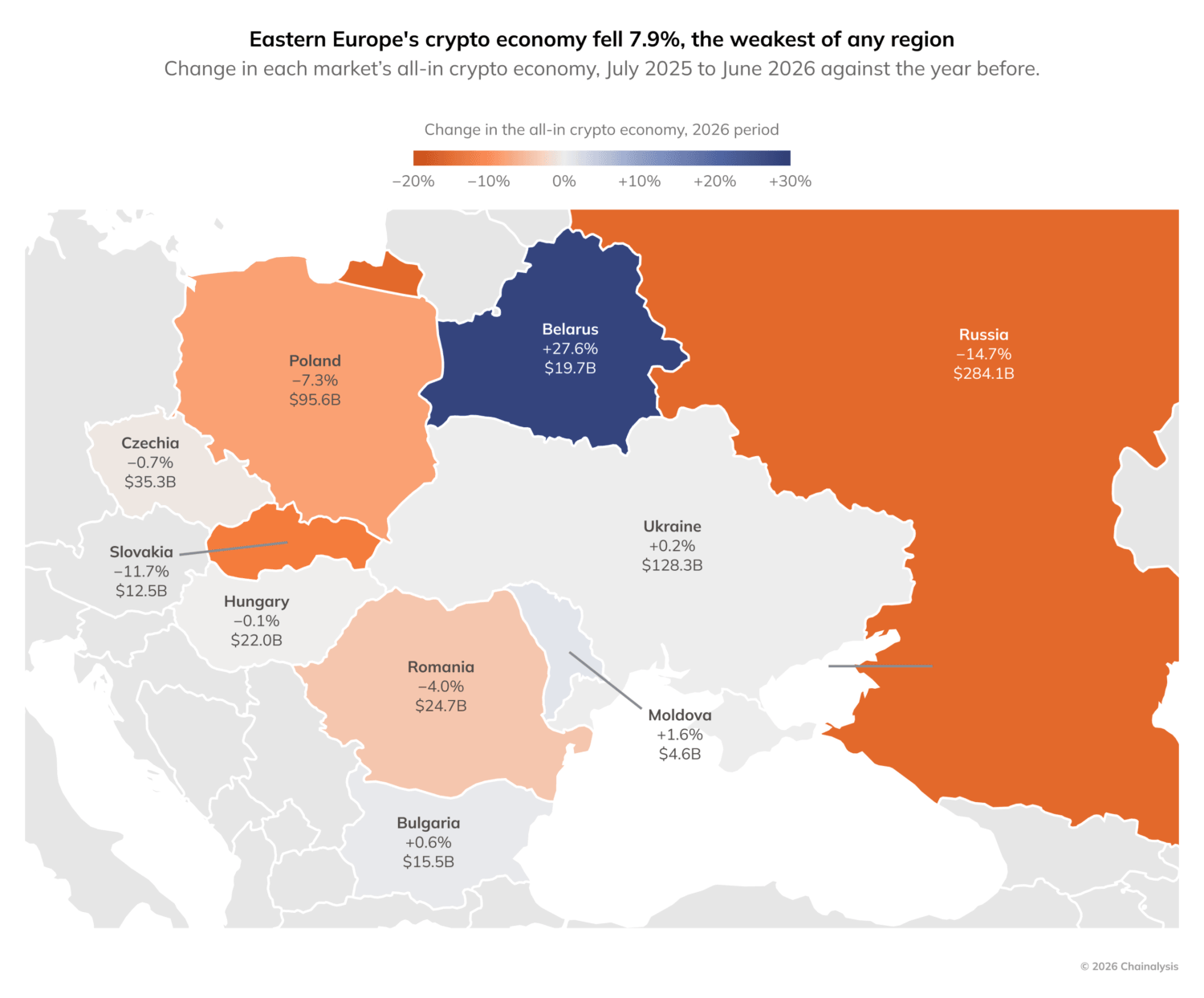
Figure: Eastern Europe's crypto economy contracted 7.9% YoY, showing the weakest performance among all major regions
Data shows the downturn in Eastern Europe was primarily driven by significant pullbacks from large institutional and whale capital. In sharp contrast, retail transfers with individual amounts under $10,000 demonstrated remarkable resilience.
Among all funds flowing to crypto service platforms, Eastern European retail investors contributed the highest share globally. Retail annual transaction volume across various platforms in the region marginally increased to over $11 billion, while retail activity on Decentralized Exchanges (DEXs) grew by nearly 25%.
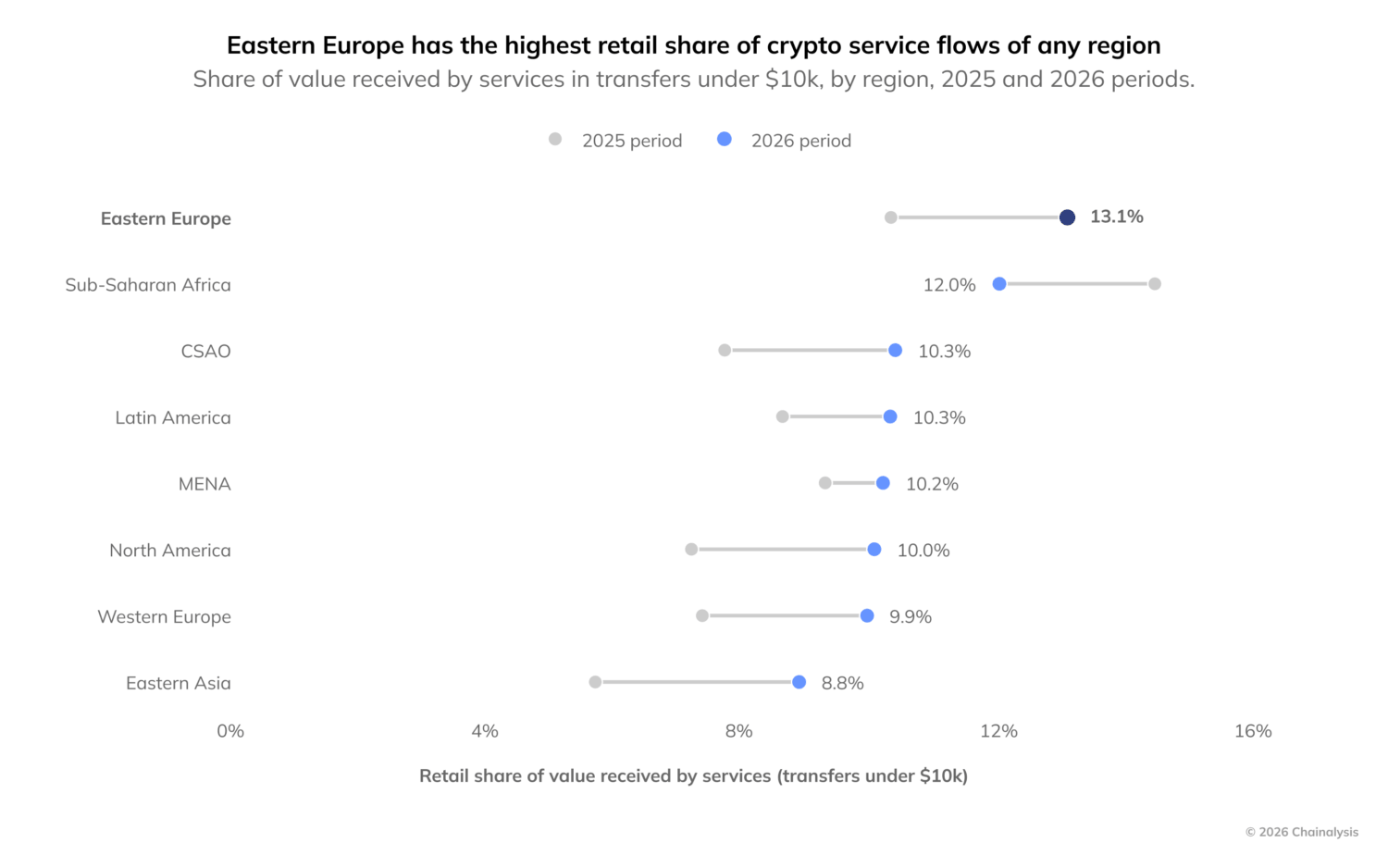
Figure: Eastern Europe boasts the highest retail share across all crypto service fund flows
Cash-Heavy Services Surge Against the Trend: Crypto ATMs and P2P Become Liquidity Oases
Even as Eastern Europe’s broader crypto economy faces contraction, cash-intensive crypto services have carved out a completely independent counter-cyclical trajectory.
The volume of cryptocurrency received through crypto ATMs and OTC P2P exchanges in Eastern Europe rose counter-trend by 1.5%, outpacing every other major geographic region including North America, Western Europe, and Asia-Pacific.
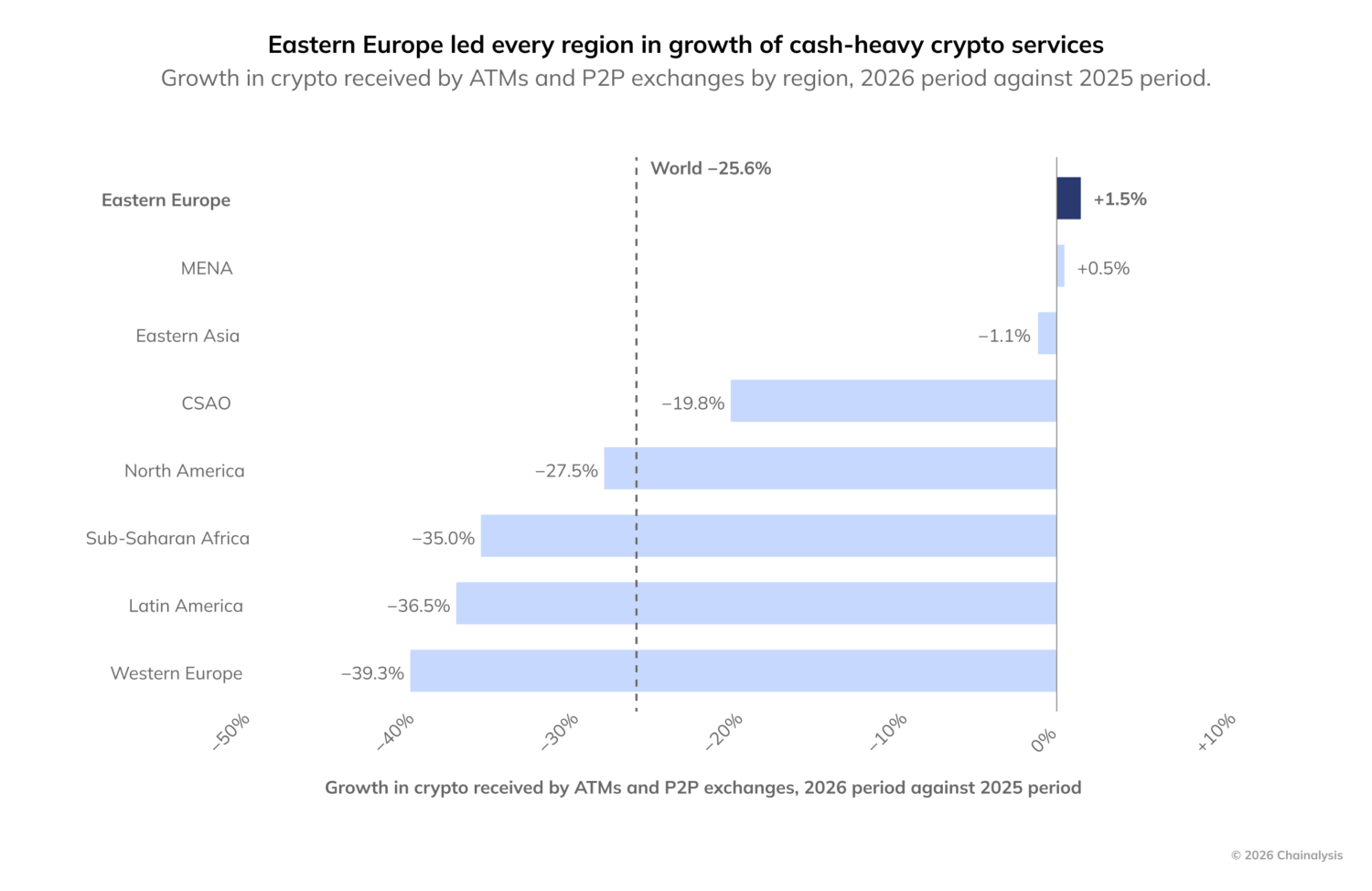
Figure: Eastern Europe leads all global regions in the growth rate of cash-heavy crypto services
This distinct cash preference is deeply rooted in Eastern Europe’s complex social fabric. For years, segments of the population have lacked trust in the stability and privacy protections of traditional banking systems.
More importantly, a vast number of cross-border migrant workers, participants in the gray economy, and war refugees lack full local bank accounts and residency permits. Consequently, physical crypto ATMs and cash-based P2P transactions, which require no stringent identity checks, have become their inevitable choice for exchanging daily living expenses and transferring private assets.
A Lifeline Amid the Refugee Crisis: The Landscape of Ukraine’s Cross-Border Stablecoin Network
Over four years into the Russia-Ukraine conflict, the economic ties between millions of Ukrainian refugees scattered abroad and their families back home have been deeply embedded into blockchain networks.
On-chain fund tracking reveals that capital flowing from Eastern European neighbors like Poland, the Czech Republic, Bulgaria, and Romania into mainland Ukraine closely mirrors the flow patterns of funds directed toward Ukrainian communities residing in those host countries.
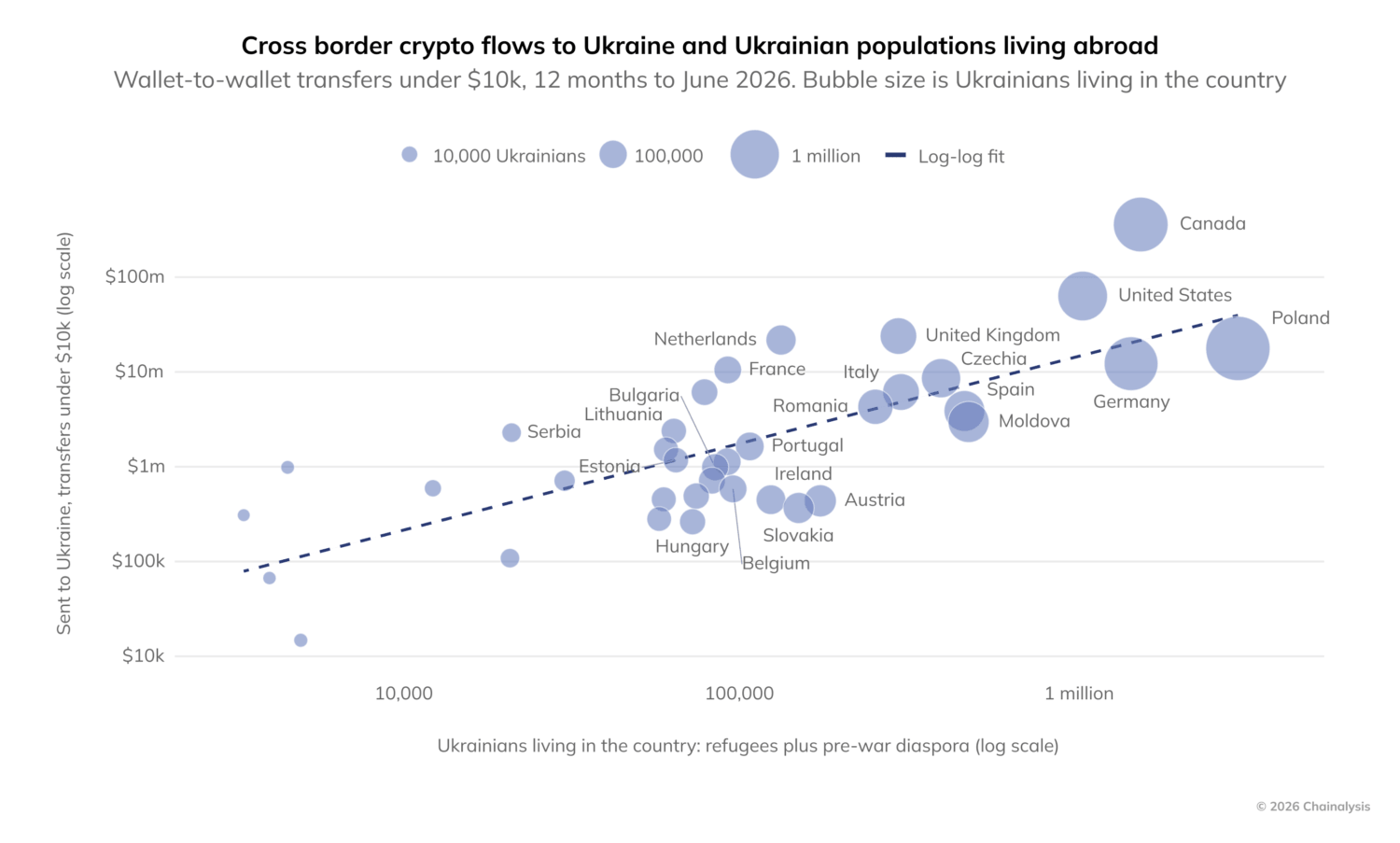
Figure: Cross-border crypto fund flows between mainland Ukraine and overseas diaspora communities show high alignment
This characteristic of humanitarian support and survival maintenance is particularly pronounced in the realm of peer-to-peer (P2P) stablecoin payments.
Statistics indicate that across 21 East-Central European markets surrounding Ukraine, a striking 16 markets show Ukraine itself as the top outbound destination for retail stablecoin P2P remittances.
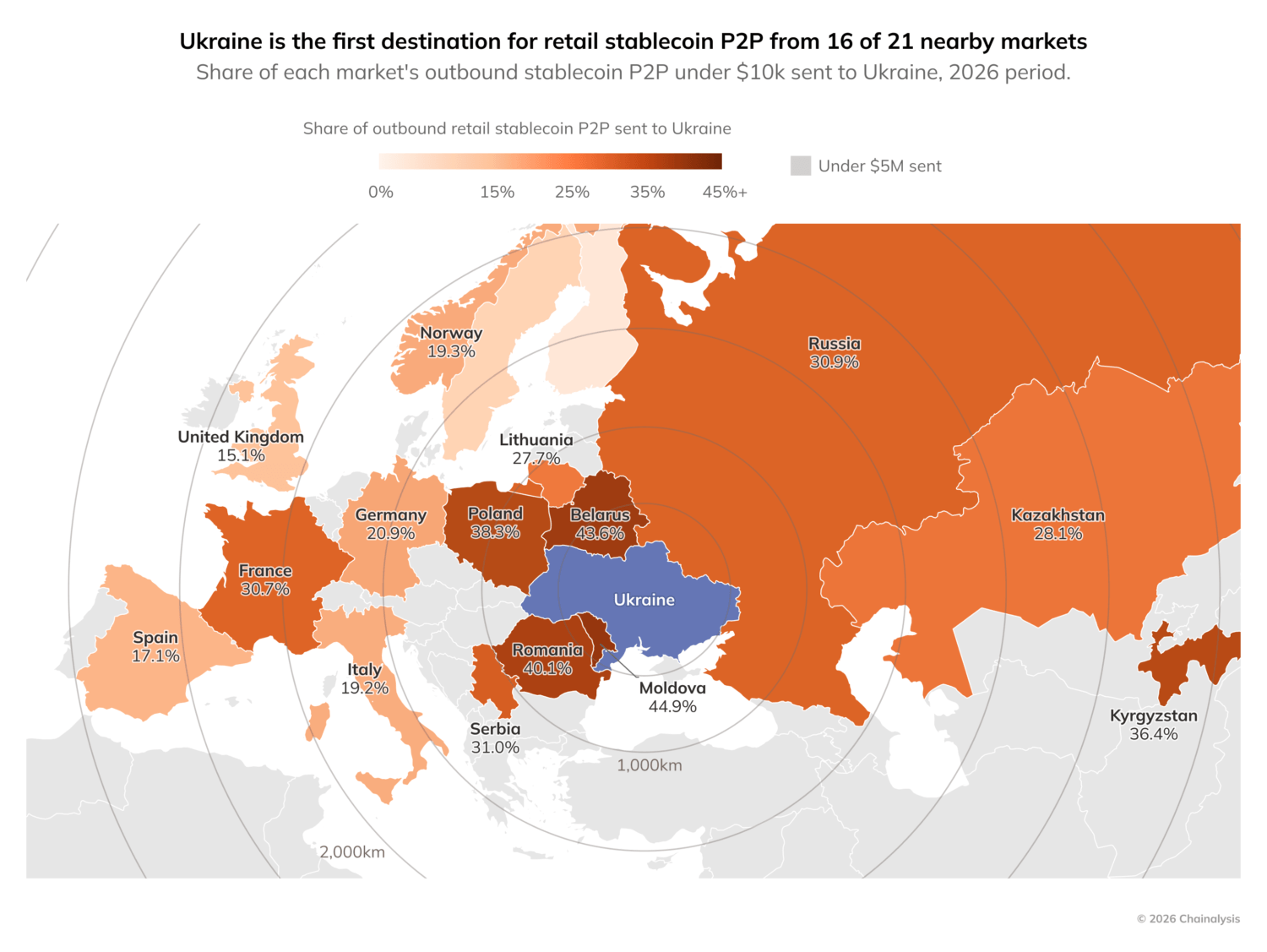
Figure: Ukraine is the primary destination for retail stablecoin P2P remittances in 16 neighboring Eastern European countries
In an environment marked by high inflation, wartime foreign exchange controls, and the lengthy processing times coupled with exorbitant fees of traditional cross-border bank remittances, stablecoins pegged to the US dollar have become the "hard currency" for millions of Ukrainian civilians sending family support and pursuing commercial self-rescue across borders.
The Polish Hub: Hosting Over a Third of Crypto ATMs and Surging P2P Cash-Outs
As the key frontline nation accepting the most displaced Ukrainians, Poland has rapidly evolved into the largest crypto-fiat exchange and cash-out hub across Eastern Europe.
Data shows that Poland alone accounts for approximately 38.5% of all crypto ATM terminals in Eastern Europe, forming an exceptionally dense offline physical network.
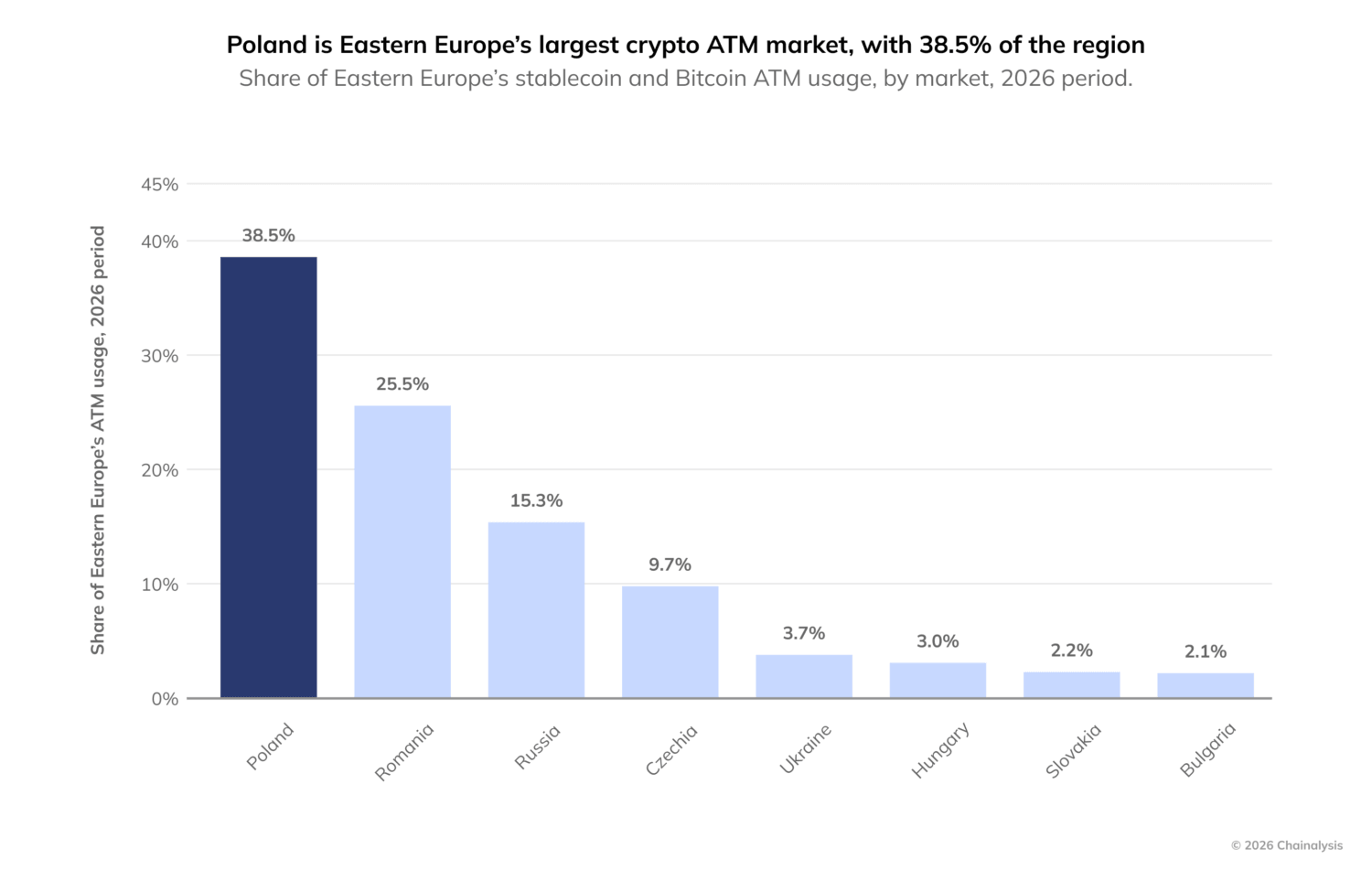
Figure: Poland holds 38.5% of all crypto ATM terminals in Eastern Europe, ranking as the region's largest market
Among various cash-out channels, Poland’s crypto ATMs demonstrate astonishing growth momentum. Over the past year, transaction volumes for Poland’s crypto ATMs increased by 21.8% year-over-year, while the total amount of fiat cashed out surged by 28.6%, significantly outpacing both the Eastern European average and all other fiat cash-out channels.
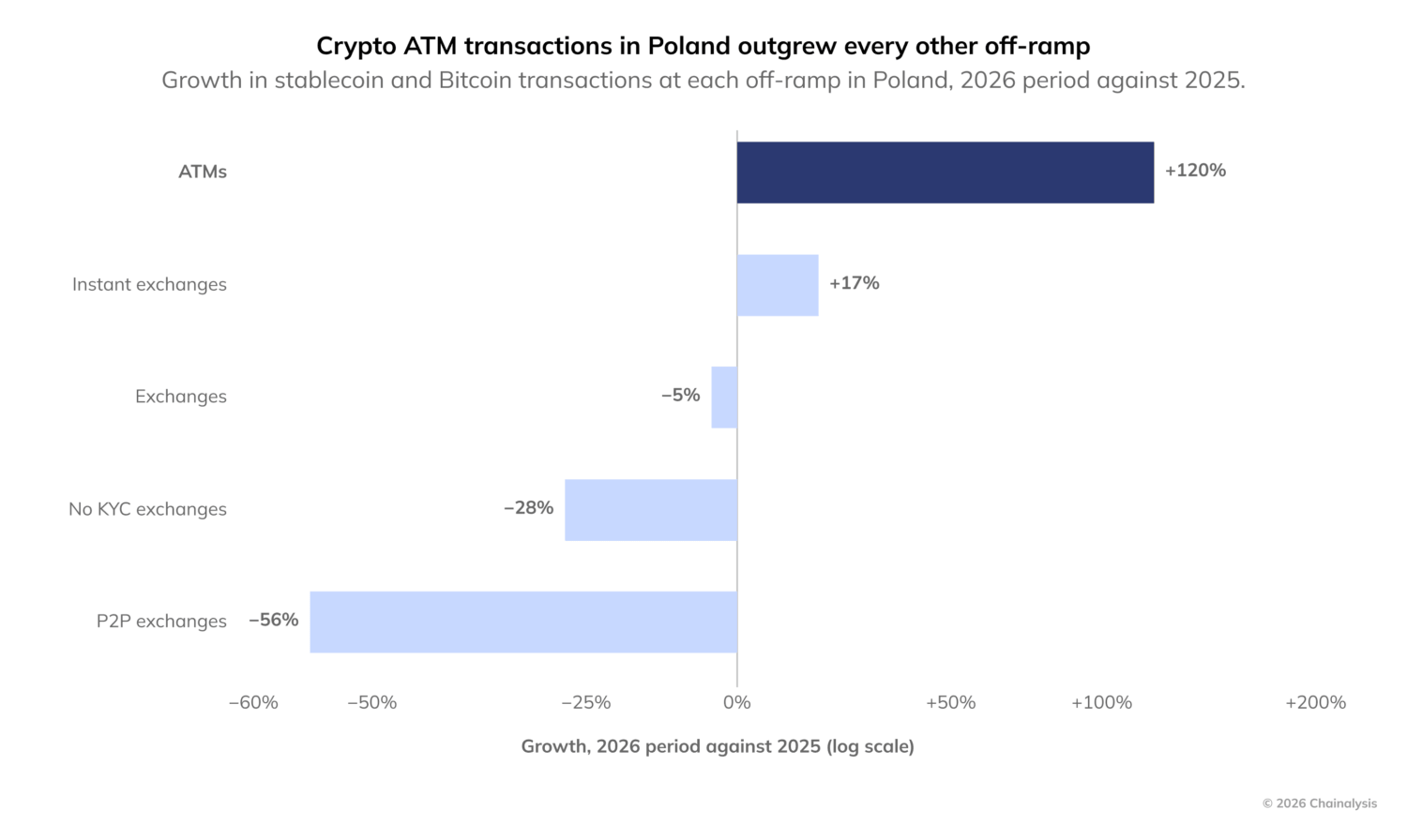
Figure: Transaction count and amount growth rates of Poland's crypto ATMs far exceed other traditional cash-out channels
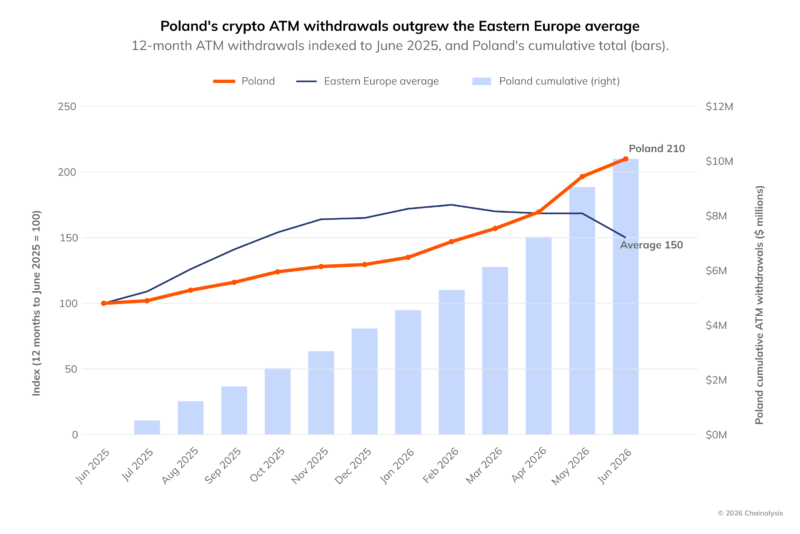
Figure: Growth rate of cash-out volume at Poland's crypto ATMs consistently outperforms the broader Eastern European average
More notable is the drastic shift in asset composition. In Poland’s P2P trading landscape, the total trading volume of stablecoins (USDT/USDC) quadrupled, while traditional Bitcoin P2P trading volume shrunk by a third.
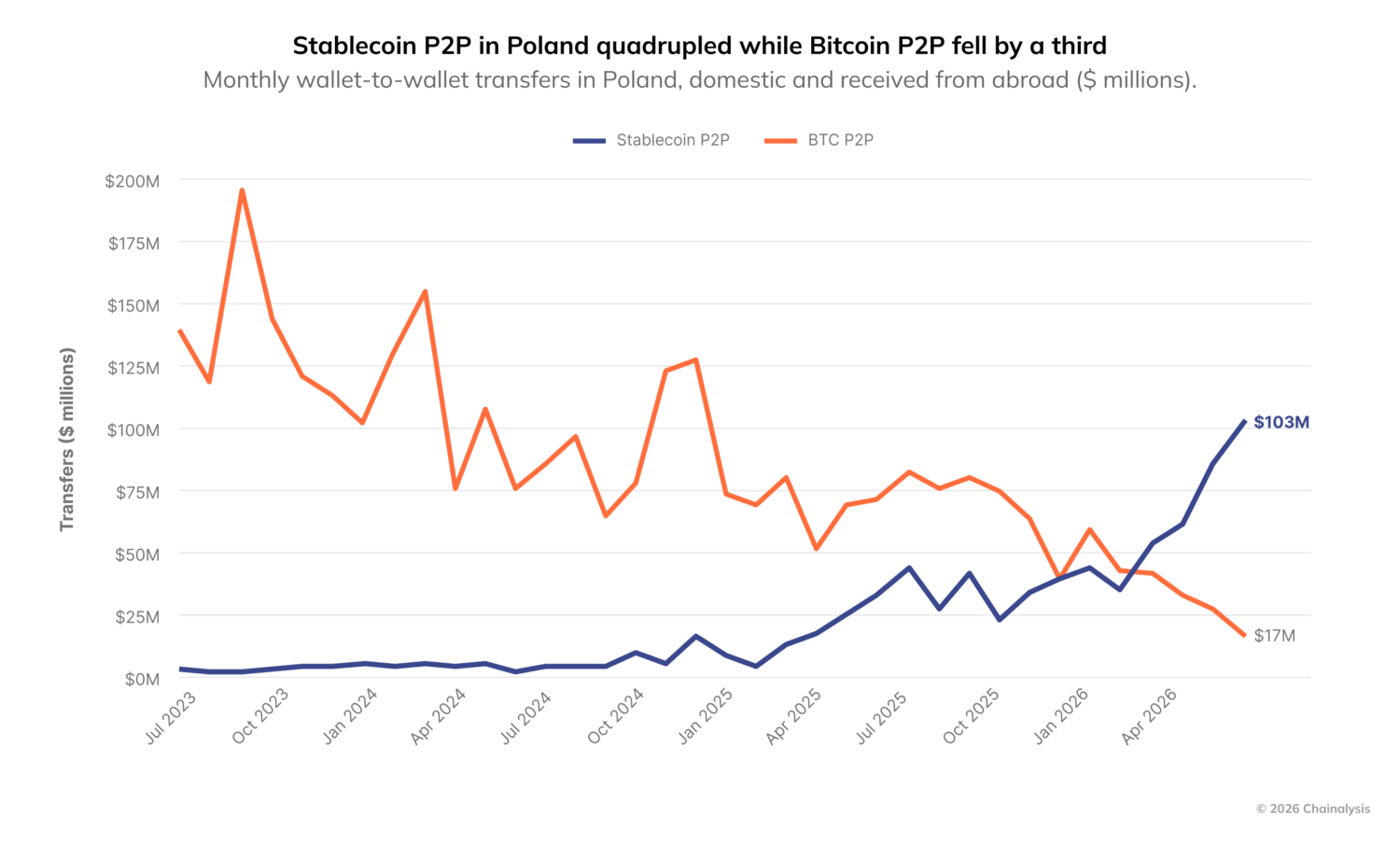
Figure: Poland's stablecoin P2P volume soared fourfold, while Bitcoin P2P declined by one-third
This fully demonstrates that crypto assets in Eastern Europe have long transcended pure price speculation and investment tools, evolving comprehensively into daily settlement infrastructure characterized by high liquidity, price anchoring, and instant settlement.
The Tax Reform Shockwave: How Romania’s Stringent Tax Laws Drive Funds Toward Permissionless Trading
If the cross-border refugee flows showcase the risk-hedging value of crypto technology, the Romanian case vividly illustrates the massive backlash power that government regulation and tax policies exert on on-chain capital flows.
In late 2024, the Romanian government signaled plans to abolish the long-standing tax exemption for micro-crypto transactions below 200 RON (approx. $45) per trade and 600 RON (approx. $135) annually, while imposing a uniform tax rate on all crypto gains.
Upon announcement of this legislative measure, the Romanian market immediately underwent a severe restructuring driven by risk aversion.
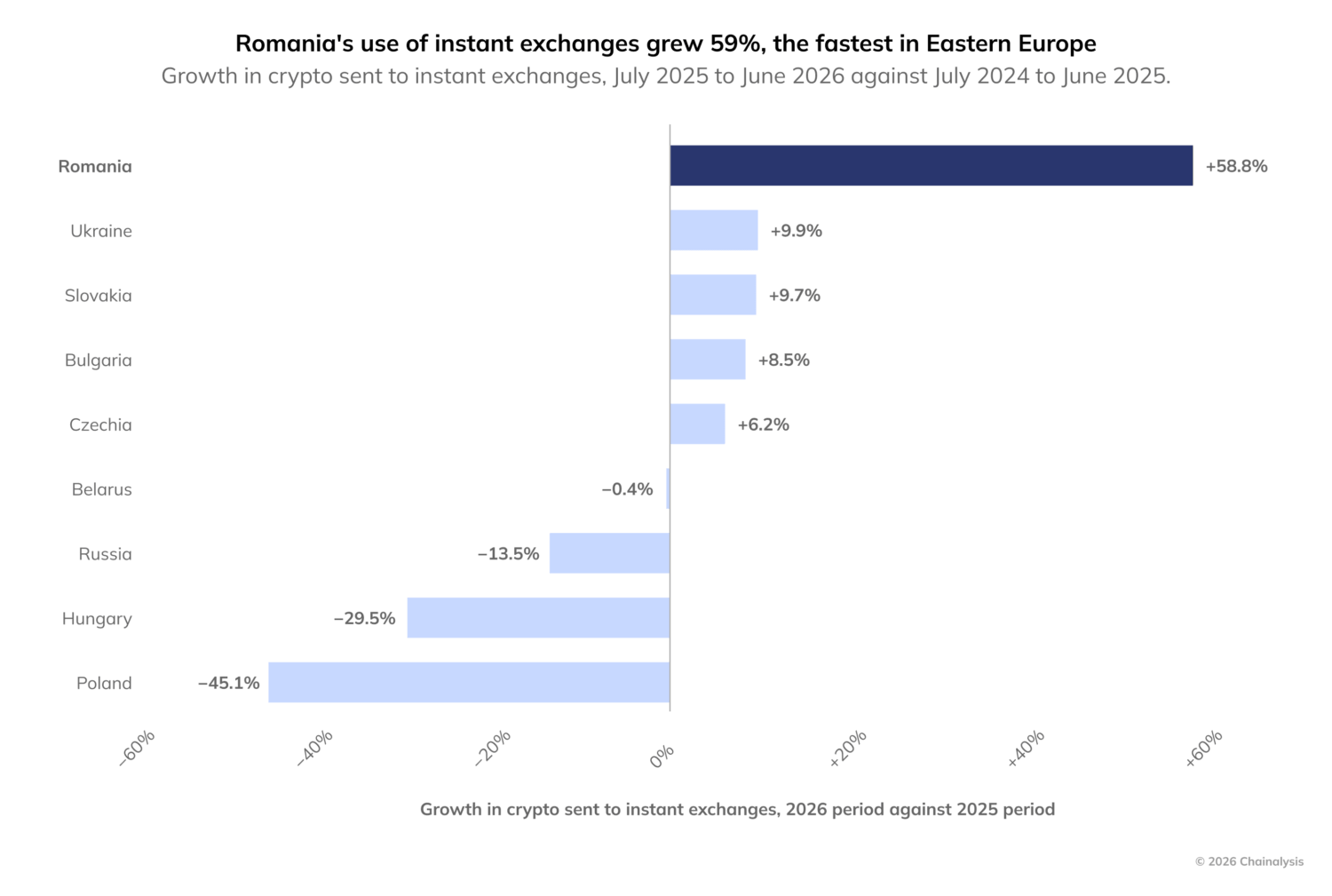
Figure: Usage of instant exchanges in Romania surged 59%, recording the highest growth rate in Eastern Europe
On-chain data shows that following the announcement, the market penetration rate of mainstream centralized exchanges—which mandate strict KYC and regular reporting to tax authorities—plummeted dramatically in Romania, falling from above the Eastern European average to well below the mean.
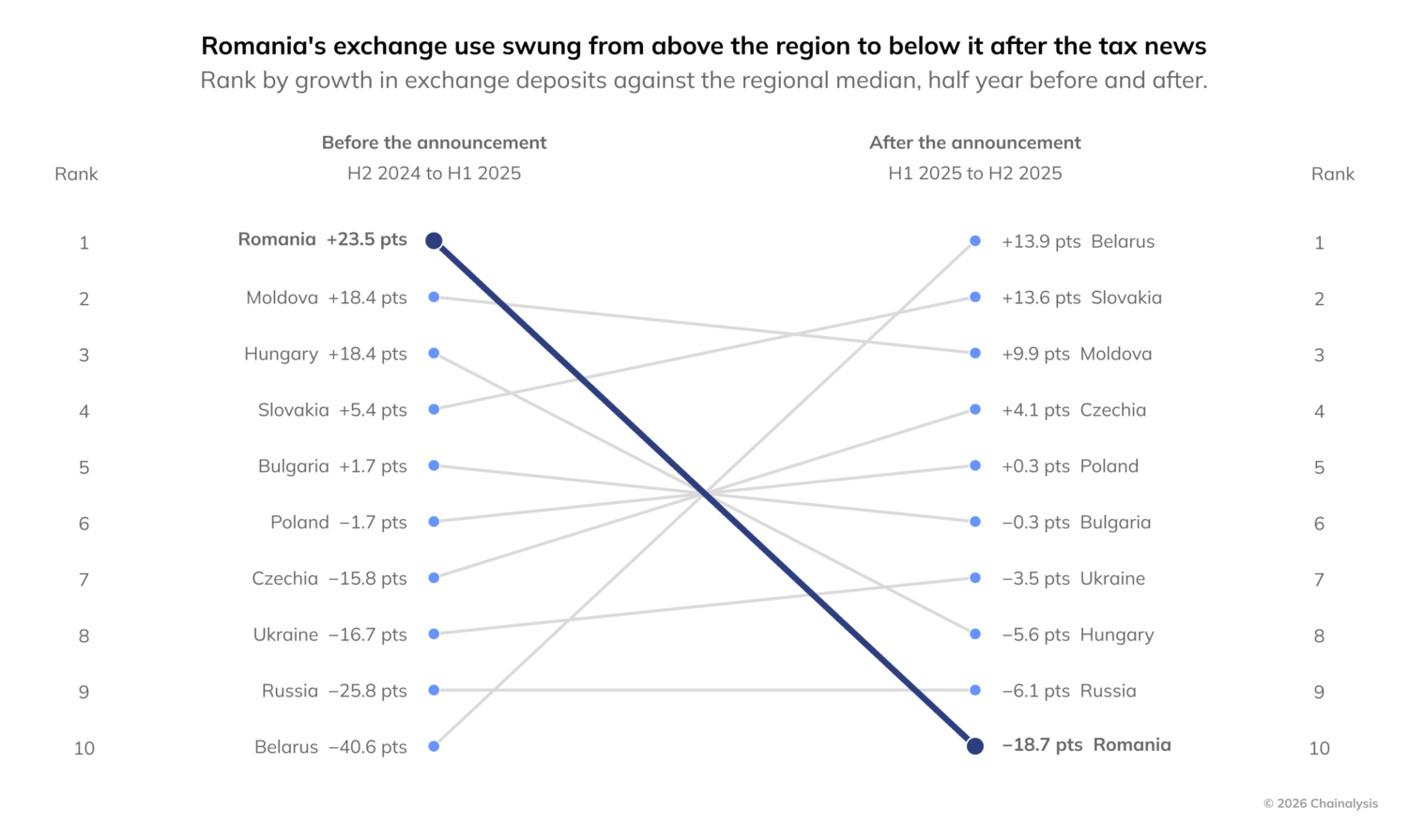
Figure: Compliant exchange usage in Romania experienced a cliff-like drop after the tax reform announcement
The displaced funds did not leave the crypto ecosystem; instead, they flooded into account-less, ID-free "Instant Exchanges" and decentralized alternatives. Their share of fund inflows skyrocketed by 59%, leaping to first place in Eastern Europe.
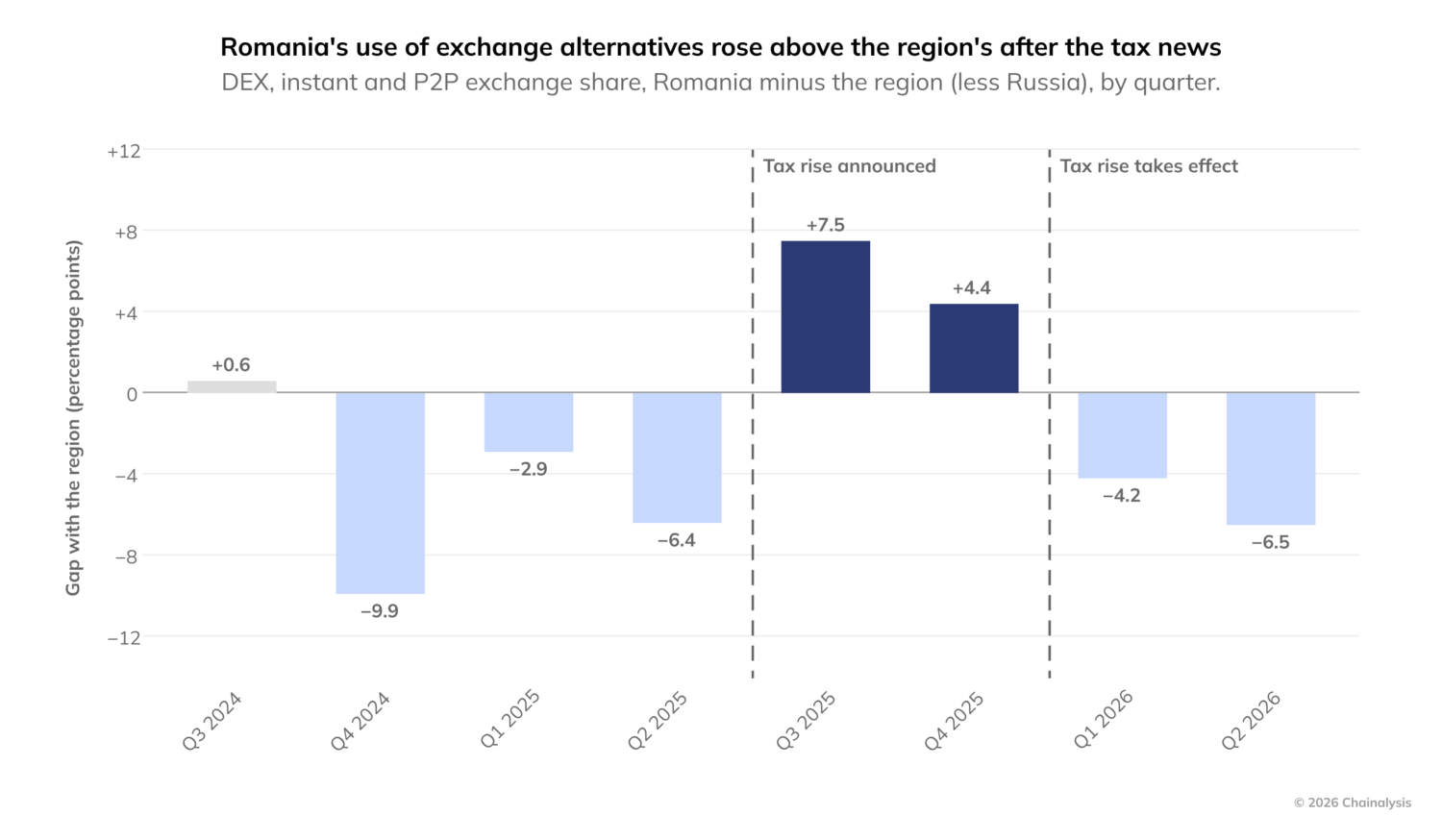
Figure: Strict tax enforcement pushes Romanian users entirely toward decentralized and alternative trading channels
The Romanian case serves as a warning to regulators worldwide: in the highly censorship-resistant world of blockchain, blunt taxation and restrictions rarely yield expected fiscal revenue. Instead, they often drive substantial compliant trading activity into unlicensed underground channels that are harder to monitor and lack consumer protections.
Conclusion & Reflection: The Essential Need for Crypto Amid Turbulent Geopolitics
The crypto landscape in Eastern Europe is far richer and heavier than the simple bull-or-bear curves suggest.
Here, cryptocurrency is not a technological utopia discussed in Silicon Valley salons, nor merely an arbitrage code in Wall Street quantitative models. It is a hard tool used by ordinary people to safeguard their labor earnings and family livelihoods amidst spreading wars, currency devaluation, seeking refuge abroad, and shifting policies.
From the crypto ATMs queuing up day and night on Polish streets to the stablecoin P2P remittance networks connecting Ukrainian refugee families, Eastern Europe is proving to the world that when traditional financial order fractures, the fundamental value of blockchain as an open finance protocol truly comes alive.
Join TechFlow official community to stay tuned
Telegram:https://t.me/TechFlowDaily
X (Twitter):https://x.com/TechFlowPost
X (Twitter) EN:https://x.com/BlockFlow_News
 Chainalysis