With all licenses secured, why are crypto payments still failing to run properly?
Author: Shao Jiaodian
At a certain stage of development for a crypto payment project, licenses are typically not the first issue to surface. A company may already hold a CASP authorization, complete its FinCEN MSB registration, and integrate with overseas licensed payment institutions, yet its operations still hit bottlenecks at specific stages such as handling client funds, managing wallet controls, maintaining fiat currency accounts, and processing merchant settlements.
Once the business actually goes live, several issues quickly come to light: an institution capable of handling digital assets may not be authorized to execute Euro payments; banks may be willing to open operational accounts but refuse to allow them to pool third-party client funds over the long term; and the entities responsible for client acquisition, contract signing, wallet control, and transaction execution may also be different companies within the same group.
As a result, each company in the group has its own regulatory identity, yet the entire transaction still cannot be completed smoothly. Having more licenses does not solve this problem; the key lies in whether clients, assets, fiat currencies, and liabilities converge onto a single, executable business chain.
A license can only answer whether an entity is permitted to conduct a regulated activity. Who receives the client, who controls the stablecoins, who disburses the Euros, why the bank accepts these funds, and who handles refunds or account freezes—all of these must be mapped to specific entities, contracts, accounts, and system permissions.
In previous articles, we separately discussed U.S. MSBs, Canadian MSBs, Australian DCEs, EU MiCA CASPs, Dubai VARA, Hong Kong stablecoin regulations, and licensed partnerships. Returning to the practical operations of crypto payments, the core question remains quite straightforward: every step has its compliance arrangements, so why do transactions still fail to go through?
The focus of evaluation should be on which entities, accounts, and systems the transaction actually passes through, rather than simply reviewing a list of licenses.
The project needs to break down client wallets, asset custody, stablecoin conversions, on-chain transfers, fiat payments, and merchant settlements item by item, clearly stating which entity completes each function, under what authorization it operates, and who bears liability in case of issues.
The project requires a mapping table linking business functions to regulatory identities: specifying which entity handles client wallets, asset custody, stablecoin conversions, on-chain transfers, fiat payments, and merchant settlements, respectively, along with the corresponding authorizations and liability assignments.
Licenses Not Mapped to Actual Business Operations
The most common mistake projects make is grouping all regulatory qualifications obtained by the group onto a single promotional page, then assuming these licenses collectively cover the entire scope of business.
For example, the group holds a U.S. MSB registration, an EU CASP authorization, and established partnerships with licensed payment institutions in other regions. These regulatory statuses are undoubtedly valuable, but they cannot be simply added together.
A U.S. FinCEN MSB registration is not a unified operating license covering nationwide money transmission activities; specific operations must still be evaluated against state-level regulations.
An EU CASP can enter other member states through MiCA’s passporting mechanism after completing the required cross-border notification, but it can only provide crypto-asset services within the scope of its original authorization across borders. Completing passporting does not automatically grant it full operational permissions akin to those of a Payment Institution or Electronic Money Institution.
For stablecoin payment projects, the complexities may run even deeper. On March 2, 2026, the transitional period previously set by the EBA for aligning MiCA with PSD2 ends. Certain services involving the transfer of Electronic Money Tokens (EMTs) and custodial wallets may simultaneously require resolution of payment service authorizations.
This means the project cannot merely ask how many licenses the group holds; it must verify item by item: under which entity’s specific authorization do client wallets, asset custody, stablecoin conversions, on-chain transfers, fiat payments, and merchant settlements fall?
What the project actually needs is a functional mapping table aligned with regulatory identities, not a simple inventory of group licenses.
Mismatched Client Relationships, Asset Control, and Fund Paths
Imagine a corporate client preparing to pay for goods to a European merchant.
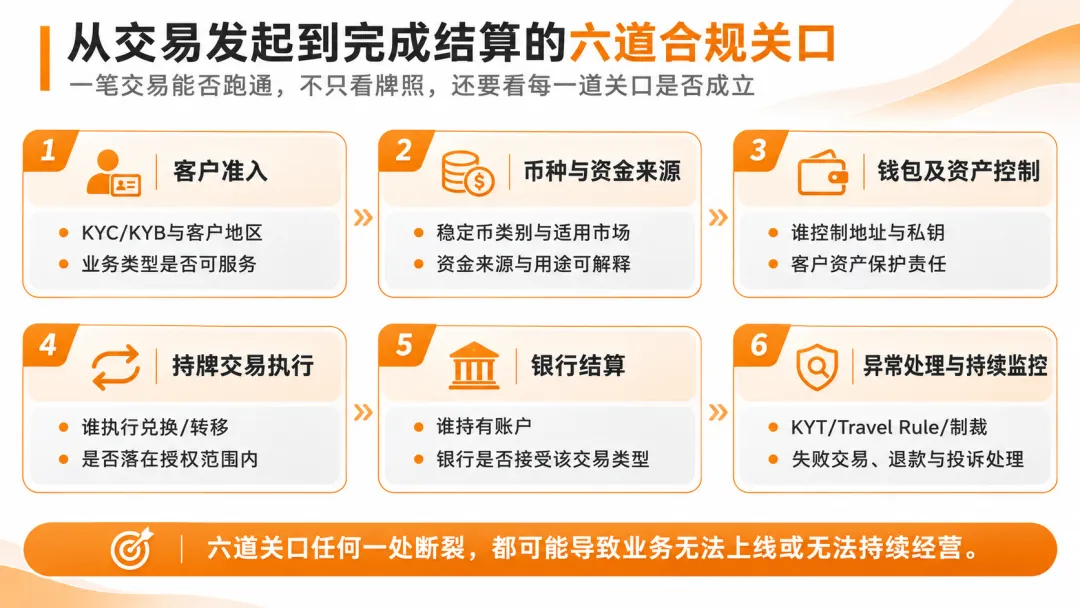
The client registers on the project’s official website, submits corporate documentation, and completes KYC/KYB checks before transferring stablecoins to the platform-specified wallet. After the platform executes the conversion, it routes Euros to the merchant’s bank account through a payment partner.
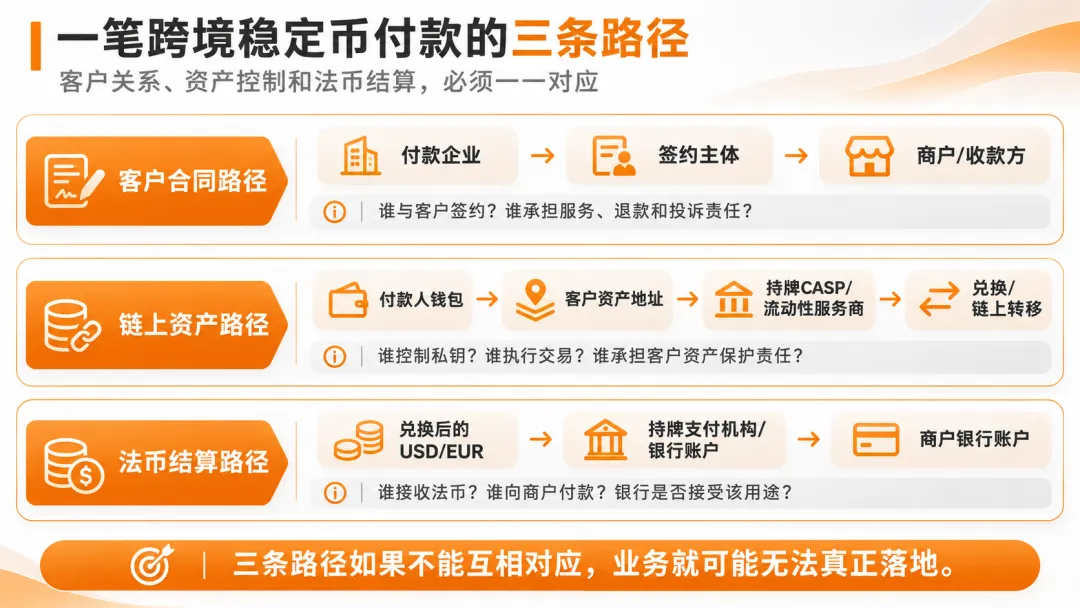
To the user, it may look like a single payment, but regulators and bank due diligence require reconstructing at least three distinct paths.
The first path concerns client relationships. Which exact group company did the client sign a service agreement with? Is the client purchasing a digital asset conversion service, a funds transmission service, or a comprehensive cross-border payment service? Which entity is responsible when refunds or complaints arise?
The second path relates to crypto-asset control. Into which address does the client’s stablecoin land? Who controls the private keys? When are the assets transferred to the CASP or liquidity providers? Who holds the authority to execute trades, and who bears the responsibility for safeguarding client assets?
The third path covers fiat fund routing. Whose account receives the USD or EUR after stablecoin conversion? Does that account permit receiving such funds? Who ultimately executes the payment to the merchant, and can the bank identify the actual payer and payee?
If the client signs with an EU CASP, but assets and fiat funds remain under the long-term control of other entities lacking corresponding operational permissions, the project must reassess the actual service-providing entities and their legal liabilities.
Even if a contract labels an arrangement as a “technical service,” but the technology company actually receives client funds and dictates trade executions, one cannot assume it falls entirely outside financial regulatory oversight solely based on the contract title.
Holding Licenses Does Not Guarantee Bank Willingness to Process Transactions
This is where the previously mentioned issues tend to converge and become most apparent.
A company may have obtained regulatory approvals and found partners capable of providing fiat services, yet still struggle to establish stable deposit and collection accounts.
The reason may not necessarily be banks’ rejection of the crypto industry, but rather the proposed account purposes failing to gain bank approval.
For instance, just because a bank permits a company to open an account for payroll, rent, and normal operating expenses, it does not mean that account can directly be used to receive payment funds from multiple third-party clients.
The fact that a licensed institution can handle specific types of financial transactions does not imply that its banking partners have approved all client jurisdictions, transaction amounts, funding sources, and merchant categories.
The European Banking Authority (EBA) emphasizes that financial institutions should assess risks based on customers’ actual profiles and should avoid implementing excessive de-risking across entire customer segments without sufficient justification. Nevertheless, banks must still comply with anti-money laundering requirements and decide whether to establish or maintain business relationships when they cannot effectively manage associated risks.
Therefore, even if licensed, the project must explain to banks: the specific intended use of the accounts, how client funds are aggregated, whether transactions correspond to genuine commercial activities, which steps on-chain assets pass through, and how the enterprise identifies and manages abnormal transactions.
If this explanation holds no weight, simply accumulating more licenses will likely not resolve the account-opening challenges.
Licenses demonstrate that a business has a legitimate foundation for operation, but banks still need to evaluate whether they can absorb the risks once that business enters their account ecosystems.
Consequently, truly mature licensing strategies should not wait until approvals are secured before approaching banks.
Account types, payment routing, settlement methods, and the operational scope of banking partners should be considered concurrently during the initial design of the licensing framework and group corporate structure.
Many Licensed Partners, Yet No One Bears Responsibility for the Complete Transaction
The crypto payment industry has already established numerous mature infrastructure partnership models.
Wallets can integrate with third parties, identity verification can leverage KYC service providers, conversions can be outsourced to liquidity providers, and fiat payments can be handled by Payment Institutions (PIs), Electronic Money Institutions (EMIs), or banks.
This division of labor itself poses no issues. For enterprises that do not intend to obtain licenses independently across all markets, strategically utilizing licensed institutions may even prove to be a more efficient business choice.
However, the more partners involved, the easier it becomes for responsibilities to fragment.
For example, a client payment gets halted due to an on-chain address triggering a risk alert. The wallet provider claims it only handles technology, the CASP argues KYC was managed by the frontend platform, the payment institution contends the asset origin falls outside its review scope, and the project team maintains the entire workflow has been handed off to licensed partners.
If parties only start debating who has the authority to freeze funds, who is responsible for issuing explanations, and who contacts the client upon encountering anomalies, it indicates that this partnership network lacks truly executable accountability frameworks.
Article 73 of MiCA sets clear requirements regarding CASP outsourcing: entities may outsource operational functions, but they cannot thereby transfer their own regulatory obligations, nor allow outsourcing to alter the relationship between the CASP and its clients or modify authorization conditions.
Licensed partnerships must address API integrations and revenue sharing, while also clearly defining boundaries of responsibility.
Partnership agreements must also specify client onboarding criteria, transaction instructions, asset control mechanisms, compliance monitoring, anomaly handling protocols, data sharing provisions, complaint and refund procedures, regulatory inspection readiness, and client migration processes following partnership termination.
For regulated services that the enterprise itself is already actively delivering, it cannot simply rely on a partner’s license credentials to substitute for necessary direct authorizations.
Whether a service can be delegated to others for execution is fundamentally different from whether regulatory liability can be shifted to someone else.
Operations Run Smoothly Initially, Yet Fails to Sustain Continuous Risk Management
Some projects can successfully execute test transactions and offer transfer and conversion services to a small batch of clients, but face significant obstacles once scaling up.
The root cause lies in the fundamental difference in requirements between executing a single transaction and sustainably operating a financial business over the long term.
Early-stage projects might only serve a handful of corporate clients, with relatively clear transaction origins and fund usage. However, as platforms expand into additional countries, onboard more merchants, support self-custody wallets, or integrate with multiple liquidity providers, risk management demands inevitably evolve accordingly.
In July 2026, the FATF released its seventh update on the implementation status of virtual asset and service provider regulation, specifically highlighting concerns over stablecoin abuse, transactions involving self-custody wallets, offshore VASPs, DeFi arrangements, and practical difficulties in enforcing the Travel Rule.
For crypto payment projects, this means compliance cannot merely rest on completing a one-time KYC check during account opening or purchasing a suite of on-chain analytics tools.
Projects must maintain continuous capability to identify clients and counterparties, monitor anomalous transactions, fulfill applicable Travel Rule information-sharing obligations, and mitigate risks related to sanctions, fraud, and suspicious funds.
A more pragmatic question arises: once client funds have entered the platform, how should situations be handled if a transaction fails to execute or a bank refuses settlement? If a partner abruptly ceases operations, can the platform promptly identify affected client assets and arrange refunds or other lawful disposals?
A truly mature risk management framework should span the pre-transaction phase, the execution process, and post-failure resolution.
Conduct a Full Stress Test with a Representative Transaction Before Launch
Instead of gathering all licenses and policy documents for a checklist review, it is far more effective to select a representative business scenario planned for launch and run a full end-to-end simulation.
For instance, an Asian enterprise pays for goods to a European supplier using compliant stablecoins, with the supplier ultimately receiving EUR.
The project must address the following questions methodically, aligning with actual operational workflows.
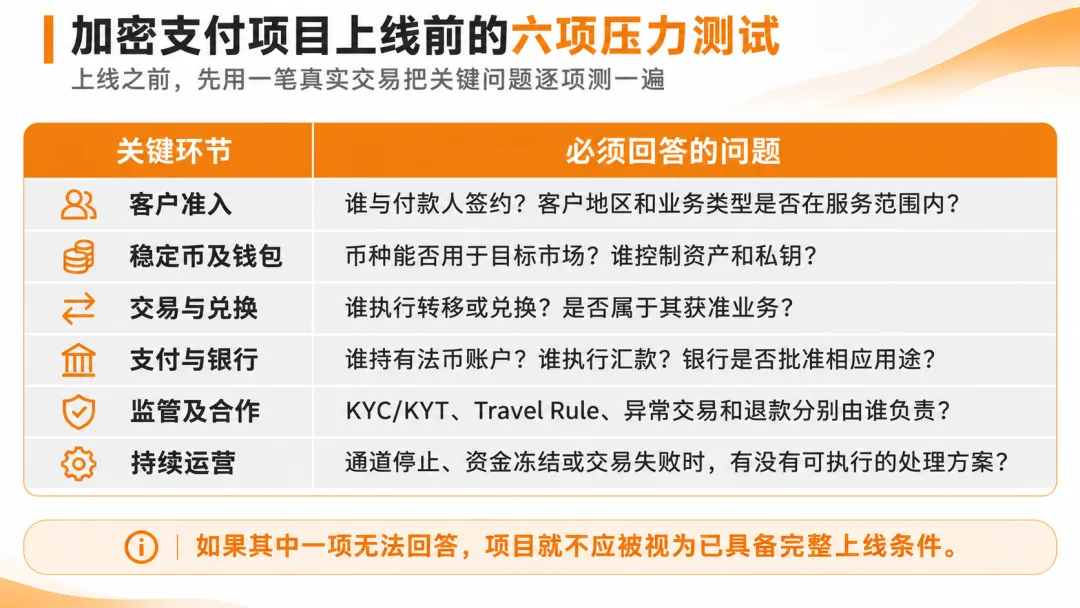
If any of these questions cannot be answered adequately, the project cannot claim readiness for full launch, nor can it mask this gap by pointing to existing licenses held at other stages.
Some issues cannot be resolved merely by acquiring an additional license. If banks reject certain types of client funds, adjustments to account structures and transaction flows may be necessary. Ambiguous internal group responsibilities might require reassigning contracting and asset-control entities. Should partners lack transaction data access capabilities, system permissions and contractual arrangements will need revision.
For enterprises, this auditing methodology offers a much closer approximation to real-world operations than simply tallying license quantities.
Coordinating Multiple Licenses: Three Essential Maps Are Indispensable
An enterprise planning to sustain global crypto payment operations over the long term does not necessarily need to establish completely independent business frameworks in every market.
However, it must verify that disparate regulatory entities can operate collaboratively under clear governance rules.
A more rational planning approach can be divided into three phases.
Phase One: Design the Business Model First, Then Select Regulatory Pathways.
The project must clarify which countries host primary clients, where capital originates, where final settlements occur, and whether the product involves issuance, custody, conversion, fund transfers, or traditional payment services.
Only on this basis can it be determined which qualifications the group must secure independently and which operations can be fulfilled through licensed partnerships.
Phase Two: Concurrently Design Licensing, Accounts, and Fund Routing.
Enterprises should determine client contracting entities, asset control mechanisms, bank account purposes, payment partners, and internal/external service agreements during the initial corporate structuring phase, rather than incrementally adding new subsidiaries for each new license obtained.
For projects intending to expand across multiple markets, proactive consideration must be given to local client onboarding requirements, cross-border service restrictions, and the boundaries of permissible business activities.
Phase Three: Validate the Entire Framework Through Live Transactions.
Prior to formal mass deployment, representative clients and transaction types should be selected to verify alignment among capital flows, information flows, and liability streams according to approved testing protocols. Capabilities must also be stress-tested across scenarios involving anomalous transactions, partner disconnections, refunds, and customer complaints.
The emphasis lies not on executing a single successful payment, but on confirming whether the entire operational model can sustain continuous execution in live environments.
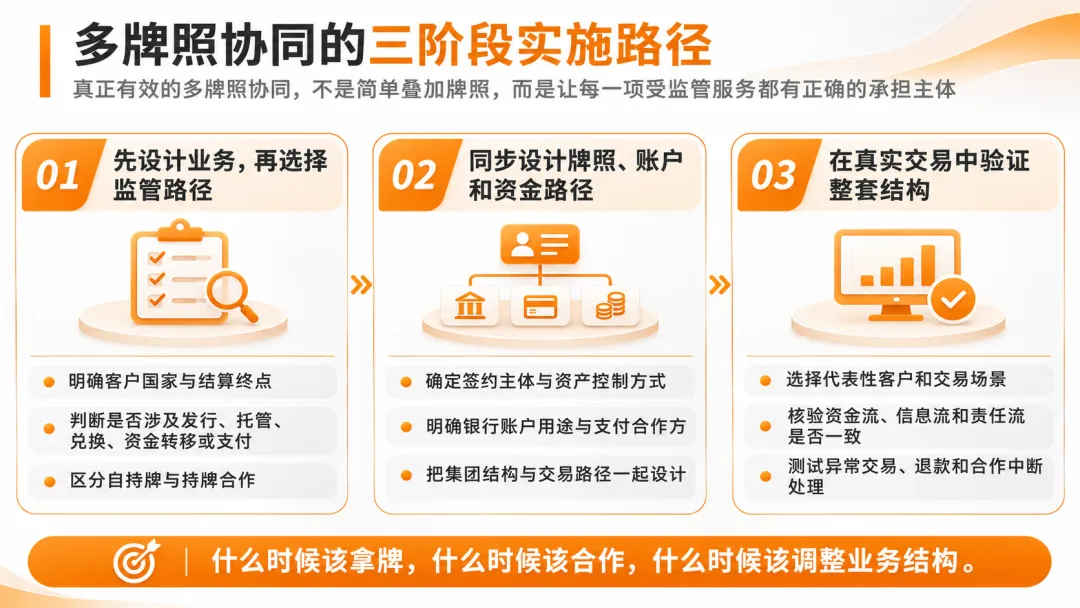
Knowing when to acquire licenses, when to pursue partnerships, and when to restructure business operations.
Conclusion: Licenses Must Ultimately Translate into Executable Payment Routes
From U.S. MSBs, Canadian MSBs, and Australian DCEs, to Salvadoran DASPs and Cayman VASPs, extending to EU MiCA, Dubai VARA, Hong Kong stablecoin frameworks, and multi-license coordination, we have examined varying national and regional regulatory pathways in our "Global Crypto Payment Compliance Map" series.
Each regulatory regime possesses distinct characteristics tailored to specific markets and operational requirements.
Yet viewing the entire series holistically reveals a unifying concern running through every installment:
The challenge for a crypto payment project extends beyond merely identifying what individual jurisdictions permit; it equally demands figuring out how to interconnect disparate countries, financial institutions, and operational functions.
A single MSB registration cannot substitute for state-level permits; one CASP authorization does not automatically encompass all fiat payment services; a VARA license cannot inherently resolve every payment token-related issue; and hosting multiple licensed partners does not guarantee banks will gladly accept associated funds.
Projects should prioritize structural integrity in their operational architecture over sheer license counts.
Who serves as the client-facing provider, who lawfully holds and transfers assets, who executes conversions and payments, why banks consent to route funds through them, and who assumes liability during anomalies.
Only when every question yields precise answers do licenses genuinely transform into substantive business capabilities.
The ultimate objective of global crypto payment compliance is not to equip every enterprise with the maximum number of licenses, but to ensure that each fund movement traverses a lawful, transparent, and sustainable payment pathway.
This constitutes the core inquiry that the entirety of the "Global Crypto Payment Compliance Map" series aims to resolve.