
Amid a sweeping Q3 market downturn, how much is Circle still worth?
Author: Web3 Xiaolv (Will Awang), DuKe Fintech
Following the Q3 earnings release, Circle fell alongside tech stocks and crypto assets. Looking solely at the financials, adjusted EBITDA rose from $143 million to $317 million, representing a significant increase. However, after deducting ARC presale revenue, the figure drops to approximately $135 million, lower than both of the previous two quarters.
Circle’s total revenue and reserve income for Q3 2026 stood at $865 million, up approximately 23% quarter-over-quarter. Of this, reserve income was $658 million, down approximately 1.5% quarter-over-quarter; other revenue was $207 million, compared to $34 million in the previous quarter. Third-quarter other revenue included approximately $182 million from ARC token presales.
Adjusted EBITDA for the quarter reached $317 million, a quarterly increase of approximately 122%, with the group's RLDC margin rising from 41.2% in the prior quarter to 52.4%.
When the Q1 earnings were released, we calculated Circle's valuation once. This time, let's recalculate the stablecoin business (issuance + payments): how much value can the reserve business support, and how much valuation can the payment business contribute?
ARC Presale Inflates Profits, USDC Average Balance Declines
At first glance, the Q3 earnings look strong. Total revenue and reserve income increased from $701 million to $865 million in Q3, with approximately $182 million derived from ARC token presales. The company recognized approximately three-quarters of the presale revenue after the public mainnet launch, along with the completion of token minting and delivery.
Excluding ARC presale revenue, total revenue and reserve income for Q3 was approximately $683 million. By directly subtracting the ARC presale revenue from the disclosed adjusted EBITDA, we arrive at approximately $135 million, which is lower than the $143 million in Q2 and $151 million in Q1.
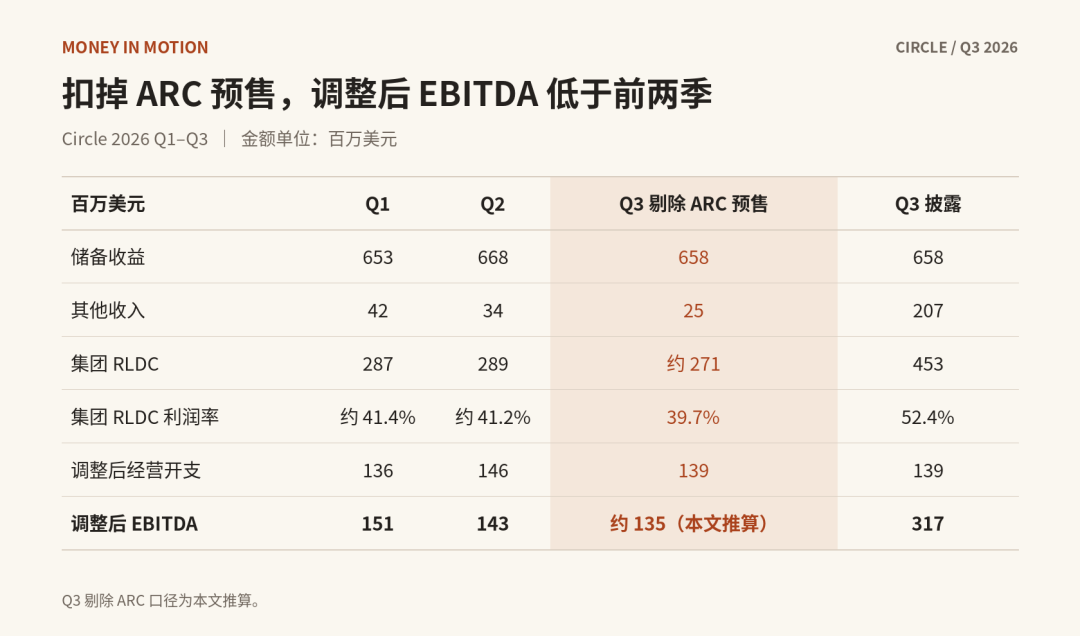
RLDC in the table represents the amount remaining from total revenue and reserve income after deducting distribution, transaction, and other costs. Dividing this figure by total revenue and reserve income yields the group's RLDC margin.
For Every $100 Earned in Reserve Income, Circle Keeps 80 Cents Less
Reserve income decreased from $668 million to $658 million in Q3. The reserve yield marginally increased to 3.54%, failing to offset the impact of a 4% decline in average USDC circulating supply. The average balance for the quarter was $73.3 billion.
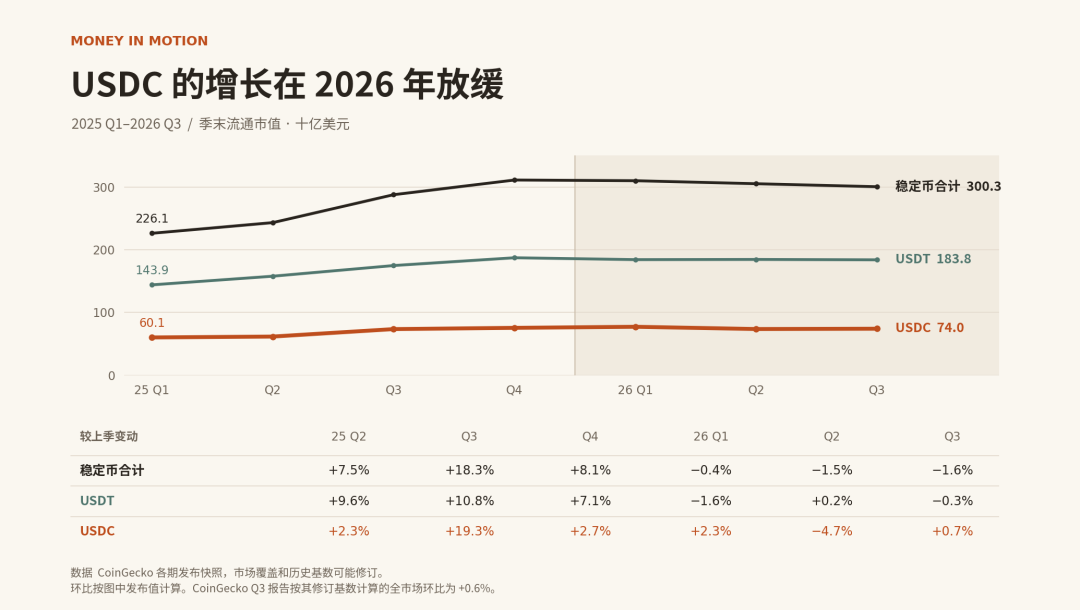
(The chart shows end-of-quarter market capitalization; what impacts reserve income for the quarter is the average quarterly balance. The main chart retains published values for each period, while the Q3 quarter-over-quarter change for combined stablecoins uses CoinGecko's revised Q2 baseline.)
For every $100 earned in reserve interest in Q3, after deducting related distribution and transaction costs, Circle retained $37.80. In Q2, it could retain $38.60. The CFO attributed this decline primarily to the Hyperliquid partnership running its full course for the quarter, with the associated USDC balances held on Coinbase.
The profit-sharing terms under Binance's renewed agreement will only run their full course starting in Q4.
Coinbase and Circle renewed their contract under the original terms. The terms remained unchanged, but where the funds are held did.
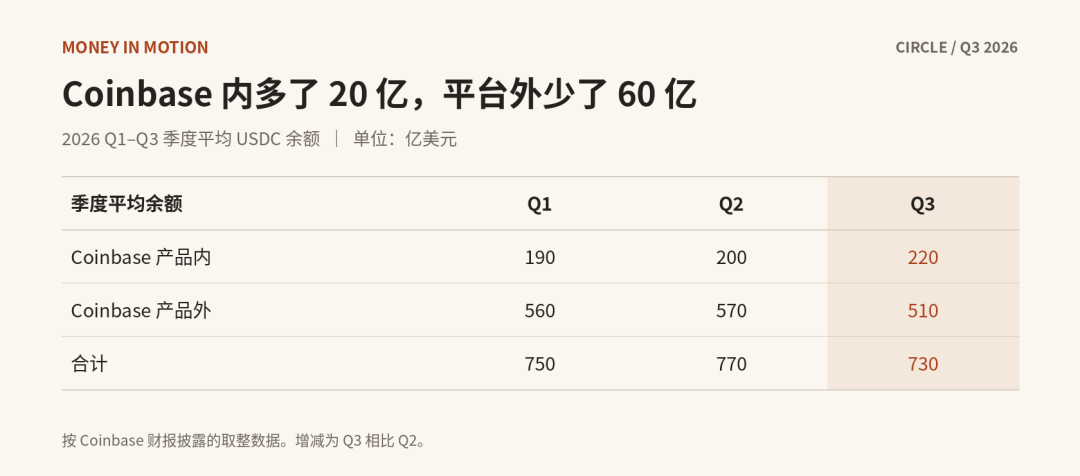
Based on rounded figures disclosed by Coinbase, the average USDC balance across the entire network decreased by $4 billion in Q3. There was an increase of $2 billion within Coinbase products, offset by a decrease of $6 billion outside the platform. Allaire aims to incentivize major channels more heavily to eventually drive USDC growth outside the platform. However, no growth in off-platform balances has been observed this quarter.
Market drawdowns may also be dragging down balances; this needs to be evaluated over the next few quarters.
Payment Volume Increased, So Where Is the Revenue?
Excluding ARC presales, Circle's other revenue dropped from $42 million in Q1 to $34 million in Q2, falling to just about $25 million in Q3. Management stated that fewer blockchain integration projects contributed to revenue recognition this quarter. We believe this will become the norm going forward, as there are now very few new public chains or integration projects being launched.
What we want to know more is whether payments can generate a consistent, recurring quarterly revenue stream.
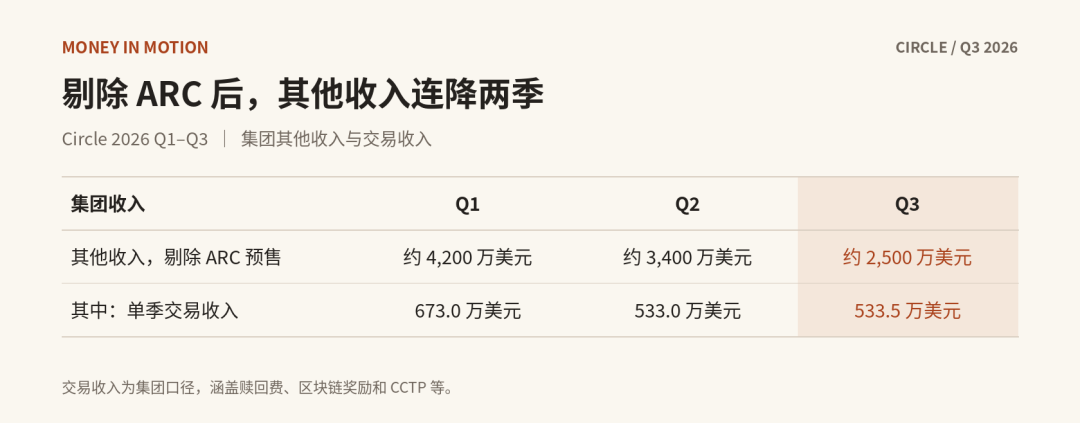
Other revenue also includes subscription and service fees for chain integrations and maintenance, fund management, etc. Transaction revenue covers redemption fees, blockchain incentives, and digital asset trading infrastructure income (including CCTP). Q2 transaction revenue was derived by taking the nine-month cumulative figure and deducting Q1 and Q3 amounts.
CPN Payment Volume Surged, But How Much Shows Up in the Financials?
The Circle Payments Network (CPN) connects financial institutions, using stablecoins for cross-border settlements. Its end-of-quarter annualized payment volume rose from $8.3 billion in Q1 to $14.7 billion in Q2, reaching $41.3 billion in Q3. This figure is extrapolated from approximately $3.4 billion in transaction volume during the last 30 days of the quarter.
At a fee rate of 5 basis points (0.05%), running at the Q3-end pace for a full year would translate to approximately $20.65 million in revenue for CPN. The financial reports only disclose the group's total transaction revenue, which also includes items such as redemption fees, blockchain incentives, and CCTP. It remains unclear exactly how many CPN transactions are fee-bearing and how much they actually generate.
How Much of Tazapay’s Volume Will Turn Into Circle’s Revenue?
Circle plans to acquire its still-unheld stake in Tazapay for approximately $400 million in stock, with purchase price adjustments made upon closing. Tazapay boasts an annualized payment volume exceeding $25 billion, with about 60% involving stablecoins. It had previously served as a design partner for CPN.
Since Tazapay was already a CPN partner, why acquire it? It holds a customer base and possesses a network for routing payments to local bank accounts. By acquiring these capabilities, Circle will have the opportunity to onboard more transactions and facilitate inbound payments, FX conversion, and outbound disbursements. Based on Q3-end volumes, if a 10 bps fee is charged by 2027, the annualized revenue would reach approximately $41.3 million.
Should Tazapay simultaneously bring new chargeable transactions, payments could contribute even more to other revenue.
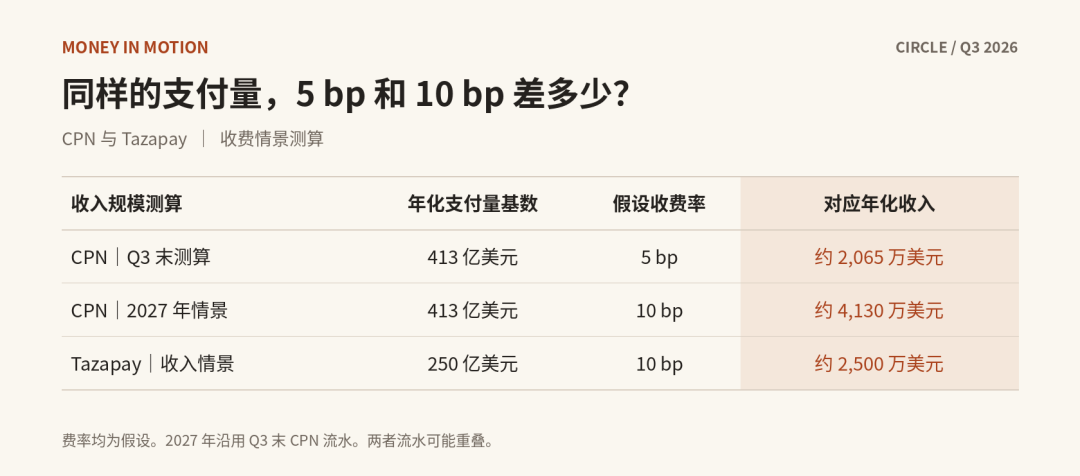
The table tests two different fee rates using the same CPN payment volume. There will be significant overlap in volume between the two, so they cannot simply be added together. However, the Tazapay volume is more concrete (the CPN figure is aggregated). The 10 bps is merely a uniform estimation assumption; actual revenue depends on which transactions are fee-bearing, who collects the fees, and how the revenue is split.
Assuming the deal is priced at an 8x P/E ratio, the equity acquired for $400 million would need to contribute approximately $50 million in after-tax net profit annually. Whether this price is worthwhile depends on how much Tazapay currently earns and how much additional profit Circle can extract post-acquisition.
What Is Each Tier of Circle’s Three-Layer Business Worth?
We continue using the May breakdown method, valuing the reserve business, other business, and ARC separately. Recalculating with this quarter's data, the primary range is approximately $59–$95 per share, with a neutral estimate around $77.
The first tier retains the Q1 multiple of 10x / 14x / 18x, referencing pricing for banks, custodians, and asset managers. 10x assumes no growth premium, 14x factors in the growth value of USDC, and 18x requires stronger scale expansion and stabilized interest rates. These multiples apply to the balance after reserve income is net of distribution, transaction, and other costs, before corporate operating expenses and taxes are deducted.
The second tier references valuations for high-growth payment companies, applying multiples of 20x / 25x / 30x to other revenue, with a separate 10x stress-test case. The third tier estimates approximately $750 million based on an ARC presale price of $0.30 per token, a 10 billion initial supply, and a assumed 25% retention rate post-sale.
The model uses an annualized Q3 reserve contribution of approximately $984 million and a midpoint of revised full-year other revenue guidance at about $138 million.
Share valuation = (Reserve contribution × multiple + Other revenue × multiple + ARC valuation + approximately $1.7 billion cash) ÷ approximately 256 million shares.
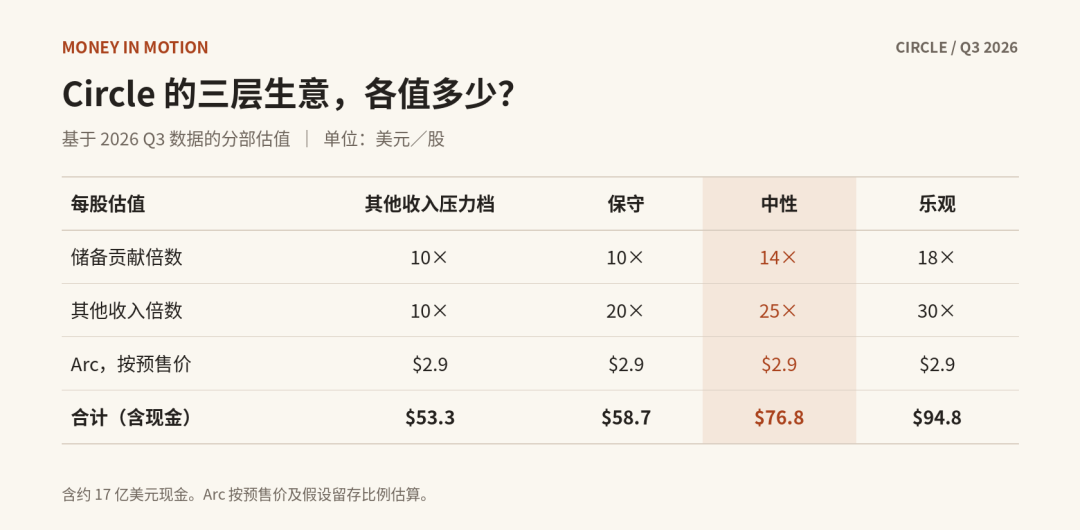
Full-year other revenue guidance, excluding the recognized ARC presale, ranges from approximately $128 million to $148 million. Tazapay is expected to close in 2027, and its profits plus newly issued shares are not yet factored into this table.
Both Mizuho and Citi attribute the Q3 beat primarily to the ARC presale. Looking ahead, Mizuho worries that profit-sharing will compress Q4's net reserve margin to slightly above 30%, according to sell-side projections.
Citi places greater emphasis on the adoption of payments and CPN, forecasting other revenue of approximately $400 million by 2027, though the public summary does not break out how much of that comes from recurring payment fees.
The Take | If the Money Doesn't Stay, Can It Still Profit?
Circle is attempting to make the same pool of capital generate two types of revenue. Money staying in USDC earns reserve income. Money flowing through the payment network earns service fees. Even if a transaction is converted back to fiat currency on the same day, it can still leave revenue for Circle, which is precisely why Tazapay is noteworthy (bringing the company closer to customers and solving the last-mile problem).
Q3 already revealed pressure on the first revenue stream. Balances are declining, channel profit-sharing is increasing, and the gap between issuance scale and shareholder returns is widening. The second revenue stream boasts substantial transaction volume, yet still lacks a clear breakdown of fees and costs. The 10 bps estimation indicates the business model is worth waiting for, but it is not yet sufficient to treat it as realized profit. (This projection likely extends to 2027.)
Therefore, the revenue structure in the upcoming Q4 will also face challenges: Binance's distribution agreement will reflect its impact over a full quarter, alongside compression in circulating supply and trading volume amid a less optimistic macroeconomic landscape.
Although we are seeing many newly launched stablecoins like OUSD targeting traditional finance payments, these are largely internal system stablecoins, posing very limited disruption to widely circulated market stablecoins like USDC and USDT. However, the overall stablecoin market continues to be influenced by macroeconomic conditions.
Regarding ARC, we essentially calculated only a presale price, which effectively prices in a call option. Future developments are set aside for now. This time, we focus solely on the value of CRCL under stress scenarios.
As for Agentic Payments, the CRCL narrative leans more toward the stablecoin angle, remaining largely thematic. There aren't particularly many practical applications (which are hard to reflect in financial statements), nor is there a clear synergy with AI gateway integrations (where fiat-side and card-processing sides would be more attractive).
Thus, in this recalculation, we care more about the underlying assumptions behind the valuation range. The reserve business supports today's operations, but the valuation the payment business can command depends on when it converts transaction volume into recurring revenue.
Ultimately, regardless of the narrative, the core objective boils down to driving massive adoption of USDC. This is the essence. Volume drives everything.
This article does not constitute any investment advice. The stablecoin industry is currently undergoing simultaneous shifts in regulation, competitive dynamics, and interest rate environments. Any variable arriving earlier or later than anticipated could completely undermine the conclusions drawn here, including the author's most confident assertions. The calculations in this article are merely one way to understand the issue, not a guarantee or commitment regarding stock price direction. Markets are always more complex than any framework. Please treat this article as a starting point for thought, rather than a guide for execution.
Join TechFlow official community to stay tuned
Telegram:https://t.me/TechFlowDaily
X (Twitter):https://x.com/TechFlowPost
X (Twitter) EN:https://x.com/BlockFlow_News
 0xWillmfer