Tether's Excess Reserves Halved in Q1: Were Gold and Bitcoin Declines the Main Reason?
By: Zennon Kapron, Forbes
Translated by: AididiaoJP, Foresight News
On September 9, Tether and Fasanara Capital announced the launch of StableFund. This is a private credit fund, with the two sponsors contributing a combined $400 million as startup capital, aiming to raise up to $3 billion from third-party institutions. Tether serves as co-sponsor, responsible for identifying financing opportunities related to USDT and providing stablecoin settlement infrastructure.
Note: Fasanara Capital is a London-based global asset management firm co-founded in 2011 by Francesco Filia, currently managing approximately $6 billion in assets, with a focus on fintech-driven private credit strategies.
The fund will lend to fintech platforms in over 60 countries, covering small business loans, consumer credit, trade receivables, and supply chain finance. The fund is registered in the Cayman Islands. However, the press release did not specify how much of the $400 million came from Tether, which has not disclosed since.
Six weeks prior, on July 31, Tether released its reserve report for June 30. Total assets stood at approximately $187.75 billion, with total liabilities at about $183.64 billion. The difference of $4.11 billion is what Tether refers to as "excess reserves"—the portion of reserve assets exceeding liabilities, equivalent to Tether's safety cushion.
As of March 31, this figure was $8.23 billion, which Tether highlighted in its press release headline as an all-time high. Within one quarter, excess reserves decreased by $4.12 billion, a drop of 50.1%, while liabilities changed by only $106 million during the same period.
When viewed together, these two developments warrant closer examination.
Why Excess Reserves Were Halved
Tether did not break down the reasons for the decline item by item, stating only that the quarter was "strong" in its press release. But the answer lies in the audit report by BDO.
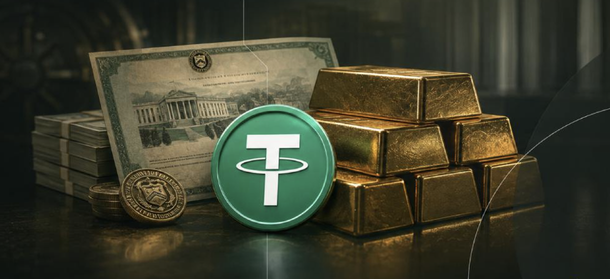
Tether's reserves are not solely U.S. Treasury securities. As of June 30, reserve assets included:
- $114.96 billion in U.S. Treasuries
- $25.6 billion in reverse repos
- $40.3 million in cash and bank deposits
- $18.84 billion in precious metals
- $5.8 billion in Bitcoin
- $3.76 billion in publicly traded equities
- $5.24 billion in other investments
- $13.45 billion in secured loans
The $6.5 billion in money market funds held at the end of 2024 have been fully liquidated.
The issue lies with gold and Bitcoin. The gold price used by BDO fell from $4,668.06 per ounce on March 31 to $4,008.02 on June 30, a decline of 14.1%. Bitcoin dropped from $68,200 to $58,600.
Gold and Bitcoin together account for $24.6 billion. With excess reserves at only $4.1 billion, a mere 17% fluctuation in these two assets could completely erase the excess reserves.
BDO's equity rollforward data offers a clearer picture: the group's equity at the start of the year was $6.34 billion; with negative net income of $3.17 billion in the first half, and an addition of $943 million in capital, it ultimately stood at $4.11 billion.
For a company holding six times its surplus in gold and Bitcoin, a 2.2% safety cushion means that if gold and Bitcoin prices continue to fall, excess reserves will be further eroded, even though those losses are not yet fully recognized on the books.
Tether can cite 2025 profits of $10 billion and audited surpluses of $6.814 billion to demonstrate strength, but the trajectory is clear: one year ago, excess reserves accounted for 3.5% of liabilities; at the end of 2024, it was 5.2%; now it stands at just 2.2%. The cause of the decline is not user redemptions, but asset depreciation.
The Loans It Promised to Eliminate
Consider secured loans—the loans Tether extends to borrowers backed by collateral.
In December 2022, following the collapse of FTX, Tether pledged, "From this point forward throughout 2023, we will reduce secured loans in our reserves to zero." At the time, this category of loans totaled $6.1 billion.
In reality: one year later it was $4.8 billion, by the end of 2024 it reached $8.19 billion, and by the end of 2025 it hit $17.04 billion. As of June 30, 2026, it stood at $13.45 billion. Tether described a reduction of $2.38 billion as a "15% cut."
The $13.45 billion in secured loans is 3.3 times the $4.1 billion in excess reserves.
BDO did not disclose the borrowers or collateral types. Its description of the loans is "over-collateralized and monitored regularly," whereas the previous three reports stated they were "fully collateralized by liquid assets." This shift in wording is noteworthy.
Excess reserves hit record highs in the first quarter and halved in the second, while Tether was simultaneously cutting back on loans it had pledged to eliminate three years ago. In the third quarter, it launched another lending fund.
This is not its only new lending initiative. Bloomberg reported this month that as of late June, U.S. precious metals dealer Gold.com owed Tether approximately $1.45 billion, for which Tether provided most of the financing for the dealer's $1.7 billion in precious metals leases. In November, Tether stated it had extended about $1.5 billion in commodity trade credit and planned to "significantly expand." In June, alongside its invested lender Ledn, it announced that holders of the XAUT gold token would be able to borrow against them later this year.
Tether's position is that its investments are "funded by the company's excess capital and profits and are completely segregated from USDT reserves." Secured loans fall within the reserves; StableFund's capital commitment likely falls outside. However, neither the StableFund press release nor the June reserve report explicitly clarifies this.
The Issue Is Role Conflict, Not Concentration
Fasanara itself is not the problem. Founded in London in 2011 by Francesco Filia, the firm manages over $6 billion in assets and has spent the past decade lending through fintech sponsors—precisely the business model described for StableFund.
Even if segregation is accurate, the problem persists because every dollar Tether invests in the fund comes from group equity. This stems from Tether's multiple roles in this structure: it acts as the sponsor sourcing loans, an advisor providing guidance to the loan-holding fund, and an issuer facilitating fund transfers via the operational rails it controls.
Filia describes Tether's value proposition as "the world's largest stablecoin network, a crypto-native investor base with massive capital capacity, and the USDT rail." He told GTR that loans can remain in traditional currencies, noting that "neither the loans themselves nor the fund equity need to be tokenized." Tokens merely facilitate fund transfers.
But if loans under StableFund encounter trouble—deployed across 60 countries, spanning consumer credit and small business loans originated through 141 fintech sponsors partnering with Fasanara—Tether will have reputational incentives to support them. And a support decision made by a company with only a 2.2% safety cushion, regardless of which account the funds originate from, is fundamentally a reserve issue.
Over the 90 days leading to September 22, USDT's circulating supply decreased by approximately $2.8 billion, a drop of 1.5%. This does not constitute a run. The Q3 reserve report will show how excess reserves performed during the same period.
The Rules Tether Is Circumventing
Signed into law on July 18, 2025, the GENIUS Act defines permitted reserve holdings for authorized payment stablecoin issuers: cash, insured deposits, U.S. Treasuries with remaining maturities of no more than 93 days, overnight repurchase agreements, government money market funds, etc. The scope is limited.
Section 4(a)(2) stipulates that reserves "shall not be pledged, rehypothecated, or otherwise reused directly or indirectly by the authorized payment stablecoin issuer," with narrow exceptions only. Proposed rules regarding issuance were published by the Treasury on August 18, with a comment period closing October 19, and the act is expected to take effect on January 18, 2027.
Tether's response is USAT—an independent token issued through Anchorage Digital Bank starting January 27, designed for compliance. The same press release states that USDT is "moving toward" compliance.
The act sets two critical deadlines: Section 3(b) prohibits U.S. digital asset platforms from offering non-compliant stablecoins three years after enactment (July 18, 2028); Section 18 permits foreign issuers to enter the U.S. market once the Treasury determines their home jurisdiction's regime is comparable.
StableFund is precisely the kind of structure the rule aims to prevent, merely assembled one layer outside the direct regulatory boundary. The GENIUS Act does not prohibit a foreign issuer's parent company from launching private credit using its own equity—it prohibits reserves from being used for this purpose. This is why the undisclosed figures—how much of the $400 million came from Tether and where it originated—are more critical than the fund's size itself.
Stablecoin issuers commit to redeeming at par. When valuations move against them, fulfilling that commitment relies on surplus. By the end of June, surplus stood at $4.1 billion, half of what it was in March.
What to Watch
The Q3 reserve report is expected to be released around the end of October, featuring three key points of observation:
First, whether excess reserves will recover alongside a rebound in gold prices. If gold and Bitcoin bounce back, the safety cushion may recover; if they continue to fall, pressure will intensify further.
Second, whether the secured loan portfolio will continue declining or resume rising. Tether pledged to eliminate them three years ago, yet their actual scale expanded instead. Whether this trend reverses is worth watching.
Third, whether StableFund's capital commitment appears in the reserve report or only in the group report. This determines whether there is a firewall between this capital and USDT reserves.
Additionally, two other matters warrant tracking. An audit announced by KPMG on August 13 regarding 2025 revealed that surplus exceeded BDO's report for the same date by $476 million, a discrepancy whose basis Tether has yet to explain, making reconciliation highly beneficial. Furthermore, the Treasury's comparability determination for foreign issuers under Section 18 is the gateway for USDT to enter the U.S. post-2027, and must address one question: Is an issuer initiating private credit for a fund it advises comparable to one expressly prohibited from doing so?
The Q2 press release declared reserves strong. Perhaps they are. But the true purpose of a safety cushion is proven on the day reserves are no longer strong. Tether lost half its safety cushion in a single quarter and responded by launching private credit initiatives.
Join TechFlow official community to stay tuned
Telegram:https://t.me/TechFlowDaily
X (Twitter):https://x.com/TechFlowPost
X (Twitter) EN:https://x.com/BlockFlow_News
 Forbes