Stablecoin ‘Shadow Banking’ Shadow War: Tether Enters Private Credit With $3 Billion
Author: TechFlow
After becoming the world's most profitable and cash-rich "atypical financial institution" by issuing USDT, Tether has finally taken the most crucial step toward transitioning from virtual to real-world assets.
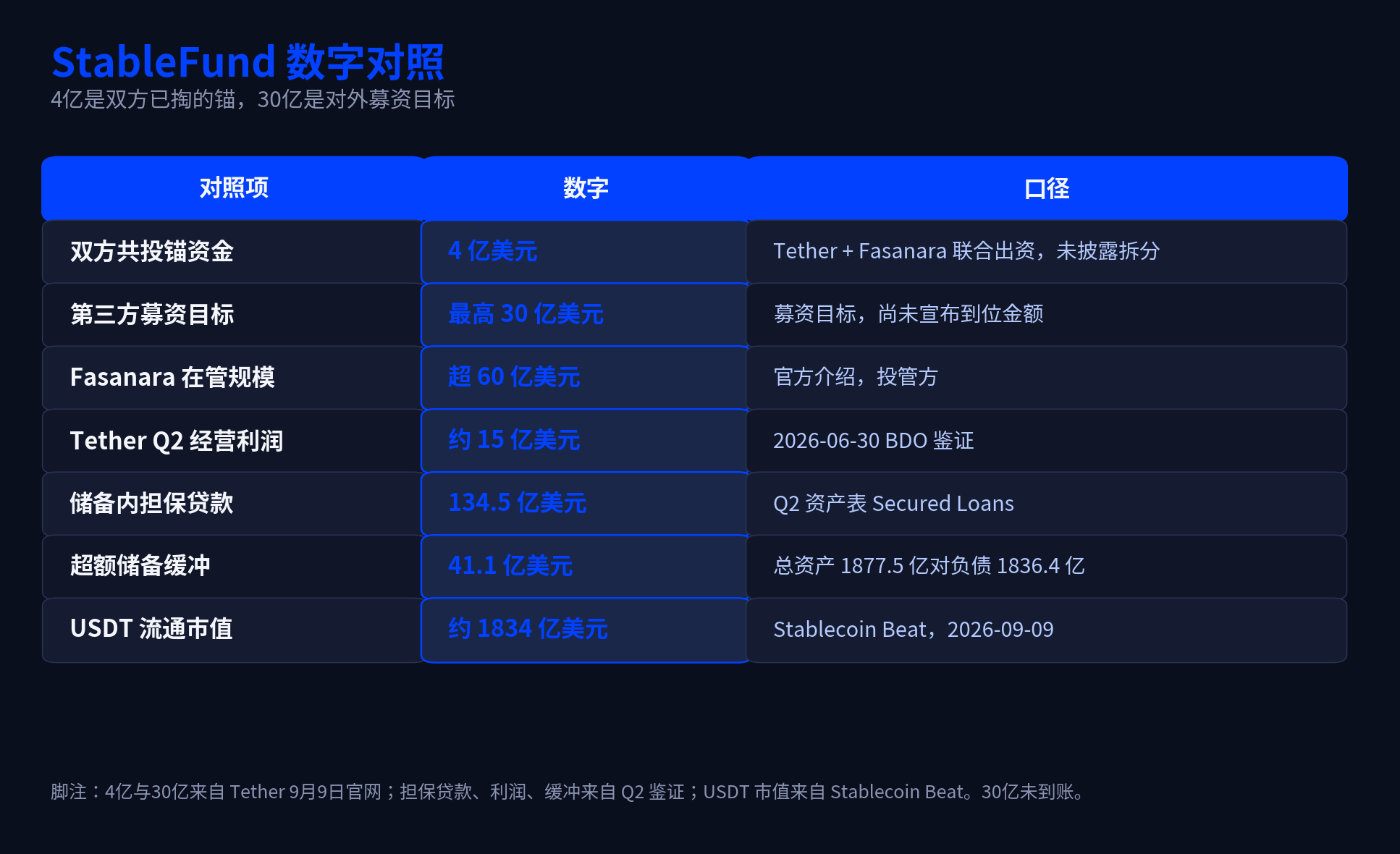
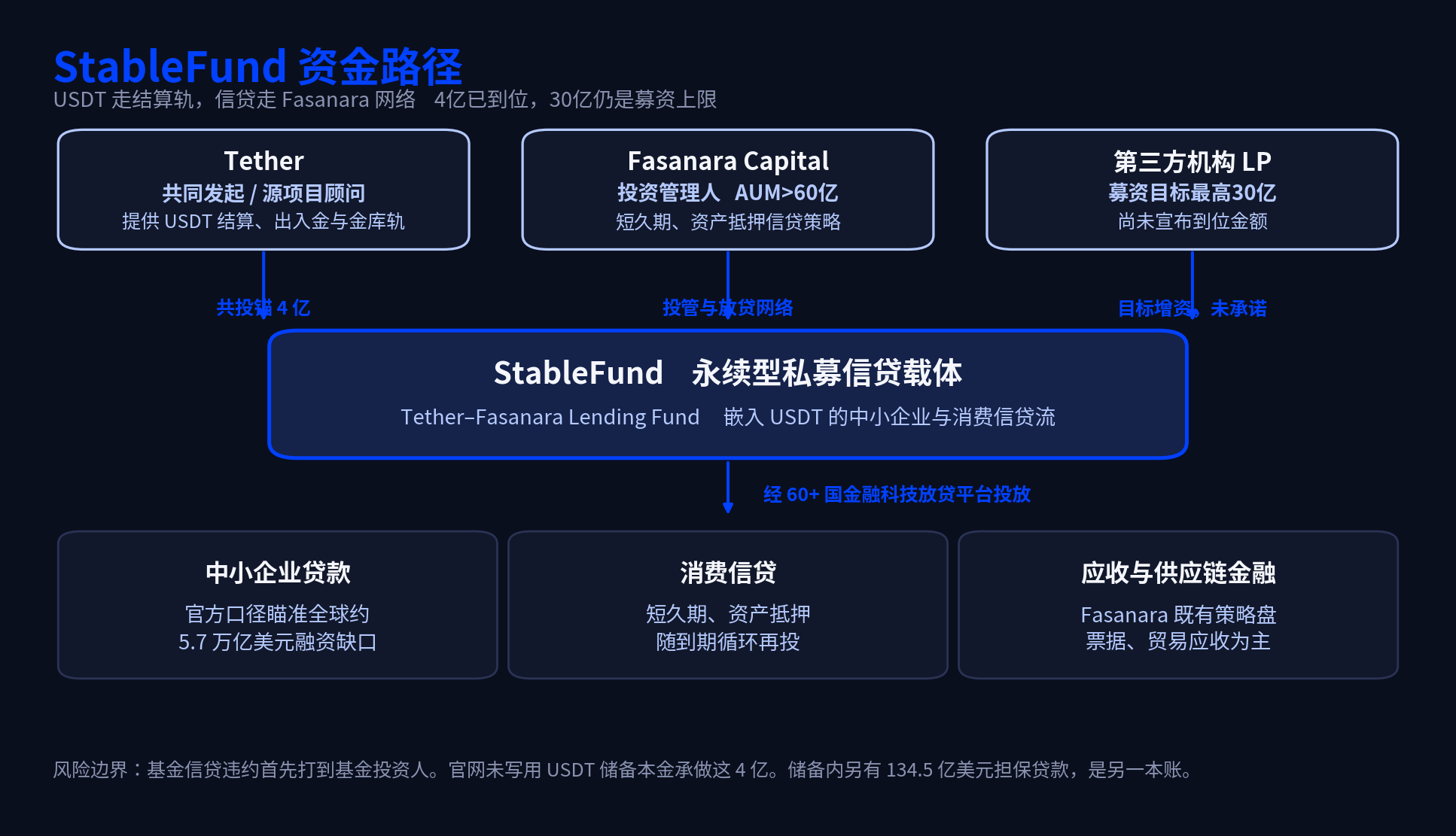
On September 9, Tether partnered with London-based alternative asset manager Fasanara Capital to launch the StableFund, a perpetual private credit fund with a scale of up to $3 billion. Both parties initially committed $400 million as anchor capital and have officially opened fundraising to external institutions.
This time, Tether is no longer targeting liquidity within crypto exchanges, but rather real-world SME lending and consumer credit distributed across more than 60 countries. While Silicon Valley continues to debate cryptocurrency's actual use cases, Tether—holding substantial U.S. Treasury interest payments—is quietly evolving into traditional finance's most ambitious "on-chain shadow bank."

The Capital Flywheel: From Risk-Free Spreads to Wall Street's "Feasters"
In the past two years, Tether's business logic has been extremely straightforward: absorbing interest-free stablecoin minting demand while dumping hundreds of billions in reserve funds into risk-free U.S. Treasury assets.
This steady, spread-arbitrage "money-printing machine" model allowed Tether to easily record approximately $1.5 billion in operating profit in the second quarter this year.
However, with the approach of global macro rate-cut cycles, the golden window for passively harvesting risk-free spreads is narrowing. Tether's massive profit reserves must find the next reservoir capable of absorbing huge capital flows while offering higher return elasticity.
Private Credit has emerged as the ideal destination.
Amid traditional commercial banks in Europe and America contracting their balance sheets and a global SME financing gap reaching $5.7 trillion, giants like Blackstone and Apollo on Wall Street have long deployed heavy forces here. But unlike traditional Wall Street institutions, Tether carries a weapon for dimensional-strike dominance: it not only provides capital, but also the "pathway".
In this $3 billion play, the funding channel has been completely reconstructed. Borrowers no longer receive USD wire transfers that require multi-layer correspondent banking, take days to settle, and incur high fees; instead, they receive USDT that hits their accounts in seconds.
Bypassing Traditional Banks' Lending Rails with USDT
In this new vehicle named StableFund, the division of labor between Tether and Fasanara is extremely clear, representing a classic "front shop, back factory" model.
London-headquartered Fasanara plays the role of "underwriter" and "risk controller." This specialized asset manager overseeing over $6 billion in assets has long laid out lending networks on fintech platforms across more than 60 countries. They are responsible for precisely drip-feeding capital into short-duration, asset-backed SME and consumer credit strategies.
Tether, on the other hand, plays the role of the most corefunding source and settlement rail. Tether CEO Paolo Ardoino maintains an extremely restrained clarity on this: Tether does not personally engage in collections, but rather provides the stablecoin infrastructure that enables cross-border lending to run smoothly.
With this, the narrative around USDT has undergone a fundamental shift. It is no longer just a "trading pair" used by crypto players to hedge volatility, but has become a lending pump directly plugged into emerging market real economies. Tether is transforming liquidity once confined to crypto casinos into a USD substitute that reshapes global real-economy corporate financing efficiency.
Dual-Track On- and Off-Balance-Sheet Moves, Entering the Deep Waters of Shadow Bank Risk Management
Entering real-world credit means Tether has officially stepped into the risk-control minefield that traditional banks fear most:
If borrowers default, who takes the first hit?
Under the current structure, the newly established StableFund is an off-balance-sheet fund. Theoretically, its credit default losses will be absorbed by the fund's net value and LPs (Limited Partners), thereby remaining isolated from the 1:1 redemption reserves backing USDT.
But outside scrutiny has never ceased. Because within Tether's own balance sheet, the credit business is already a colossus. As of Q2 this year, secured loans still account for up to $13.45 billion in Tether's reserve assets. In comparison, the new fund's $400 million initial anchor capital is merely a drop in the bucket.
What truly intimidates Wall Street and regulators is this: when a stablecoin giant lacking highly transparent audits holds multibillion-dollar pledged lending on its balance sheet and simultaneously begins lending to small and micro entities off-balance-sheet via fintech platforms in 60 countries, it has effectively become a super shadow bank evading all capital adequacy constraints.
Until this $3 billion target is fully raised, StableFund remains merely a probing operation. But once Tether leverages its extremely low cost of capital and USDT's settlement advantages to truly tear open a breach in the global private credit market, any large-scale cross-border collection failures or collateral depreciation could evolve into a stress test for the entire crypto liquidity foundation.
At that point, this "unlicensed global central bank" operating outside regulatory oversight will inevitably face Washington's harshest scrutiny.
Join TechFlow official community to stay tuned
Telegram:https://t.me/TechFlowDaily
X (Twitter):https://x.com/TechFlowPost
X (Twitter) EN:https://x.com/BlockFlow_News
 深潮TechFlow