Bitget hackers attempted to transfer over $50 million via NEAR Intents, but ultimately only $166,000 succeeded.
Author: Alex Shevchenko
Compiled by: TechFlow
TechFlow: Following Bitget's near $388 million hack, a large volume of stolen funds began cross-chain transfers. NEAR Intents disclosed that its risk intelligence system, SHIELD, identified over $50 million in suspicious fund flows, with only $166,000 passing review, and another $503,000 frozen during execution. More notably, NEAR Intents used this incident to clarify a highly controversial principle: infrastructure can remain permissionless, but it does not have to remain neutral when it comes to assisting in laundering stolen assets.

On September 24, Bitget was hacked. Approximately $387.5 million in funds were stolen. A significant portion of these funds were transferred across chains, primarily flowing into Ethereum. The hackers attempted to move over $50 million via NEAR Intents, but ultimately only $166,000 went through, while another $503,000 was intercepted during execution.
Below is an overview of the incident, our response measures, and our current stance.
Disclaimer: All figures in this report are indicative and rounded. Some transactions may be mislabeled, which could cause discrepancies in attributed amounts. We estimate that the actual values deviate from these figures by no more than 10%.
Data
To analyze the flow of funds, we utilized trace.bgblockchain.xyz, @arkham, NEAR Intents' internal logs and SHIELD data, along with other public resources.
The vast majority of funds touching the cross-chain protocol have been consolidated into Ethereum and converted to ETH. Based on available information, the fund allocation across channels is as follows:
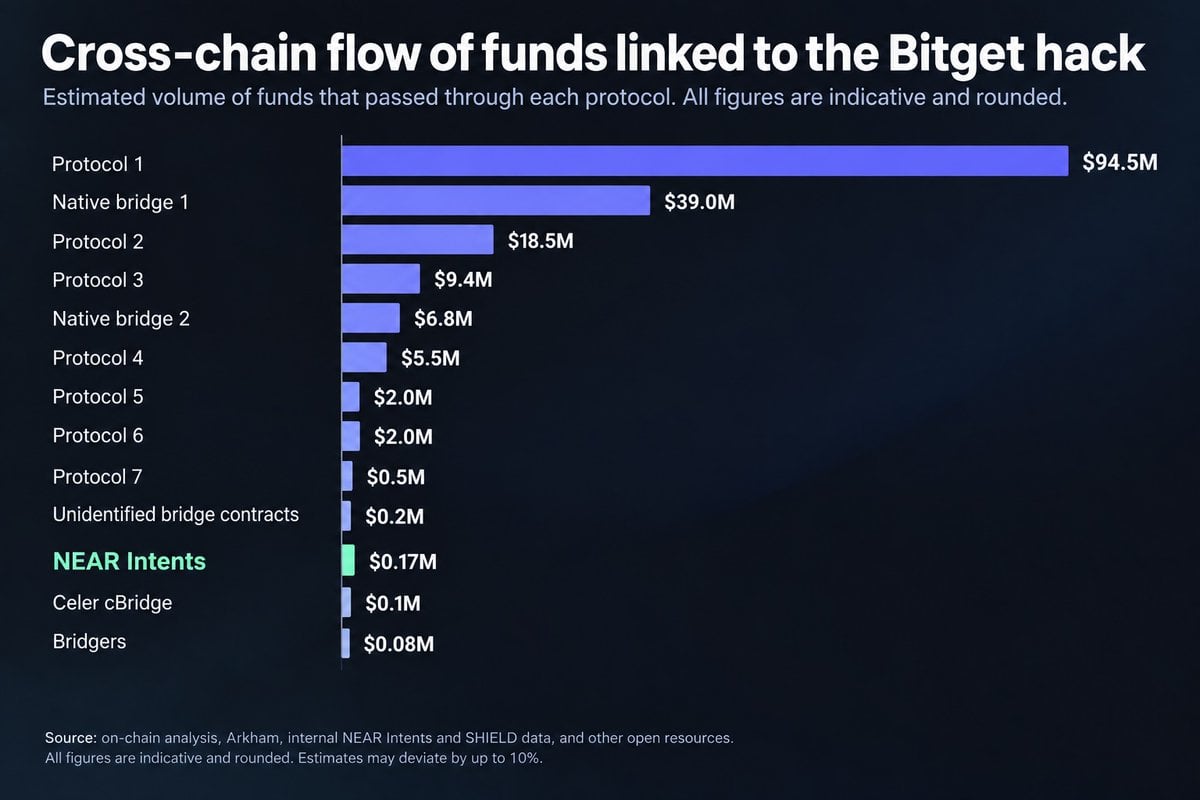
Figure: Cross-chain fund flows related to the Bitget hack
SHIELD
NEAR Intents typically processes over $100 million in daily cross-chain transaction volume. However, in this incident, stolen funds flowing through our system accounted for only a tiny fraction. The reason for this is precisely SHIELD.
SHIELD is our risk intelligence layer designed to protect NEAR Intents. It automatically detects anomalies in fund flows, aggregating massive input signals from KYT (Know Your Transaction) and intelligence providers, independent researchers, enterprises, and the industry's largest centralized institutions. Based on these signals, the protocol can decide how to handle a given transaction.
Among other flags, SHIELD can also identify transactions linked to hacking incidents. This triggers two possible system behaviors: either the protocol does not respond to the quote, or it aborts execution while the transaction is already in progress.
In the Bitget hack incident, SHIELD detected over $50 million in attempted money laundering fund flows (duplicates filtered; these funds subsequently flowed to other providers), of which $166,000 unfortunately passed review. Meanwhile, SHIELD froze $503,000 of stolen funds during execution. These funds are currently restricted, awaiting corresponding legal and recovery procedures.
Our Stance on the Hack Incident
We believe that hacks harm not only the victims but the entire cryptocurrency industry as well. Following every major hack, we observe a reduction in economic activity and capital outflows from the crypto sector.
We believe decentralized, permissionless systems should be built. But being permissionless does not mean being neutral. Those who build these systems must make choices regarding what these protocols empower. Refusing to assist in laundering stolen assets is one such choice.
Property rights are the foundation of a functioning market. A financial system that allows someone who steals assets to liquidate them without restriction is not a freer system, but merely one that protects thieves. Such a system cannot become the pillar of future economies.
NEAR Intents is not a place for laundering stolen assets.
A Message to All Parties
To the Hacker: NEAR Intents stands directly opposed to your actions. Do not come after us.
To @bitget: We know you are under pressure. Please reach out to us through appropriate legal and law enforcement channels so that the frozen funds can be handled within formal legal proceedings.
We are aware that you have established a 5% + 5% bounty.
We voluntarily waive our share of the bounty so that you can recover as much of the stolen funds as possible.
To Wallet Providers: You are responsible for the integrations you implement. If your interface is used to transfer stolen funds, you are not mere bystanders: your integration choices may expose you and your users to regulatory, legal, and reputational risks, including contact with assets linked to the hack or other financial crimes. Poor liquidity providers not only bring risk to yourselves but also offload it onto your users. Please choose your providers carefully.
To Hacked Projects: Containment is crucial. Blockchains are interconnected, making it far more difficult to track and contain funds across all ecosystems compared to doing so within a single ecosystem. Contact event response firms like @zeroshadow_io, or communities like SEAL911, which can deploy tools such as SHIELD. Notify major CEXs, stablecoin issuers, and other centralized entities. Ideally, you should have established these connections and contingency plans in advance.
Cryptocurrency cannot demand the recognition of digital property rights while simultaneously building infrastructure optimized for liquidating stolen assets.
NEAR Intents will continue to operate as permissionless infrastructure, but with clear boundaries. We will actively combat the laundering of stolen funds.
Join TechFlow official community to stay tuned
Telegram:https://t.me/TechFlowDaily
X (Twitter):https://x.com/TechFlowPost
X (Twitter) EN:https://x.com/BlockFlow_News
 @AlexAuroraDev