Which licenses are required for operating crypto payment services in Hong Kong?
Author: Shao Jiadian (Mankun Blockchain Legal Services)
"Which licenses do we need?" This is the first question asked when a payment company brings a stablecoin payment solution to Hong Kong. The number of licenses required cannot be determined directly from the product name; what matters is the specific on-chain and off-chain roles the company assumes: Does it collect payments on behalf of clients, or trade stablecoins itself? Does it settle funds into merchants' bank accounts, or allow merchants to retain balances within the platform for continued use? Does the platform safeguard wallets and private keys on behalf of merchants?
A single transaction may pass through three stages involving stablecoins, bank accounts, and platform balances, but this does not mean a single "crypto payment license" can cover all of them. Fiat conversion and cross-border receipts/payments involve MSO; whether merchant balances can be retained for further payments involves SVF; only when the company itself operates a virtual asset trading platform, controls client assets, or issues stablecoins will it fall under the analysis for VATP, VA Dealing, VA Custody, or Stablecoin Issuer Licence. License determination ultimately depends on these specific business activities, rather than remaining attached to the generic product name "crypto payment."
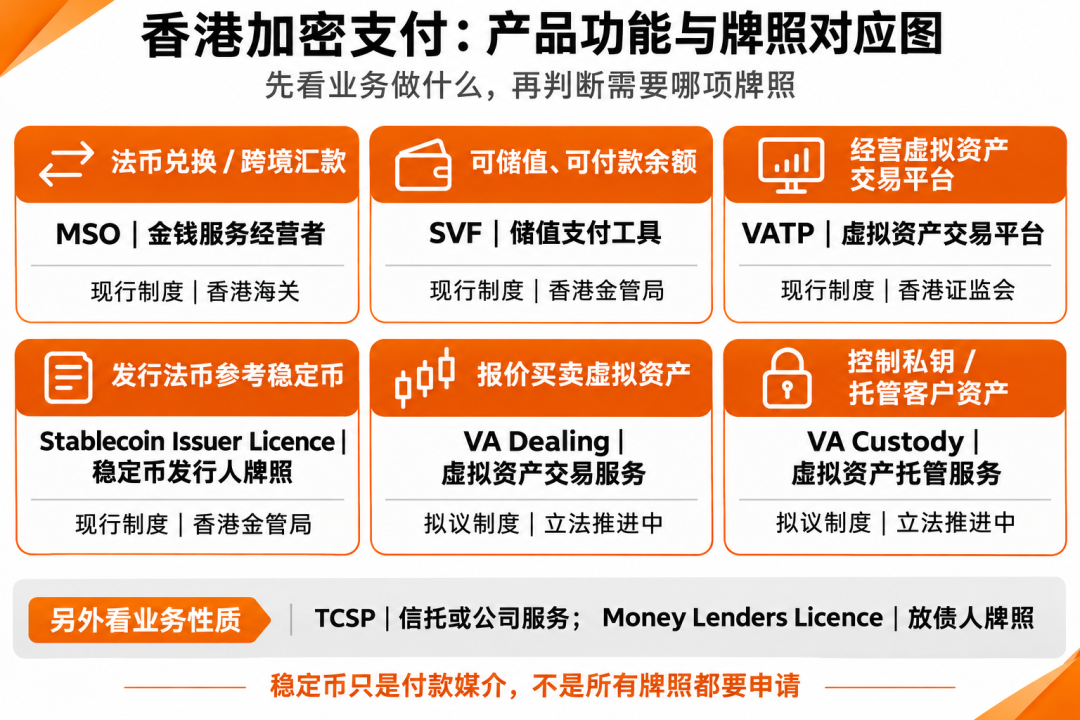
Figure: Comprehensive mapping of Hong Kong crypto payment product functions and corresponding licenses
MSO and SVF Correspond to Two Distinct Business Models
For payment products operating in Hong Kong, the Money Service Operator license (MSO) and the Stored Value Facility license (SVF) are typically the first two regulatory frameworks that come into compliance focus.
MSO Covers Fiat Exchange and Cross-Border Remittances
When stablecoin receipts are credited to a merchant's account, they typically undergo an additional "cash-out" stage: a buyer pays in stablecoins offshore, and the platform or its settlement arrangement converts the value into Hong Kong dollars, which the merchant finally receives in their bank account. For payment companies, the key determinant is not "which currency was used," but whether the company has accepted client entrustment in Hong Kong to arrange the cross-border receipt and payment of this HKD amount. The MSO license covers fiat currency exchange and remittance services, including sending or arranging the sending of funds to overseas locations, receiving or arranging the receipt of funds from overseas, and arranging the collection of funds abroad. While banks handle the final transfer, this does not automatically remove the payment company from the transaction chain.
Here lies a common point of confusion: converting stablecoins to HKD does not equate to "currency exchange" under the MSO regime. MSO governs exchanges and remittances between fiat currencies; holding an MSO license does not automatically grant authorization to trade stablecoins or conduct virtual asset transactions. In other words, a payment company may need to handle two separate tracks: buying or exchanging the crypto on one side, and collecting payments, remitting, and settling in HKD on the other. Whether the latter falls under MSO depends on whether the company collects money on behalf of clients, arranges cross-border payments, or commits to clients regarding when the HKD will clear.
If the company directly handles HKD collections and cross-border remittances, it must prepare according to MSO application requirements, focusing on the compliance officer, anti-money laundering processes, and bank accounts. If the company opts to partner with an already licensed MSO in Hong Kong and outsources the HKD settlement portion, it must still review the actual contract to clarify each party's responsibilities, ensuring the partner's scope of business covers this arrangement.
SVF Is Not Automatically Triggered Just by Having a Balance
After the merchant sells goods, the platform receives payment. Is this money immediately transferred to the merchant's bank account, or does it first sit in the platform's account, allowing the merchant to use this balance to pay suppliers, advertising fees, or even employee salaries? This is the critical dividing line that determines whether to trigger an SVF (Stored Value Facility license).
The core logic of an SVF is fund retention coupled with subsequent payment functionality. If the platform allows merchants to retain balances in their accounts, and these balances can be used to initiate new payments to third parties, it has already taken on the characteristics of a stored value facility. For many early-stage payment teams, the threshold for an SVF is quite high: paid-up capital of at least HKD 25 million, plus the HKMA imposes very strict requirements on applicants' financial strength, risk management, and independent custody of funds. Many companies that choose Hong Kong as their initial step for overseas expansion often cannot afford these upfront costs.
Therefore, many payment solutions intentionally design around SVF: after merchant collection, the platform merely transmits settlement instructions, and funds are settled directly into external bank accounts under the merchant's name within a specified timeframe, avoiding the creation of a circulating fund pool within the platform. If a merchant needs to make external payments, they must go through an independent funding process again, rather than directly transferring inbound balances to the next party. This contraction in product logic often saves significant time in achieving regulatory compliance.
Other Licenses Depend on Whether the Product Enters Relevant Business Activities
Beyond basic payment and settlement, if a product further extends into trading, issuance, or lending, it will trigger licensing regulation in other dimensions.
VATP Applies to Operating a Virtual Asset Trading Platform
The presence of stablecoins in a payment solution easily leads people to think of the Virtual Asset Trading Platform license (VATP). However, in actual operations, most payment companies do not need, nor actively apply for, a VATP.
VATP regulates platforms that provide clients with automated virtual asset matching, centralized trading, and custody, which aligns more closely with a traditional exchange business model. The role of a standard payment company is typically that of a service provider, not an exchange. If the platform merely accepts stablecoins paid by clients, converts them to fiat currency based on external rates, and transfers the funds to merchants, there is no marketplace for buyers and sellers to freely place orders and match trades throughout the process, meaning it would not fall under the current VATP regulatory scope.
Turing a payment system into a "mini-exchange" is often the result of distorted compliance measures: for example, to allow merchants to freely choose when to swap currencies, the platform builds an internal matching mechanism behind the scenes. Or to improve exchange efficiency, it acts as a market maker, providing instant quotes to users within the platform. Once this step is taken, the heavy compliance burden brought by virtual asset trading activities must be faced.
The Stablecoin Issuer Licence Corresponds to Issuance and Redemption
Following the Legislative Council's passage of the Stablecoin Ordinance in May 2025, Hong Kong has established an independent licensing regime for fiat-backed stablecoin issuers. It must be clarified that using stablecoins within a payment product is fundamentally different from issuing stablecoins oneself.
Building a crypto payment solution almost always involves using mainstream stablecoins already circulating in the market as settlement tools; whereas the Stablecoin Issuer Licence targets entities that issue stablecoins to the public and commit to redeeming fiat currency at par value. The HKMA sets extremely high thresholds for issuers regarding full high-quality reserve assets, local entity establishment, independent custody, and continuous auditing. If a payment company merely embeds stablecoins into acquiring or settlement processes, there is absolutely no need to aim for an issuer licence. A more practical approach is to select stablecoins that align with Hong Kong's future regulatory expectations, monitor the HKMA's published list of compliant stablecoins and intermediary guidelines, and ensure the underlying currency relied upon by the product is itself compliant.
Money Lenders Licence Used for Operating Merchant Loans
The Money Lenders Licence is usually not on a payment team's initial licensing checklist, but if the product proposal includes "advance settlement" or "merchant installment plans," it may become relevant.
Some payment solutions offer early settlement services to attract large merchants: before the merchant's payment is cleared from overseas, the platform fronts the cash out of its own pocket, later deducting fees and principal from the actual received funds. If this advance evolves into a compensated financing arrangement, or if the platform directly provides short-term loans to merchants collateralized by future receivables, it may cross into the realm of money lending business. Money lending in Hong Kong is governed by the Money Lenders Ordinance and jointly administered by the Police Force and the Companies Registry. If a payment company wishes to offer such value-added services, it must either obtain its own Money Lenders Licence or partner with an already licensed money lender, avoiding unlicensed lending operations.
Currency Exchange and Custody Are Where Payment Products Most Easily Cross the Line
Under the current regime, payment solutions are most likely to stumble not on MSO or SVF, but on the virtual asset trading and custody segments where regulators are currently tightening oversight.
Under Hong Kong's existing legal framework, if a company trades virtual assets with clients in its own capacity or provides over-the-counter (OTC) exchange services, it currently sits in a transition period while the HKMA and SFC draft new licensing systems. According to consultation summaries from the Treasury Bureau and the SFC, Hong Kong will separately introduce independent licensing regimes for Virtual Asset Dealing services and Virtual Asset Custody services in the future. This means that if a payment company both collects stablecoins for clients and acts as the counterparty to buy those stablecoins itself, convert them to fiat, and give the fiat to clients, this "proprietary exchange" activity will likely require an independent VA Dealing licence in the future, and can no longer be loosely covered under MSO's inclusion of foreign exchange.
The same logic applies to custody. If a payment platform generates custodial wallets for merchants, stores private keys on platform servers, and requires platform signing for every merchant transfer request, the platform effectively controls the clients' virtual assets. The upcoming VA Custody regime will impose strict requirements on this type of service regarding independent capital, distributed key management, and segregation between hot and cold wallets. Many payment teams assume that "managing keys for clients" improves user experience during product design, often overlooking that regulatory logic treats this directly as fiduciary or custodial business. If a company wishes to avoid heavy custodial compliance costs, adopting a non-custodial architecture or integrating with a qualified third-party institutional-grade custodian is usually a more prudent path.
Map Your Product Item by Item
List ing the functionalities the company plans to offer is often more useful than simply counting licenses. The table below maps common business actions against their corresponding licensing scopes, facilitating a comparison with your product to see which parts constitute basic payment flows, and which have extended into virtual asset trading, asset custody, stablecoin issuance, or merchant financing.
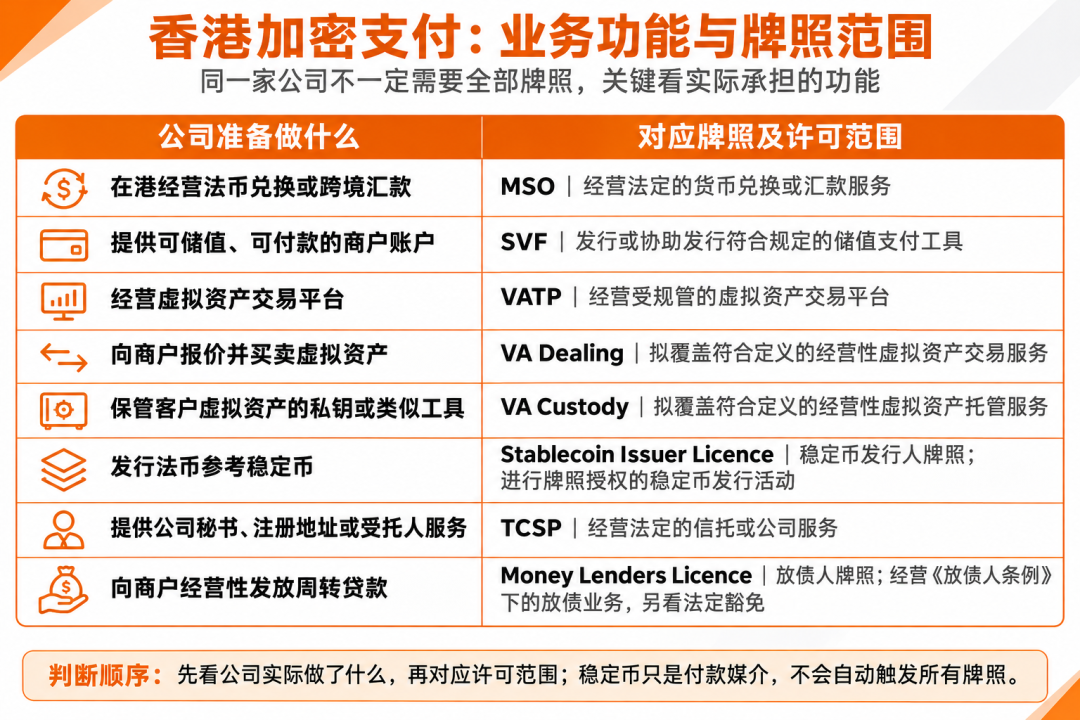
Figure: Mapping of Hong Kong crypto payment business actions and corresponding licensing scopes
Conclusion
For companies preparing to operate crypto payments in Hong Kong, license determination does not need to start with "how many licenses exist in Hong Kong." What needs clarification are several specific arrangements: who handles fiat conversion and cross-border receipts/payments, whether the platform creates a spendable balance, whether the company trades virtual assets itself, who controls wallets and private keys, and whether funds are lent to merchants.
Once broken down, the relationship between licenses becomes less complex: MSO and SVF are typically the first regulatory frameworks evaluated for payment products; VATP and the Stablecoin Issuer Licence only enter the core analysis when the company itself operates a trading platform or issues stablecoins; VA Dealing and VA Custody currently depend on legislative progress; TCSP and Money Lenders Licence depend on whether the company actually provides trust or company services, or finances merchants.
Therefore, the most valuable step before launch is not listing every license, but clearly mapping fund flows, asset control, and customer relationships, then checking them item by item against licensing scopes. Only then can you determine whether the current design can go live directly, which features need to be scaled back, and which issues must wait for new regulations and detailed rules to take shape.
References: Hong Kong Customs “Guidelines for Money Service Operators Licensing” (MSO); Hong Kong HKMA “Explaining Notes on Stored Value Facility Licensing” (SVF); Hong Kong SFC “Code of Conduct for Virtual Asset Trading Platforms” (VATP); Hong Kong SFC and HKMA “Joint Circular Regarding Intermediaries’ Virtual Asset Related Activities”; Hong Kong “Stablecoin Ordinance” and other publicly available regulatory materials.
Join TechFlow official community to stay tuned
Telegram:https://t.me/TechFlowDaily
X (Twitter):https://x.com/TechFlowPost
X (Twitter) EN:https://x.com/BlockFlow_News