USDC's Quantum Migration Dilemma: Covering 37 Public Chains, Security Depends on More Than Just Circle
By: Liam 'Akiba' Wright
Translated by: Saoirse, Foresight News
Circle has issued a warning: the resources required for quantum circuits to break mainstream blockchain signature algorithms are continuously decreasing, citing a low resource consumption record of 813 logical qubits.
Implementing USDC's quantum migration directly exposes cross-ecosystem dependency issues: every host public chain, wallet, custodian, cross-chain bridge, and user account will ultimately need to adopt more secure transaction authorization methods.
Current contract documentation from Circle lists USDC deployments across 37 mainnets. While the company can protect its managed infrastructure and exercise token contract permissions across supported networks, it cannot rotate user private keys, overhaul custodial signing systems, or unilaterally modify signature rules on Ethereum, Solana, XRPL, and other public chains.
In its August 31 disclosure, Circle urged developers to audit their own cryptographic systems, vet third-party dependencies, and prepare for key rotation. As of September 2, USDC's market cap stands at approximately $73.6 billion, making ecosystem coordination a matter of protecting massive assets. If the migration only hardens Circle's own keys while leaving old wallets, cross-chain bridges, or underlying chain paths exposed to risk, the entire USDC ecosystem will remain unprotected.
The 813 Qubit Record Is a Reference Metric, Not a Countdown
Circle stated that the 813 logical qubits represent a low resource consumption record updated on the ECDSA.fail website in August 2026. This data demonstrates improving resource utilization efficiency in quantum circuit design, but the figure is easily misinterpreted by the general public.
This public challenge specification targets the secp256k1 elliptic curve used by Bitcoin and Ethereum, optimizing reversible point addition circuits; scoring is based on peak logical qubit width multiplied by the average number of Toffoli gates. Developers can reduce bit width by increasing logic gate counts, or reduce logic gate consumption by increasing bit width. Therefore, the standalone figure of 813 does not fully describe a Shor's algorithm attack, circuit depth, error correction overhead, nor reflect the actual runtime of the attack on physical hardware.
(Note: Toffoli gates are a critical computational instruction in quantum computers. Quantum programs designed to crack encryption algorithms heavily rely on them. Evaluating quantum cryptanalytic capability requires assessing both the number of qubits and the count of such instructions.)
A March 2026 paper clearly illustrates this trade-off. Researchers estimate that an attack against 256-bit elliptic curve discrete logarithms requires either fewer than 1,200 logical qubits and up to 90 million Toffoli gates under one approach, or up to 1,450 logical qubits and 70 million Toffoli gates under another. Prerequisites for this minute-level attack scenario include a high-clock-speed superconducting architecture, a 10⁻³ physical error rate, planar connectivity, and fewer than 500,000 physical qubits.
Compared to a simple bit-width metric, these estimates offer a more comprehensive resource model, yet they still cannot pinpoint when such hardware will become available.
Circle's external hardware comparisons also contain inaccuracies. Its article claims Google achieved 105 logical qubits using Willow. However, Google positions Willow as a 105-qubit processor; the corresponding Nature paper documents an experiment using 105 physical qubits to achieve distance-7 surface code logical storage, effectively utilizing 101 qubits. This is fundamentally different from the 105 logical qubits required to execute an attack.
Advancing migration does not require artificially setting deadlines. The U.S. National Institute of Standards and Technology (NIST) has incorporated SLH‑DSSA into the FIPS 205 standard and mandated that institutions immediately begin replacing cryptographic schemes vulnerable to quantum attacks. NIST's 2035 timeline merely indicates when related algorithms will be deprecated and removed from the standard, not a prediction of a "quantum attack day."
The true benchmark for initiating migration is ecosystem readiness: public chains need ample time to implement new signature verification rules; wallets and custodians require proven key rotation processes; and users need a transition period where traditional cryptographic authorization and post-quantum authorization can run in parallel, preventing liquidity fragmentation or locked user assets.
Arc Is Only One Layer Within Circle's Control Across 37 Public Chains
Arc enables Circle to more directly build post-quantum cryptographic support capabilities, but official documentation delineates multiple layers of logic, whereas Circle's external disclosures simplify this to "supporting SLH‑DSA."
Arc's execution layer documentation introduces a precompiled program capable of verifying SLH‑DSA‑SHA2‑128s signatures. This precompile allows smart contracts to validate the corresponding signature type, but it will not automatically replace the signature mechanisms used for standard network transactions.
Arc's custody guidelines continue to use standard secp256k1 ECDSA for transaction signing. Its post-quantum roadmap outlines launching optional beta post-quantum wallet signing upon mainnet deployment, with post-quantum validator signing features to follow later. Circle also clarified that Arc has not finalized a definitive post-quantum transaction signing scheme and will support hybrid-mode ECDSA signatures during the migration phase.
Arc can serve as a testing ground for hybrid signature schemes. However, relying solely on Arc upgrades will not render USDC quantum-safe across Ethereum, Solana, and the remaining 35 mainnets.
USDC Quantum Migration Involves 37 Distinct Network Paths
The number of networks publicly announced by Circle is constantly changing. Its June 29, 2026, USDC page text references 35 networks, yet actually lists 37 names. The contract address master list referenced in this article records a total of 37 mainnets. Including the Arc testnet would bring the Circle Mint list to 38, so the Arc testnet is excluded from this tally.
The table below distinguishes between verifiable signature types and host chains requiring independent cryptographic audits. The "EVM Path" refers to Ethereum-style externally owned accounts, which default to secp256k1 ECDSA and recover public keys after signing; smart contract accounts, meanwhile, can utilize custom contract verification logic. The "Chain-Specific Scheme" denotes cases where official public chain documentation lacks a standardized unified signature algorithm, avoiding forced specification of a single solution. The Status column indicates whether a public chain has implemented full-network post-quantum upgrades, which does not imply an absence of exploratory R&D work on those chains.

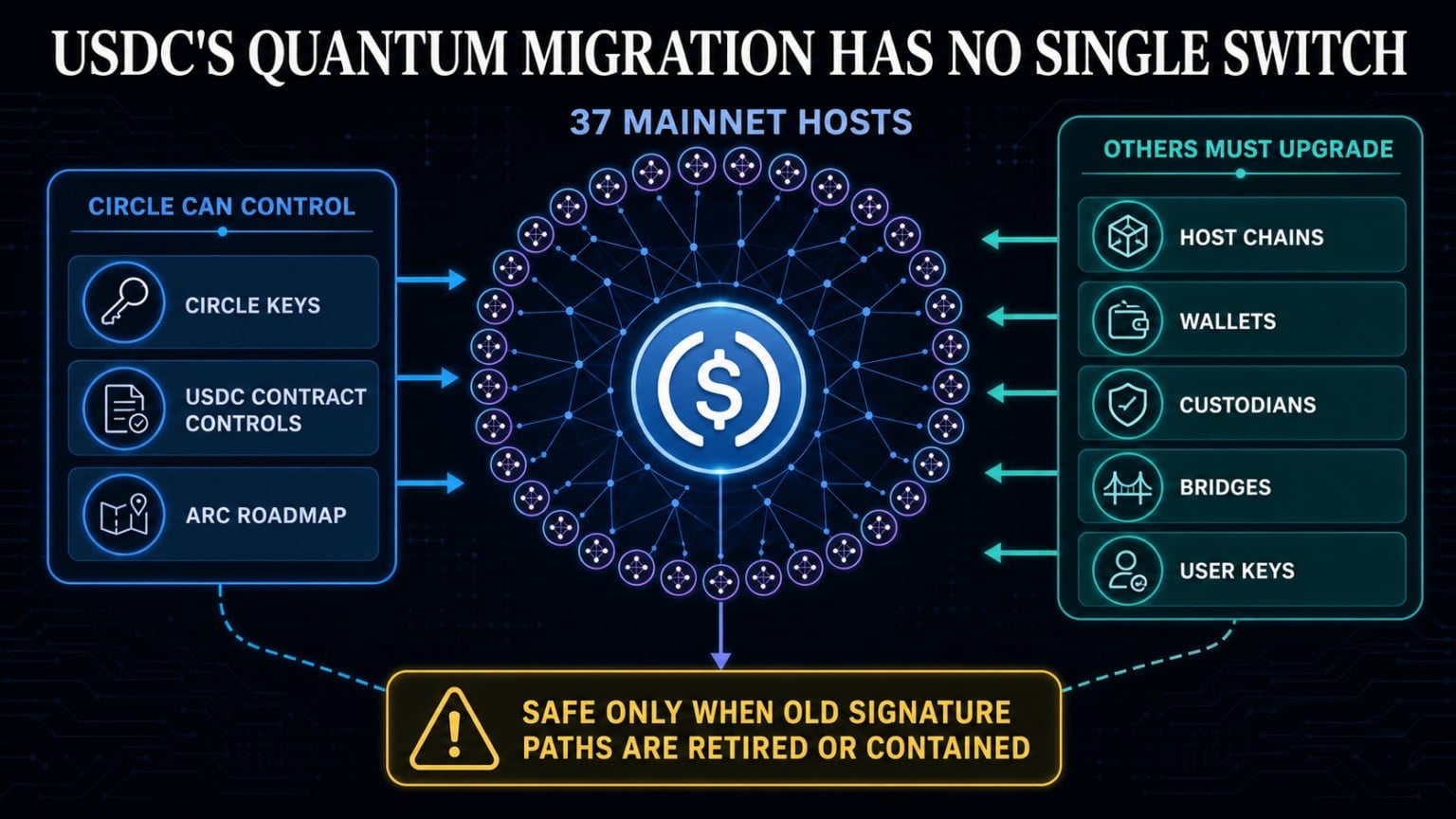
USDC's quantum security upgrade cannot rely solely on unilateral action by Circle. The 37 public chains, wallets, custodians, cross-chain bridges, and users must upgrade synchronously. Only by completely decommissioning legacy signature mechanisms will the system be truly secure overall.
Examples illustrate this: no single deadline can cover the entire ecosystem. Solana transactions use Ed25519 signatures; Polkadot supports sr25519, Ed25519, and ECDSA accounts simultaneously. Even comparing internally within Ethereum, migration approaches differ between externally owned accounts and smart contract wallets, let alone non-EVM public chains.
Each public chain's upgrade decision-making mechanism is entirely different. XRPL proposal amendments require over 80% of trusted validators to support them for two consecutive weeks; Algorand protocol modifications demand an absolute majority vote on-chain; Stellar network upgrades rely on validator consensus. Circle holds no authority to intervene in any of these decisions.
Freeze and Reissue Permissions Cannot Accomplish User Key Rotation
Circle wields several key control capabilities at the token level. Its EVM fiat-backed token design embeds privileges to mint, burn, pause transfers, blacklist addresses, and upgrade contracts. The USDC Terms of Service also stipulate that it retains the power to freeze addresses and suspend services under specific scenarios.
These capabilities allow risk containment when security incidents occur within contracts. Where conditions permit, Circle can freeze addresses, halt minting or transfers, and execute redemptions or reissuances of tokens in accordance with legal and operational regulations. However, freezing addresses cannot mitigate risks stemming from compromised private keys, nor can it alter the signature verification logic of underlying public chains.
Responsibility for key-related risks falls on different entities:
- Circle: Must rotate issuer and contract management credentials it controls.
- Users / Custodians: Must transfer assets from risky accounts using wallets and public chains compatible with new signatures.
- Cross-Chain Bridge Operators: Must protect their own signing and contract permissions while coordinating liquidity across both sides.
- Underlying Chain Communities: Must approve and implement protocol-level changes.
- Wallet Providers, Hardware Wallets, Exchanges: Must support both legacy and new signature algorithms concurrently during the transition period.
Therefore, the weakest link is not necessarily the public chain with the slowest technological iteration. Custodians struggle to rapidly rotate keys for tens of thousands of accounts; cross-chain bridge emergency control logic still relies on vulnerable keys; and a vast number of users consistently refuse to migrate assets before legacy signature schemes are retired—all of these can serve as attack vectors.
A viable implementation strategy cannot simply rely on a block height as an off-switch. Each operator must catalog risk/security keys, verify target account types, deploy software and hardware adapted to new signatures, and establish disposal strategies for balances that remain unmigrated indefinitely. Hybrid signature modes must have a defined expiration; traditional signatures cannot be retained indefinitely as bypass mechanisms. While Circle can set milestones for its own contracts and services, each public chain ecosystem must independently decide when and how to shut down legacy signing pathways.
Even Without a Definitive "Quantum Attack Day," the Urgency of Migration Is Real
The value of Circle's disclosure lies in transforming post-quantum cryptographic preparedness into an immediate operational plan. The 813 qubit record proves that while hardware teams tackle error correction technology, attack-oriented quantum circuits will continue to improve. NIST's published standards also provide developers with tested, ready-to-deploy solutions.
However, this disclosure contains exaggerations: it directly juxtaposes 813 attack-oriented logical qubits against Willow's 105 physical qubits, placing them on the same measurement scale. Simultaneously, the article underestimates the real-world gap: validating SLH‑DSA signatures internally within Arc versus comprehensively implementing USDC authorization, settlement, and asset recovery across dozens of production public chains present vastly different levels of difficulty.
Circle can optimize systems within its jurisdiction. But only after host public chains, wallets, custodians, cross-chain bridges, and all users complete migration—and every legacy signing path is either retired or strictly constrained—can Circle claim that USDC as a whole has achieved quantum security. This is a large-scale migration project entangling multiple veto powers, far from a simple cryptographic toggle.
Join TechFlow official community to stay tuned
Telegram:https://t.me/TechFlowDaily
X (Twitter):https://x.com/TechFlowPost
X (Twitter) EN:https://x.com/BlockFlow_News
 @CryptoSlate