Research on 83 Token Buybacks and Dividends: Only 16 Outpaced Inflation—Why Token Burning Doesn't Necessarily Lead to Price Appreciation
Author: Tranks, Four Pillars
Compiled by: TechFlow
TechFlow Summary:In recent years, the crypto market has consistently focused on how protocols can return revenue to token holders. From early dividend models to the now-popular buy-and-burn mechanism, the market once viewed value capture as a panacea for driving token price appreciation. However, can buy-and-burn truly translate into genuine excess returns for holders?
Research firm Four Pillars conducted a quantitative breakdown of 83 core mainstream tokens on DefiLlama, analyzing the actual operating data across three major mechanisms: buy-and-burn, treasury holdings, and staking distributions. The study found that the nominal return yields of the vast majority of tokens were completely swallowed up by concurrent token unlocks and inflation dilution. Consequently, net accrual yields depend largely on supply growth rates rather than the mechanisms themselves.
Core Takeaways
According to DefiLlama data, among the 83 selected mainstream tokens, 66 have introduced mechanisms to return a portion of protocol revenue to token holders. Of these, 76% were officially launched in 2025 or later. Macroscopically, these mechanisms can be categorized into three streams: burn, treasury hold, and staking distribution.
Over the past 12 months, various protocols have cumulatively returned approximately $2.12 billion in value to holders, with 66% coming from buy-and-burn mechanisms. Notably, 76% of the total buy-and-burn volume is heavily concentrated across just three high-revenue protocols: Hyperliquid, Tron, and Pump.fun. This indicates that the massive burn amounts are driven by top-grossing projects favoring burns, rather than the burn mechanism itself possessing higher value accumulation efficiency.
Among the 66 tokens with a market cap exceeding $50 million, only 16 boast a positive "Net Accrual Yield" (the return rate minus the concurrent circulating supply inflation rate). The magnitude of net yield does not depend on the type of mechanism chosen, but rather on the scale of inflation release and whether protocol revenue is sufficient to cover newly released sell pressure.
After analyzing 39 tokens utilizing burn and hold mechanisms, the Spearman correlation coefficient between net accrual yield and the 1-year price performance relative to Bitcoin (BTC) was merely +0.29, indicating a weak positive correlation. This suggests that, at the current stage, value capture is just one of many variables determining token prices.
Value capture mechanisms currently operate somewhere between narrative hype and fundamental reality. Burns are suitable for rewarding general holders, treasury holds are better for protocols still requiring capital for expansion, and distribution with lock-up periods suits projects needing to bind long-term holders. Designs that align with a protocol's development stage, coupled with clear communication of intent, are prerequisites for transforming value capture into tangible fundamentals.
In recent times, the crypto market has paid unprecedented attention to protocols that channel revenue back to token holders, commonly through buybacks, burns, and fee distributions. Hyperliquid set the benchmark for this wave by dedicating most of its revenue to repurchasing its native token on the open market, prompting an explosive surge in protocols adopting similar return mechanisms.
Out of the 83 core tokens filtered via DefiLlama data, 66 have established rules to return a portion of revenue to holders, with over three-quarters formalized after 2025. This article begins by categorizing value capture mechanisms, then sequentially breaks down the concentration distribution of returned value, the actual proportion captured by holders, and the mapping effects of these mechanisms on secondary market prices.
Three Value Return Methods: Burn, Buyback, and Distribution
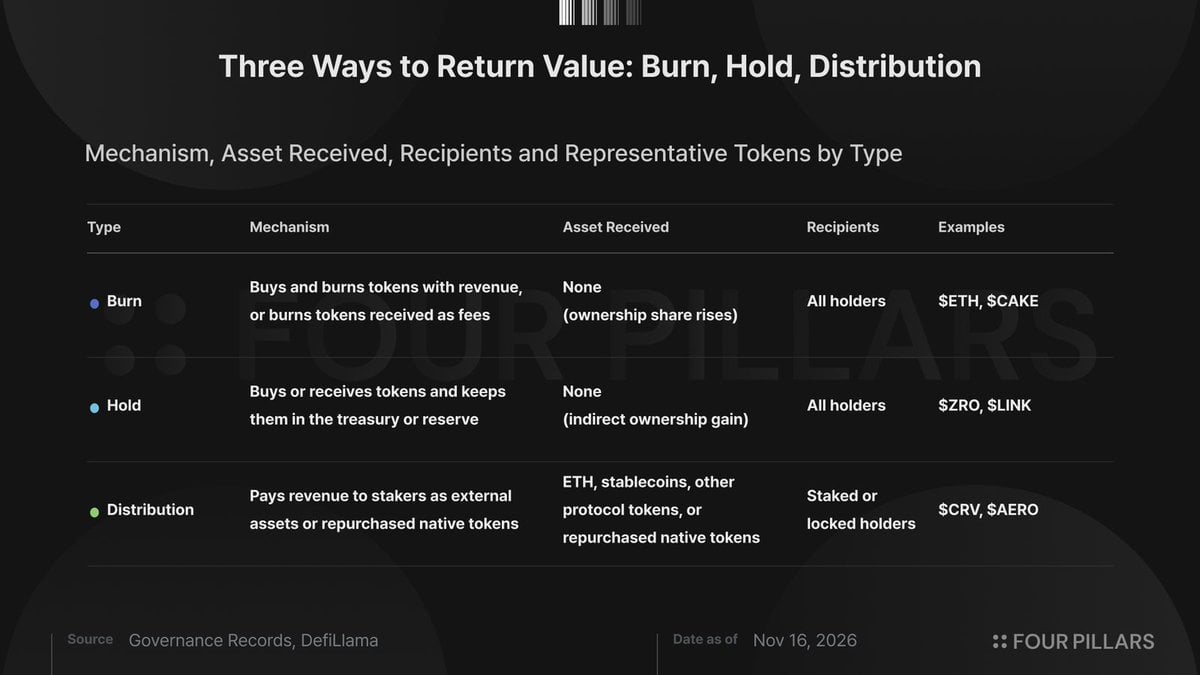
The chart above clearly delineates the three major value return streams across three dimensions: operational mechanism, asset type received by holders, and beneficiary scope:
The first category is Buyback & Burn (Burn): Protocols use revenue to buy back tokens on the secondary market and immediately destroy them, or directly route collected token fees to a dead address. Holders do not receive any external assets directly, but the reduction in total circulating supply passively increases every holder's ownership share. Representative projects include ETH and CAKE.
The second category is Treasury Hold (Hold): Protocols use revenue to repurchase their native token or collect it as fees, then store it within the protocol's treasury or reserve fund. Holders similarly do not acquire external assets directly but gain indirect ownership benefits. Representative projects include ZRO and LINK.
The third category is Distribution (Distribution): Protocols distribute revenue directly to stakers in the form of external assets (such as ETH or stablecoins) or repurchased native tokens. Only holders who complete staking or lock-up qualify to receive payouts. Representative projects include CRV and AERO.
As of November 2026, the 83 sample tokens selected for this study primarily focus on protocols with annualized revenues of at least $10 million on DefiLlama, or those returning at least $1 million to holders. Among these, 66 tokens are confirmed to have explicit return rules. It is worth noting that a single protocol is not necessarily restricted to just one mechanism. For example, Sky (formerly MakerDAO) allocates net surplus to buy back tokens and distribute them to stakers, while simultaneously using part of its tokens for direct buybacks and burning.
Value Returns Are Highly Concentrated Across Three Burn Protocols
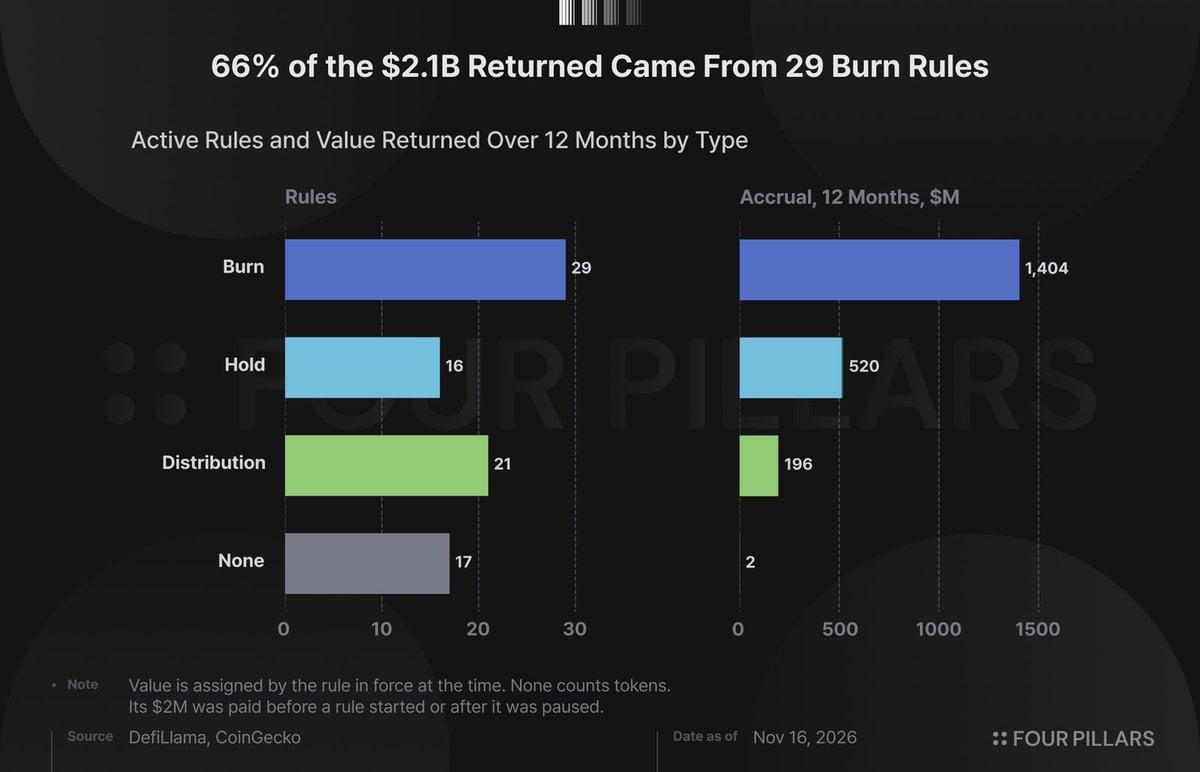
Of the 66 tokens analyzed under specific rules, 29 utilize burns, 16 employ treasury holds, and 21 implement distributions. However, in terms of capital volume, returned value shows extreme skew. Of the cumulative $2.12 billion returned over the past 12 months, buy-and-burn mechanisms account for $1.404 billion, representing a staggering 66%.
More critically, 76% of the total burn volume comes exclusively from three mega-protocols: Hyperliquid contributed $602 million, Tron contributed $333 million, and Pump.fun contributed $133 million. In other words, the absolute dominance of burns in the data stems not from superior capture efficiency, but simply because the web's three highest-profit cash-cow protocols all opted for the burn model.
In contrast, the distribution model returned only $196 million, far lower than burns and treasury holds. This is primarily because distribution models were mainly adopted by legacy DeFi protocols from the previous cycle (2020–2021), such as Curve, Yearn Finance, and Convex. Meanwhile, high-revenue new-generation protocols launching after 2024 largely gravitated toward burns or treasury holds. However, when calculating the ratio of returned value to circulating market cap, the distribution category actually boasts the highest cumulative fee yield, as this group is predominantly composed of high-yield, low-market-cap tokens.
Furthermore, distribution mechanisms typically only apply to users who stake or lock their tokens for the long term, and do not flow to ordinary spot holders. For protocols distributing native tokens via dividends, if the returns merely stem from minted token subsidies, they cannot practically be considered substantive revenue distributions.
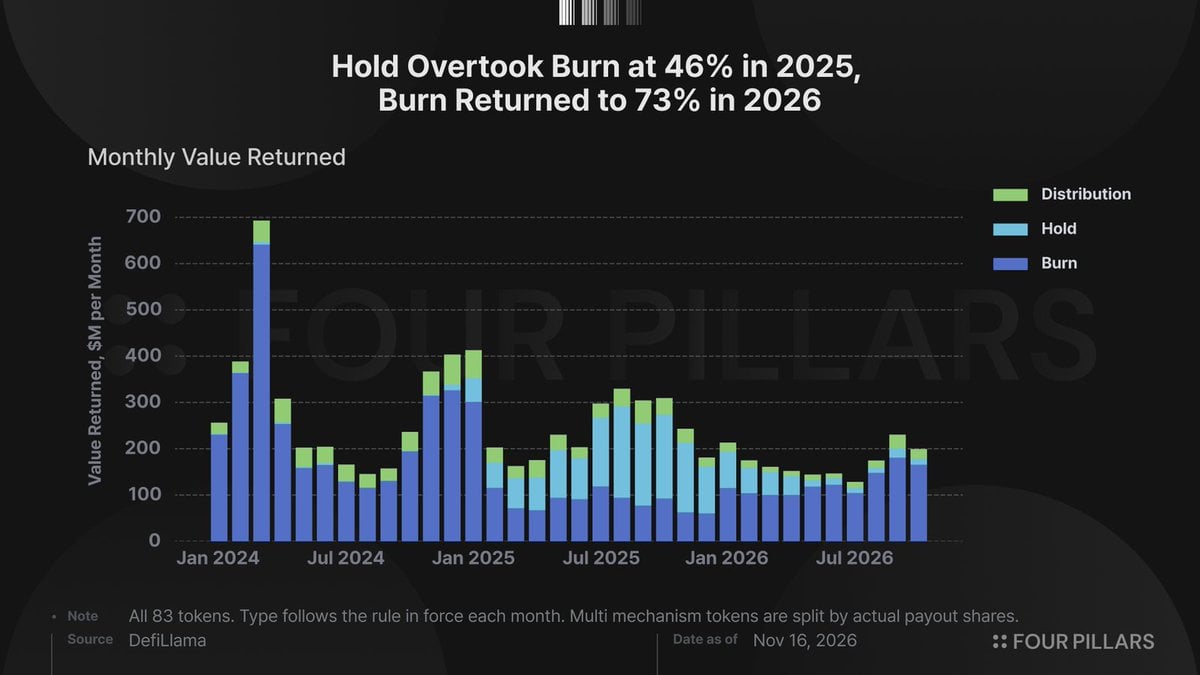
Viewing this from a temporal perspective, the market share of each mechanism underwent drastic shifts across different years. Burns dominated in 2024, treasury holds briefly surpassed them to capture 46% of the share in 2025, and by 2026, fueled by an explosion in trading volume across derivatives and meme sectors, the burn mechanism reclaimed its absolute peak at 73%.
Supply Growth Matters More Than Return Scale
Focusing solely on the dollar amount a protocol returns only reveals half the picture of token fundamentals. If a protocol repurchases $10 million worth of tokens, but concurrently issues $50 million in new coins during the same period due to team vesting unlocks, early investor cash-outs, and liquidity mining incentives, the equity of token holders remains fundamentally diluted.
To filter out inflationary interference, this study introduces the "Net Accrual Yield" metric: calculated by subtracting the percentage increase in circulating supply during the same period from the protocol's nominal return yield over the past 12 months.
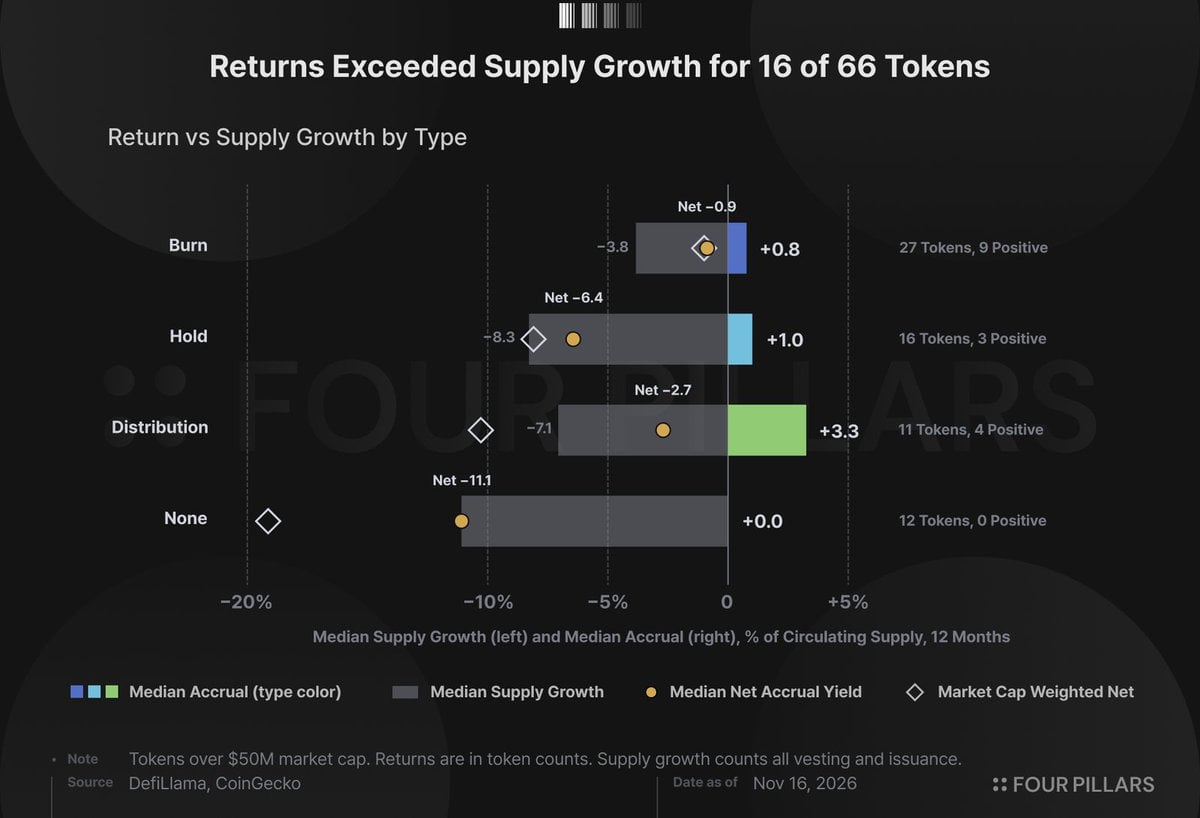
The stark reality is that among the 66 tokens with return mechanisms, only 16 maintain a positive net accrual yield. This means the revenue return pace of the vast majority of protocols fundamentally cannot keep up with the speed of unlock-driven sell pressure. The so-called gains obtained by holders pale in comparison amid waves of supply surges.
BREAKING it down by category, the burn mechanism performs best overall, with a median net accrual yield of −0.9% and a market-cap-weighted average of +0.8%. Out of 27 statistical samples, 9 tokens achieved net positive yields. The treasury hold category recorded a median of −6.4% (market-cap weighted at −8.3%), distributions posted a median of −2.7% (market-cap weighted at −7.1%), while tokens with absolutely no return mechanisms saw a median plummeting to −11.1%.
Data indicates that the core determinant of success or failure for net accrual yield is neither the form of the mechanism nor merely its existence, but rather the absolute scale of token supply inflation and whether a protocol's true profitability can cover that scale. While revenue return mechanisms undoubtedly hold value, especially for mature projects that have survived peak unlock periods and entered a fully circulating, stable phase, income feedback truly transforms into solid token fundamentals only then.
Net Accrual Yield Only Partially Reflects in Price
So, can net accrual yield directly boost a token's secondary market price? Backtesting the past 12 months of data reveals that the median price appreciation relative to BTC for the 16 tokens with positive net yields was +3%, whereas the median drawdown relative to BTC for tokens with negative net yields reached a steep −24%, drawing a clear divergence between the two groups.
However, at the individual case level, even among the 23 tokens sharing the burn camp, price trajectories exhibit extreme divergence: Hyperliquid (HYPE) surged a staggering +158%, while other tokens also executing burns suffered a sharp −64% crash. Out of 9 tokens with positive net yields, 5 failed to outperform BTC, and 2 tokens experienced a 50% price cut despite nominal value returns reaching 6% of their circulating market cap.
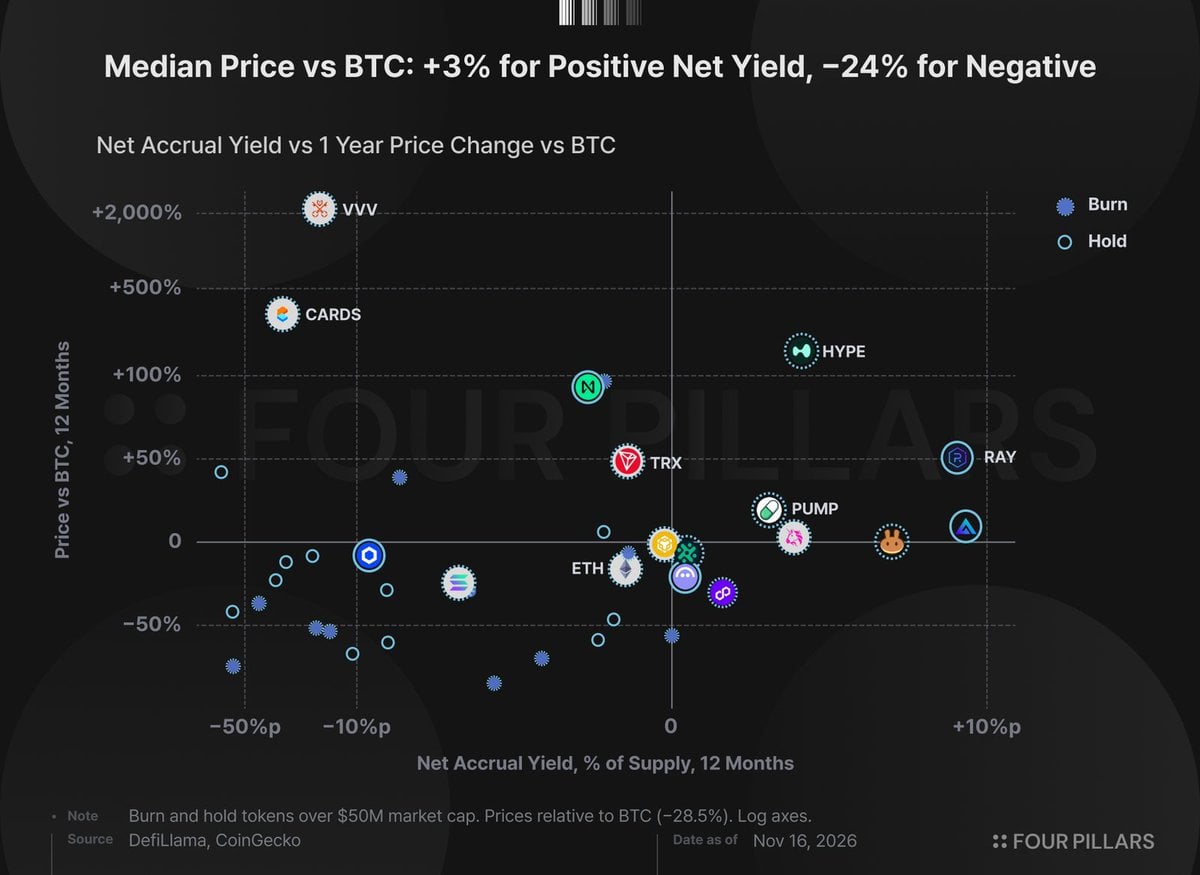
The chart above plots scatter distributions of 39 tokens utilizing burn and hold mechanisms, with net accrual yield on the x-axis and 1-year price appreciation relative to BTC on the y-axis. The Spearman correlation coefficient between the two stands at a mere +0.29, indicating only a weak positive relationship.
This result reveals that while value returns do provide a certain degree of cushion for token prices during bear markets, their decisive weight on pricing remains relatively limited. Fluctuations in token prices are still predominantly driven by macro sentiment, sector narratives, market speculation, and unforeseen exogenous events.
Necessary Conditions for Transitioning from Narrative to Fundamentals
Token value capture today still oscillates between narrative fervor and fundamental anchoring. Early in a bull market, merely announcing the adoption of a buy-and-burn mechanism is enough to ignite an emotional surge. As tokens mature, however, the intuitive and immediate boosting effect of burn mechanics often fosters investor path dependency. Hyperliquid's dazzling track record further drives numerous projects to treat it as a dogma that must be emulated.
Yet, evaluating the significance of value capture mechanisms should never remain confined to short-term hype. Beneath returning value to holders lies an obvious misalignment of interests: which mechanism truly benefits coin holders, and which truly serves the long-term development of the protocol?
From a holder's perspective, burns are undeniably the most favorable mechanism. Buy-and-burn unconditionally benefits all token holders by tangibly and permanently retiring circulating supply. While treasury holdings indirectly increase ownership percentages, whether the treasury will eventually sell tokens to cash out still hinges on governance decisions. Although distribution mechanisms pay out cash or tokens, they typically attach stringent long-term lock-up requirements, and receiving native tokens exposes recipients to downside volatility risks inherent to that very token.
Conversely, from an operational standpoint for protocols, the priority ranking is exactly reversed. Industry giants like Hyperliquid, boasting abundant cash flow, exceptionally high profit margins, and a robust team token structure, indeed have the confidence to channel nearly all fees back into the ecosystem. However, if early-stage startups with weak revenues, still desperately needing capital for protocol R&D, market expansion, and liquidity incentives, blindly copy this model, their future growth momentum will be instantly drained.
In such scenarios, treasury holdings actually serve as the most ideal protective umbrella for protocols. Accumulated token reserves can flexibly address future unexpected crises, fund development expenses, or serve as ammunition for strategic acquisitions. Similarly, the distribution mechanism requires user lock-ups; although this restricts liquidity, it deeply binds holders' long-term governance interests to the protocol, effectively deterring short-term arbitrageurs from dumping and exiting.
No single "optimal value capture mechanism" exists universally. For highly profitable, mature protocols that have moved past initial expansion phases, buy-and-burn is the logical optimal solution. For early-stage projects still requiring capital nourishment, treasury holding forms the most robust moat. And for protocols heavily reliant on long-term community governance, distribution with lock-up constraints acts as the ideal adhesive.
The truly critical factor is not blindly following current trending paradigms, but tailoring matching capture mechanisms according to a protocol's own development stage and value orientation, while communicating the underlying design logic to the market clearly and transparently. Once a protocol's wave of token unlocks gradually subsides, real revenue can sustainably cover operational costs, and the design intent achieves consensus understanding among holders, value capture can finally evolve from an ethereal narrative slogan into rock-solid protocol fundamentals.
Join TechFlow official community to stay tuned
Telegram:https://t.me/TechFlowDaily
X (Twitter):https://x.com/TechFlowPost
X (Twitter) EN:https://x.com/BlockFlow_News
 Four Pillars