Does every GTA release coincide with a financial crisis? This time, GTA 6 and Anthropic’s IPO land on the same day.
Written by: Lucas, TechFlow
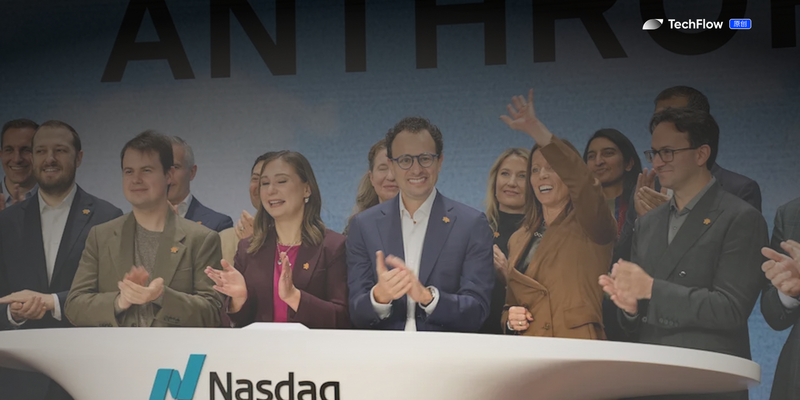
On November 19, 2026, *GTA 6* unlocked on console platforms. On the same day, Anthropic listed on NASDAQ at $83 per share (ticker: ANT), reaching an intraday high of $115.10 before closing at $97.17.
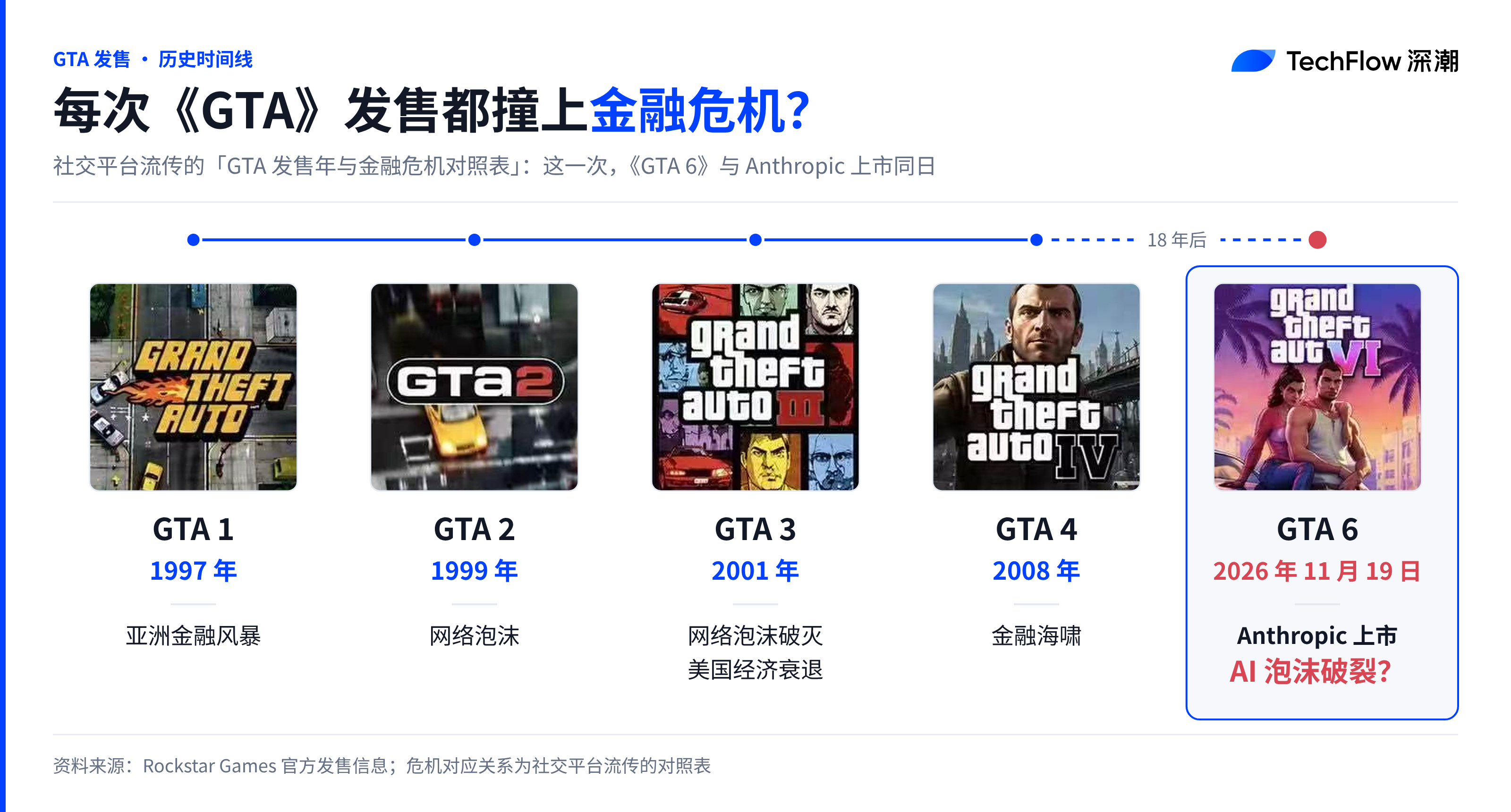
Social media quickly circulated a "comparison table between GTA release years and financial crises," pinning the 1997 Asian financial crisis, the 1999 dot-com boom, the 2001 bubble burst, and the 2008 subprime tsunami squarely on this game.
Jokes about the game are merely dinner-party chatter; what Wall Street truly watches closely is the auditing of the AI bubble behind humanity's largest IPO.
Giants Invest Capital While Recouping Chip Payments
Over the past year, Wall Street's biggest reason for suspecting AI is a financial game has been dubbed "circular financing."
In conventional transactions, customers pay suppliers for products. But in 2026's AI compute supply chain, upstream chipmakers and cloud giants first invest in large model companies, which then convert those funds into long-term cloud service and chip procurement contracts, flowing back into upstream financial statements.
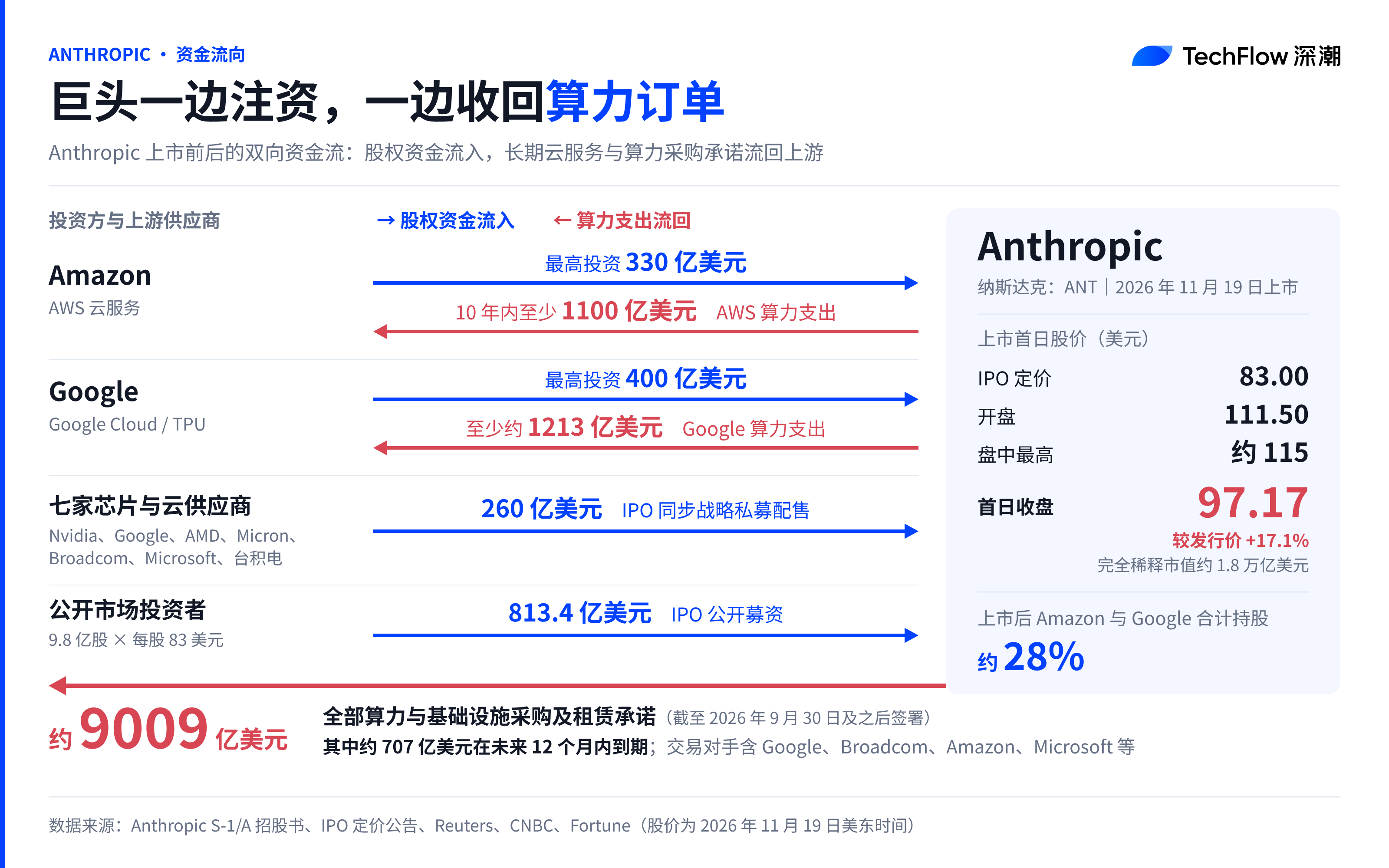
The updated S-1 prospectus filed by Anthropic provides specific figures. Amazon will invest up to $33 billion in Anthropic, which subsequently pledged to spend at least $110 billion on Amazon Web Services (AWS) over ten years. Google will invest up to $40 billion, with Anthropic committing to spend at least $121 billion on Google Cloud.
This circular ledger reached its climax on listing day, November 19.
For this IPO, Anthropic raised $81.34 billion in public offerings, while simultaneously introducing a $26 billion strategic private placement funded by six core chip and cloud suppliers: Nvidia, Google, AMD, Micron, Broadcom, and Microsoft.
Post-listing, Amazon and Google will jointly hold nearly 30% of Anthropic's shares. The company's balance sheet carries total compute procurement commitments amounting to approximately $900.9 billion, with about $69.8 billion maturing within the next twelve months.
Former Morgan Stanley trader and President of Weiss Multi-Strategy Advisers, Jordi Visser, directly named Nvidia as the core driver of circular financing in his November 10 analysis. He pointed out that the closed loop where suppliers provide financing or lease guarantees to clients, who then use those funds to purchase chips, may not trigger a collapse on its own, but it tightly binds the financial leverage across the entire industry chain.
Who Is Actually Paying the Bill?
If the entire chain only involved giants shuffling funds among themselves, this game wouldn't have lasted until the listing bell. Another set of micro-level customer data disclosed in Anthropic's prospectus provides starkly opposite evidence.
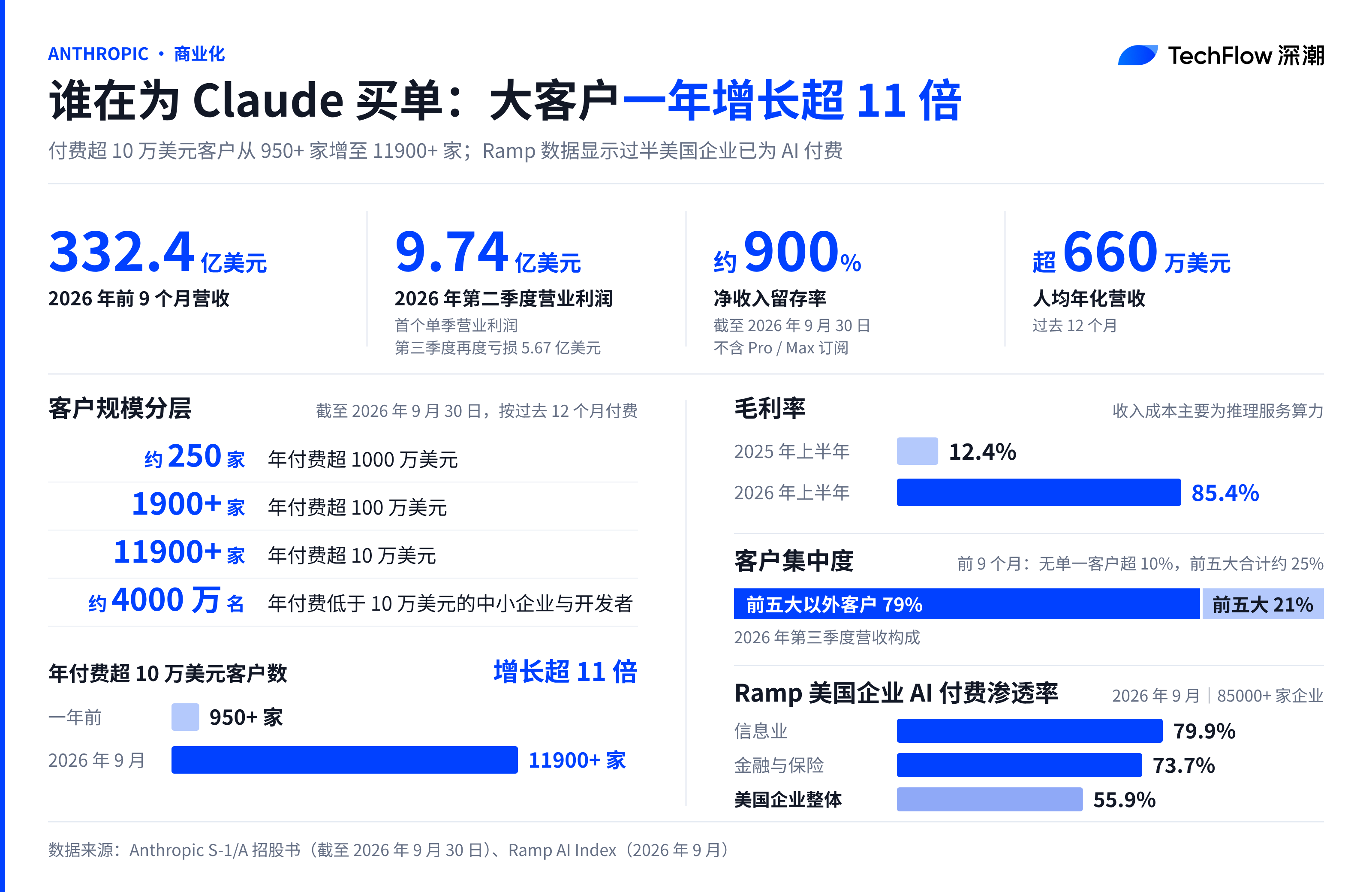
As of September 30, 2026, Anthropic had over 11,900 institutional clients paying more than $100,000 over the past twelve months, an increase of more than eleven times from the roughly 950 registered a year earlier. Clients paying over $1 million annually exceeded 1,900, while top-tier accounts paying over $10 million annually reached approximately 250.
Additionally, the company boasts approximately 40 million small-to-medium enterprise and individual developer clients paying less than $100,000 annually. Revenue per employee averages an impressive $6.6 million.
The revenue structure also does not rely on a handful of major backers to prop up the facade.
Out of the $33.24 billion in total revenue in the first nine months of 2026, no single client accounted for more than 10%. The combined share of the top five clients dropped to approximately 25%, with roughly 79% of third-quarter revenue coming from a broad base of clients outside the top five.
The income statement also demonstrates rapid commercialization. The company's net revenue retention rate stands at around 900%. Gross margins on inference services jumped from 12.4% year-over-year in H1 to 85.4%, securing its first-ever quarterly operating profit of $974 million in Q2.
Corporate expense management platform Ramp's September 2026 "AI Adoption Index" further corroborates demand penetration. Among over 85,000 U.S. companies on its platform, 55.9% have made genuine paid software purchases for AI, with IT adoption reaching 79.9% and financial/insurance sectors hitting 73.7%.
Beneath the surface-level lifelines exchanged among cloud giants, genuine, billable commercial demand for code generation and enterprise workflows is indeed materializing.
The True Vulnerability Lies in the Payers' Pockets
With the giant circular flows and corporate payments clarified, the weakest link in the entire capital chain actually lies in the middle layer.
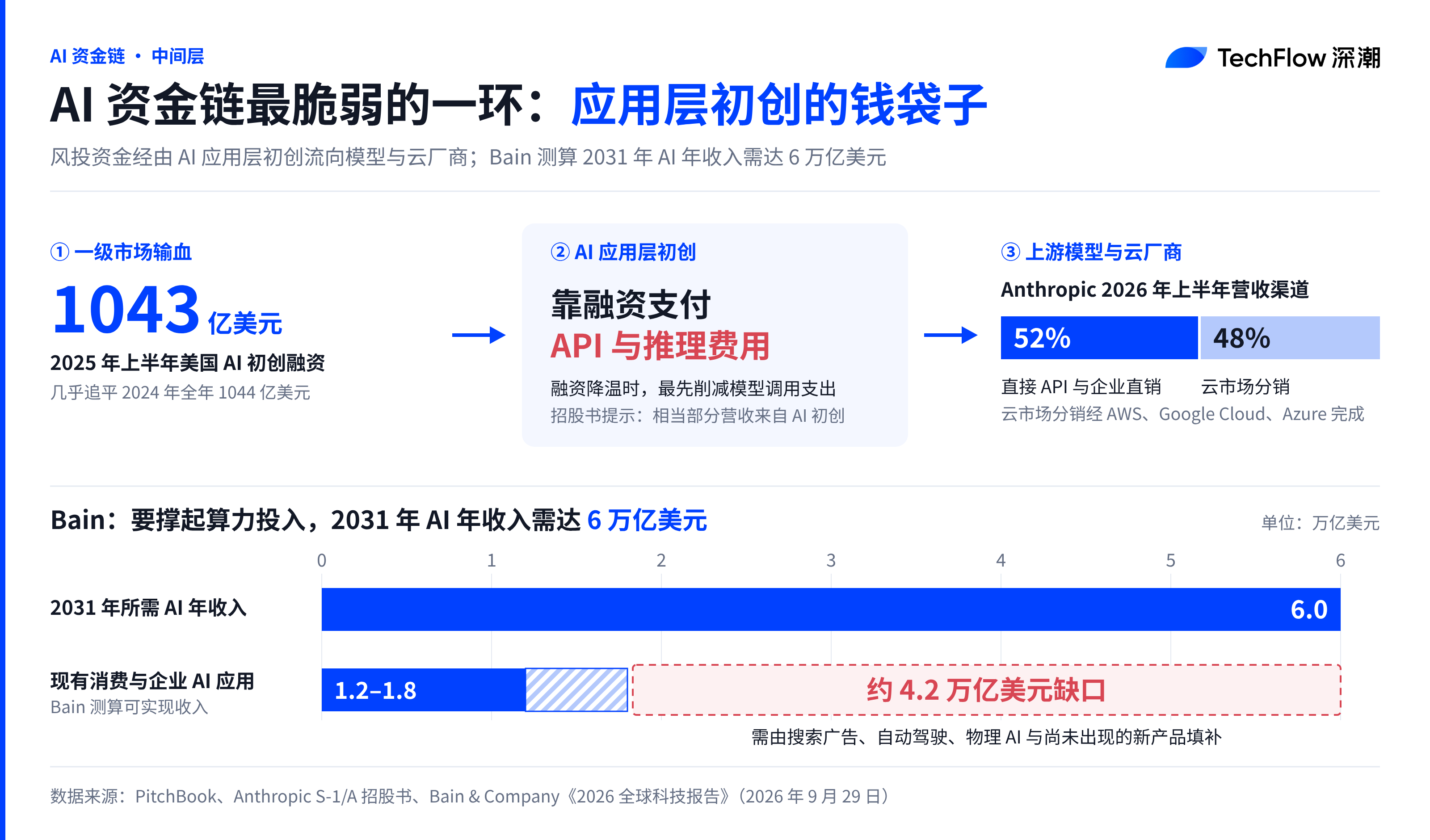
In the "Risk Factors" section of the prospectus, Anthropic explicitly warned that a significant portion of its revenue comes from various AI startups and technology firms. The filing did not break down the precise proportion of this cohort by whether they were venture-backed, but disclosed channel breakdowns: in H1 2026, 52% of sales came from direct API calls and enterprise direct sales, while 48% originated from cloud market distribution.
The reason these AI application-layer startups can afford to pay high monthly fees for Claude API calls relies entirely on a steady stream of equity financing from venture capital funds and tech giants.
Data from PitchBook shows that in H1 2025 alone, U.S. AI startups secured $104.3 billion in funding, nearly matching the full-year total of the previous year. Research and calculations by a16z and Sequoia Capital on AI application companies indicate that 30% to 50% of a growth-stage AI startup's funding directly converts to API call and inference costs paid to model providers and cloud vendors.
Once primary market funding cools, these startups will immediately cut or defer their model call expenditures.
A compute projection report published by consulting firm Bain in 2026 highlights a much broader revenue shortfall. To sustain the current industry-wide surge in data center construction costs, the global AI market must generate $6 trillion in real end-user revenue annually by 2031. Yet by 2026, existing applications only create between $1.2 trillion and $1.8 trillion, leaving more than $4 trillion in commercial use cases yet to be invented.
A Bubble Isn't Necessarily a Bad Thing
Even with this $4 trillion forward revenue gap, equating high valuations directly to a catastrophic crash overlooks established patterns in technological history.
The reason capital is willing to invest hundreds of billions into compute infrastructure five years early is precisely because the distant endgame of compute replacing human labor and reshaping software distribution rights is clear enough.
In the business world, once a new technology is confirmed as the universal foundation for the next decade, markets will inevitably engage in a collective rush. Companies would rather endure overcapacity and diluted valuations than risk falling behind at the table.
Amazon founder Jeff Bezos defined the current AI frenzy as an "industrial bubble" rather than a pure financial one during Italian Tech Week.
He believes that while financial busts often leave devastation in their wake, industrial bubbles—though they similarly funnel excess capital into both good and bad ideas—ultimately deposit tangible compute infrastructure for society, much like the fiber-optic networks left by the 1990s internet bubble or life-saving drugs emerging from the biotech bubble.
Oaktree Capital co-founder Howard Marks also provided a calm counterpoint in his November 11, 2026 memo, *The Layman Looks at AI*. He acknowledges that AI technology is absolutely not an illusion, while reminding investors to recall Buffett's observations on the internet era: efficiency gains from disruptive technologies ultimately tend to benefit consumers and society as a whole, rather than necessarily translating into sustained excess profits for today's leading companies.
Confronted with rapidly iterating technological roadmaps, Howard Marks bluntly stated that going heavy on AI at current prices is essentially "largely an act of faith."
The trajectory of Anthropic's stock surging and retreating on its November 19 debut precisely illustrates this rational pricing. A closing price of $97.17 on day one corresponds to an approximately $1.75 trillion fully diluted valuation, nearly 25 times annualized third-quarter revenue. This indicates that the secondary market remains willing to pay for genuine revenue growth, yet refuses to endlessly inflate premiums for distant compute commitments.
Bubbles do not necessarily have to collapse instantaneously like they did in 2001, but the trend is shifting from "sprinkling money blindly" to "quarter-by-quarter reconciliation."
Join TechFlow official community to stay tuned
Telegram:https://t.me/TechFlowDaily
X (Twitter):https://x.com/TechFlowPost
X (Twitter) EN:https://x.com/BlockFlow_News
 深潮TechFlow