Behind the USDe Rebound: A Whale on the Brink of Liquidation Accounts for Three-Quarters of the Rally, ENA Buyback Likely Delayed Until 2027
Author: Alea Research
Translated by: TechFlow
TechFlow Reads: Underlying synthetic dollar asset USDe issued by Ethena experienced significant volatility in October. Although a yield spread still exists between its staking token sUSDe and competitors', its circulating supply contracted by 7.4% in a single month, revealing the true nature of its expansion: growth is not driven by passive savings but is deeply tied to looped leverage within the lending market.
With rising borrowing rates on Aave and slashed subsidy budgets, deleveraging by a single large multisignature account nearly triggered a domino effect. This research report thoroughly deconstructs Ethena's revenue distribution mechanism, the lifecycle of looped loans, and the realistic timeline for the governance token ENA's initial token buyback.
Current USDe dynamics exhibit a clear pattern: its scale expands rapidly when borrowers engage in looped leverage, and contracts sharply once they unwind their leveraged positions.
Looping refers to borrowers depositing USDe into a lending protocol as collateral, borrowing other USD stablecoins, and then using the borrowed funds to mint more USDe, repeatedly staking them in a cycle. The recent October perfectly illustrated this mechanism.
Throughout October, the yield spread between Ethena's savings token sUSDe and Sky's competitor sUSDS remained stable at 1.23 percentage points, matching September's figures. Historically, whenever this spread exceeded 1 percentage point, USDe's circulating supply saw robust growth. However, in October, USDe's supply shrank counter-trendly by 7.4%.
This contraction began on October 6, the day USDe hit its historical peak size. On the decentralized lending protocol Aave, the borrowing rate for USDT directly constitutes the financial cost for borrowers executing USDT loops. On that very day, the USDT borrowing rate on Aave surged abruptly, breaching the native staking APY of sUSDe.
Yet, it was precisely this same looping mechanism that helped USDe quickly reclaim lost ground throughout November.
Over the week ending November 8, Ethena minted up to .62 billion USDe for a single multisig Safe wallet executing loops on Aave. By November 8, the overall USDe supply had fully recovered its losses since October 6, rebounding to approximately .8 billion.
However, this massive leveraged multisig address posted a critically precarious health factor of just 1.02 on November 12, teetering dangerously on the edge of Aave's 1.0 liquidation threshold.
If this address is forced to liquidate or proactively unwinds its looping leverage, three-quarters of USDe's previous rebound will evaporate instantly, significantly delaying the launch of ENA's inaugural buyback program.
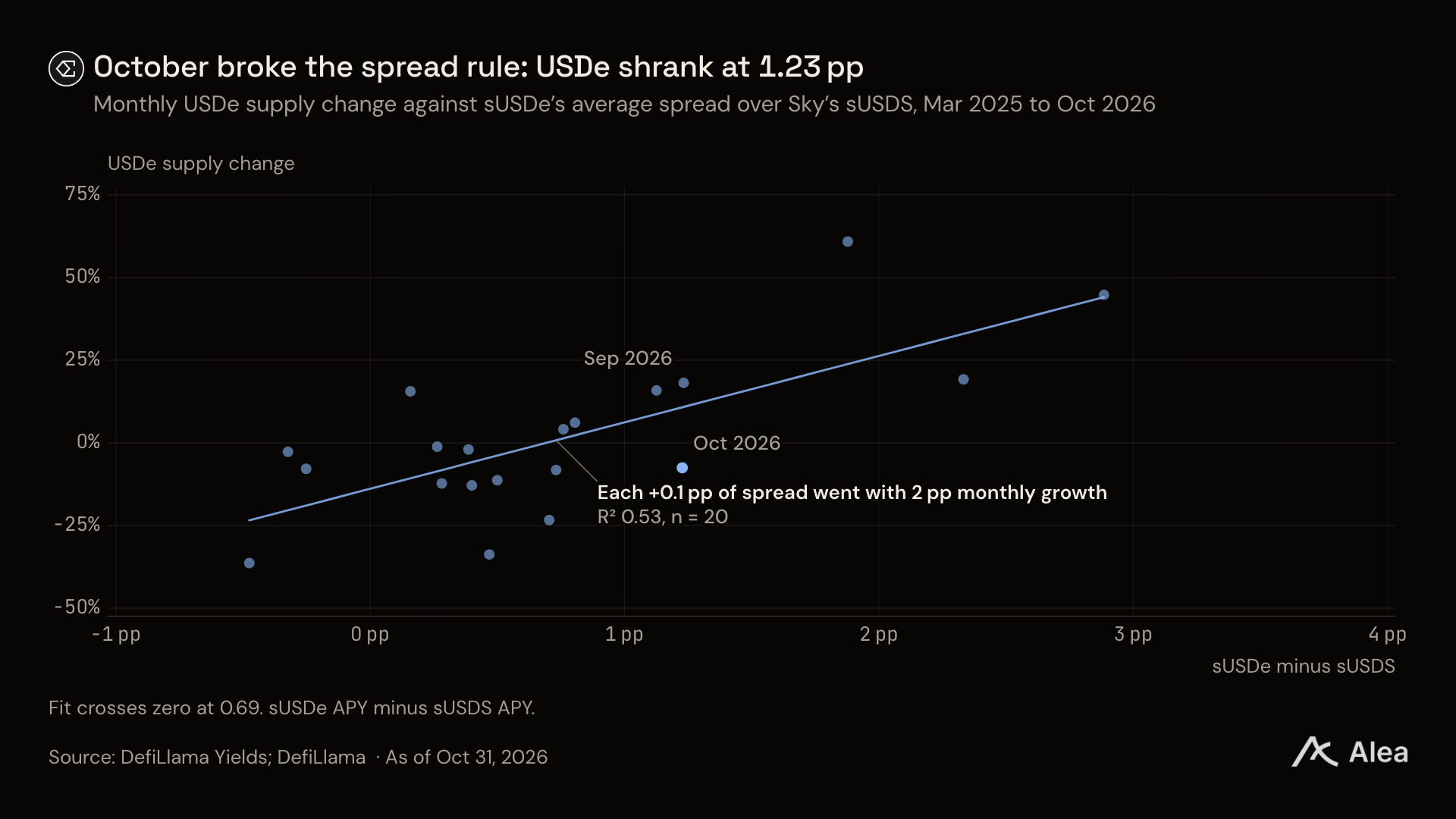
Chart: Relationship between the spread of sUSDe vs sUSDS and USDe growth rate (DefiLlama)
Core Takeaways
Ecosystem partners and lending markets claimed the majority of protocol incentives: In Q3 this year, Ethena's external partners and subsidized Safe wallets targeting the lending market distributed 69% of the quarter's total protocol incentives, leaving only 30% for retail investors directly staking in sUSDe vaults.
Aave looping incentive budget halved in October: Ethena's weekly subsidy budget for Aave loops was cut by more than half in October. With similar target incentive yields, the shrunk reward pool made it difficult for the protocol to sustain its massive looped capital stock.
Scale rebound heavily relies on a single leveraged whale with a health factor of 1.02: If the value of collateral relative to liabilities experiences a mere ~2.3% slippage, this multisig address will trigger forced liquidation.
ENA's post-September 30 drawdown was twice as severe as ETH's: Due to an increase in circulating ENA supply, its overall market cap decline roughly matched ETH's, but its per-token price endured a much sharper drop.
At September's expansion pace, the first ENA token buyback would occur in February 2027: If calculated based on Q3's average expansion speed, the triggering of the inaugural fee switch threshold could even be delayed until mid-to-late 2027.
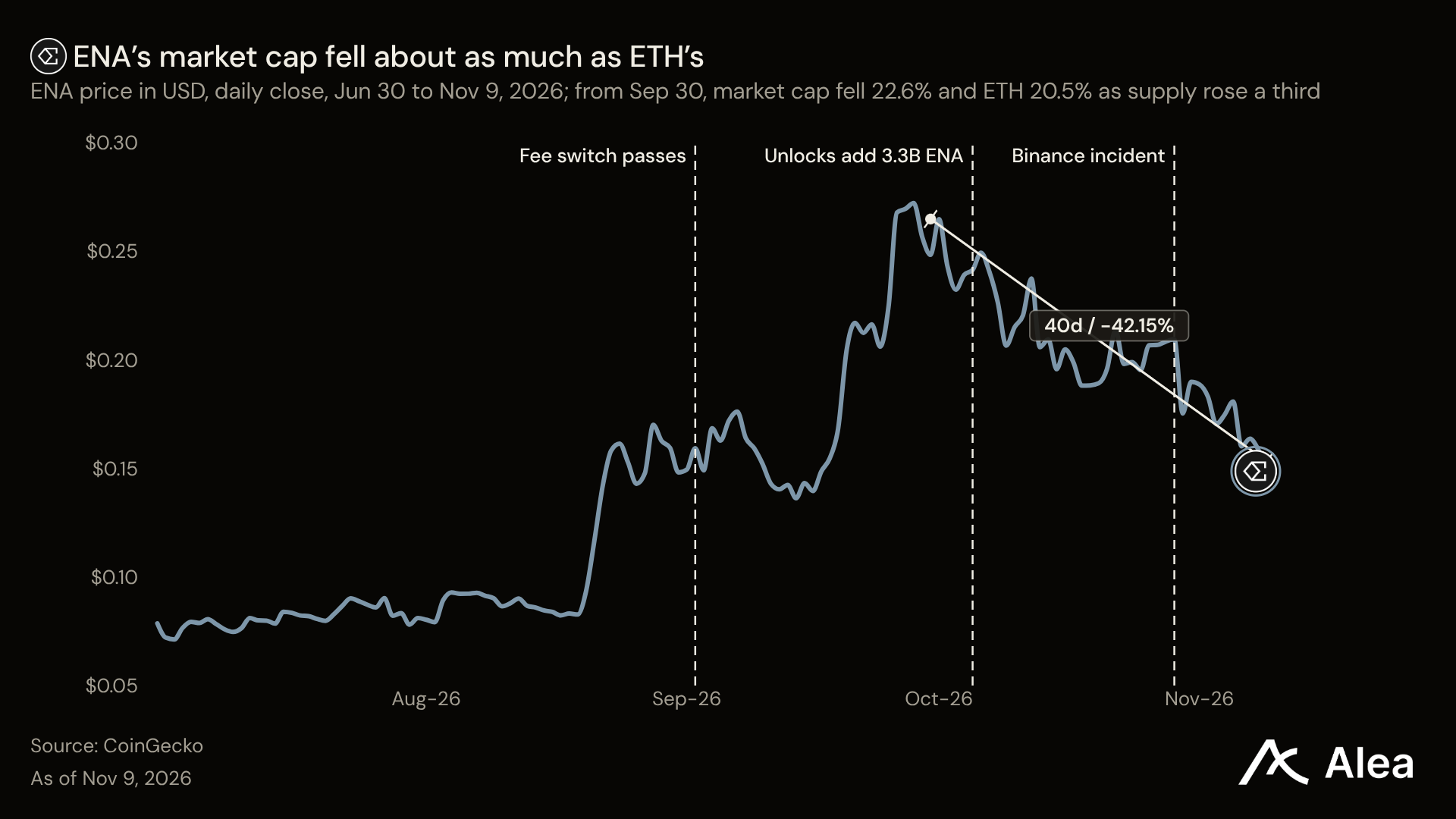
Chart: ENA price movement and token unlock milestones (CoinGecko)
Ethena's Revenue Sources and Distribution Mechanism
At its core structure, USDe is a fully backed synthetic dollar composed of a portfolio of yield-generating assets. Whitelisted institutions can swap USDC or USDT for USDe near parity.
Subsequently, Ethena allocates these funds to long spot positions and short perpetual contract positions on major centralized exchanges to capture basis trade arbitrage.
In Q3 this year, Ethena distributed a total of million in USDe incentive earnings, a slight increase compared to Q2's million. These revenues primarily flow into three core channels: sUSDe staking vaults, external ecosystem partners, and Liquid Leverage programs designed to incentivize looped lending in the credit market.
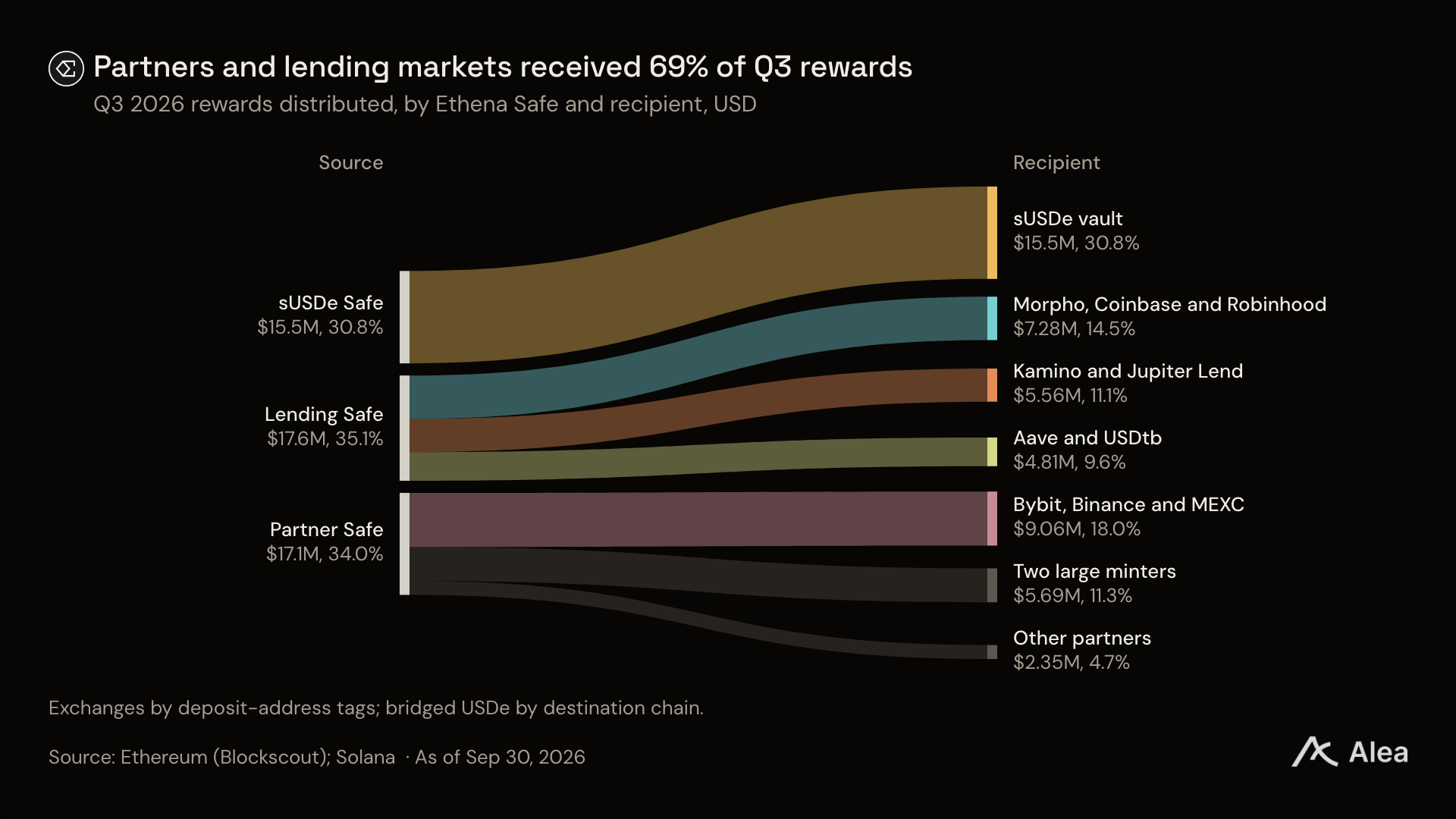
Chart: Distribution of Ethena Q3 incentive flows (Blockscout)
sUSDe is a savings credential token aimed at ordinary users. Its essence is an ERC-4626 vault: users stake USDe to receive sUSDe, with the vault's NAV continuously appreciating with each reward distribution, currently yielding an APY of approximately 5%.
Different from pure staking vaults, Ethena's Liquid Leverage initiative specifically subsidizes USDe suppliers on the core Aave V3 market.
Aave issues interest-bearing aEthUSDe tokens for staked USDe, while Ethena funnels additional rewards directly to loopers who lend stablecoins for arbitrage.
Notably, this targeted subsidy is exclusively disbursed to active positions actually holding borrow liabilities, and the lending loop exponentially magnifies this subsidy effect. Taking November 6 data as an example, Aave's comprehensive annualized borrowing rate for USDC stands at 4.86%, but after factoring in Ethena's special subsidies, the borrower's net borrowing cost is drastically pulled down to just 1.15%.
In contrast, the classic early looping strategy—which allowed borrowing USDe against sUSDe collateral—had completely turned unprofitable by September this year. At that time, Aave's risk management arm imposed stricter rate curves for USDe borrowing, eliminating the arbitrage margin for that path.
Loop Scale Expansion Outpaces USDe Itself
To further reduce friction costs for institutional looping, Ethena first zeroed out minting and redemption fees for USDC on July 9, followed by implementing the identical zero-fee policy for USDT on August 24. The official team acknowledged that this adjustment made institutional market making and cross-chain looping exceptionally smooth.
As of September 30, USDe's volume on emerging L1s Plasma and Robinhood Chain accounted for one-third of the total stablecoin supply across both networks. By stark contrast, on the Ethereum mainnet, USDe's share of the overall stablecoin market caps off at merely 1.9%.
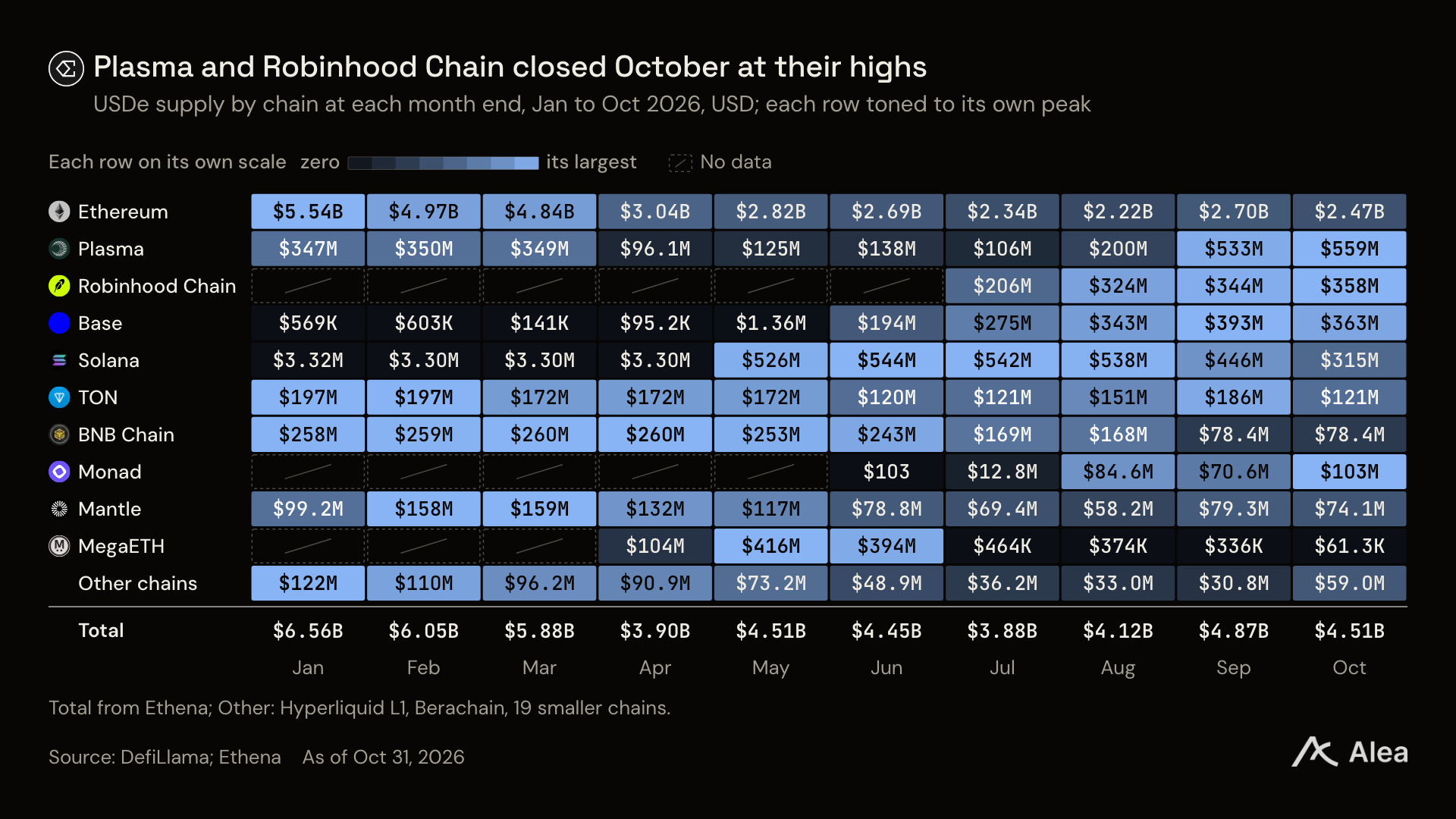
Chart: USDe market share on emerging chains like Plasma and Robinhood Chain (DefiLlama)
The October Storm: Why Did the Spread Rule Fail?
Traditional spread analysis models only measure the passive income earned by savers, completely ignoring the actual borrowing costs borne by leveraged loopers. On a growth curve fitted to 20 months of historical data, September's figures aligned almost perfectly with the model. However, in October, actual scale expansion diverged severely from theoretical predictions by hundreds of millions of dollars.
Every borrower engaging in leveraged stacking via asset pledging must pay floating interest on borrowed USD. Whether their collateral is sUSDe or subsidized USDe, the borrowing cost directly determines the viability of loop arbitrage. On October 6, the day USDe peaked, the USDT borrowing rate on Aave skyrocketed, completely surpassing the yield ceiling.
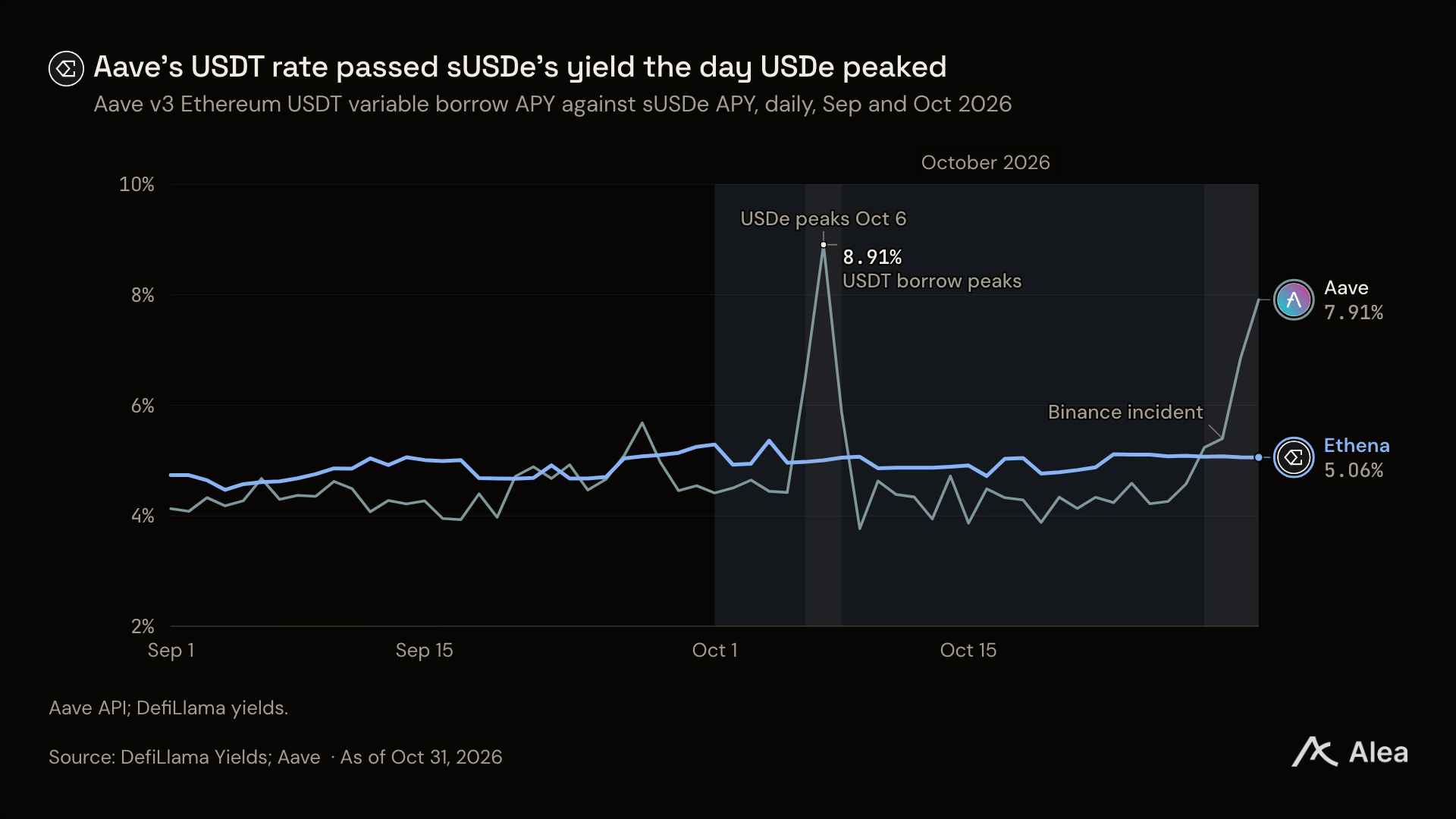
Chart: Inversion trend of Aave USDT borrowing rates versus sUSDe yields (Aave API, DefiLlama)
Although borrowing rates on Aave gradually fell back below sUSDe yields starting October 9, the outflow trend of USDe capital did not halt. The Ethereum mainnet absorbed the majority of October's outflows, as whale funds began sequentially closing positions and redeeming.
To compound the issue, Binance encountered a sudden security incident on October 29, temporarily restricting internal USDe and ENA withdrawal channels on the exchange. Ethena later disclosed its risk exposure on the platform was approximately million, further exacerbating market risk-off selling.
Meanwhile, Ethena's official incentive budget for Aave loops underwent substantial reductions throughout the month: weekly reward payouts plummeted cliff-like from approximately 5.12 million aEthUSDe at the end of September to 2.22 million by month-end, drastically reducing the allure for leveraged capital.
Single Aave Loop Whale Sustains Scale Rebound
Within Ethena's architecture, only officially whitelisted institutional addresses possess direct minting authority over USDe. Each minting instruction requires authorization and signature from designated entities, explicitly listing the type and amount of pledged collateral and the final recipient address.
On November 6, a multisig Safe wallet ending in 0xa711 initiated a full 21 rounds of borrow-mint-loop cycles consecutively over a mere four hours.
In each round, the address deposited funds into Aave to borrow USDC, promptly forwarded them to market makers, signed minting tickets, and ultimately recycled the newly minted USDe back into Aave as collateral.
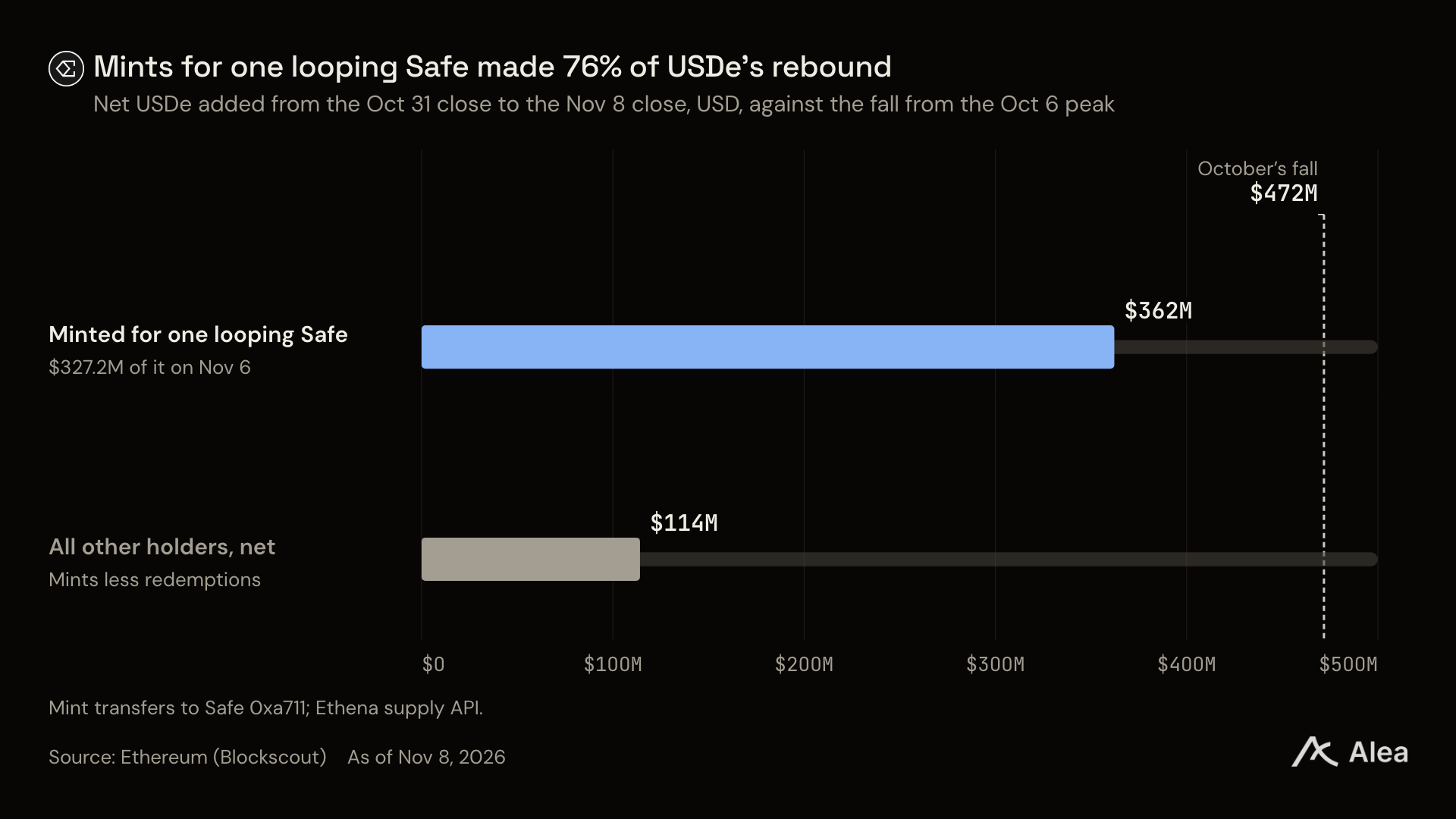
Chart: Proportion of USDe rebound driven by single large multisig address looping on Aave (Blockscout, Ethena)
The 0xa711 whale address had been continuously harvesting loop subsidies: on November 2, the address had just claimed approximately 132,000 aEthUSDe rewards from official contracts.
Midway through this leveraging march, the address's debt scale on Aave had ballooned to .9 billion, compressing its overall health factor to an extremely fragile 1.02.
Following November 9, as some other large holders initiated redemptions, USDe circulation dropped slightly from .9 billion that day to .1 billion by November 11.
During this period, savings-side spreads remained resilient, with sUSDe's 30-day average yield maintained at 5.10%, still outperforming sUSDS by roughly 1.3 percentage points. However, the entire market's marginal liquidity was entirely dictated by leveraged borrowing.
When Will ENA's Initial Token Buyback Arrive?
As the protocol's governance token, ENA did not secure any direct cash flow dividends from underlying reserves during Q3. Holders unanimously approved a proposal to activate the Fee Switch on September 2.
According to the plan, once USDe's 14-day moving average supply hits a specific threshold, the protocol will direct 20% of net reserve yield toward publicly buying back ENA.
However, as of the market close on November 8, USDe's actual supply still faces a massive gap of . billion away from triggering the first-tier buyback threshold.
Due to the 14-day moving average lagging behind real-time supply by roughly a week, assuming September's relatively strong momentum, USDe would take until at least February 2027 to meet the condition; averaging out Q3's expansion speed pushes it further to mid-to-late 2027.
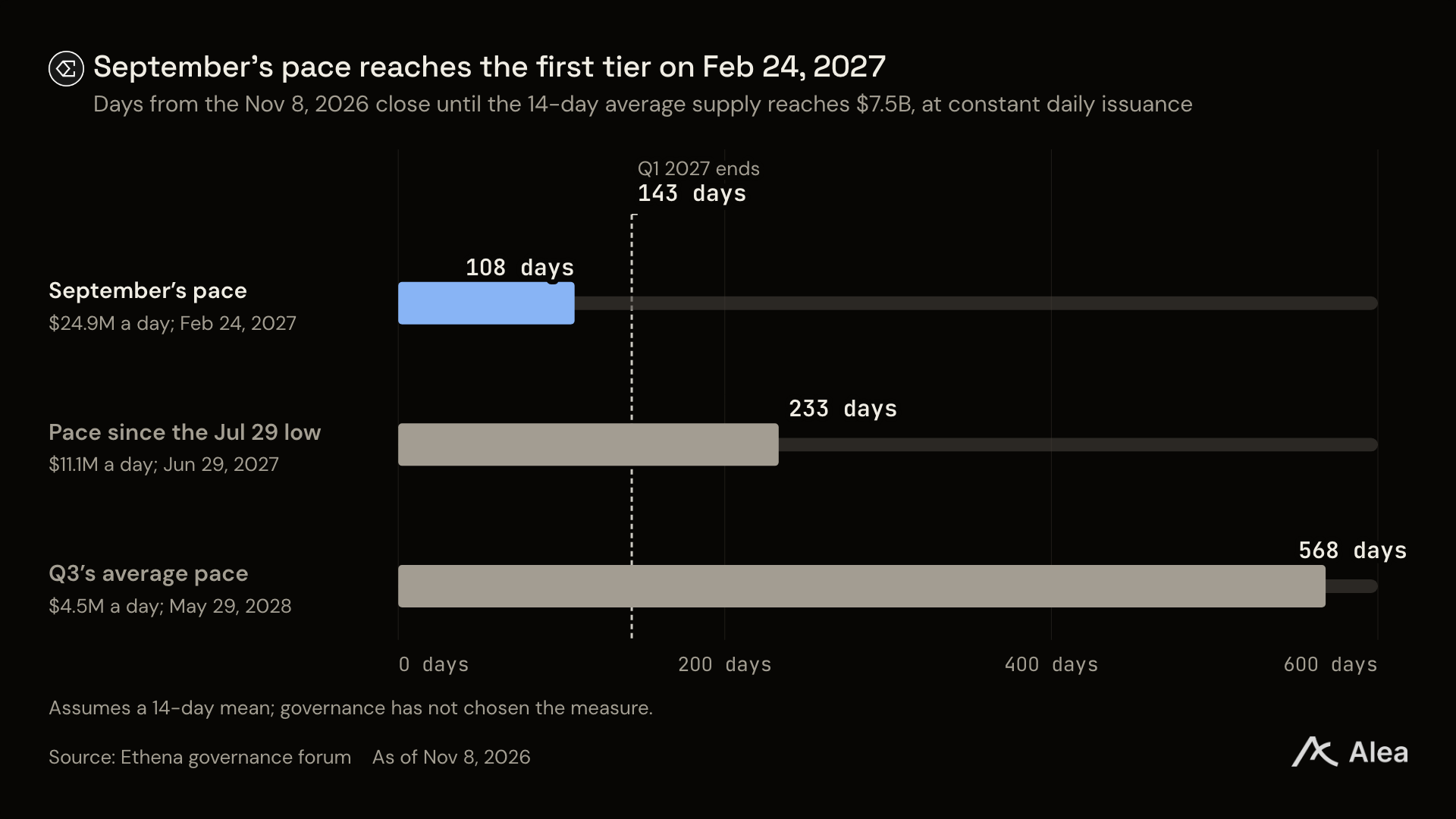
Chart: Projected timing for ENA's inaugural Fee Switch buyback under different supply expansion scenarios (Alea Research)
To alleviate secondary market sell-pressure expectations, the Ethena Foundation previously shifted forward the entire linear unlock schedule for subsequent early investors on October 5. This is precisely why, following the heavy selling pressure in early October, the shrinkage magnitude of ENA's total market cap did not exceed that of the broader Ethereum index.
Admittedly, not all capital growth relies heavily on high-risk loan leverage. For instance, Binance launched a dedicated 10% annualized yield subsidy for retail holders valid until November 30. But deep in on-chain waters, what truly dictates the rise and fall of USDe's scale—and the lifeblood of ENA's token buyback—remains these loop borrowers dancing on the very edge of the lending abyss.
Join TechFlow official community to stay tuned
Telegram:https://t.me/TechFlowDaily
X (Twitter):https://x.com/TechFlowPost
X (Twitter) EN:https://x.com/BlockFlow_News
 @AleaResearch