
Morgan Stanley US Equity Strategy Report: Q3 Position Adjustments Narrow, Hedge Funds Significantly Increase Holdings in Small-Cap Energy Stocks
Author: Chaoxiang Research
With the disclosure of third-quarter 2026 U.S. equity 13F holding reports complete, the latest positioning trends of Wall Street institutions have come to light. In a report released on November 19, 2026, Michael J. Wilson and Nicholas Lentini of Morgan Stanley's U.S. equity strategy team noted that institutional portfolio adjustments in Q3 narrowed significantly compared to Q2. Capital flowed into technology, healthcare, and energy sectors in line with their rallies, while allocations to industrials and consumer discretionary were trimmed. In the small-cap space, the energy sector rebounded from being the most heavily reduced position in Q2 to taking the top spot for increases, while hedge funds massively dumped small-cap tech stocks.
Large-Cap Portfolio Adjustments Cool Off as Capital Rides Momentum into Tech, Healthcare, and Energy
U.S. large-cap equities experienced overall volatility contraction in Q3, with the S&P 500 index posting only a marginal gain of 2% for the quarter, though sector divergence was extreme.
Dragged down by surging U.S. Treasury yields and the Federal Reserve's rate hike in September 2026, utilities (-12.4%) and industrials (-9.7%) significantly underperformed the broad market, while energy (+17.2%), information technology (+7.2%), and healthcare (+6.5%) surged to lead gains.
Institutional position changes almost perfectly mirrored this market performance. Morgan Stanley's analysis of 13F filings for the top 100 asset managers and top 100 hedge funds as of September 30, 2026, revealed that large-cap investors primarily increased allocations to information technology (+1.3%), healthcare (+0.5%), and energy (+0.4%) in Q3, while reducing exposures to industrials (-0.8%), consumer discretionary (-0.6%), and utilities (-0.3%).
The pace of additions has clearly slowed. The 1.3% increase in tech sector allocations by institutions in Q3 was far lower than the 5.8% surge in Q2. Morgan Stanley pointed out that the four sectors receiving net inflows were precisely the outperforming leaders, indicating that the rise in weightings was more passively driven by stock price appreciation rather than proactive, large-scale rebalancing by institutions.
Hedge funds' trading pacing closely aligned with the broader large-cap trend, focusing on adding healthcare (+0.9%) and information technology (+0.8%) while trimming industrials (-0.8%) and consumer discretionary (-0.5%). The financials sector emerged as the only area showing conflicting signals across long and short positioning, with hedge funds making a contrarian addition of 0.3% while the aggregate 13F filers reduced exposure by 0.2%.
Despite the modest quarterly increase, tech stocks remain an "underweight hotspot" in the eyes of institutions. Given that information technology's benchmark weight in the S&P 500 rose from 38% to 40%, all institutions maintained a persistent 1.0% underweight in the sector, while hedge funds expanded their underweight position from 6.3% in Q2 to 7.2%.
Small-Cap Style Shifts Dramatically as Energy Makes Turnaround to Become Hedge Fund Top Pick
Unlike the moderate adjustments in large-caps, small-caps underwent a drastic style rotation in Q3.
The Russell 2000 index fell 7.5% in Q3 2026, giving up some of its Q2 gains. Small-cap capital concentrated heavily in healthcare (+1.1%) and energy (+1.0%), while drastically exiting industrials (-1.1%), information technology (-0.6%), and consumer discretionary (-0.6%).
The energy sector staged the most dramatic reversal. In Q2, energy had been the most heavily sold sector among small-caps (long-only funds reduced by 1.0%, hedge funds by 1.3%), but in Q3, hedge funds reversed course and added 1.3% to small-cap energy, catapulting it to the number-one targeted sector for hedge fund increases in the small-cap universe.
Small-cap tech stocks were ruthlessly abandoned by hedge funds. Hedge funds cut small-cap IT positions by 0.8%, completely reversing their Q2 stance of increasing them by 1.8%; the pace of additions to small-cap healthcare also plummeted from 4.3% in Q2 to just 0.1%.
Even with the decelerated pace of buying, hedge fund positions in small-cap healthcare remain startlingly high. As of September 30, 2026, hedge funds allocated 39% of their small-cap assets under management to the healthcare sector (primarily concentrated in small-cap biotech), far exceeding the Russell 2000's 21% benchmark weight, representing an overweight premium of 18 percentage points. These funds were largely freed up by significantly underweighting cyclical sectors such as financials (-7.9%), industrials (-6.5%), and consumer (-3.3%).
Microsoft and Nvidia Gain Hedge Fund Buying, Overseas Capital Allocation Remains Stable
Looking at global capital distribution, U.S. equity positioning remains highly domesticated.
U.S.-domestic registered funds hold 81% of institutional positions in the S&P 500, EMEA funds account for 16%, and Asia-Pacific funds make up 3%, all roughly in line with Q2 levels. Energy is the most domestically dominated sector (86%), while real estate boasts the highest degree of internationalization (overseas capital accounts for 21%).
At the individual stock level, Morgan Stanley focused on securities where the top 100 hedge funds showed the largest changes in active position weights. Among the top 25 weighted constituents of the S&P 500, Microsoft (+1.0%), Nvidia (+0.8%), and Meta (+0.5%) emerged as the most favored targets for hedge fund additions in Q3, while Alphabet Class A shares (-0.3%) and Tesla (-0.2%) saw slight trimming.
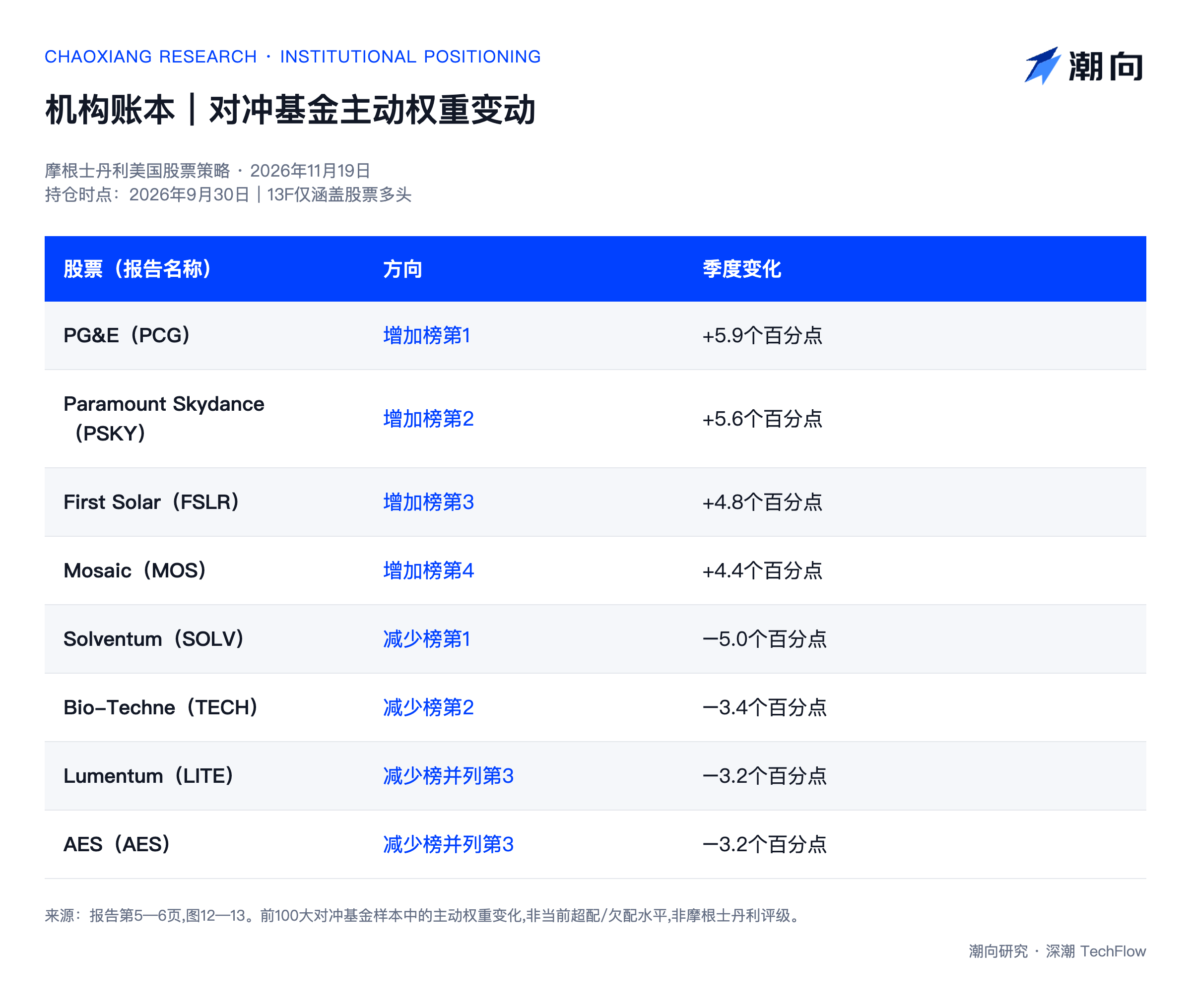
Zooming out to the entire S&P 500 constituent universe, utility PG&E (+5.9%), Paramount Skydance (+5.6%), First Solar (+4.8%), and Mosaic (+4.4%) led the list for active hedge fund weight increases; medical device company Solventum (-5.0%), Bio-Techne (-3.4%), and optical communications manufacturer Lumentum (-3.2%) topped the reduction lists.
Morgan Stanley ultimately cautioned that 13F filings only reflect long stock positions as of September 30, 2026, excluding derivatives and short positions. Moreover, market styles have further evolved in Q4 alongside interest rate shifts. Investors should combine these reports with the latest price movements for comprehensive assessment.
This article represents Chaoxiang Research's compilation and interpretation of third-party brokerage research reports. Ratings, target prices, earnings forecasts, and related judgments cited herein reflect the views of the respective brokerage analysts, represent only the stance of their affiliated institutions, do not constitute Chaoxiang Research's viewpoints, and do not constitute any investment advice.
Markets carry risks; decisions require independence. This article should not serve as the basis for buying or selling any securities.
Join TechFlow official community to stay tuned
Telegram:https://t.me/TechFlowDaily
X (Twitter):https://x.com/TechFlowPost
X (Twitter) EN:https://x.com/BlockFlow_News
 @chaoxiangooo