Goldman Sachs Research Breakdown: Alibaba Cloud Growth Surges to 53%, Profits More Than Double, Doubling the Upside for Alibaba
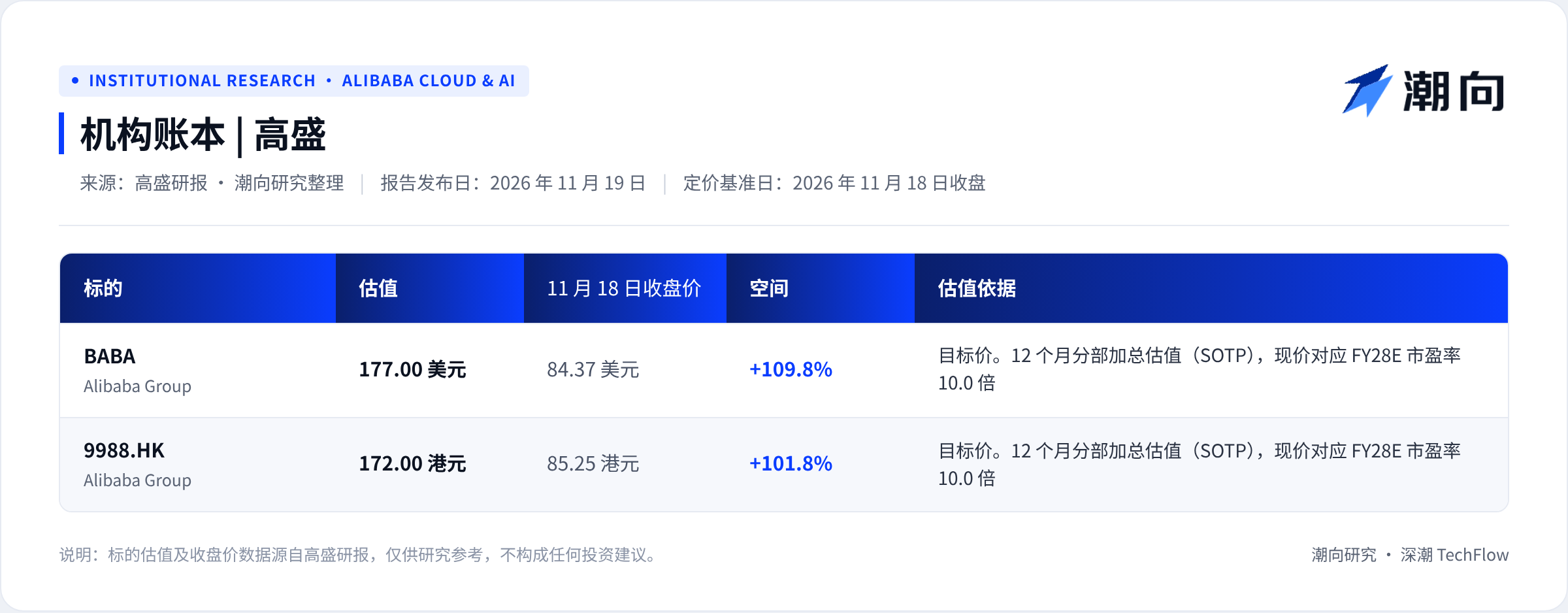
Alibaba Cloud and computing power services recorded a 53% year-over-year quarterly revenue growth, with its commercialization profit margin surging to 14.5%, driving Alibaba's adjusted EBITA for Q2 FY2027 to jump 260% year-over-year. Goldman Sachs analyst Ronald Keung's team maintained a "Buy" rating in an earnings quick take released on November 19, setting a $177 target price for US shares and HK$172 for Hong Kong shares. The firm believes AI commercialization is translating into tangible profit returns and driving the group's free cash flow (FCF) out of the trough.
Alibaba Cloud Posts 53% Quarterly Revenue Surge, Profit Margin Climbs to 14.5%
For Q2 FY2027 ending September 2026, Alibaba's total revenue reached RMB 271.519 billion, a 10% year-over-year increase, broadly aligning with Goldman Sachs' and market consensus expectations. The group's adjusted EBITA amounted to RMB 32.636 billion, a 260% year-over-year surge, exceeding Goldman Sachs' estimate by 6% and market consensus by 16%.
The core engine driving earnings above expectations came from Alibaba Cloud and computing power services. The segment's quarterly revenue reached RMB 60.973 billion, with the YoY growth rate accelerating from 45% in the prior quarter to 53%, surpassing Visible Alpha's market consensus by approximately 3 percentage points.
Growth was fueled by a surge in external paid demand. Revenue from external customers on Alibaba Cloud grew 64% year-over-year, while recurring external revenue excluding compute equipment solutions surged even higher at 67%. Revenue from AI-related products has registered triple-digit year-over-year growth for thirteen consecutive quarters.
Scale effects are quickly materializing on the income statement. Alibaba Cloud's adjusted EBITA margin for the quarter reached 14.5%, above Goldman Sachs' forecast of 12.5% and significantly higher than the prior quarter's 11.6%. Segment profit more than doubled year-over-year by 121% to RMB 8.838 billion, exceeding Goldman Sachs' estimate by 16%. Based on this, Goldman Sachs calculated that Alibaba Cloud's marginal profit margin for the quarter hit 23%.
Hardware infrastructure is also advancing in tandem. T-Head unveiled its next-generation "Zhenwu V900" AI chip during the quarter, while simultaneously upgrading its super-node architecture and native cloud infrastructure tailored for AI agents.
Narrowing Losses in Flash Shopping Boost E-commerce Profits, Net Income Weighed Down by Tax Rate
The instant retail business, which had weighed on group profits over the past few quarters, delivered a loss-narrowing result in the second quarter.
Combined e-commerce group revenue for the quarter was RMB 197.237 billion, a 2% year-over-year increase. Among this, customer management revenue (CMR) stood at RMB 75.033 billion, showing an apparent 5% year-over-year decline, primarily impacted by revenue deductions from new merchant incentive programs. After excluding this accounting deduction, CMR on a comparable basis actually grew 1% year-over-year, meeting Goldman Sachs' expectation.
The profit side, however, saw a strong rebound. Due to improved unit economics in instant retail, the business narrowed its losses while maintaining stable market share, with quarterly revenue growing 22% year-over-year to RMB 58.8 billion. Driven by this, the e-commerce group's adjusted EBITA surged 243% year-over-year to RMB 38.851 billion, with the profit margin rising to 19.7%, above Goldman Sachs' forecast of 18.8%.
The AI labs and applications segment is also accelerating commercialization. This segment's quarterly revenue growth rate jumped from 16% in the prior quarter to 51%, reaching RMB 4.435 billion, surpassing Goldman Sachs' estimate by 24%. Adjusted EBITA losses for the segment narrowed significantly to RMB 10.503 billion, compared to RMB 13.861 billion in the previous quarter.
The only blemish appeared on the net profit front. Although operating profit greatly exceeded expectations, the group's adjusted net profit for Q2 was only RMB 20.031 billion, below Goldman Sachs' forecast of RMB 27.728 billion. Adjusted earnings per American Depository Share (ADS) were RMB 8.10, 24% below market consensus. Goldman Sachs noted that this was mainly due to the effective tax rate jumping from 23% in the same period last year to 37% in the current quarter.
CapEx Below Expectations, Cash Outflow Narrows
Over the past year, Wall Street's biggest concern regarding Alibaba was the bottomless pit of spending on AI infrastructure. Q2 cash flow data provided a relieving signal.
Alibaba's capital expenditure for the quarter was RMB 50.477 billion, a 60% year-over-year increase. The growth pace slowed from 75% in the prior quarter and was 20% below Goldman Sachs' estimate of RMB 62.803 billion. On a peer comparison basis, this scale remained below Tencent's RMB 65 billion in cash capital expenditure for the same period. As of the end of September 2026, the company's contracted but unpaid capital commitments totaled RMB 62 billion.
While continuing investments in cloud infrastructure, the group's Q2 free cash flow outflow narrowed to RMB 34.5 billion due to narrowing instant retail losses and increased cloud customer prepayments, improving by over RMB 10 billion compared to the prior quarter's RMB 44.7 billion outflow. Management reiterated in the earnings release that they will adhere to an AI investment discipline focused on return on invested capital (ROIC), aiming to push free cash flow into positive territory ultimately.
Six Key Focus Areas at Earnings Call and Valuation Upside
Goldman Sachs outlined six key tracking areas for the upcoming earnings call in its report, with the most critical being compute supply and contract durability.
First is the capex plan over the next few years to support gigawatt-level data center expansion against the backdrop of constrained external high-end compute rentals, as well as T-Head's self-developed ASIC production ramp-up speed and per-token cost advantages.
Second is the lock-in period of compute contracts. Currently, the proportion of one-year and multi-year locked contracts in GPU-as-a-Service (GPUaaS) and Model-as-a-Service (MaaS) determines whether Alibaba can smoothly achieve a three-year payback period within a five-to-six-year equipment depreciation cycle, even if industry supply recovers and compute prices drop in the future.
Third is the inflection point for losses at the AI application layer, and the performance of paid seats for enterprise-focused QwenWork, leveraging DingTalk distribution and T-Head compute costs, in competing with Tencent's WorkBuddy and ByteDance's Doubao Office.
Based on the closing price on November 18, Alibaba's US shares (BABA) traded at $84.37 and Hong Kong shares (9988.HK) at HK$85.25, implying a valuation of only 10.0 times Goldman Sachs' FY2028 EPS forecast. Using a Sum-of-the-Parts (SOTP) valuation methodology, Goldman Sachs assigned a 12-month target price of $177 for US shares and HK$172 for Hong Kong shares, implying upside potential of over 100%.
Institutional Ledger
This article is compiled and interpreted by Chaoxiang Research based on third-party brokerage research reports. The ratings, target prices, earnings forecasts, and related judgments cited herein reflect the views of the respective broker analysts, representing only their institutional stances. They do not represent the views of Chaoxiang Research and do not constitute any investment advice.
Markets involve risks; decisions should be made independently. This article should not serve as the basis for trading any securities.
Join TechFlow official community to stay tuned
Telegram:https://t.me/TechFlowDaily
X (Twitter):https://x.com/TechFlowPost
X (Twitter) EN:https://x.com/BlockFlow_News
 @chaoxiangooo