
Goldman Sachs Research Analysis: Philadelphia Fed Manufacturing Plunges 14.6 Points, Yet Factory Gate Prices Hit Four-Year High
The November Philadelphia Fed Manufacturing Index plummeted by 14.6 points month-over-month to 6.3, well below the above-20 consensus expected by both Goldman Sachs and the market, while the output price index surged to its highest level since June 2022. In a research report issued on November 19, Goldman Sachs Chief Economist Jan Hatzius's team noted that the manufacturing sector is experiencing diverging sentiment alongside sticky inflation, while the sharp increase of 70,000 in continuing jobless claims was primarily driven by disruptions from Michigan's system switch, indicating no genuine deterioration in the U.S. labor market.
Orders Turn Negative, Shipments Strengthen, Manufacturing Enters a Polarized Split
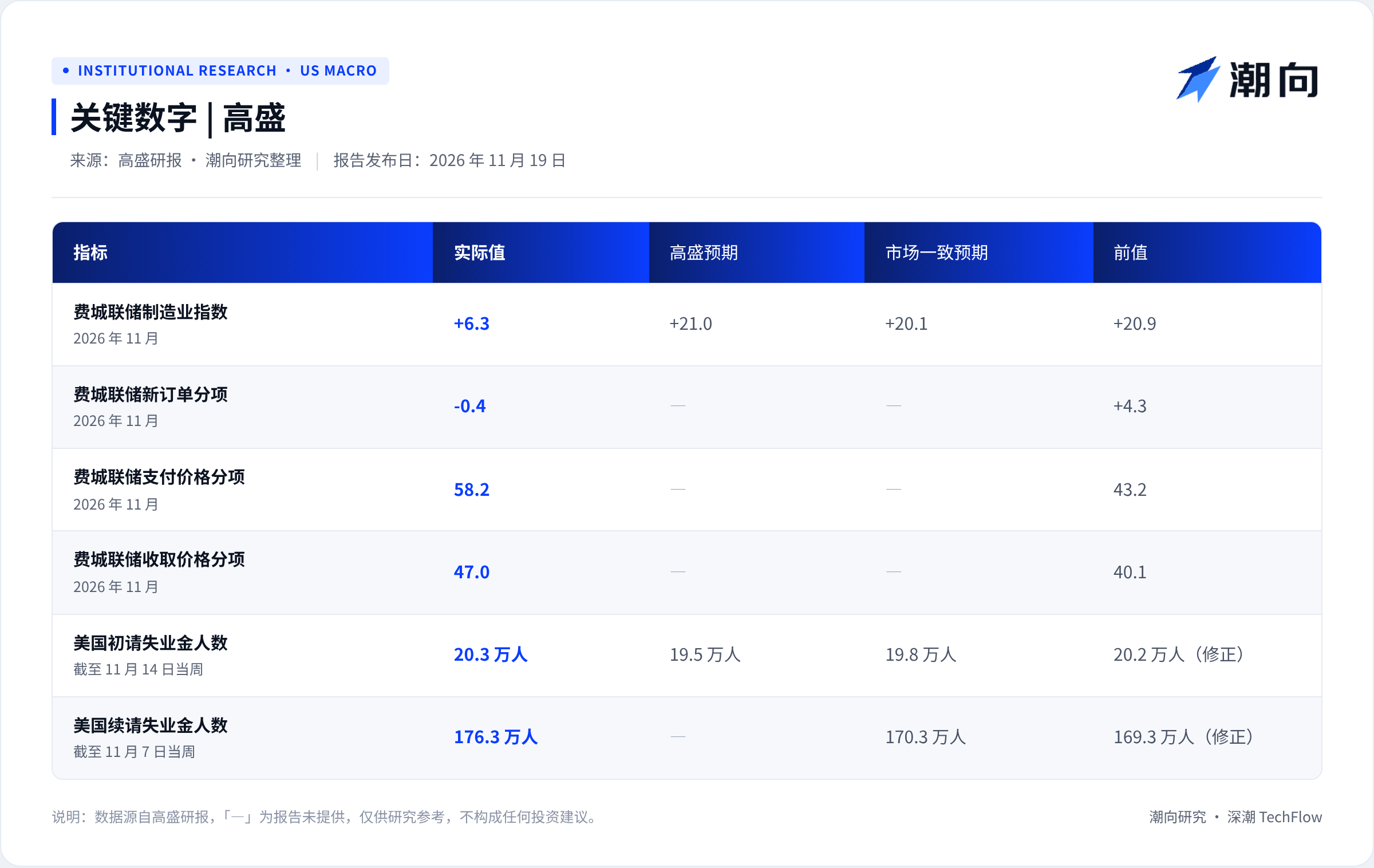
The November Philadelphia Fed Manufacturing Index recorded 6.3, a decline of 14.6 points from 20.9 in October, marking a third consecutive month of falls. This reading fell well short of Goldman Sachs's expectation of 21.0, as well as the market consensus of 20.1.
Breaking down the components, plant operations present a contradictory picture of weakening new orders against faster shipments. The new orders component, representing future demand, dropped 4.7 points to -0.4, falling below the zero line into contraction territory.
Indicators reflecting current production rhythms remain in expansion territory. The shipments component rose against the trend by 10.4 points to 25.7, and the employment component also climbed 2.5 points to 11.6, indicating that factories are still rushing to deliver backlogged orders and maintaining hiring.
Supply chain bottlenecks continue to ease. The delivery times component fell 5.0 points to 3.5, suggesting that supplier delivery speeds are accelerating.
Corporate confidence in the medium term has not been shattered by the single-month downturn in business sentiment. The six-month business conditions expectation index edged up 0.6 points to 33.6, remaining within a historically relatively stable range.
Raw Material Costs Surge 15 Points, Output Prices Hit Over Four-Year High
More alarming to bond market and Federal Reserve traders than the cooling business survey index is the resurgent price pressure highlighted in the poll.
The November payments price index skyrocketed by 15.0 points month-over-month to 58.2, indicating that manufacturing firms are facing rapidly rising procurement costs for raw materials and intermediate goods.
Companies have passed these cost pressures directly onto downstream quotes. The November receipts price index jumped 6.9 points to 47.0, reaching its highest level since June 2022.
Goldman Sachs further corroborated this trend using cross-regional business survey summary charts. After standardizing the receipts price components across surveys such as the New York Fed, Philadelphia Fed, S&P Global Purchasing Managers' Index (PMI), and Institute for Supply Management (ISM), the manufacturing price index has risen more than one standard deviation above the historical mean, with the services price index similarly holding above average.
As new orders turn negative on the demand side, upstream and downstream quotes rise simultaneously, pouring cold water on market bets that inflation will recede smoothly.
Continuing Unemployment Claims Jump by 70,000, Culprit is Michigan's New System
Weekly unemployment data released on the same day appeared equally weak on the surface, but after disaggregating the state-level details, Goldman Sachs offered a completely different diagnosis.
For the week ending November 14, initial jobless claims in the U.S. increased by 1,000 to 203,000, slightly above Goldman Sachs's estimate of 195,000 and the market consensus of 198,000, with the prior value revised to 202,000. The four-week moving average, which smooths weekly fluctuations, rose by 2,000 to 198,000, remaining in a historically low range.
By state, Missouri saw initial claims drop by 5,000, reversing the anomalous spike from the previous week; New Jersey and California also each decreased by 2,000.
What truly drew market attention was the jump in continuing unemployment claims. For the week ending November 7, regular continuing claims nationwide surged by 70,000 in a single week to 1.763 million, significantly exceeding market expectations of 1.703 million, with the prior value revised to 1.693 million.
Goldman Sachs pointed out that over 60% of this 70,000 increase came from a single state. Michigan's continuing claims skyrocketed by 44,000 that week, while initial claims also rose by 7,000, both marking the largest single-week increases since the pandemic.
Goldman Sachs economists concluded that Michigan's anomaly was highly likely linked to the launch of a new unemployment insurance application system in the state, representing a technical and statistical data disruption rather than a signal of substantive deterioration in the U.S. labor market.
Key Figures
This article is a compilation and interpretation by Chaoxiang Research of third-party brokerage research reports. The ratings, target prices, earnings forecasts, and related judgments cited herein represent the views of the respective brokerage analysts, reflect only their institutions' stances, do not represent the views of Chaoxiang Research, and do not constitute any investment advice.
Markets carry risk, and decisions must be independent. This article should not serve as the basis for buying or selling any securities.
Join TechFlow official community to stay tuned
Telegram:https://t.me/TechFlowDaily
X (Twitter):https://x.com/TechFlowPost
X (Twitter) EN:https://x.com/BlockFlow_News
 @chaoxiangooo