From AGI to ASI: Four Paths to Superintelligence
Author: Tim Genewein, Google DeepMind
Compiled by: TechFlow
TechFlow Guide: For decades, AI research has consistently focused on one epoch-making milestone: building artificial general intelligence (AGI) capable of human-level intellect. Yet, as frontier models' reasoning capabilities and cognitive boundaries evolve exponentially, humanity must confront a more profound era-defining question: What happens after AGI?
In a comprehensive essay, Google DeepMind Research Scientist Tim Genewein situates general intelligence within a grand coordinate system of continuous evolution, thoroughly deconstructs the underlying flywheel driving cognitive industrialization, and provides a detailed analysis of the four technological pathways required to advance from expert-level AGI to artificial superintelligence (ASI), which would comprehensively surpass the collective wisdom of humanity.
For decades, the entire AI academia and industry have kept their research focus firmly locked onto one highly symbolic, monumental milestone: creating artificial general intelligence (AGI) that reaches human-level wisdom.
With rapid breakthroughs in foundational compute infrastructure and large language model architectures, AGI is gradually evolving from an unattainable theoretical hypothesis into a readily achievable practical possibility. At this very moment, we can no longer avoid a more critical and solemn inquiry: Once AGI is achieved, where will technology and civilization ultimately steer?
The leap from AGI to artificial superintelligence (ASI) is absolutely not a single event that occurs overnight, but rather a long-cycle evolution driven jointly by multiple complementary and intertwined technological routes. To clarify this complex vision of the future, we need to establish a rigorous cognitive coordinate system.
A Continuous Spectrum of General Intelligence
To deduce how advanced artificial intelligence will unfold in the future, the clearest method is to treat general intelligence, whether biological or machine-based, as existing on a continuous and smooth spectrum.
Human-level AGI, situated at the midpoint, is merely a specific node on this lengthy spectrum. Prior to this, humanity has already developed narrow, non-general AI, as well as various foundational large model systems in their embryonic and developmental stages.
Artificial superintelligence (ASI), meanwhile, resides at the higher end toward the right of this spectrum. It is defined as an advanced entity capable of comprehensively and stably surpassing the collective wisdom formed by top human experts across the vast majority of economic, scientific research, and decision-making domains.
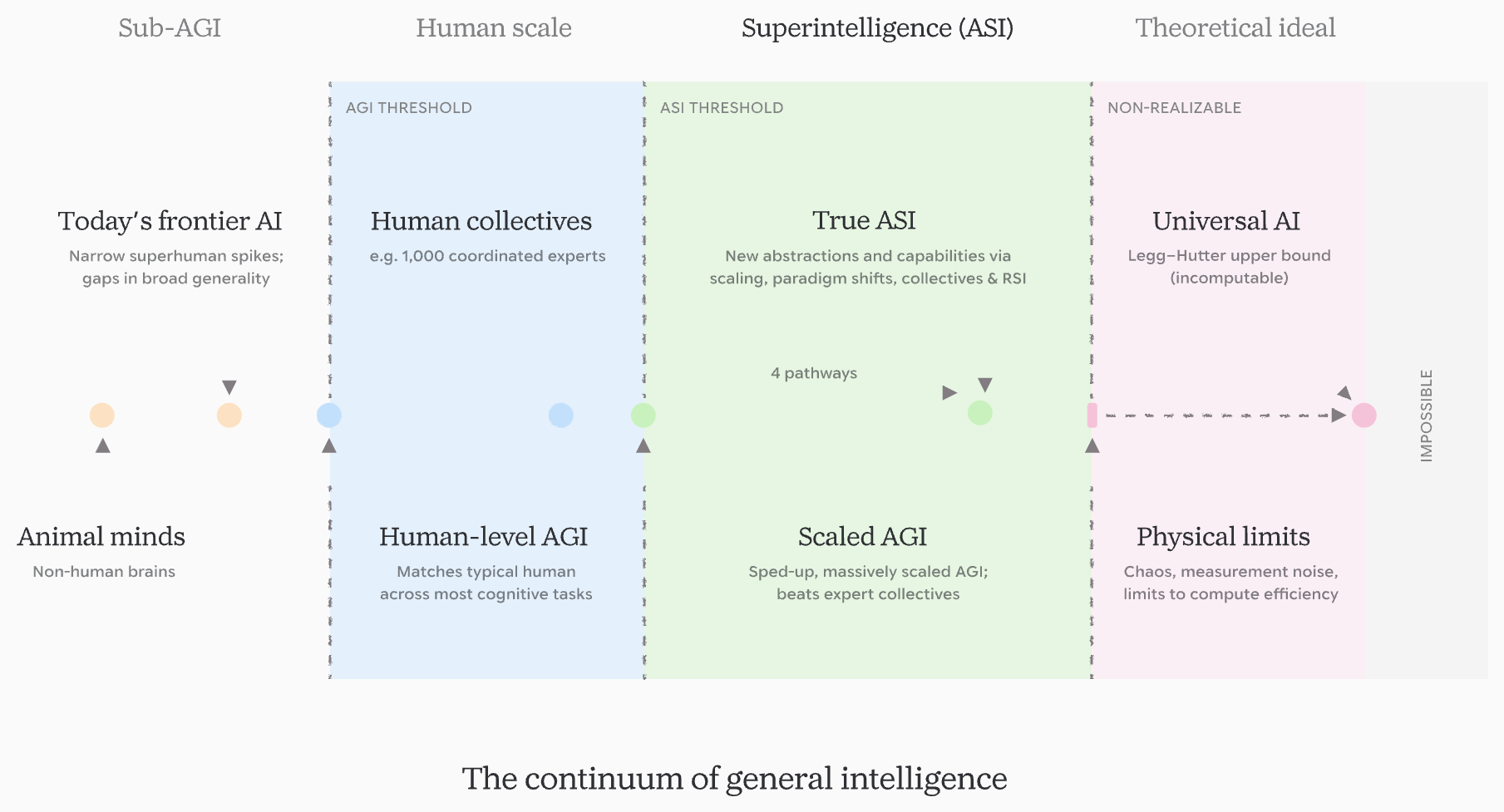
Figure: The continuous spectrum of general intelligence extending from human levels to theoretical limits (Google DeepMind)
From a purely mathematical perspective, we already have a relatively rigorous understanding of the theoretical physical and mathematical limits at the apex of the intelligence spectrum, such as optimization bounds and information entropy limits in theoretical computer science.
However, merely knowing the ultimate upper bound does not clearly map out the specific path leading to the peak. Even algorithms proven theoretically optimal often require astronomical resources far exceeding the total computational power available on Earth for full implementation.
More practically valuable leaps in reality often occur at the intersection of suboptimal heuristic algorithms and efficient engineering architectures. Between expert-level AGI and fully human-surpassing ASI lies a no-man's-land awaiting deep exploration by technological pioneers.
Cognitive Industrialization: The Triple Composite Flywheel of Effective Compute
Even if some observers harbor pessimism regarding the sustainability of isolated capability breakthroughs in frontier models, a deeper transformation sweeping across the entire industry remains equally unstoppable: cognitive industrialization.
In the past decade, the fundamental fuel driving AI's rapid advancement has been the compound exponential growth of effective compute. This continuously expanding flywheel is forged by three core pillars that mutually multiply each other:
First, iteration of hardware manufacturing processes: Under the evolution of Moore's Law and its derivative physical architectures, the floating-point compute performance purchasable per dollar has maintained a compound annual growth rate of approximately 1.5x over the past few decades.
Second, qualitative leaps in algorithmic efficiency: Over the past ten years, the absolute compute required to train models with equivalent intelligence benchmarks has plummeted by a factor of 3 to 6 annually; meanwhile, efficiency gains in algorithmic and quantized deployment for model inference have also reached approximately 3x year over year.
Third, surging scale of compute infrastructure investment: Global capital investment in AI-dedicated compute hardware is expanding rapidly at a rate of roughly 2.5x annually, as large-model training clusters are speeding toward scales of hundreds of thousands of GPUs.
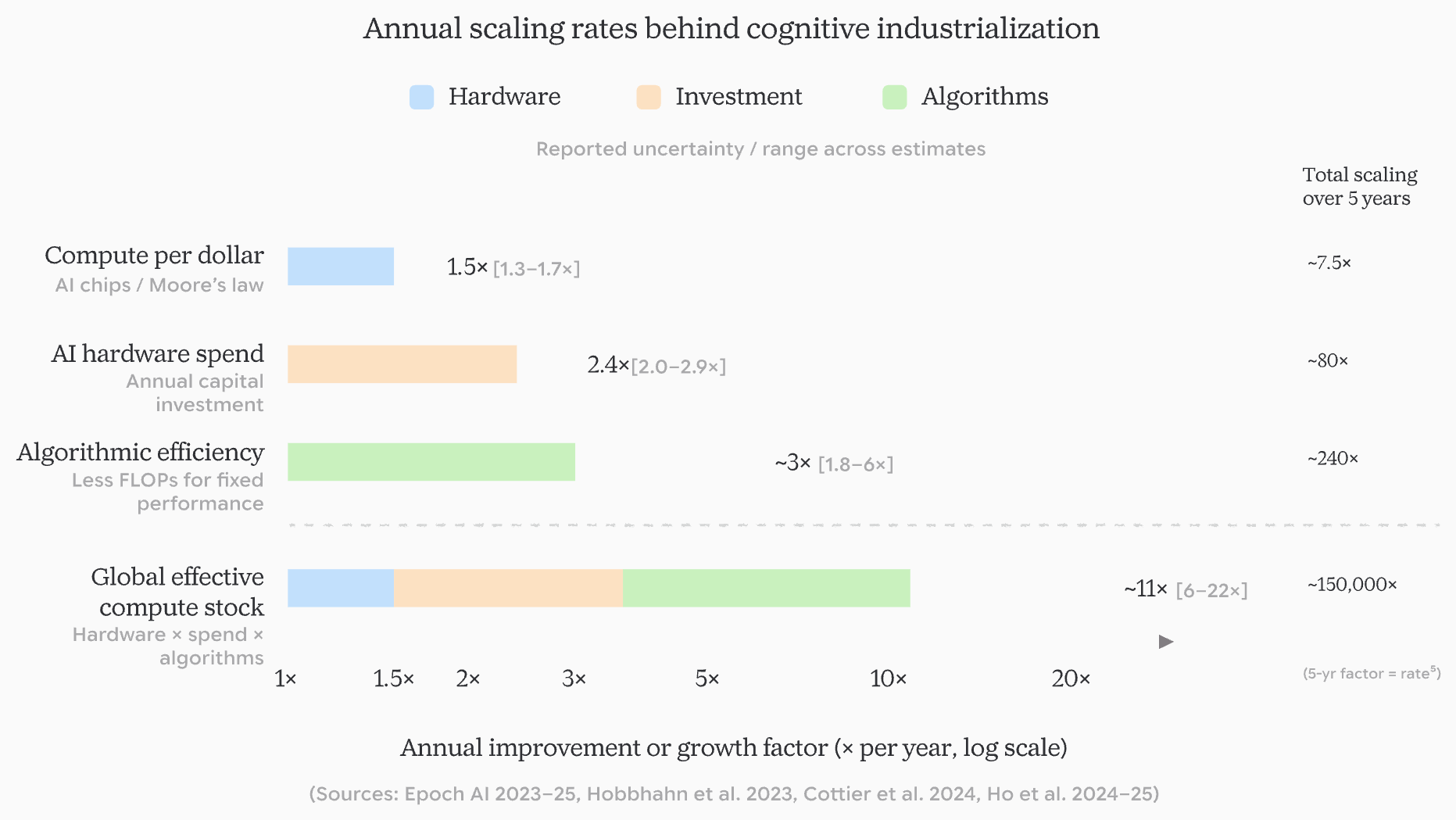
Figure: Composite drivers propel the exponential expansion of effective compute (Google DeepMind)
When these three forces stack upon one another, the global supply of effective compute exhibits a staggering expansion of over an order of magnitude annually. This means that even if foundational frontier architectures stagnate in the short term, the marginal cost of already achieving AGI-level capabilities will be rapidly compressed to near zero.
This democratization of cognitive productivity through industrialization empowers society to simultaneously deploy millions of digital experts, tackling scientific challenges and engineering tasks that once consumed generations of humans, resolving them in parallel within extremely short cycles.
Four Core Pathways from AGI to ASI
Yet, the pace of technological evolution will absolutely never stop at merely scaling existing capabilities. In the journey toward true superintelligence, Google DeepMind has outlined four distinct yet highly complementary key evolutionary pathways:
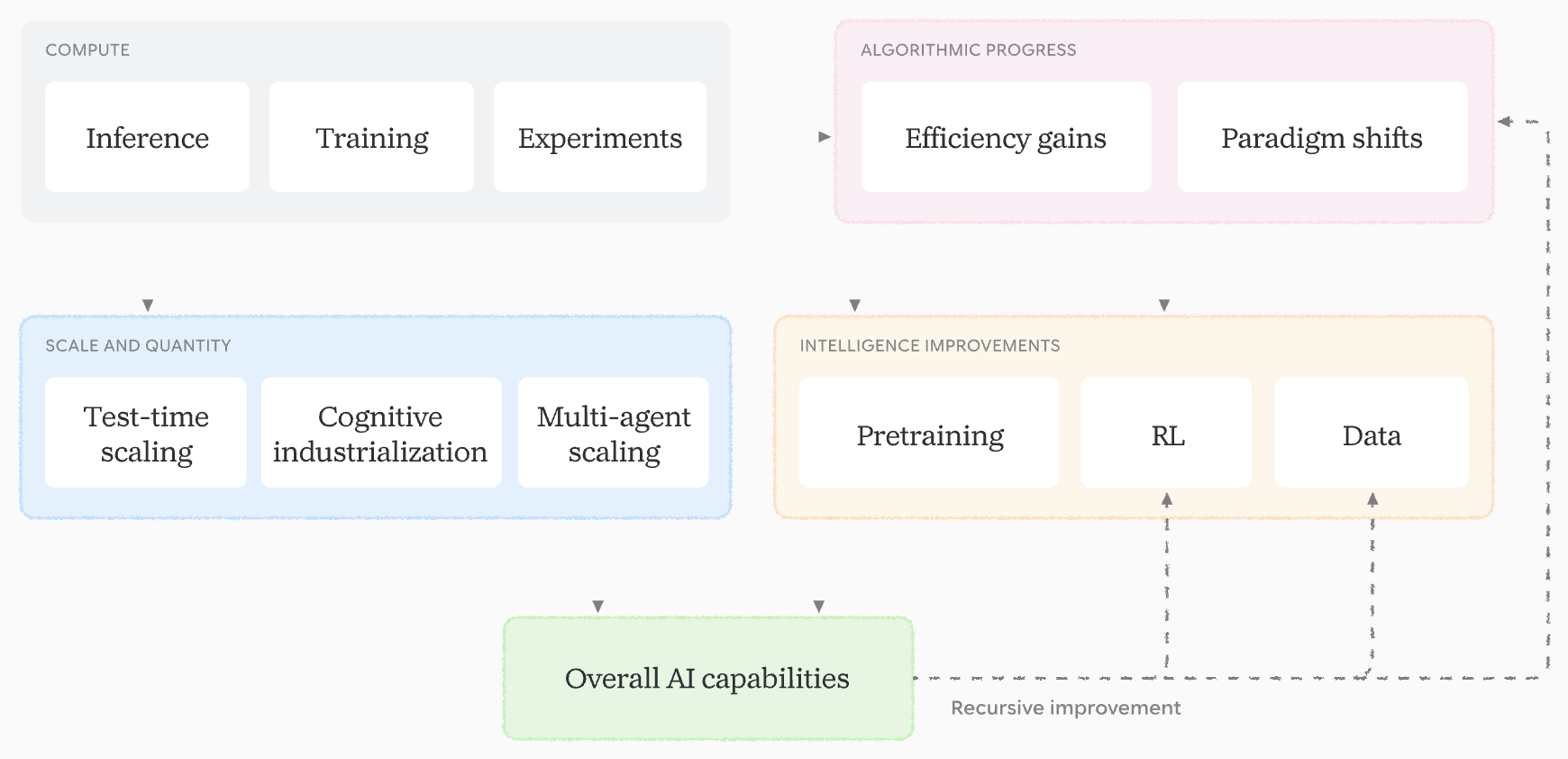
Figure: Four core evolutionary pathways advancing from AGI to superintelligence (Google DeepMind)
Pathway One: Model and Data Scaling
The first pathway is the scaling laws that humanity is currently most familiar with and finds most intuitive. By continuing to increase neural network parameter capacity, injecting vastly larger volumes of high-quality multimodal data, and pairing them with corresponding training FLOPs.
The strength of scaling laws lies in their astonishing predictability and empirical validity. As effective compute maintains compound expansion of several-fold annually, models will continuously deepen their representations of complex concepts and cross-domain knowledge transfer.
Meanwhile, inference-time compute during the post-training phase and reinforcement learning exploration are carving out an entirely new second growth curve beyond mere model capacity.
Pathway Two: Paradigm Shifts
The second pathway concerns fundamental paradigmatic leaps in deep algorithms and foundational architectures. Historical experience shows that the marginal returns of a single technological paradigm will inevitably slow down, paving the way for entirely new disruptive architectures.
The currently mainstream pure autoregressive Transformer architecture still reveals inherent limitations when dealing with ultra-long-horizon causal planning, active hypothesis testing under uncertainty, and physical interaction with environments.
Future paradigmatic breakthroughs may include, but are not limited to: search-based deep planning frameworks integrated with world models, neuro-symbolic hybrid systems, and novel neuromorphic architectures inspired by biological brain neural mechanisms that diverge from the Transformer design.
Pathway Three: Enhancing Agent Coordination
The third pathway focuses on distributed collaboration systems composed of multiple heterogeneous agents. Humans are able to create brilliant modern civilization not because individual brains are several times more powerful than those of ancient Homo sapiens, but rather due to highly precise social division of labor and institutional coordination.
When tens of thousands of specialized AGI agents can collaborate with one another using standardized communication protocols, incentive-compatible coordination mechanisms, and multi-role task allocation, the collective intelligence emerging from the entire network will far exceed the compute limits of any single model.
Such multi-agent systems can not only self-organize to tackle complex scientific research projects, but also significantly reduce the incidence of single-point hallucinations and reasoning fallacies through mutual checks and cross-validation in dynamic environmental game-theoretic interactions.
Pathway Four: Recursive Self-Improvement
The fourth pathway is the most controversial and profoundly impactful core driver on the road to superintelligence: recursive self-improvement (RSI).
In traditional research paradigms, human researchers constitute the primary bottleneck for improving AI systems; however, once AGI itself possesses the ability to read the latest papers, independently design model architectures, write efficient compilation toolchains, and conduct large-scale algorithmic experiments, the evolution of intelligence will become completely self-contained.
Every iterative upgrade of the system creates a more powerful next-generation AI developer, thereby catalyzing higher-level algorithmic breakthroughs at a faster pace. This self-reinforcing positive feedback loop is precisely the core source of momentum predicted by mathematicians and computing pioneers for an intelligence explosion.
Diversified Evolutionary Paths Toward Superintelligence
It must be emphasized that these four evolutionary pathways are absolutely not mutually exclusive or fragmented, but instead exhibit an extremely tight collaborative resonance effect.
Scaling lays the computational and data foundation for the germination of entirely new paradigms; meanwhile, more efficient agent coordination architectures can conversely greatly accelerate parallel R&D efficiency during the recursive self-improvement process.
The journey from human intelligence to superintelligence is neither an unattainable myth nor the instantaneous arrival of a singular point, but rather a magnificent technological odyssey co-authored by engineering exploration, mathematical reasoning, and industrial synergy.
Only by deeply understanding the physical laws and evolutionary pathways supporting this process can human society make adequate preparations to calmly harness and responsibly guide the dawn of true superintelligence.
Join TechFlow official community to stay tuned
Telegram:https://t.me/TechFlowDaily
X (Twitter):https://x.com/TechFlowPost
X (Twitter) EN:https://x.com/BlockFlow_News
 @GoogleDeepMind