
JPMorgan Research Report Analysis: FY2028 Revenue Raised to $741.5 Billion, Price Target Increased to $230 Despite Three Lingering Questions
NVIDIA (NVDA) posted Q3 FY2027 revenue of $115.8 billion, with full-year FY2028 revenue projected to exceed $741.5 billion. In a report released on Nov. 18, J.P. Morgan analyst Harlan Sur maintained an "Overweight" rating and raised the price target for December 2027 from $215 to $230. While results beat expectations across the board, the bank highlighted three unresolved questions regarding leadership succession, regulatory investigations, and long-term financing.
New Architecture Drives $20 Billion in First Full Quarter
In Q3 FY2027 ending late October 2026, NVIDIA reported total revenue of $115.844 billion, up 20% sequentially and 103% year-over-year. This figure exceeded the company's guidance midpoint of $108 billion by $7.8 billion and surpassed Wall Street consensus estimates of $109.1 billion by approximately 5%. Adjusted EPS for the quarter reached $2.68, also significantly beating the consensus estimate of $2.08.
The Datacenter business continued to lead growth, generating $107.610 billion in quarterly revenue, up 21% sequentially and 110% year-over-year, far surpassing the market consensus estimate of $101.9 billion.
The core driver behind this wave of beats is the next-generation Vera Rubin architecture. Vera Rubin contributed nearly $20 billion in revenue in its first full production quarter, setting a record for the fastest product ramp-up in NVIDIA's history. Driven by this, Hyperscale revenue re-accelerated sequentially from 13% in Q2 to 23%, reaching $60.1 billion for the quarter, a 71% year-over-year increase.
The AI Cloud & Enterprise (ACIE) segment posted $47.5 billion in quarterly revenue, up 18% sequentially and nearly triple year-over-year. This was primarily driven by bulk purchases of Vera Rubin chips by Neoclouds, as well as frontier large model labs beginning to build their own large-scale data centers.
Sovereign AI and Physical AI businesses both grew at nearly 3x year-over-year rates. Networking revenue broke through $21 billion for the quarter, with co-packaged optics (CPO) scaling solutions entering mass production. Driven by strong sales of Blackwell workstations, the Edge Computing segment generated $8.2 billion in quarterly revenue, up 14% sequentially and 42% year-over-year.
Profitability was equally robust. Benefiting from a more favorable product mix, the adjusted gross margin for the third quarter reached 74.9%, above the market consensus estimate of 74.1%. Operating cash flow for the quarter stood at a high of $48.3 billion, doubling the $24.1 billion recorded in Q2. NVIDIA returned approximately $28 billion in cash to shareholders through $22 billion in stock buybacks and $6 billion in dividends during the quarter, bringing cash and marketable securities on hand to $97.7 billion at quarter-end.
Q4 Guidance Includes Benefit from Additional Accounting Week
NVIDIA's guidance for Q4 FY2027 has a midpoint of $130 billion, representing 12% sequential growth, significantly above the market consensus estimate of $124 billion.
J.P. Morgan deconstructed the calendar details within this guidance in its report. The Q4 reporting cycle includes an extra accounting week, which provides an additional boost to quarterly revenue and operating expenses.
A more critical change involves assumptions around the China market. The Q4 guidance sets China data center compute chip revenue to zero and excludes all shipments of permitted Hopper chips. Excluding the impact of changes in the China region, NVIDIA's implied sequential growth rate for its core business in Q4 is approximately 15%.
Regarding margins, the company expects adjusted gross margin to decline to the 71%–72% range (midpoint 71.5%) in Q4, a drop of approximately 340 basis points sequentially, slightly below the market consensus estimate of 71.9%.
The report explains that the margin compression aligns with the transition path previously outlined by management, as the company continues to fulfill prior purchase orders at legacy prices. Management reiterated that Q4 marks the bottom for margins, and as new product pricing takes effect, FY2028 gross margin will rebound to the 72%–73% range. Adjusted operating expenses for Q4 are expected to rise to approximately $10.7 billion, primarily driven by the extra accounting week and costs associated with the product architecture transition.
FY2028 Revenue Forecast Raised to $741.5 Billion
Despite pressure on Q4 gross margins, NVIDIA surprisingly upgraded its long-term growth framework for FY2028 (corresponding to calendar year 2027). Management projects FY2028 revenue growth will reach approximately 75% year-over-year, higher than the previously guided ~70% expectation.
Accelerating growth further atop the already substantially elevated FY2027 base means NVIDIA's total FY2028 revenue will reach approximately $741.5 billion, about 6% above Wall Street consensus estimates.
This forward visibility stems from dual validation from cloud providers and the supply chain. The report notes that industry backlog among hyperscalers has climbed from $2 trillion three months ago to $2.5 trillion.
To secure upstream capacity, NVIDIA's overall Supply Commitments as of the end of Q3 have surged from $279 billion to $390 billion, with the new portion consisting mainly of multi-year memory chip procurement agreements. Management simultaneously expects both CPU and enterprise business revenues to more than double in FY2028.
Although the U.S. Department of Commerce issued a new round of export control regulations during the week of Nov. 18, management stated that global computing demand far outpaces supply, and external demand is sufficient to offset the impact of the controls.
Based on this, J.P. Morgan raised its FY2027 adjusted EPS forecast for NVIDIA by 10% to $9.66, and increased its FY2028 adjusted EPS forecast by 19% to $17.20, corresponding to a revenue forecast of $741.511 billion.
Three Key Questions Remain Unresolved
While fundamentals are strengthening across the board, J.P. Morgan explicitly warned in its report that NVIDIA's stock will still face significant volatility in the short term, as three core issues remain unanswered.
First is leadership succession and execution risk. During the earnings call, the Board confirmed that Jensen Huang will not return to the CEO role, and the company is currently searching for a permanent successor. Interim CEO Colette Kress emphasized that the three-year product roadmap remains unchanged, with Vera Rubin Ultra scheduled for launch in 2027 and the next-generation Feynman architecture slated for 2028. However, maintaining an annual chip release cadence during the leadership transition, managing an extensive supply chain, and retaining top R&D talent poses a severe test for any organization.
Second, the shadow of regulatory investigation has not dissipated. Although NVIDIA has halted shipments of Hopper products to China and excluded the country from earnings guidance, the report points out that the scope of investigations by the U.S. Securities and Exchange Commission (SEC) and the Department of Justice (DOJ) regarding chip diversions extends far beyond the Chinese market, and these regulatory uncertainties will continue to weigh on market sentiment.
Third is infrastructure financing and power bottlenecks for calendar year 2028. Management adopted a more cautious tone when discussing ecosystem financing support, explicitly stating that chip capacity allocation now depends on customers' readiness regarding land, power, and data center shells.
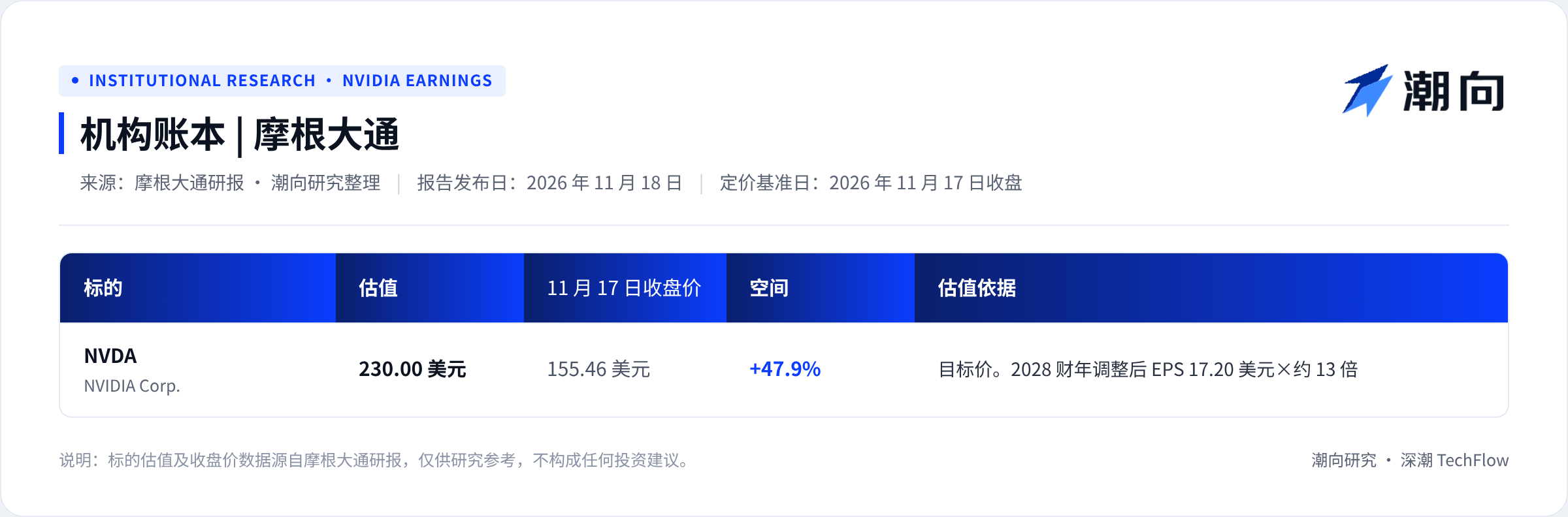
NVIDIA's current share price stands at $155.46. Based on J.P. Morgan's FY2028 adjusted EPS of $17.20, the stock trades at a mere 9.0x forward P/E. Applying a 13x multiple (aligning with the company's recent trading range of 11x to 16x), the bank sets a $230 price target, arguing that supported by strong demand and accelerating shareholder returns, the stock still has considerable room for recovery.
Institutional Ledger
This article is compiled and analyzed by Chaoxiang Research based on third-party brokerage research reports. The ratings, price targets, earnings forecasts, and related assessments cited herein reflect only the views of the respective brokerage analysts and represent solely the positions of their institutions, not those of Chaoxiang Research, nor do they constitute any investment advice.
Investment involves risks; decisions should be made independently. This article should not serve as the basis for buying or selling any securities.
Join TechFlow official community to stay tuned
Telegram:https://t.me/TechFlowDaily
X (Twitter):https://x.com/TechFlowPost
X (Twitter) EN:https://x.com/BlockFlow_News
 @chaoxiangooo