Crypto Morning Brief: Revolut Experiences Large-Scale Service Outage, PingCAP Database and Customer Data Allegedly Stolen by Hackers
Author: TechFlow
Yesterday's Market Dynamics
Bloomberg: Polymarket CEO Misused Company Funds for Personal Expenses
According to Bloomberg, sources familiar with the matter revealed that when Founders Fund considered investing in the decentralized prediction market platform Polymarket in 2025, it discovered that the platform's CEO, Shayne Coplan, had used company funds to pay for private jet charters, apartment rent, and personal expenses, even though Polymarket had not yet generated revenue. Before officially transferring the investment funds, Founders Fund required Coplan to implement ongoing internal financial control rectification measures and fully repay the relevant amounts.
PingCAP Database and Customer Data Suspected of Being Stolen by Hackers, Involving Enterprises such as Bitget and Pionex
Hacker group FULCRUMSEC publicly disclosed an attack on PingCAP's distributed database service provider's TiDB Cloud hosted platform. Over the past two months, attackers continuously infiltrated the system using leaked cloud credentials from its codebase, cumulatively stealing 10.6 TB of core data and releasing an initial data packet exceeding 200 GB. Leaked records show that blockchain-related enterprises including Bitget, Pionex, DigiPlus, NFTscan, and Chainbase, as well as prominent multinational corporations such as Booking.com, Shopee, and Capcom, are among the affected entities.
This breach covers 180,000 tenant organizations, over 400,000 unique email addresses, 115,000 plaintext application programming interface (API) keys (of which 42,000 are active), as well as over 20.6 million customer production environment structured query language (SQL) statements, hundreds of millions of gateway connection logs, and over 5 million server internet protocol (IP) addresses. Additionally, 413 private source code repositories, internal ticketing system records, cloud service financial bills, and customer relationship management data are also within the scope of this breach.
The attackers noted that some production credentials and access keys for affected customers have long remained in support tickets and logs, and PingCAP internally recorded security vulnerabilities such as multi-tenant isolation and root privilege resets as early as 2022 but failed to thoroughly patch them. Currently, the relevant platforms have not issued official public responses to this data breach incident.
Note: At present, the authenticity of the relevant data and its specific scope of impact have not been independently verified, nor is there evidence indicating that user assets at the aforementioned exchanges have been compromised as a result.
Xie Jiayin Responds to TiDB Cloud Incident: No User Sensitive Data Leaked, Service Discontinued Over Two Months Ago
Xie Jiayin, Head of Greater China at Bitget, stated in a post that investigations confirmed hackers breached and obtained data from PingCAP's TiDB Cloud database product; Bitget, along with companies like Baidu, had previously collaborated with the firm. He clarified that Bitget only stored certain publicly visible trade log data (i.e., data visible to all users in the trade channel) in that database, and stopped using the related services over two months ago. The incident did not involve any user data, let alone the leakage of sensitive information such as passwords.
Previous reports indicated that PingCAP's database and customer data were suspected of being stolen by hackers, involving enterprises such as Bitget and Pionex.
SlowMist: Qubic Wallet Contains Security Vulnerability, Private Keys May Be Recovered Through Six Consecutive Network Observations
The SlowMist security team found during analysis of the Qubic wallet that when generating account seeds and the dejaVu identifier value publicly exposed in network packet headers, the wallet reused the same non-cryptographically secure random number (Math.random()) data stream, potentially allowing private keys to be recovered through network observation.
Potential attack vectors indicate that attackers could collect dejaVu identifiers from node communications, use six consecutive observations to deduce and restore the 128-bit pseudo-random number generator state, reconstruct the 55-character account seed, verify it via the public key exposed in balance requests, recover the private key, and ultimately forge SchnorrQ signatures to transfer assets.
SlowMist has confirmed the technical feasibility of this recovery chain through a proof of concept, while noting that actual exploitation depends on factors such as network trust boundaries and observation continuity. They recommend using cryptographically secure random number generation for key creation and conducting comprehensive security audits.
DeepSeek Announces Full Open-Sourcing of Internal Reasoning Framework DeepInfer
DeepSeek announced it will fully open-source its internal reasoning framework, DeepInfer, and simultaneously release the production-grade token encoder-decoder component, deepseek-recipe, to help developers and enterprises optimize throughput, latency, and deployment costs for large-scale model inference.
DeepInfer integrates high-performance operators and a deeply optimized inference engine, supporting capabilities such as distributed inference, speculative decoding, SWA Bounded Replay, and structured outputs, while remaining compatible with NVIDIA and Huawei Ascend platforms. DeepSeek stated that it has already implemented high-throughput, low-latency large-scale inference services for DeepSeek V4.1 Flash based on DeepInfer, and future new models' inference codes and subsequent optimizations will continue to be updated within this framework.
Additionally, deepseek-recipe will maintain consistent processing logic with DeepSeek's official API, enabling the community to experience API usage closely aligned with official deployments.
Liquid Network to Gradually Restart BTC and LBTC Redeeming, Network Recovery Enters Final Stage
Liquid Network's official announcement on phased recovery progress stated that network recovery work has entered its final stage, focusing on strengthening security mechanisms, conducting independent audits, and gradually restoring anchored asset redeeming functions.
Regarding functionality restoration, the network will first gradually open semi-automated BTC and LBTC redemption services, coordinating with participating redemption service providers for implementation; this service itself imposes no protocol-layer trading volume limits. In the next phase, Liquid Network will restore 1:1 Bitcoin reserve support for the network, followed by progressively reopening Federation redeeming functions to authorized PAK key holders. However, the full restoration of related functions still depends on the completion of remaining security checks and operational requirements.
1inch Card to Cease Operations, Users Must Transfer Balances Before December 18
According to updated information on the 1inch Card FAQ page, the 1inch Card project will gradually cease operations. New user registration channels have been formally closed, although existing cards and accounts remain accessible in the short term.
1inch advises cardholders to withdraw or spend their card balances as soon as possible, with a deadline of December 18, 2026. Funds in the card are held by licensed electronic money institution Monavate, with account and card issuance technical services provided by Crypto Life (CL). Even if this deadline is missed, according to issuer terms, remaining e-wallet funds can still be redeemed within a maximum period of six years after account closure.
Revolut Experiences Widespread Service Outage, Affecting App and Offline Card Payments
According to The Independent, British neobank Revolut experienced a widespread service outage on October 20, affecting both its app usage and users' debit/credit card payments at physical stores. Revolut posted on X stating that multiple features are currently experiencing service interruptions, some services may be inaccessible, engineering teams are working tirelessly to restore operations, and apologized to users. On social media, users from the UK, France, Spain, and other regions reported being unable to make payments or transfers. As of the report's publication, Revolut's official system status page still showed all systems as "operating normally," and it remains unclear whether the outage affected all users.
US Government Bans Civilian Agencies from Using DeepSeek Products
According to Bloomberg, the Trump administration has banned U.S. civilian government agencies from using products or services from Chinese AI startup DeepSeek, citing concerns that its operations in China may pose threats to national security.
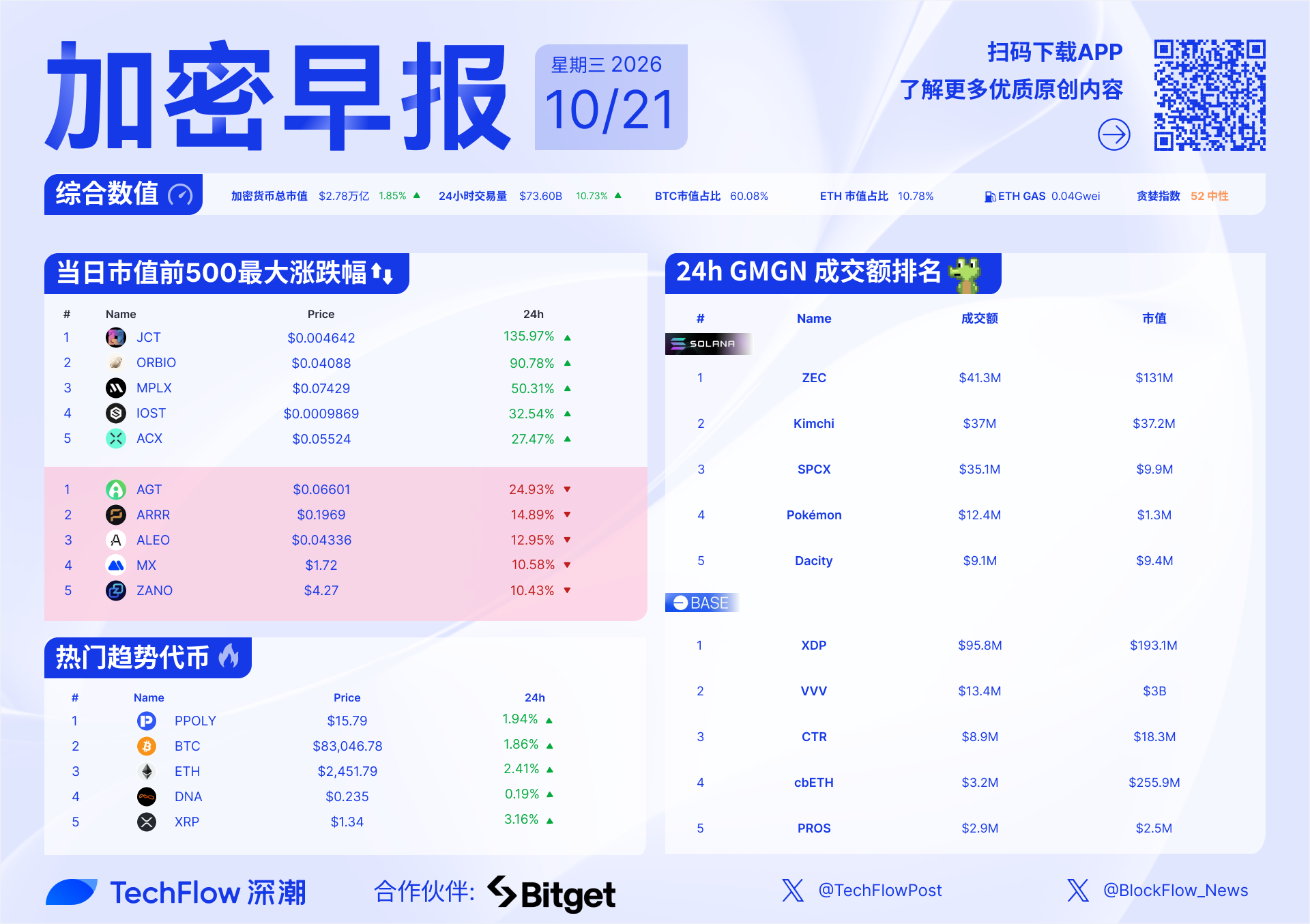
Today's Market Overview
Recommended Readings
One Share of SpaceX Per Child, Musk's $10.5 Billion Universal Experiment
https://www.techflowpost.com/article/34722
Musk plans to gift one share of SpaceX stock to every American child starting in 2027, valued at approximately $10.5 billion, drawing a contrast with Anthropic's charitable fund. Anthropic plans to allocate at least 5% of its shares to a public interest fund, with institutional bodies deciding how the funds are utilized. Meanwhile, Musk hopes to use the U.S. government's proposed 'Trump Account' to allow children to directly benefit from corporate equity appreciation. The article suggests this is not merely a competition among tech billionaires for philanthropy, but also an exploration of how ordinary people can share in the wealth created by technology amid a backdrop where AI may massively displace jobs. However, the controversy lies in whether entrusting social security to stock markets and entrepreneur donations can truly replace stable, sustainable public welfare?
Podcast Notes | Tom Lee: ETH to Surpass $10,000 Over Next Year, More Institutions to Buy Crypto Assets in Q4 This Year
https://www.techflowpost.com/article/34721
Summarized from the latest interview with Fundstrat co-founder Tom Lee, the core thesis is: he expects ETH to significantly exceed $10,000 over the next 12 months. He cites three main reasons: Ethereum continues to dominate the institutional asset tokenization sector, traditional institutions' crypto asset allocation is just beginning, and digital asset treasuries are consistently buying, reducing market circulating supply. Tom Lee also pointed out that ETH rose approximately 65% in Q3, while the S&P 500 remained largely flat; currently, Ethereum treasuries hold about 7% of the supply, and he projects this could rise to 15% over this cycle. The core logic is that institutional adoption combined with treasury buying may jointly tighten ETH supply and demand, but surpassing $10,000 remains his market forecast rather than a guaranteed outcome.
Papertrade Temporarily Withholds Free PAPER Token Transfers to Prevent External Short Attacks on Liquidity Pools
https://www.techflowpost.com/article/34720
Papertrade has paused the opening of free PAPER token transfers and restructured trading fees and token minting mechanisms to prevent external short attacks on liquidity pools. The team believes that if PAPER could be shorted on external markets, attackers could manipulate major coin prices while establishing short positions, thereby amplifying profits from attacking the protocol's pools. The new mechanism will also apply differentiated fees for ultra-short-term trades and shift from the previous linear model of minting 100 PAPER per $1 loss to a dynamic minting mechanism tied to circulating supply. However, this also means early holders may be gradually diluted, as the protocol recalibrates between security, genuine trading demand, and early participant interests.
Tether Counters U.S. Senator's Sanctions Compliance Questions with Data
https://www.techflowpost.com/article/34713
An ongoing clash between Tether and the U.S. Senate regarding USDT sanctions compliance. A U.S. Senator's investigative report claimed that of 846 wallets linked to Iran sanctions or seizure targets, 84% of transactions primarily used USDT, questioning Tether's blacklist screening efforts. Tether CEO Paolo Ardoino countered that since 2023, the average time for the company to freeze implicated addresses has been four weeks ahead of official sanctions, and solely in 2026, it has assisted law enforcement in freezing approximately $550 million in Iranian-linked assets, with related on-chain stablecoin trading volume dropping by 94%. This dispute also highlights the evolving role of stablecoin issuers: shifting from cooperating with judicial investigations to proactively executing on-chain fund freezes, sparking debates over centralized control, regulatory boundaries, and the freedom of capital movement.
Join TechFlow official community to stay tuned
Telegram:https://t.me/TechFlowDaily
X (Twitter):https://x.com/TechFlowPost
X (Twitter) EN:https://x.com/BlockFlow_News
 深潮TechFlow