Behind Kalshi’s $40 Billion Valuation: Why Weekend Sports Betting Fees Surpass Election Day?
Author: Alea Research
Translated by: TechFlow
TechFlow Summary: Following a new $1 billion Series G funding round, prediction market platform Kalshi’s valuation has skyrocketed to $40 billion. However, the market’s prevailing perception remains stuck in the traditional narrative that “political elections drive platform prosperity,” severely underestimating the fundamental transformation of its underlying business structure.
Alea Research’s in-depth data report reveals that while Election Day generated over $200 million in trading volume, the true drivers of continuous cash flow and high fees for Kalshi are weekend NFL sporting events and Combo bets (Combos). The fees generated on the single-day Football Super Sunday have already exceeded Election Day fees by 35%.
This article systematically breaks down Kalshi’s actual revenue model and fee pricing formula, and by comparing the valuation multiples of traditional derivatives giant CME, analyzes how prediction markets are evolving from sporadic political events into a high-frequency, long-tail entertainment finance commercial flywheel.
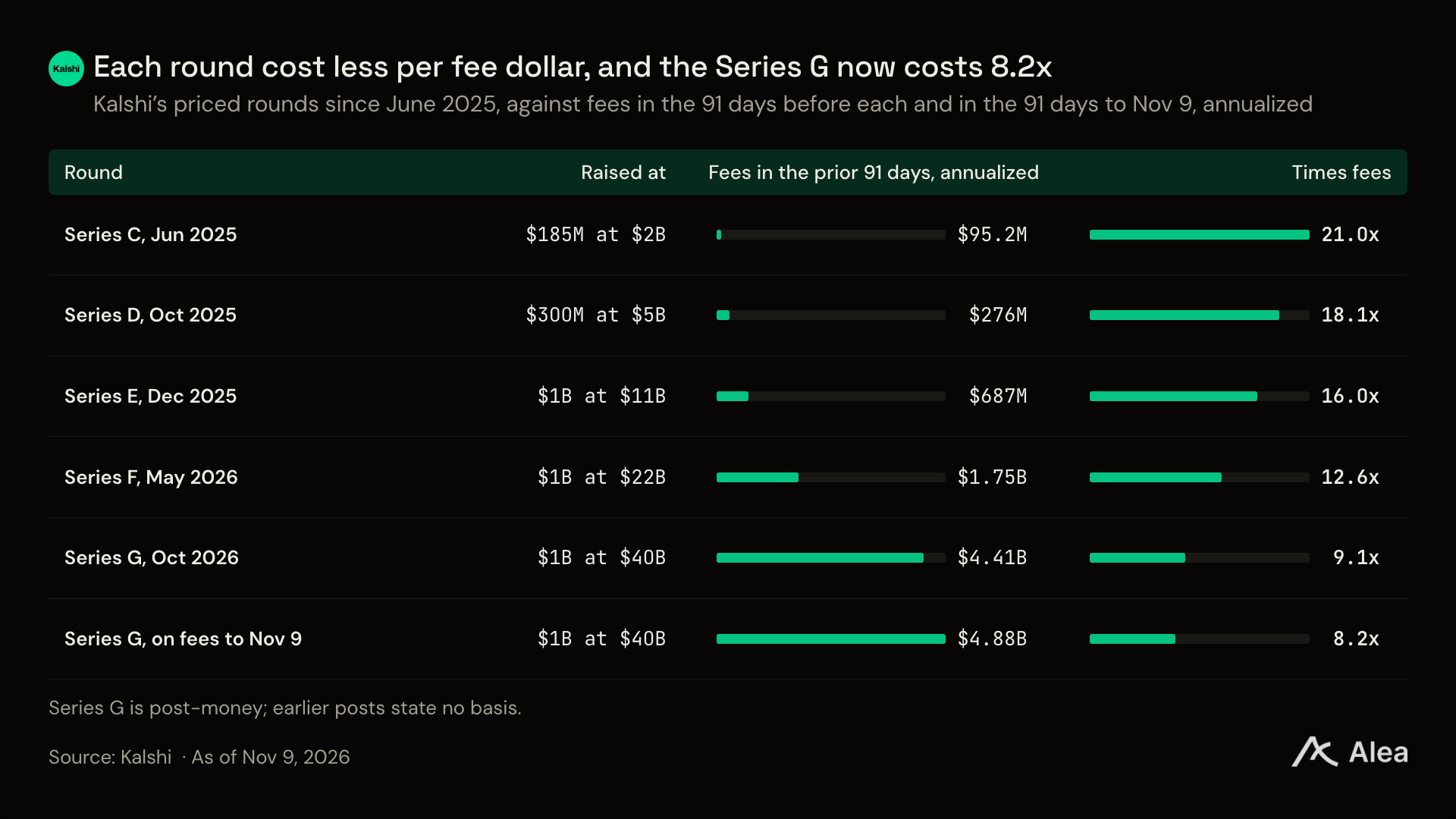
Kalshi’s $40 billion valuation in this round of Series G funding is equivalent to 8.2 times its annualized fee revenue over the most recent 91 days. In comparison, its valuation multiple during the previous round in June 2025 stood at a high of 21.0 times.
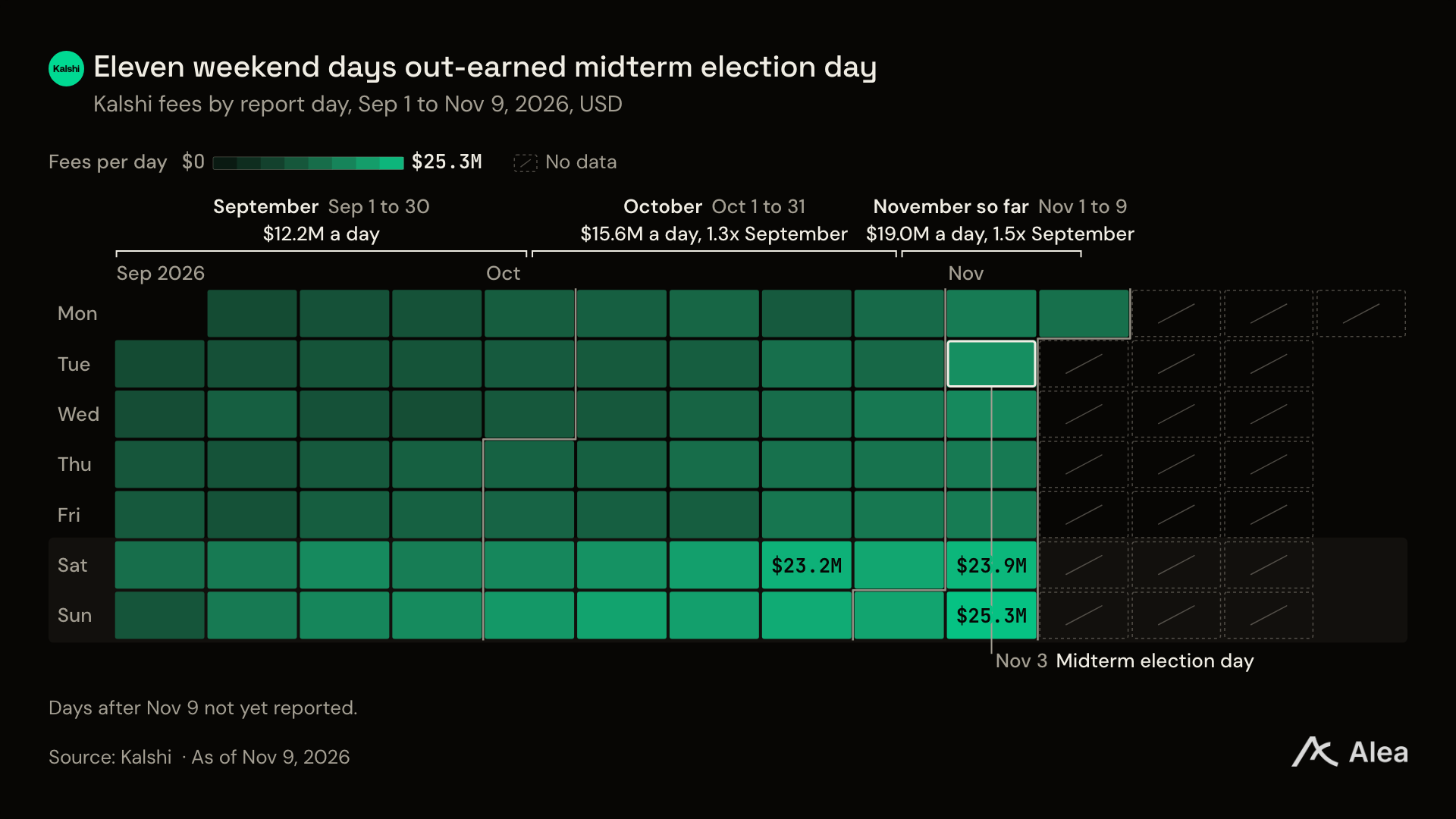
Since October, Kalshi has earned more in daily fees on 11 Saturdays and Sundays combined than it did on the day of the midterm election vote. This indicates that although political events generate massive nominal trading volumes, the true drivers of sustained high fees have shifted to long-tailed sporting events and combo trades.
Key Takeaways
If calculated based on full-year complete fee revenue, Kalshi’s valuation multiple corresponding to the Series G round stands at 14.5 times, already lower than Chicago Mercantile Exchange’s (CME) price-to-sales valuation of 15.7 times; if calculated only based on the recent explosive trend in fees, the valuation multiple shrinks even further to 9.1 times.
In just the first 40 days of the fourth quarter, $653 million in fees were generated, which directly accounts for two-thirds of Kalshi’s total revenue over the past four quarters.
Combo bets (Combos) played a decisive role in increasing fee revenue: from October to November, average daily fees surged from $12.2 million to $19 million, with the entire $3.13 million increase contributed solely by combo trades.
Although political contracts generated $211 million in trading volume on Election Day, they only contributed $3.31 million in fees; conversely, on the Sunday immediately following the election, Kalshi’s daily fee income reached an astonishing $25.3 million, a full 35% higher than Election Day.
Why Election Day Fee Revenue Falls Short of Football Super Sunday
In the November 3 election, the favored candidates on Kalshi’s board won 479 out of the first 487 contests. Kalshi reported total midterm election trading volume reaching $2.5 billion, nearly double the scale of the 2024 presidential election, yet no explosive windfall appeared in fee revenue.
This is determined by Kalshi’s core fee formula: Fee per trade = 7% × Number of contract lots × Price × (1 - Price). Converted per dollar traded, the effective rate is essentially 7% × (1 - Price).
On Election Day, the vast majority of capital chased highly certain favorites. In key Senate races, Kalshi’s market pushed the winner’s probability above 99% an average of 115 minutes before major media outlets like CNN officially called the race. When the win probability hits 99%, (1 - Price) drops to just 0.01, causing the fee per dollar traded to approach zero.
Conversely, weekend sports betting market transactions sit at the opposite end of the probability curve. On a top-performing Sunday, sporting events and combo bets accounted for 87% of the day’s total fee revenue. Since individual sports betting odds are often close to even-money, and combo bet odds across multiple events are highly dispersed, the platform’s fee capture capability reaches its theoretical maximum.
Combo Bets Now Contribute One-Third of Platform Fees
Among all product lines, the average daily fee increment generated by Combo bets (Combos) exceeds the sum of all other segments.
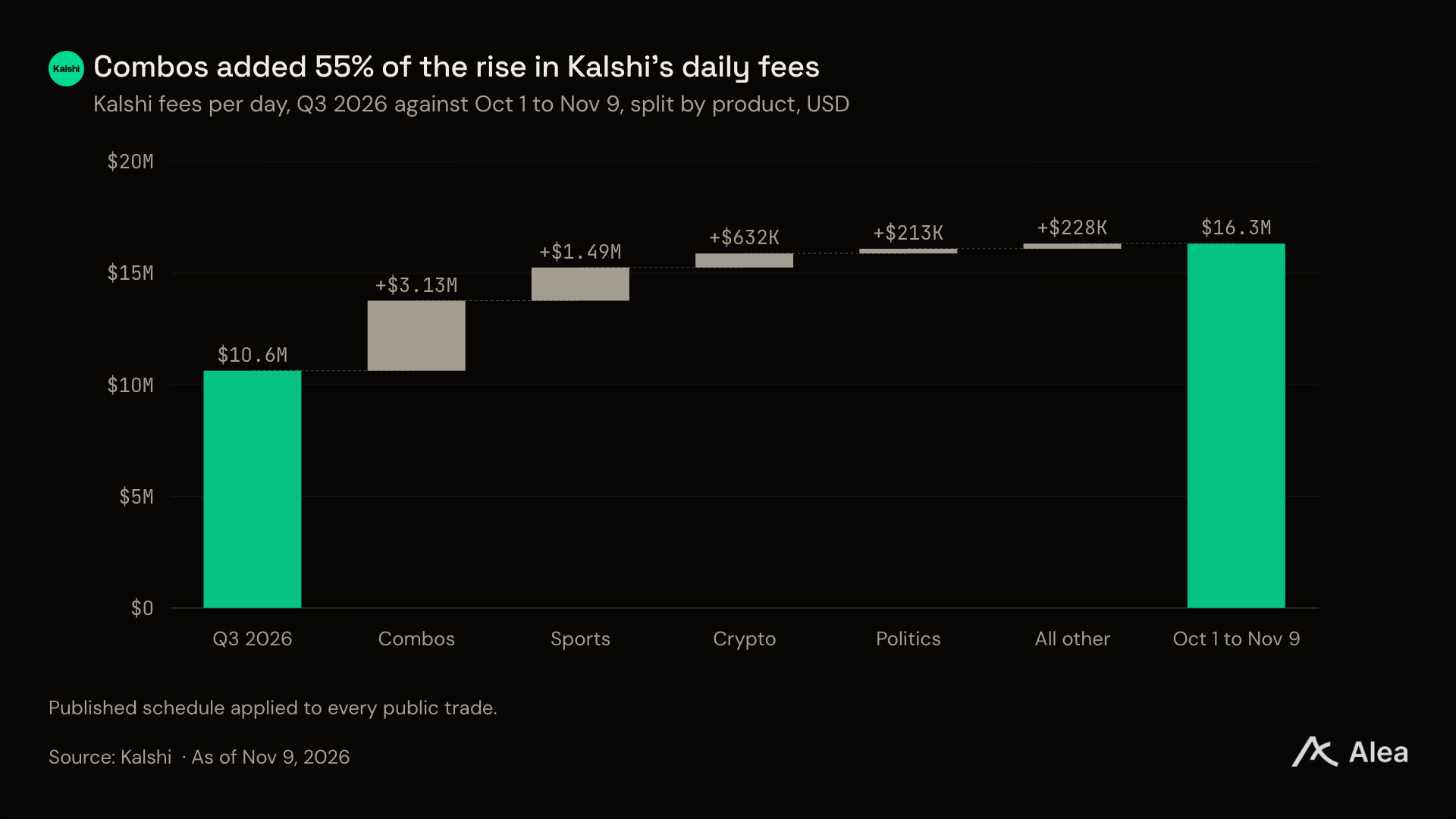
From October 1 to November 9, combo bets contributed a staggering 33.3% of fee revenue despite accounting for only 15.6% of platform trading volume. Over this brief one-month period, average daily fees from combo bets more than doubled, surging from $2.43 million per day in early October to $5.56 million in November.
Combo bets have now become Kalshi’s second-largest revenue pillar, trailing only single-line sports betting. Sporting events contribute an average daily increment of $1.49 million; on the best-performing Sundays, NFL series games alone generated 59% of sports-related fees. Although the crypto prediction market has expanded in scale, its average daily fee increment is only $570,000.
Valuation Multiple Is Cheaper Than CME Under Both Annual and Recent Metrics
This $1 billion round of funding was led by top-tier institutional investors Wellington Management and Sequoia Capital. Co-founder Tarek Mansour stated that this substantial capital will primarily be used to expand stock-specific derivative businesses, procure underlying compute clusters, develop indices, and build institutional-grade connectivity.
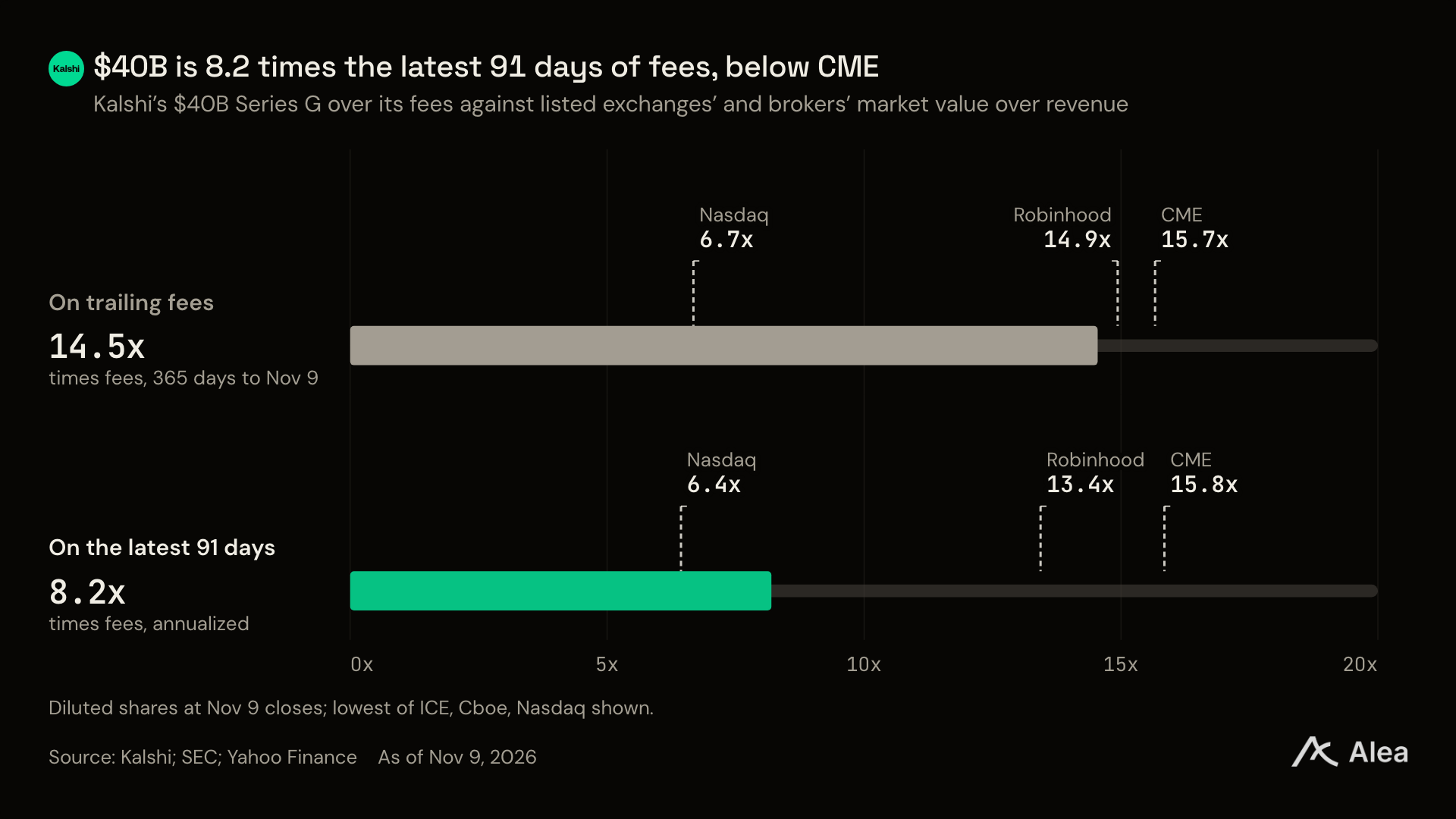
Measured against one year of fee revenue, Kalshi’s valuation multiple is just 14.5 times. For comparison, the world’s largest derivatives exchange, Chicago Mercantile Exchange (CME), recorded a price-to-sales ratio of 15.7 times over the past four quarters, while online broker leader Robinhood boasts an even higher P/S ratio of 31.7 times.
Notably, these figures represent only gross fees before deducting rebates and liquidity incentives, and do not yet include the recently launched perpetual stock contracts business. Sports betting and combo bets accounted for 77% of fee revenue over the most recent 91 days, directly pushing the platform’s annualized revenue runway up to $4.87 billion.
Valuation Multiple Would Spike to 33 Times Without Sports and Combo Trades
Despite the impressive overall numbers, portfolio concentration poses a core potential risk. If sporting events and combo bets are excluded, the annualized total fee revenue generated by Kalshi’s other businesses (primarily crypto) over the past 91 days amounts to only $1.21 billion.
Stripped of the robust cash flows from sports and combo businesses, supporting a $40 billion valuation would instantly inflate the valuation multiple to 33.0 times, significantly exceeding the valuation anchors of traditional financial infrastructure like CME.
Furthermore, Kalshi possesses independent, product-specific pricing power. This August, the platform proactively halved fees for 19 baseball series; two weeks later, it directly quadrupled rates for any single open-interest position exceeding 100,000 contracts, demonstrating immense pricing elasticity across the platform.
Perpetual Stock Contracts Hit $1.13 Billion in Volume Within 5 Days of Launch
Single-stock perpetual futures contracts went live on November 5. Within just five days, 58 individual stock perpetual contracts have seen trading activity, covering high-profile names such as SpaceX, Nvidia, and Micron.
A critical ongoing lawsuit will determine whether this product can survive long-term. On November 3, a federal court in New York denied a request for an injunction to halt single-stock perpetual trading, securing a precious window for this innovative product to take root.
The business objective is clear: Kalshi is positioning this product as a direct counterpart to traditional brokers’ Payment for Order Flow (PFOF) rebate model. In the traditional system, market-making giants like Citadel Securities pay rebates to retail brokers to obtain retail order flow; in Kalshi’s ecosystem, users can engage in 24-hour, low-cost leveraged trading directly within a regulated, central limit order book market.
The U.S. Commodity Futures Trading Commission (CFTC) has firmly backed Kalshi in state-level legal battles. On October 27, the CFTC formally sued Utah State to prevent state regulators from engaging in secondary enforcement against exchanges holding federal compliance licenses. Meanwhile, the CFTC’s review of Kalshi’s prediction market margin requirements will conclude on December 21. At the current expansion pace, the fourth quarter will unquestionably become the most watershed quarter in the history of prediction market development.
Join TechFlow official community to stay tuned
Telegram:https://t.me/TechFlowDaily
X (Twitter):https://x.com/TechFlowPost
X (Twitter) EN:https://x.com/BlockFlow_News
 @AleaResearch