The "Casting a Wide Net" Strategy Is Failing: Crypto Enters the Era of Value Investing
Author: Zeneca
Translated by: TechFlow
TechFlow Summary: The retail investor's most familiar "spray and pray" strategy is failing. Data shows that from bear market bottom to bull market peak, the median return of the top 100 tokens was only 0.99x. Using three sets of cycle data, Zeneca demonstrates that the crypto market is shifting from "everything pumps" to "a few high-quality assets consistently outperform," which demands a completely different approach to token selection from investors.

Hey everyone. I'm back. Thank you for your patience during my time away from screens and the digital world to rest properly. I'm excited to start writing again, sharing my thoughts and perspectives with you, so let's dive right in.
Imagine you had $10,000 on November 20, 2022, about a week after the FTX collapse. That date represents roughly the closest point to a bottom any of us could have encountered. You invest $100 into each of the top 100 cryptocurrencies by market cap, and hold through the entire bull run, ETF approvals, elections, inauguration pumps, everything, until October 6, 2025, when the total market cap peaks. What do you think your returns would be?
Your money roughly doubles to about $19,400. Not bad, but compare it to the alternative. If you put that same $10,000 solely into Bitcoin and held it, its value would be around $76,600. Three-quarters of the gains among the top 100 tokens came from just ten coins, and the median token in that basket is worth 99 cents for every dollar you invested. So even holding from bear market bottom to peak, more than half of your holdings are underwater.
Outperforming Bitcoin is not easy.

This was the "spray and pray" strategy many of us learned crypto with, and for a long time it genuinely worked. But it has clearly broken down. It didn't work last cycle, and it certainly won't this one. I believe what replaces it will look much more like value investing, closer to the methods of Ben Graham and Warren Buffett, rather than anything we've seen in crypto before.
So this letter is about that transition, and how I plan to position myself for the next bull market accordingly.
"Spray and pray" used to yield a positive expected value, but since 2017, every cycle's returns have been worse than the last.
Chasing trends suffers from the same issue. Most winners from each narrative never return, while tens of thousands of new tokens go live daily, competing for the same pool of capital.
Meanwhile, funds used by projects for buybacks and burns of their own tokens have grown roughly tenfold since 2021, remaining resilient even in bear markets. In the year leading up to October 2026, tokens with genuine buybacks outperformed Bitcoin at roughly twice the frequency of other tokens.
So I want to do for crypto what Graham and Buffett did for stocks: hold a select few strong projects that put actual money behind their own tokens, buy them when they're cheap (or before growth is fully priced in), and hold for years.
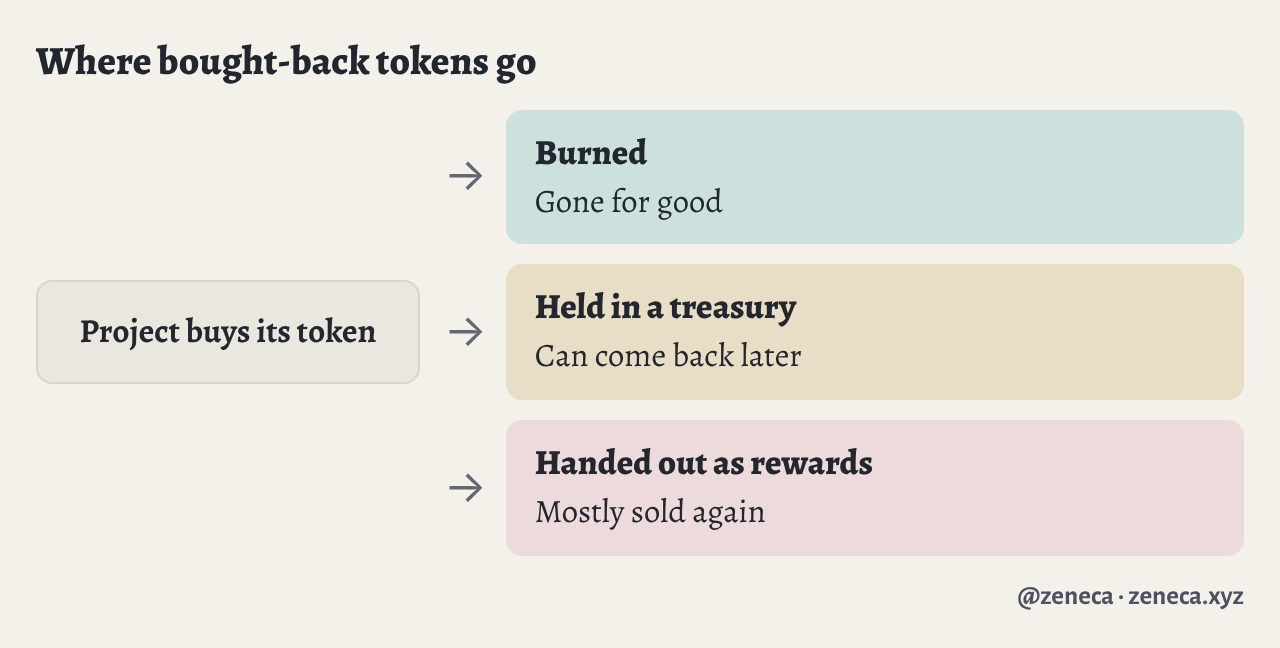
What happens to tokens after buybacks matters too. Burned tokens disappear permanently, while tokens distributed as rewards are typically sold straight back into the market.
ZEC is my exception, a store-of-value token with absolutely no buybacks (Buffett would hate it, but he hates Bitcoin and gold too, so who cares).
How Did We Get Here?
Those of us who entered in 2017 remember that almost everything pumped. The median top-100 token peaked around 46x higher in January 2018, with most beating Bitcoin. So no matter what coin you bought on CoinMarketCap, nearly any pick made serious money. The spray-and-pray strategy was born then, and honestly, in that market, it might have genuinely been the right play.

In 2021, it was still fairly common, just with smaller magnitudes; median tokens performed roughly in line with Bitcoin. By 2024-25, the top-100 median token only tripled even at its best moment, with only about one-eighth beating Bitcoin. Most tokens peaked in mid-2024, over a year before the broader market topped out. If you felt your alts peaked in early 2024 while everyone insisted we were still in a bull market, it's because most alts actually did. Most likely endured a painful rollercoaster waiting for an "alt season" that never arrived, and that era may never come again.
Another way many of us played was trend-chasing. ICOs, DeFi Summer, NFTs, Alternative L1s, Memecoins, AI agents—I'm sure I missed some. Enter new narratives early, exit before everyone else. This worked beautifully until it broke. Of the top 100 in 2017, only about 10% made new highs in the next cycle, and the overall memecoin market cap sits at roughly one-fifth of its December 2024 peak. As for NFTs, don't get me started (🥲).
However, one thing stands out. Some alts appear to be decoupling from Bitcoin, even during bear markets.
Assume you took $10,000 at last cycle's peak, October 6, 2025, and diversified across the top 100 coins. Today it's worth about $5,700 (only 6 of 100 are green), whereas if you went all-in on Bitcoin, it'd be worth roughly $6,700. But if you somehow knew which tokens would perform best and allocated $1,000 to the top 10, you'd have about $20,800. Put $2,000 into the top 5 performers, and you'd end up with roughly $31,800.
I ran the same comparative test at the tops of the previous two cycles, buying on January 7, 2018, and November 8, 2021, holding for a year. The results reveal a clear trend: the best-performing coins are decoupling from BTC.

So, without hindsight, how do we find and pick the "best" coins? To answer that, I believe we first need to understand why the spray-and-pray strategy broke down in the first place, and where capital is flowing now.
Why Did Spray-and-Pray Break Down?
I believe the primary reason is simply too many tokens competing for the same pool of capital. For readers of this newsletter, that should hardly come as a shock. The token oversupply has been glaringly obvious for years.
At the January 2018 peak, CoinMarketCap listed fewer than 1,400 tokens total. By late August 2026, Pump.fun alone launched roughly 44,000 new tokens daily. The number of tokens increased by several orders of magnitude, while the buyer count (and capital supply) clearly failed to keep pace.
The real institutional inflows largely flowed to the largest names. From the FTX trough to the October 2025 peak, Bitcoin captured roughly two-thirds of new market liquidity, ETH, XRP, BNB, and SOL took about a quarter, and all other coins combined got roughly one-tenth. ETFs, treasuries, and funds don't spray-and-pray. They buy a few things they can explain to LPs, then sit on them.

Even that final tenth concentrated on very few coins. Just ten took nearly half, mostly legacy names like DOGE, TRX, ADA, LINK, and XLM, with HYPE and SUI being the only newcomers. During the same period, coins listed on CoinMarketCap grew from ~21,800 to ~36,200, while Pump.fun alone issued millions more, meaning the vast majority of new tokens received virtually nothing.

So if the next rally resembles the last, holding too many tokens mostly ensures you're stuck with a basket of assets going nowhere fast.
What's Replacing the Spray-and-Pray Gamble?
Along the path toward great crypto dreams, many of us have hoped to see native protocols willing to spend real money on their own tokens. This mainly refers to buybacks and burns, pulling tokens off the market (with a few exceptions like Aerodrome distributing fees to stakers).
These tokens have always existed, but there are visibly more now, and the market's response has been robust enthusiasm and sudden capital inflows. It turns out we love holding tokens tied to protocols that generate real revenue, and we love them even more when those protocols use that revenue to support price and holders alike.
Token buyback spending grew from ~$190 million in the year ending October 2021 to ~$1.85 billion in the year ending October 2026, while the number of projects spending over $1 million annually rose from 10 to over 70. DefiLlama has continuously tracked protocols, so part of the growth is just better data coverage, but even so, this remains a massive shift.

What I find most fascinating is the last bar. Over the past year, the total crypto market cap fell by more than a third, yet funds used for buybacks and burns remained slightly up. Prices crashed hard while cash kept flowing in, which is essentially the core tenet of value investing.
Ben Graham famously said, often quoted by Buffett: The market is a voting machine in the short run, and a weighing machine in the long run. For most of crypto's history, there was literally nothing to weigh, so it was all voting (memes, narratives, whoever had the strongest Twitter army). I don't think voting will ever fully disappear, but this is the first time a significant portion of the market can actually be placed on a scale to show real weight, and I believe more capital will ultimately flow there.
What Would Ben Graham Buy?
Graham wrote The Intelligent Investor in 1949, and Buffett, his student, built Berkshire Hathaway on a version of that book. It's one of my all-time favorites, highly recommended to everyone. The core idea is to buy businesses generating earnings at prices below their intrinsic value, then exercise patience.
Graham's most famous concept is Mr. Market, a hypothetical business partner who shows up daily, offering to buy your shares or sell his to you, pricing them entirely on his mood. You don't have to trade with him or agree with him; you just step in when his quotes are absurd. The crypto market's Mr. Market is arguably the most extreme. The entire market dropped more than half between October 2025 and June 2026, and those exact days are when you should be buying good businesses.
Another crucial concept of his is the margin of safety, which basically means paying well below what you believe something is worth, so you're still fine even if you misjudge. The closest thing I've found to a P/E ratio in crypto is market cap divided by the amount a project spends annually on buybacks (or burns). If a token has a $1B market cap and spends $50M yearly on buybacks, you're paying 20x. At the time of writing, some of the best-operated, largest projects (HYPE, JUP, PENDLE, and SKY) trade around 30x, giving us a rough baseline metric.
Buffett's modification to Graham's framework is: "It's far better to buy a wonderful company at a fair price than a fair company at a wonderful price." He also noted that if you had a punch card with only 20 slots and had to punch one hole per lifetime investment, you'd think deeply about each decision, yielding vastly better outcomes.
A handful of tokens, each thoroughly understood—that's my version.
Who Actually Beat Bitcoin?
I wanted to verify these claims against reality, so I compared all coins trading above a $300M market cap as of October 11, 2026 (100 in total) against Bitcoin. I analyzed both the one-year performance and the full stretch from the FTX trough (for newer coins, tracking from when their market cap first exceeded $100M).
In the year leading to October 11, 2026, Bitcoin dropped roughly a quarter, with 37 of the 93 coins that existed a year prior outperforming it. The heavy outperformers were quite mixed. VVV surged ~16x, DRV ~14x, ZEC and XMR rode the privacy narrative, HYPE more than doubled, QNT, NEAR, JST, and MORPHO were in the mix, along with a few recently launched small caps.
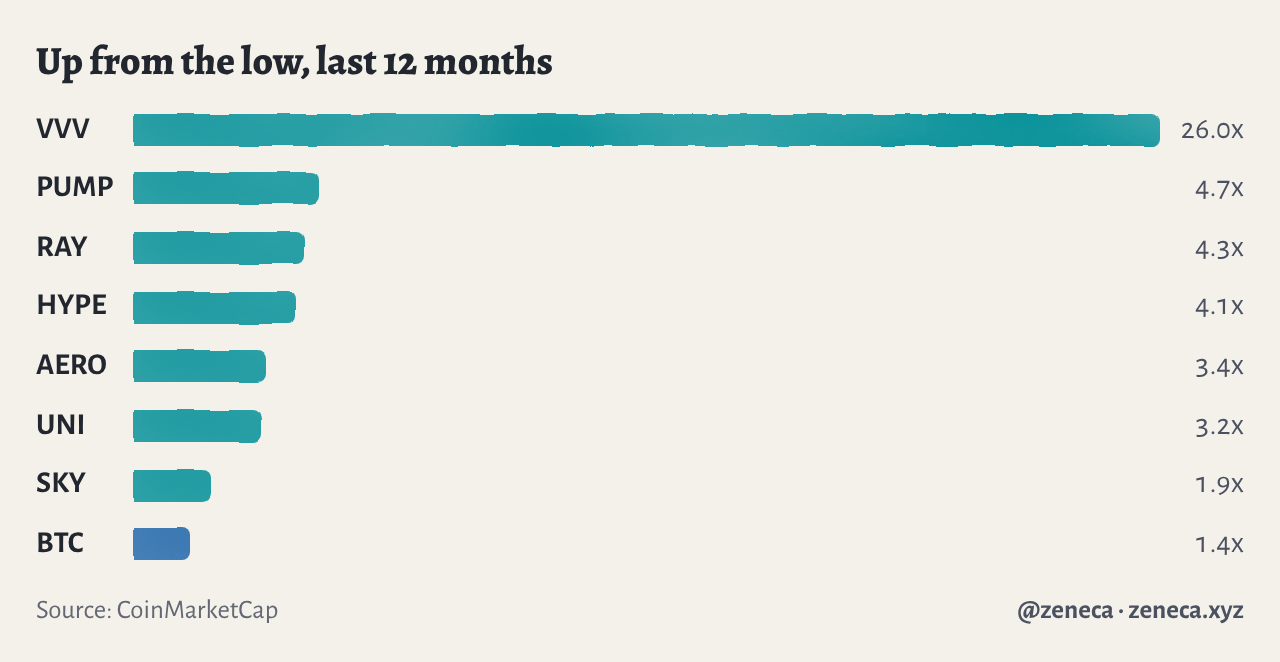
But splitting them into tokens backed by genuine buybacks versus all others reveals a stark difference. Roughly 60% of buyback-backed tokens beat Bitcoin in a year, compared to only ~25% of others. Over the longer timeframe, ~50% of buyback tokens outperformed vs ~25% of others. PUMP returned roughly double Bitcoin's gains in a year, while SKY, UNI, and RAY performed roughly 1.7x to 1.9x Bitcoin's returns.

Buybacks aren't a magic bullet either. CAKE and CRV have been buying back for years, yet remain down ~85% to 90% against Bitcoin since the FTX trough; BONK's launchpad spent heavily on buybacks, yet the token lagged behind. The strong performers were either growing simultaneously, sufficiently cheap relative to buyback spend, or both. Meanwhile, many of the biggest winners had zero buybacks, with ZEC being the prime example.
What impressed me most is just how cheap some became while the underlying businesses kept running. This is Mr. Market at his most generous:
At PUMP's low on June 25, 2026, the total token market cap was roughly three times Pump.fun's annualized buyback amount at the time. It subsequently pumped nearly 5x from there.
At the February 2026 low, AERO's market cap was less than three times the annual fees flowing to stakers, after which it tripled+.
At the January 2026 low, HYPE traded at roughly 11x annual buyback spend, rising to ~27x by October 2026 as it roughly quadrupled.
VVV bottomed at ~$0.95 on December 1, 2025, when the total market cap was ~$40M, while Venice reportedly generated ~$10M in annual revenue. It rallied ~26x.
Both RAY and UNI tripled+ from their lows, with SKY nearing a 2x.
None of those lows looked like opportunities to most people at the time. PUMP's optimal entry occurred when memecoins were dying, the market was in bear territory, and its founders were still facing lawsuits. But that's precisely the whole point of Mr. Market. When sentiment hits rock bottom, prices do too, while the underlying business remains indifferent.
To summarize everything in a Buffett-esque phrase you've likely heard: Be fearful when others are greedy, and only greedy when others are fearful.
Historically, it's been hard to get excited about being greedy with alts while others fear, outside of BTC. Now, however, we finally see genuine commercial entities with trackable revenue and auditable histories, allowing us to start approaching crypto through a true value investing lens.
So How Do You Distinguish a Good Business from a Mediocre or Terrible One?
Here are the questions I'd ask, roughly in this order.
Does It Actually Make Money?
I mean money earned directly from customers. Many newly distributed network tokens are valued far higher than their actual revenue. As of October 2026, Bittensor subnets generate ~$30M in annual customer revenue, yet newly minted TAO represents more than ten times that figure, so it currently fails this test.
How Much of That Money Actually Enters the Token and Stays There?
This is where most tokens stumble. Fees are what users pay, revenue is what the protocol keeps (e.g., Uniswap directs most fees to liquidity providers). Profit is what remains after deducting team expenses, incentives, and any newly minted tokens issued to retain users. Only at this stage do you know how much actually flows into the token.
Hyperliquid channels nearly all revenue into HYPE buybacks, while Pump.fun dedicates roughly half its income to buybacks and burns for PUMP. Collector Crypt is an excellent business; in the year leading to October 2026, its capsule packs generated ~$94M in revenue, but only ~1% of that funded buybacks and burns for CARDS.
I love CARDS, view it as a solid business and a token worth holding, but whenever I see people buzzing about its revenue numbers, something feels off. Revenue is nice, but looking at it in isolation is meaningless. You need to know how much of that revenue converts to profit, and how much of that revenue or profit gets cycled back into the token ecosystem.
Then comes what happens to tokens post-buyback, a detail I feel gets overlooked more easily. Burned tokens vanish forever. Tokens sitting in treasury reserves might eventually re-enter circulation. Tokens distributed as rewards or cashback are mostly dumped straight back onto the market, making buys and sells roughly net-zero.
Brave buys back BAT purely to pay ad viewers, who mostly sell it immediately, so it never counts as a genuine buyback. Since September 2026, ether.fi issues one ETHFI as cashback to cardholders for every two it buys back, and many of those holders sell as well.
That said, I still like both BAT and ETHFI, but remember to always follow up asking where those tokens ultimately went when a project tells you how much it spent on buybacks.
Will Lockups Eat These Alive?
If teams and investors sell more tokens to you than buybacks pull off the market, the buybacks lose their potency. Before mid-2029, Pump.fun unlocks nearly $40M in PUMP monthly for the team and early investors, meaning much of its buyback activity just absorbs insider selling. Even so, it can still be a strong token, but you must factor that in.
Will It Still Exist in 2029?
If I'm holding something for years, it must survive bad periods too. A phrase I often repeat is: the only prerequisite for thriving in this space is survival first. That applies equally to protocols and us. While not every survivor performs exceptionally (far from it), if a protocol survives, grows steadily, generates revenue, and uses a slice to back its token, its odds of outperformance skyrocket.
What About Growth?
Value investing is often misconstrued as only buying cheap, boring stuff, but Buffett himself wrote in 1992: "Growth is always a component in the calculation of value." In 1972, he paid roughly three times book value for See's Candies—a move Graham would never sanction—because Charlie Munger convinced him that great businesses justify premium pricing. By 2007, See's had already generated ~$1.35B for Berkshire.
So I'm willing to pay higher valuation multiples for rapidly growing assets, provided the growth is genuine and the price hasn't already front-run every bit of future expansion. Derive captures the majority of on-chain options volume; open interest at early October 2026 was over 10x higher than the same period a year prior. Furthermore, since a vote in October 2026, half of its fees weekly buy DRV. At roughly $0.48, DRV trades at over 100x its trailing twelve-month revenue, which looks wildly expensive compared to the ~30x multiple of the best-operated tokens.
My method for checking if growth is already priced in is reverse-engineering from the outcome. If DRV needs to trade at that same ~30x multiple while half of fees fund buybacks, Derive would need to scale fees to roughly 4-6x recent levels. If you believe that's achievable within a few years, DRV may still look cheap ex-post; if it doesn't materialize, you've just paid a growth-stock price for an asset that's stopped expanding.
And Then There's ZEC
Alright, let's address ZEC. It practically breaks every single rule laid out in this letter. Zcash generates under $1M in annual fees, none of which flow to the token, while newly minted ZEC runs hundreds of millions in value yearly. Buffett would despise it. In his 2011 letter, he stated you could play with a cube of all the world's gold infinitely, yet it produces nothing; in 2018, he called Bitcoin "probably rat poison squared."
BTC is the obvious store of value. If your sole goal is parking capital long-term and sleeping soundly, it's the prudent choice, and I won't argue with that. But the entire premise of this thesis is beating Bitcoin. As we saw at the start, that's easier said than done. So in the store-of-value segment, I pick ZEC. Zcash is essentially Bitcoin's monetary policy (21M hard cap, halving every four years) plus an optional privacy mode. I believe as more capital migrates to public chains, privacy becomes increasingly valuable.
It carries genuine risk, obviously. With zero cash flow, price relies purely on conviction. But Bitcoin has always relied purely on conviction. Bitcoin is fundamentally the ultimate memecoin, and the meme momentum around ZEC is strong enough to give me confidence holding it.
Where Could Things Go Wrong?
As always, plenty of things can break.
The voting machine could win for an extended period. If the next leg repeats the 2021 memecoin mania, a handful of boring buyback tokens will underperform, and folks will leverage pure nonsense for 50x. I can accept that, but it's the price of admission.
If growth stalls, paying premiums for it will turn punitive, so I'll size these positions smaller than those already executing heavy self-buybacks. Buybacks themselves can halt too. If a team or DAO decides to pause them—which we've seen with Aave and Sky—they can, and you generally have zero legal recourse over revenue guarantees.
How I Plan to Execute
Synthesizing all of the above, the rough playbook for the next bull market is as follows:
Hold a handful of tokens backed by real businesses, plus a bag of ZEC as a store of value.
Only buy if I can explain in one sentence how money flows from customers into the token, and can trace exactly where tokens go post-buyback.
Before buying anything, cross-reference unlock schedules against buyback volumes.
Compare price against buyback expenditure.
Only pay a growth premium when growth reflects in fees, and stress-test what assumptions are already baked into the price.
Write down exactly what conditions would trigger a sale before entering, then hold indefinitely unless those triggers hit.
Dollar-cost average in slowly, letting Mr. Market's bad days do the heavy lifting for me.
Measure the entire portfolio's performance against a purely Bitcoin-held benchmark, because that's the hurdle rate to clear.
Final Thoughts
One more thing: you cannot catch every opportunity, nor should you try. There will be countless great projects and tokens I never touch, some of which 10x, leaving me sidelined holding boring assets. That's fine.
I'd rather hold a select few things I truly understand and believe in, commit real capital, and give them time, than dabble in everything while lacking conviction on why I hold them. Find your own handful—the ones you'd willingly endure a 60% drawdown on because you know what the project does—and accept you'll miss out on plenty of other boats passing by.
I've got more to say, but this is my blueprint. It's a remarkably boring plan, which I consider a feature, not a bug. In the next letter, I'll detail my actual portfolio allocation, followed by deep dives into my highest-conviction tokens, dissecting some of crypto's finest assets through a strict commercial fundamental lens.
As always, thank you for reading. Feel free to drop any questions or comments below :)
Disclaimer: Content covered in this newsletter should not be construed as investment advice. I am not a financial advisor. These are merely my personal opinions and perspectives. Before trading or investing in any cryptocurrency-related products, you should always consult a professional/licensed financial advisor. Certain links shared in the article may be affiliate links.