Narrative Cycle Entry: At Which Stage Should Your Company Tell Its Story?
Author: Michael Dempsey, Managing Partner at Compound
Compiled by: TechFlow
TechFlow Note:In the tech and venture capital markets, the technology hype cycle is compressing rapidly, shrinking from the previous 48 months to just 12 to 36 months. The "narrative cycle entry point" chosen by startups when making their public debut has evolved from a public relations flourish into a first-order strategic decision that is a matter of life and death.
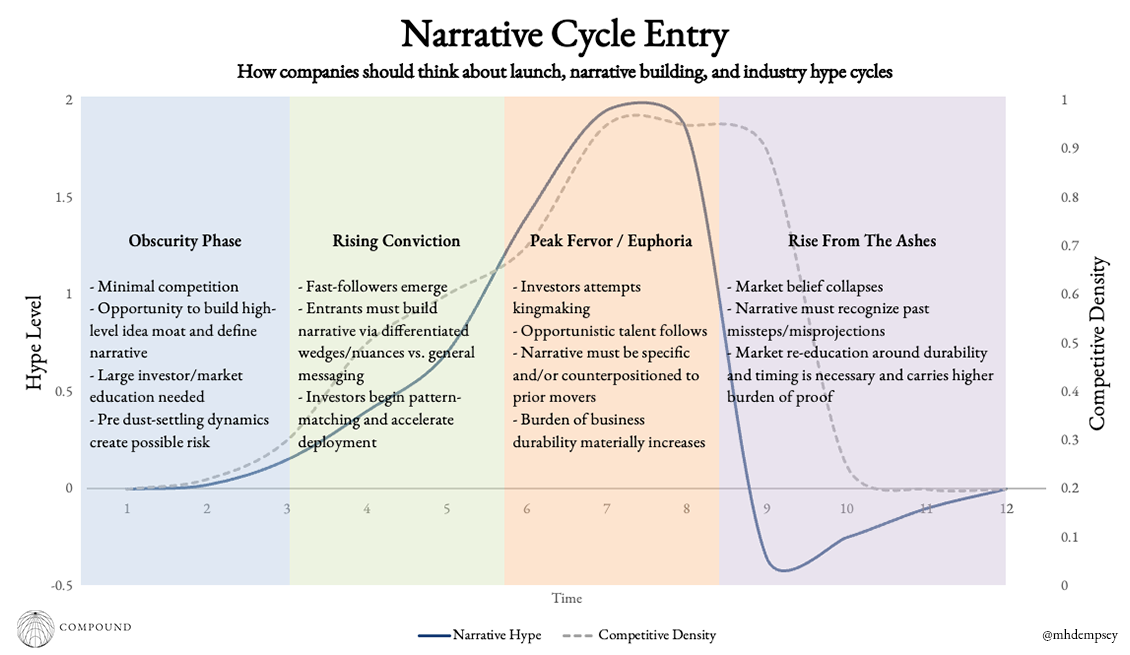
Compound Managing Partner Michael Dempsey provides an in-depth breakdown of the four evolutionary stages of the narrative cycle: the obscurity phase, the wave of rising conviction and consensus, the peak of fervor and euphoria, and rising from the ashes. Each stage operates under distinctly different physics of offense and defense; blindly applying a one-size-fits-all template will only turn companies into casualties buried in the noise.
Whether defining a category in the early stages, deconstructing micro-narratives in the mid-stage, or fighting for differentiation and distribution capabilities at the peak, top-tier teams treat narrative construction as a core infrastructure equal to product development. Only by clearly identifying which slice of the cycle you inhabit can you firmly build a cognitive moat amidst the pincer attack of capital and competitors.
When startups make their official public debut, founders must clearly recognize exactly where their current track stands within the narrative cycle. At Compound Ventures, we firmly believe this requires careful crafting, prudent handling, and strategic intent. It is also a core topic we frequently refine with our portfolio teams on a daily basis.
From the perspective of a simplified model, the technology narrative cycle can typically be divided into four progressive stages:
First, the Obscurity Phase. In the earliest stages, external attention is extremely low, watched by only a tiny inner circle, with almost no fierce competition on the same dimension. This means founders must shoulder the burden of market education, forecasting narratives before the industry establishes certainty.
Second, the Wave of Rising Conviction & Consensus. In the mid-stage evolution, hype begins to build. Multiple waves of competitors enter, collectively pushing up adjacent narratives, while top talent and investment firms quickly shift from curious bystanders to committed believers.
Third, Peak Fervor & Euphoria. Entering the late-stage intensification, heat, industry consensus, and competitive density all reach their zenith. This dramatically increases the difficulty of product differentiation, leads to obvious capital surplus, and triggers a dense influx of highly speculative followers.
Fourth, Rise from the Ashes. Following the bursting of unsustainable peaks, market expectations are completely reset. Former fervent believers turn into skeptics, and the media, talent pools, and investment community often react with deeply negative sentiment toward the commercial viability of this technology or track.
These stages are tightly interlinked and progressively advance. Operating within different phase slices requires teams to adopt distinctly different methodologies and communication strategies to precisely penetrate the market and establish effective dialogue amidst varying intensities and types of external noise.
The Obscurity Phase (Early Stage)
The obscurity phase of the narrative cycle spans a wide range, yet it is often the golden incubator for miracles, capable of defining an entirely new category from scratch here, or drastically broadening people's cognitive boundaries regarding the possibilities of a certain technology.
At today's startup pace, this phase typically lasts 12 to 36 months, during which the first 12 months often advance silently beneath the radar of the market.
The core advantage of making your debut right as the narrative cycle is born lies in establishing a thought leadership moat at a macro level and securing narrative ownership over that category. Recall the early days of NewSpace, GovTech, deep learning, and synthetic biology—none were exceptions.
By seizing this timing advantage, companies gain highly flexible and expansive narrative space for PR and market communications. Teams can initially tell stories based on macro visions that broadly concern the public, then gradually narrow their focus over time to specific product details or feature highlights that only professional buyers and inner-circle talent truly care about.
Another core dividend is that, before the market descends into cutthroat, white-hot internal competition, the battle for mission-driven or highly specialized industry talent remains relatively mild. At that time, job seekers are more willing to commit to a grand direction like space exploration without demanding specifics like satellite communications or in-orbit manufacturing.
Finally, high-execution early movers can continuously attract capital as narrative heat builds, and through the process of investment firms competing to pile on and build myths, rapidly ascend to become the Schelling Point Company or banner for that category.
However, entering a specific narrative cycle too early also carries undeniable risks and pain points.
Premature entry often leaves companies exposed to the risk of being copied or overtaken by later entrants with stronger execution, potentially even becoming a textbook case of public trial-and-error for fast followers. Given that startups typically face two to four well-funded competitors within their first 24 months, this phenomenon has become increasingly common.
Companies in the obscurity phase often struggle to build a commercialization moat of sufficient scale in time. As the pool of potential customers expands, pioneers may secure the early ecosystem, but latecomers can leverage existing lessons to capture incremental clients and scale up through precise positioning on a single core pain point.
Overall, because you entered too early, you likely ran out ahead of the dust settling. Any violent fluctuations at the industry's foundation could force you to sharply pivot and reconstruct your narrative. Early AI wrapper applications were deeply trapped in this quagmire, severely underestimating the impact of frontier large model capability leaps and foundational labs bringing proprietary models to market.
Similar dilemmas have also appeared in tracks with slowing commercialization, such as robotics infrastructure, NewSpace software, and contract manufacturing for synthetic biology. They implicitly bet that industry volume expansion would outpace reality, ultimately falling into passivity due to the inability to verify commercial flywheels according to VC pacing every 18 to 36 months.
The Wave of Rising Conviction & Consensus
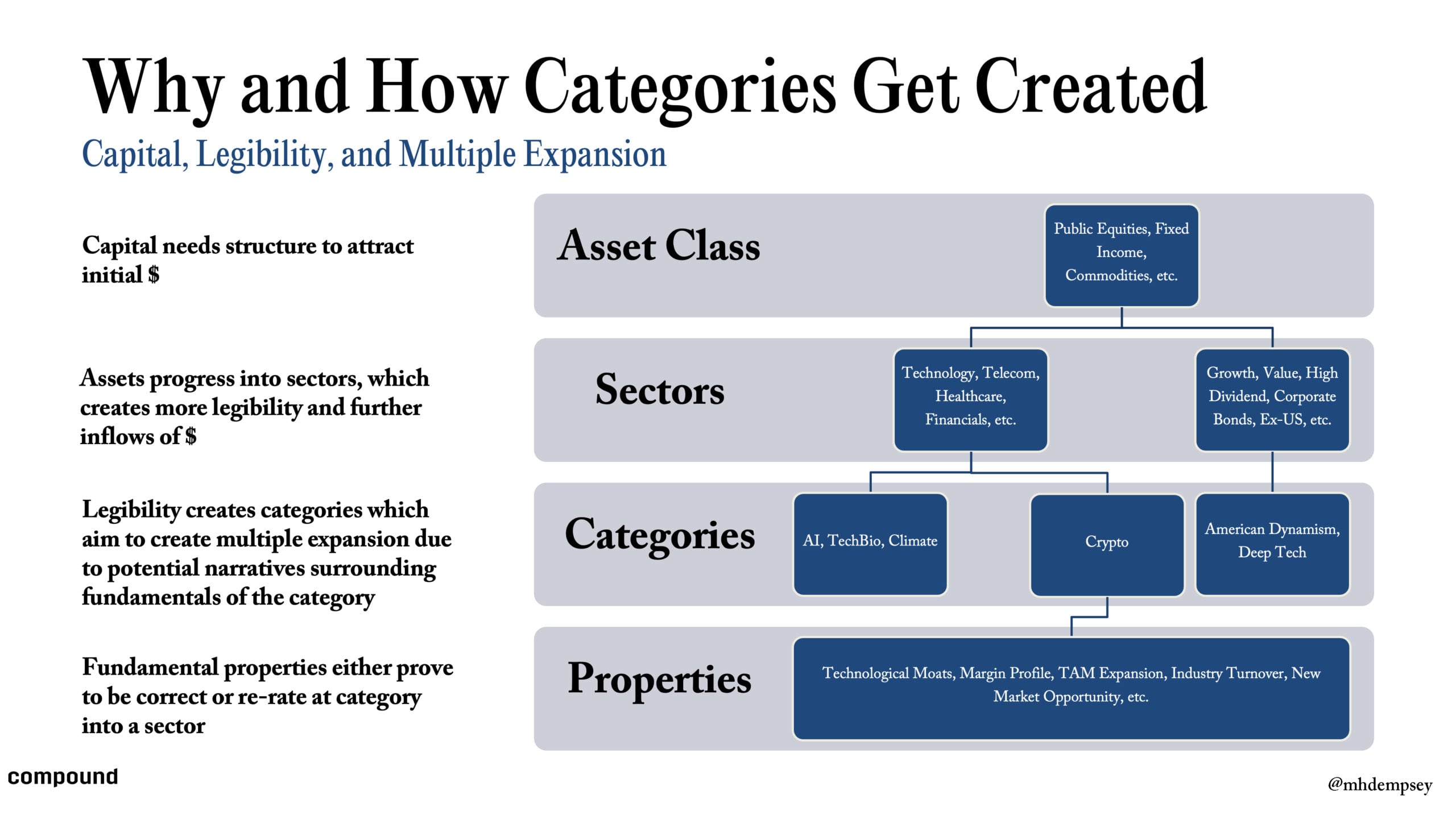
In startups and tech markets, narratives always surge in waves. With the establishment of a category, companies either successfully claim the core Schelling Point of the macro category, or they must fight fiercely to seize dominance over a micro-narrative within that category.
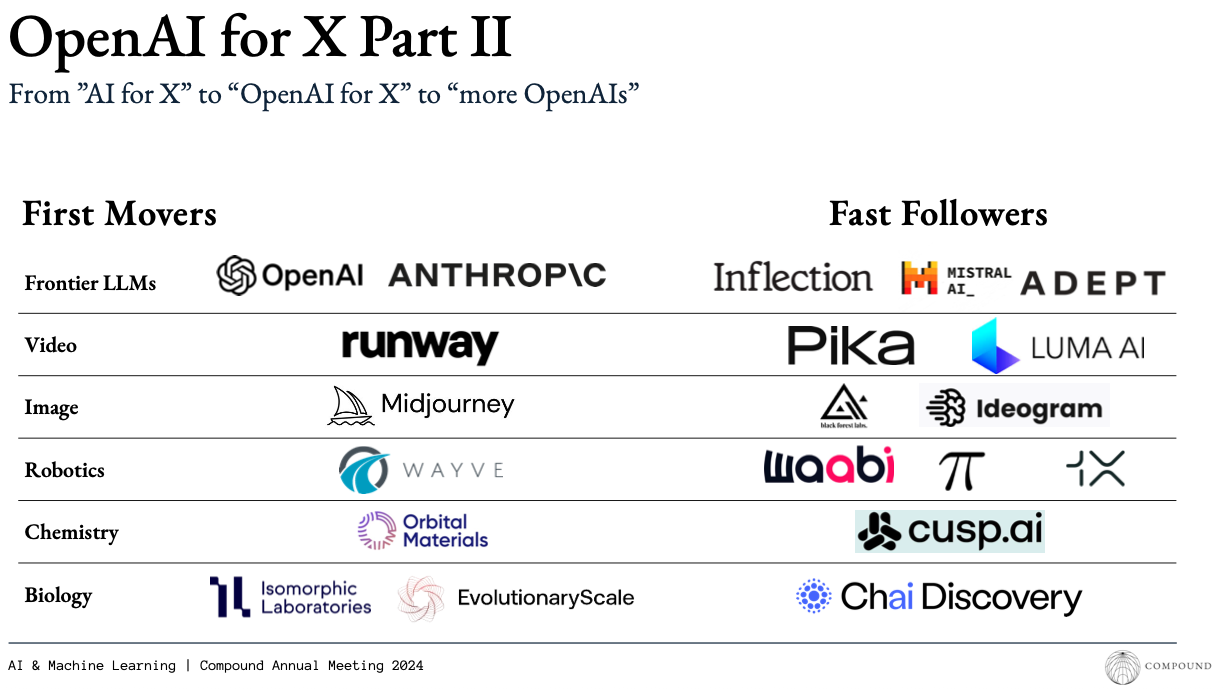
The wave of rising conviction typically features a longer evolutionary arc. During this stage, you not only witness the scaled expansion of benchmark pioneers but also see a wave of fast followers secured by early-stage financing pour in, sparking the initial signs of narrative fatigue.
These follower companies usually cling rigidly to the same narrative anchor points, often operated by polished, standard teams that raise massive capital in an attempt to overtake on all fronts. This stems from VCs blindly following after spotting viable examples, mistakenly believing that wielding larger financial firepower guarantees faster progress, but reality often dictates otherwise.
Facing the relentless bombardment of identical macro concepts over 24 consecutive months, the general public, investors, potential employees, and customers inevitably fall into aesthetic fatigue and skepticism. The entire track visually and sensorially transforms overnight from an imaginative blue ocean into a crowded, brutal red ocean brawl.
I have previously analyzed this typical dynamic in articles discussing open-source AI business models and brand moats, specifically focusing on Inflection's attempt to break into the frontier AI lab space:
For this reason, for the vast majority of founders, launching a company midway through this wave forces them to present a more precise and recognizable core belief, or effectively prove why a more focused, narrow micro-narrative holds commercial value equal to or greater than the macro narrative occupied by early leaders.
Looking at precedent: after SpaceX established its aerospace leadership (2010–2016), the commercial space track rapidly bifurcated into highly specialized sub-tracks such as satellite data platforms, rocket launches, in-orbit manufacturing, and space communications. Many frontier technology sectors replay this exact logic of fragmentation.
The advantage of entering midway through the wave lies in having more ample time to observe industry accumulation patterns if you can clearly convey your differentiation, while simultaneously enjoying the dividends of pioneers who cultivated the market early. However, this also significantly increases the burden of proof; you must rigorously demonstrate why your solution is superior and more worthy of attention.
For founders in this phase, the most practical strategy is to leverage internal perspectives from your own investors or former employees of early benchmark companies to retrospectively analyze why pioneers previously resonated with the public, customers, capital, and talent, and at what critical junctures they unfortunately lost focus.
As the midpoint of the narrative cycle gradually approaches its climax, narrative positioning itself resembles a wave that requires leveraging momentum and adaptation.
The first 5 to 10 entrants in a specific niche track usually realize quickly that if they cannot become the Schelling Point Company for the entire category, they must sequentially deconstruct and dive deeper along the macro narrative, anchoring into more concrete business scenarios. This progressive path flows downward, tier by tier, along the category pyramid to core products and applications, as illustrated below:
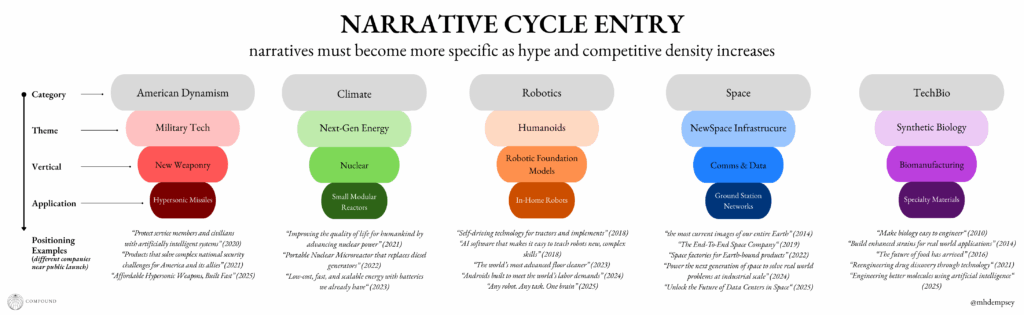
The specific deductive path is evident: a group of companies initially rallied under the broad banner of climate tech, then narrowed focus to next-generation clean energy, dove deeper into nuclear energy, and finally precisely positioned themselves around Small Modular Reactors (SMRs), building their worldview narratives around tangible engineering breakthroughs.
A similar evolution is reflected in the American Dynamism track, where its narrative thread gradually sinks from macro strategy down to defense technology, novel military hardware, and finally to specific hypersonic missile development.
If the field already demonstrates massive and continuously expanding willingness to pay commercially, companies can even skip intermediate transitions entirely, heading straight for highly vertical and easily understood scenario narratives, such as purpose-built AI for legal or financial verticals.
The mid-cycle phase presents the greatest operational difficulty precisely because the experience differs vastly between early-mid and late-mid stages. Determining when and at what pace to complete this narrative descent is an intensely grueling gamble. As a track remains in the public eye longer, the burden of proof for commercial effectiveness only grows higher.
We observe that the absolute top-tier teams often manage to continuously saturate their track with high-frequency market voice over the long term, thereby cementing themselves as core asset owners of a specific thought leadership moat. This is far from easy; it demands that teams place outbound market communications at a first-priority position in both ideology and organizational resource allocation.
Peak Fervor & Euphoria
When a track's heat and consensus climb to their zenith, it attracts a massive contingent of slower-moving laggard followers. Meanwhile, a flood of originally unrelated companies suddenly pivot to jump on the bandwagon, attempting to forcibly hitch a ride on this trending conceptual train.
Looking back at the 2021 crypto mania, numerous traditional companies hastily draped themselves in blockchain branding and rushed onto the battlefield, an atmosphere thick with impulsiveness and chaos.
This scene played out again from 2023 to 2024: a wave of startups leveraged the hot buzz around diffusion models alongside the momentum of Midjourney and Runway to raise enormous sums, producing a batch of so-called creative AI apps that ruled social media feeds for a few days before fading into silence.
The code generation track in 2025 was hardly spared this fate. Companies across the board fully caught up, ranging from enhanced IDE tools and fully autonomous coding agents to zero-code app generators. Over the past 12 to 24 months, a deluge of heavily homogenized follow-the-leader funding rounds emerged.
Despite each entrant desperately trying to differentiate upon launch through a specific feature or vertical scenario, any rational, clear-eyed observer forms a fundamental prediction: the ultimate fate of the vast majority of these enterprises will inevitably trend toward extreme homogeneity and brutal convergence.
To successfully break through and summit at the peak fervor of the narrative cycle, you must wield a genuinely disruptive product with qualitative differentiation to pierce through the noise, or possess a scale-level distribution channel to guarantee victory in direct engagements. Furthermore, massive market spending must be tightly coupled with high-frequency delivery to prevent the narrative from collapsing into a castle in the air.
Entering at the height of euphoria objectively leaves room for tactical precision in targeting narrative and real-world voids, but this relies heavily on extremely rigorous communication orchestration and solid execution. Though it appears to be the worst possible entry point, for teams that master narrative leverage or excel at powerful reverse-positioning, it can paradoxically carve out a niche among dedicated adherents.
However, the greatest fatal flaw of entering at the peak is that it often serves as a compromise for delayed public debuts, or reduces the company to a mediocre follower with absolutely no barriers to entry, failing to create any lasting ripples with real users from day one.
Rise from the Ashes
The tech industry has always been exceptionally adept at overpromising in the short term and delivering short of expectations, which frequently triggers intense emotional disillusionment, causing the entire market's hype and trust in a specific category to hard-reset to zero. This is the most agonizing moment for a founder's launch, but if historical rhymes repeat, a few phoenixes rising from the ashes will find tremendous opportunity here.
It must be admitted that initiating projects amid ruins is rarely a proactive choice; it is far more often an objective reality following the collapse of earlier trends, or an almost stubborn faith held by founding teams when facing the unknown. Even within highly rational venture capital perspectives, this pure tenacity remains exceedingly precious.
When the impulsiveness, disappointment, and disdain brought on by the crash gradually subside, the market will eventually rally once again around a cohort of rational audiences eager to be genuinely impressed, waiting to reconstruct their worldview toward this technology or track.
The finest companies can sublimate past industry collapses into indispensable prologues in their own entrepreneurial epics.
Doing so often ignites an entirely new development cycle, drives a revaluation of the entire category's worth, and helps companies rebuild ample capital reserves to withstand the onslaught of the next wave of followers, thereby pushing the narrative flywheel to spin into a new round.
The crypto industry has historically excelled at this, refreshing old architectures and injecting new speculative and mechanistic paradigms every cycle. Clean energy and climate tech have likewise endured multiple freezing and thawing periods, advancing tenaciously through the groundwork and reconstruction of countless predecessors.
Nowhere is this more intuitively visible than in biotech and computational biology. Computation drug discovery platforms like Recursion continue to fiercely fulfill their early technological promises after a decade-long marathon. Meanwhile, synthetic biology companies represented by Ginkgo tirelessly seek commercial closures amid the countless burnt-out wreckage of fallen ventures.
For these deeply cultivated hard-tech tracks, the industry might only need to witness one or two landmark inflection points bridging the chasm between promise and reality. That alone would be enough to completely overhaul valuation pricing for the entire asset class and attract massive growth-stage VC capital back into these near-dead deep waters.
The Existential Questioning of Narrative Strategy
Over the past decade, Compound has poured immense effort into systematically exploring how narratives propagate and permeate across technological breakthroughs, elite talent circles, core customers, and financial capital. Ten years ago, carefully crafted narratives might have still been viewed as a supplementary soft skill; standing in the present, mastering the timing of narratives has become a first-order strategic pillar, running parallel to product development and channel expansion.
The technology hype cycle has violently compressed from 48 months down to 12 to 36 months, drastically narrowing the error-tolerant window left for founders. Whether carving out category definitions during the obscurity phase, precisely cultivating micro-narratives as consensus rises, breaking out from the crowd at the euphoric peak via high-frequency delivery, or rebuilding industry trust amid the ruins, commercial success increasingly hinges on whether your narrative orchestration precisely aligns with the physical laws of your specific cycle.
Truly advantaged leading enterprises have long internalized narrative construction as an inseparable component of top-level corporate strategy, rather than merely treating it as post-PMF PR garnish. In brutal markets where rivals rise with lightning speed backed by colossal capital, firmly occupying cognitive ground through high-dimensional narrative positioning has long since metamorphosed from a marginal gain into an existential proposition governing corporate survival.
Join TechFlow official community to stay tuned
Telegram:https://t.me/TechFlowDaily
X (Twitter):https://x.com/TechFlowPost
X (Twitter) EN:https://x.com/BlockFlow_News
 @mhdempsey