VC Funding Keeps Growing, Yet Returns Keep Shrinking? The Venture Capital Crisis Amid the AI Boom
Author: Jerry Neumann, former Entrepreneurship Professor at Columbia Business School, veteran retired venture capitalist
Compiled by: TechFlow
TechFlow Read: Benchmark and USV, once renowned for their “small and exquisite, strictly disciplined” approach, have both recently massively expanded their fundraising scale, pushing capital per partner to historic highs. This shift away from their founding principles reflects the stark reality that the entire venture capital industry is being swept up by an AI arms race and the extreme concentration of capital.
Veteran investor Jerry Neumann draws on Frank Knight’s theory of “risk and uncertainty,” contrasting it with the crises of the 1980s, to point out that when capital inflows vastly outpace the cognitive bandwidth of partners, firms inevitably abandon uncertain bets, devolving into certainty-seeking leveraged buyouts or growth equity investments.
The excess returns inherent to venture capital fundamentally originate from underwriting truly uncharted uncertainties. As the industry’s top giants grow obsessed with scaling assets and playing premium-defense games, the traditional VC model is once again drifting toward localized extinction. The hope for incubating the next technological era will return to agile, small-cap funds willing to bet on obscure frontiers.
Abandoning Restraint: The Massive Shift of Two Early-Stage Icons
In 2024, Benchmark—one of the most successful early-stage venture firms in history—closed a $425 million fund, while its partners committed an additional $170 million of their own capital. This requires each of the five partners to oversee nearly $120 million individually.
In their letter to limited partners (LPs) at the time, the partners explicitly stated they intentionally kept the fund size at historical levels to “enforce discipline and accountability, keeping us focused on what truly matters.”
Yet this June, Benchmark raised a total pool of $2 billion: comprising a $750 million early-stage fund and, unprecedentedly for the firm, a $1.25 billion growth fund. Under the management of the same five partners, the per-person portfolio ballooned to $400 million. What was once considered “what truly matters” appears to have quietly shifted in nature.
A decade ago, Fred Wilson, founder of Union Square Ventures (USV)—long hailed as the gold standard for early-stage investing—publicly wrote, “If we ever ran a $1 billion fund, I doubt I’d get much sleep.”
Until earlier this year, USV had strictly maintained its core fund size between $125 million and $200 million. Yet just this October, USV announced the closure of a $900 million new fund—a mix of $500 million in core capital and $400 million in opportunistic capital—steered by five investment partners. Wilson is now perilously close to his old sleeping terror.
What makes Benchmark and USV so noteworthy is that their legendary reputations and outsized returns are built entirely on providing precise empowerment to nascent companies at an extremely early stage. Opting to raise funds vastly larger than their historical norms is akin to treading on the edge of abandoning their greatest strengths.
But this is no isolated incident; they are merely riding the industry’s broader, years-long surge toward mega-funds. In 2025, the top 10 VC funds captured one-third of all industry capital, a sharp increase from just 13% in 2021.
This head-concentration trend is intensifying. Year-to-date 2026, mega-funds exceeding $1 billion have consumed 72% of total U.S. VC fundraising, compared to 34% in 2025 and just 16% a decade ago. Yet firms securing these massive sums have not proportionally scaled their partner teams. An increasing share of capital is consolidating into the hands of a select few, cementing an industry-wide reality.
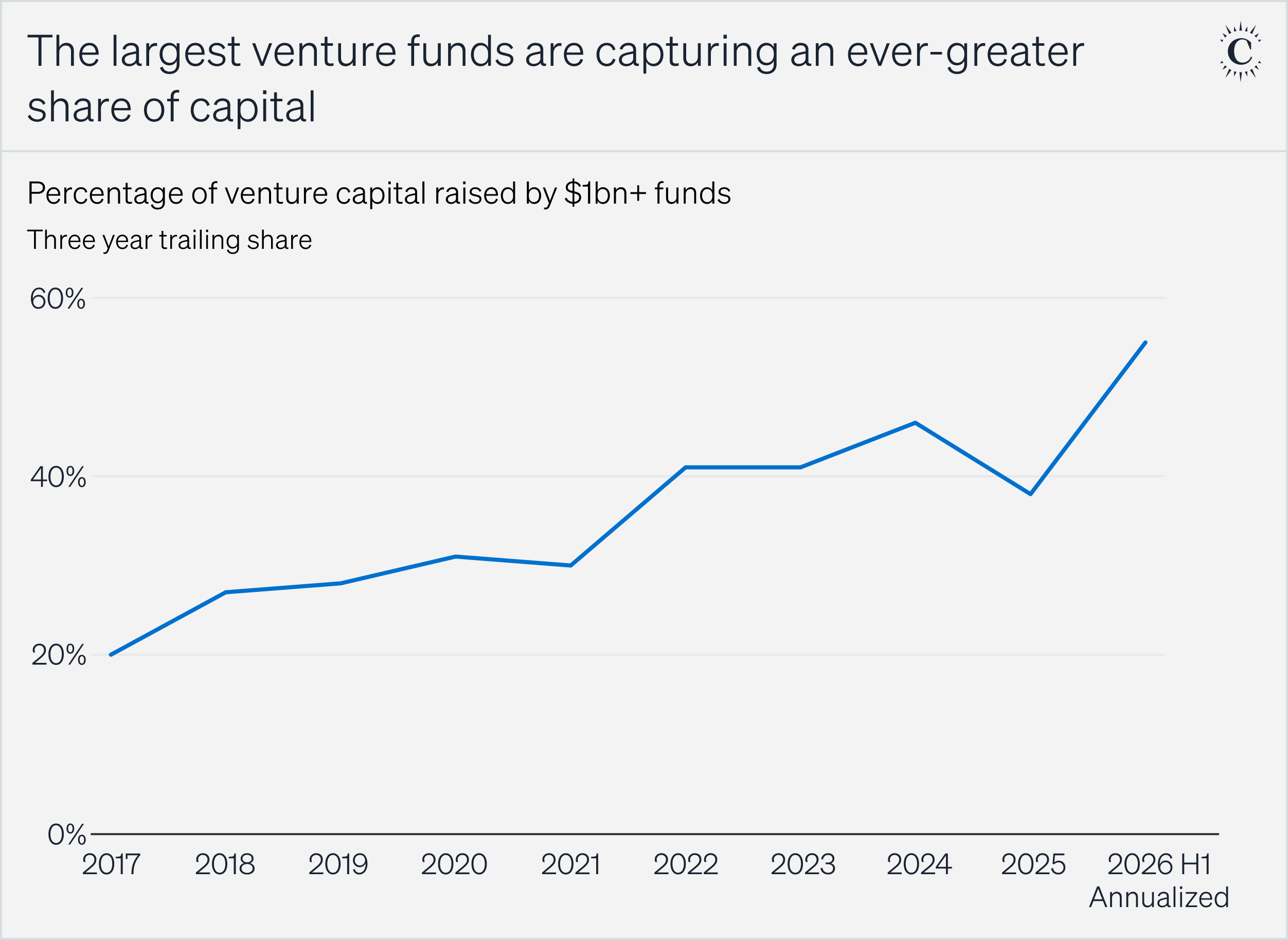
Figure: Source: 2026 NVCA Yearbook, Pitchbook
To a significant degree, VC compensation is directly tied to assets under management. For elite firms like Benchmark and USV, leveraging a proven track record to secure greater AUM for each partner is, from a commercial standpoint, entirely logical.
But venture capital’s foundational logic has always rested on two pillars: first, investing in nascent micro-companies with objectively limited capacities to absorb capital; and second, ensuring each partner personally and actively manages portfolio companies constantly vulnerable to startup mortality. When per-partner capital allocations balloon, one of these pillars must shatter. At what threshold does it cease to be venture capital altogether?
Risk versus Uncertainty: The Foundational Bedrock of Venture Capital
Pioneers of venture capital in the 1960s distilled a proven playbook: construct a portfolio of small, exploratory bets, and then deploy substantial follow-on capital into the handful that prove viable. Both components are indispensable because, in venture capital, returns adhere strictly to an extreme power-law distribution, while day-to-day operations confront founders with entrenched, profound uncertainty.
Frank Knight, who pioneered economic theories surrounding entrepreneurial uncertainty, famously distinguished between “risk” and “uncertainty”: risk exists when you can quantify winning and losing probabilities, whereas uncertainty prevails when those probabilities are completely unknowable.
Mature, well-operating corporations absorb calculated risk, while startups confront pure uncertainty. Where outcomes are certain, companies seek bank financing; where risks are quantifiable, public equity markets and private equity funds step in to price them.
But when genuine, profound uncertainty strikes—when a company’s existence hinges on variables beyond current human comprehension—only venture capital can offer a pathway. In essence, this is the core engine of the VC model. Venture capitalists navigate uncertainty by deploying capital across numerous micro-teams and staging investments to cap losses.
Well-run incumbents do not shy away from risk; insurance companies and banks trade risk daily. However, they demand statistical predictability. Consequently, large enterprises systematically filter out uncertainty-driven initiatives whose expected returns cannot be rationally modeled.
This means only those with no alternative paths pursue highly uncertain fringe concepts. Those people are founders; their calling is literally born to shoulder uncertainty. Such explorations bypass head-on collisions with resource-heavy behemoths, carving out narrow windows of survival for startups.
Historically, the most successful founders have mastered uncertainty by inventing entirely new markets. The upside ceiling for entering established markets is capped by a known addressable TAM; but brand-new markets represent uncharted territory with immeasurable potential. When Apple was founded in 1976, no one knew the true addressable market size for personal computers.
This dynamic generates highly lucrative long-tailed return distributions. The rational response to extreme uncertainty is never to mortgage everything on a single bet upfront, but rather to construct a diversified portfolio and retain optionality through staged tranches.
The Double Curse of Excess Capital: Partner Bandwidth and Yield
Founders simply cannot juggle multiple uncertain vectors simultaneously; dedicating themselves full-time to honing a single venture is already exhausting. This is precisely the societal division of labor that defines venture capital: firms manage uncertainty at the portfolio level so that frontline founders can devote their undivided attention to executing their specific visions.
VC partners must both manage their own portfolio uncertainties and advise startup teams navigating external volatility. Yet partner bandwidth is bound by hard physiological limits. The traditional rule of thumb dictates that a partner can meaningfully serve on the board and act as a lead investor for a maximum of 10 to 12 companies.
To inflate the deal flow under each partner’s name, firms typically have only two levers: either accelerate deal volume, or pack more capital into individual transactions.
If a firm pursues deal velocity, partners are forced to abdicate deep lead roles, instead relying on the diligence of outside lead investors and going along with the crowd. This free-rider problem fundamentally erodes the mechanism of mitigating startup mortality through hands-on operational support.
The alternative is enlarging ticket sizes: either paying astronomical valuation premiums regardless of fundamentals at early stages, or pushing capital into late-stage rounds. Regardless, whether one overpays early or buys into mature targets where uncertainty has already been arbitraged away, it irreversibly compresses long-term capital yields.
Late-stage growth investing has effectively mutated into a completely different asset class. It manages quantifiable, probabilistic risk rather than probing pure, uncharted uncertainty. It also demands that partners dedicate massive hours to wrangling with external secondary buyers, aggressively cannibalizing the attention previously reserved for early-stage mentorship.
Echoes of History: The Sudden Death Crisis of 1980s Venture Capital
The dynamic of excessive capital per partner triggering a collapse in aggregate fund returns has already played out in a full, painful cycle within venture history.
In 1979, the United States amended the fiduciary standards of the Employee Retirement Income Security Act (ERISA), finally clearing regulatory hurdles for massive pension capital to flood into venture capital. Within just five years, annual U.S. VC fundraising exploded sixteenfold, rocketing from $218 million in 1978 to $3.6 billion in 1983.
Yet, the industry’s ability to train qualified investment professionals could never match the sheer velocity of incoming capital. Between 1978 and 1987, average assets managed per VC professional tripled, surging from $4 million to $12 million.
The most direct casualty of this mismatch was a valuation bubble. The Wall Street Journal reported in 1983 that “valuations for young companies climbed too quickly, making it exceedingly difficult for traditional early-stage VCs to achieve the requisite 5x to 10x returns.” Net internal rates of return (IRRs) for the sector plummeted from above 30% in 1982 to roughly 8% by 1988.
Expanding fund sizes triggered deadlier ripple effects: there simply weren’t enough nascent companies available to absorb such monumental pools of capital. The Journal noted in 1988 that “massive fund sizes had relegated seed-stage investing from a core competency to a dispensable sideline.”
Seed-stage allocations collapsed nationwide, dropping from 25% of total VC capital in 1980 to just 12.5% by 1988. In response, numerous VC firms pivoted wholesale into leveraged buyouts (LBOs). A sector that barely existed in 1980 consumed 23% of all U.S. VC deployment by 1986.
Established names like J.H. Whitney, Peter C. Patricof, and Warburg Pincus either pivoted heavily or transformed entirely into LBO-focused firms. Even Sequoia capitalized briefly dabbled in leveraged acquisitions during the era.
Firms that kept the venture label instead abandoned speculative bets, channeling capital into consolidating mature incumbent industries, funding homogenous copycat competitors, and backing traditional retail businesses devoid of technological moats. Office superstore Staples represented a decent thesis, yet over the following two years, investors poured nearly $200 million into at least sixteen rival retail chains.
This rapidly devolved into brutal price wars and cascading bankruptcies. By attempting to engineer low-volatility returns through the eradication of uncertainty, the VC sector collectively delivered catastrophic bottom-line results.
As capital fled technology creation en masse to fuel mergers and mature sectors, the establishment of genuinely innovative tech companies imploded. The count of new U.S. technology products peaked in 1982 before crashing 28% by 1991; the addition of independent software vendors plunged 76% over a five-year span.
Confronted with a dearth of investable targets, committed capital flowing into VC contracted by 71% between 1989 and 1991. Describing his arrival in Silicon Valley in early 1994, Marc Andreessen bluntly noted, “It was totally dead. It was a stagnant pond.”
In short, the once-thriving VC industry absorbed far more capital than it could digest following regulatory shifts. When the velocity of money outpaced the availability of investment talent, returns began to crater. Firms responded by retreating from uncertainty, trapping themselves in a downward spiral of decaying yields.
Repeating History: The AI Arms Race
Today, we stand at an identical historical inflection point. Based on the metrics of Benchmark’s 2026 vehicle, each partner is tasked with deploying $400 million—more than triple the amount the firm previously deemed sustainable for maintaining focus. Similarly, each partner at USV is now overseeing roughly $180 million, a figure multiples of their historical allocations.
This is hardly an isolated anomaly. National VC fundraising surged to a peak of $223 billion in 2022 before plummeting to $67 billion in 2025. Although figures have ticked upward recently, colossal pools of capital remain irresistibly funneling into a handful of mega-funds. If history holds any cautionary tale, we are likely standing on the eve of repeating the early-1990s trauma.
No one is acting in bad faith to dismantle venture capital. The sheer inflation we are witnessing is fundamentally an unyielding arms race. The generative AI explosion has pushed capital requirements and market multiples to absurd extremes, suggesting that only mega-funds with deep pockets deserve front-row seats.
Frontier labs routinely require billions to construct compute clusters and train foundational models, while nascent AI startups command staggering initial-round tickets—such as Thinking Machines, which secured a $2 billion debut round in 2025. Regardless of noble intents, this dynamic fundamentally contravenes the core tenets of venture capital.
OpenAI’s early phase confronted genuine, unquantified uncertainty. That absolute unknown granted it years of breathing room to iterate on foundational technology and unit economics, burning through roughly $130 million in its initial years. Contrastingly, the vast majority of AI startups emerging today are stepping into highly saturated arenas flanked by well-funded tech behemoths.
They secure massive funding precisely because the foundational uncertainty has already been navigated by pioneers; yet simultaneously, they must brace for annihilation by the world’s best-capitalized incumbents. Investors appear trapped in an ’80s echo chamber, eagerly trading known risks in bloody oceans while hesitating to actually embrace uncharted uncertainty.
Paying premium valuations for perceived uncertainty protection to acquire commodities competing in homogenous bloodbaths ensures that realized exit multiples will inherently fail to justify the elevated entry cost. Much like General Motors overpaid more than $1 billion for Cruise at the autonomous driving peak in 2016, only to be forced into liquidation by 2024—the glitter eventually fades to reveal the harsh reality underneath.
Big Money Left, VC Right: Next-Generation Pioneers in the Ashes
Venture capital intrinsically extracts asymmetric returns by underwriting extreme uncertainty at the right tail of a power law. When a fund assigns severely overloaded capital per partner, managers are forced into compromising deals laden with unjustified premiums, or they artificially strip out uncertainty to manufacture comfort. The former is poor commerce; the latter ceases to be venture capital entirely.
In this regard, venture capital is once again cycling toward partial obsolescence. Pivoting toward growth equity or LBOs is not inherently flawed; markets genuinely require these liquidity conduits. Yet society urgently needs authentic venture capital. As mega-funds collectively drift toward maturity and M&A, nimble, small-cap vehicles must inherit the torch of discovery.
The meter of history echoes sharply in the present: Lightspeed established a $750 million-plus fund dedicated solely to acquiring legacy incumbents and slapping AI branding onto them; Thrive Capital deployed $7.6 billion to LBO ADT, a century-old home security conglomerate.
The industry’s top legacy titans are diverting massive bandwidth toward asset repackaging and acquisition roll-ups, while pure-play seed and early-stage forces are undergoing brutal contraction.
Concurrently, pure-play seed and early-stage capital formation is bleeding out. In 2025, first-time funds constituted a historic low of just 10.9% of total U.S. VC deployment; early-stage micro-funds raising under $100 million collapsed to a mere 11.7% share.
Yet recall that during the 1980s bust, it was exactly the stubborn holdouts like Kleiner Perkins and Accel—firms that clung fiercely to early-stage uncertainty—that ultimately forged themselves into dominant legends during the 1990s internet boom, steering a spectacular global renaissance in innovation.
Venture capital did not truly die in the 1980s, and it will not this time either. While jaw-dropping capital allocations will inevitably dominate media cycles, the industry’s authentic forward momentum will always belong to the minority of investors who remain grounded, patiently operating at the fringes of the unknown alongside founders mapping uncharted territories.
Join TechFlow official community to stay tuned
Telegram:https://t.me/TechFlowDaily
X (Twitter):https://x.com/TechFlowPost
X (Twitter) EN:https://x.com/BlockFlow_News
 @ganeumann