Pyth Research Report: Q3 Recurring Revenue Up 86.5% Quarter-over-Quarter to $11.49 Million, DAO Approves '100% Rule' for Full PYTH Repurchase
Author: Pyth Network
Compiled by: TechFlow
TechFlow Recap: Pyth's official Q3 review reveals an auditable commercialization trajectory: quarterly-end Active Recurring Revenue (ARR) reached $11.49 million, surging 86.5% quarter-over-quarter, with 276 paying accounts; growth is now penetrating exchanges, prediction markets, and AI agent verticals. Coupled with the DAO's newly approved "100% Rule"—where every dollar of product revenue is directed toward purchasing PYTH on open markets—token supply dynamics and data monetization are now explicitly anchored to the same lever for the first time.

At the end of Q3, Pyth recorded $11.49 million in Active Recurring Revenue (ARR), representing an 86.5% quarter-over-quarter increase. The growth is flowing into: exchanges, prediction markets, and AI.
The third quarter marked the period where Pyth's business model began to take shape.
Revenue, product usage, customer acquisition, and market coverage are advancing in tandem. Pyth is no longer just used for bringing price feeds on-chain; it is evolving into a new financial product infrastructure spanning exchanges, prediction markets, and AI.
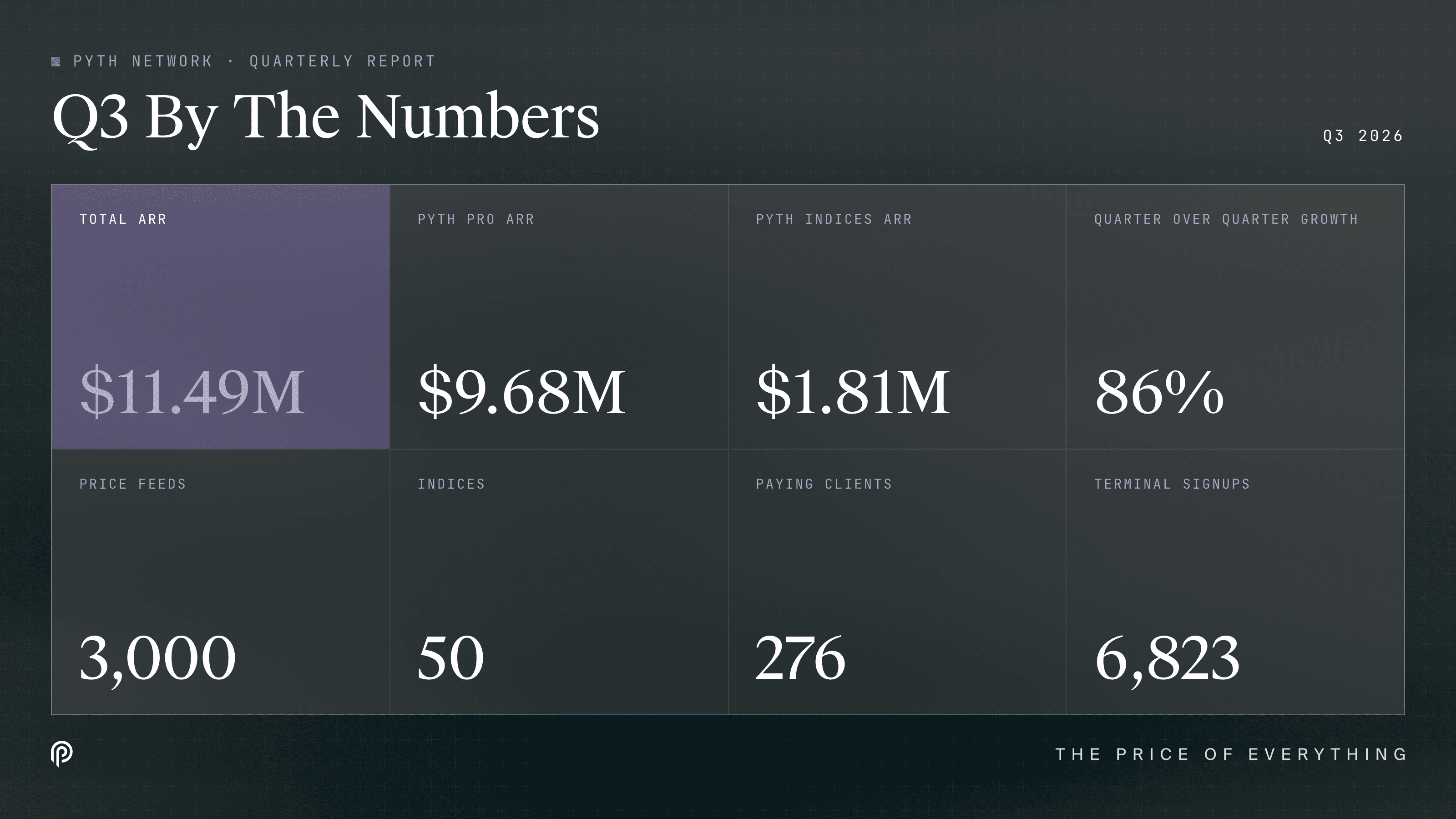
Q3 Data Overview
A Replicable Business Model Begins to Emerge
The third quarter was not merely headline-grabbing growth. It provides early evidence that Pyth is building a repeatable business model.
By the end of September, total active ARR reached $11.49 million, up 86.5% quarter-over-quarter; net new ARR for the quarter was $5.33 million.
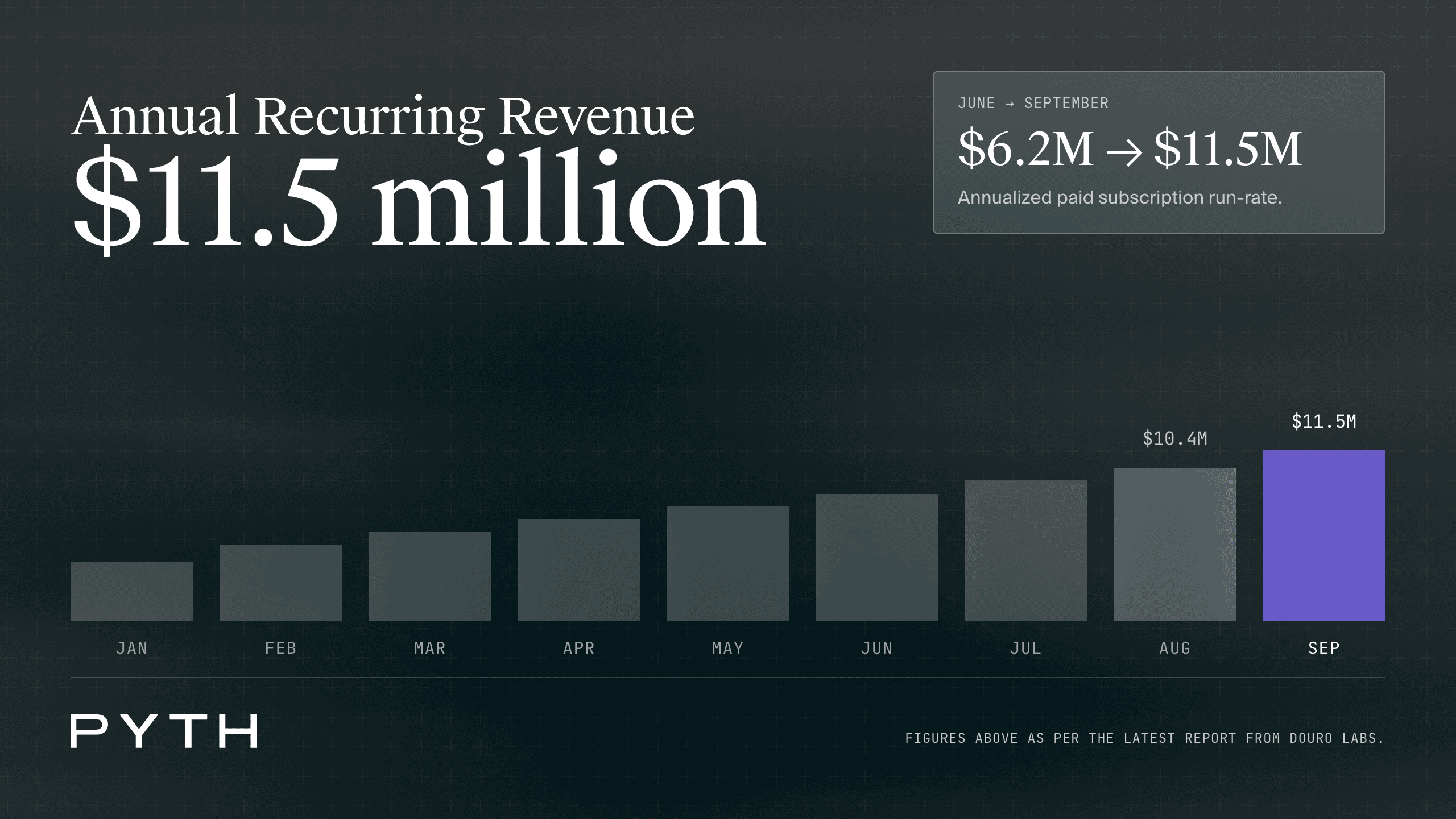
Business is also rolling out across multiple products. By late September, Pyth Pro accounted for $9.68 million in online ARR; Pyth Indices accounted for $1.81 million, covering 16 live clients. Across the entire business, there are currently 276 paying accounts. Self-serve onboarding at the endpoint has emerged as another key entry point, contributing $500,000 in new ARR alone in September.
Growth Vectors
Pyth's Q3 momentum is rolling out across three high-potential verticals: exchanges, prediction markets, and AI. On each front, current utilization serves as an early proof point for larger opportunities.
Exchanges
Pyth has already become part of the underlying infrastructure behind emerging exchange products.
During Q3, the perpetual market volume for Real World Assets (RWA) reached $2.09 trillion, with venues powered by Pyth accounting for 94.1%. Coinbase is using Pyth data to support continuously priced thematic markets; MarketVector indices calculated using Pyth data underpin the equity index futures listed on Coinbase Derivatives.
Other leading exchanges driving markets with Pyth data (Pro and Indices) include Trade[XYZ], OKX, and Lighter.
Exchanges are leveraging Pyth to launch products that traditional market data infrastructure cannot easily support. As these markets expand to include more assets, venues, and geographic reach, Pyth's opportunity expands alongside them.
Prediction Markets
Prediction markets require clear, continuous data inputs to price positions and settle outcomes. Pyth is already providing this infrastructure to leading platforms.
Kalshi is the most prominent example. The platform uses Pyth prices in markets covering equities and commodities, and in September included Pyth as the sole Source Agency in its filings related to gold and silver perpetuals on its CFTC-regulated exchange.
Pyth also supports Polymarket's real-world asset markets.
As prediction markets expand from elections and news events to financial assets, commodities, and macroeconomic outcomes, reliable market data becomes core to the product itself. As the category continues to grow, Pyth is poised to serve as that foundational data layer.
AI and Agent-Financial Systems
AI systems will require structured, timely, and programmatically accessible current and historical financial data.
Pyth and Exa are piloting what a market data layer for financial agents could look like. Exa provides network-level research context; Pyth delivers structured spot prices, historical observations, and candlestick data via MCP. Combined, they enable agents to research a company, asset, or event, retrieve corresponding market data, and synthesize a unified answer.
The opportunity extends far beyond answering market questions. As agents begin monitoring assets, evaluating opportunities, managing risk, and interacting with financial products, real-time market data will become a core input for software-driven finance. Pyth can deliver this input across a wide range of assets and use cases.
The pattern across all three verticals is identical: Pyth is already embedded in products being built today. As more exchanges, prediction markets, and AI systems move from pilot to production, Pyth's utilization will scale alongside the markets it powers.
Nasdaq Basic on the Data Marketplace
Pyth has now become an approved external distributor for Nasdaq Basic—Nasdaq's proprietary real-time quote and trade product for US-listed equities.
Nasdaq Basic will be distributed via the Pyth Data Marketplace, built specifically for software and blockchain-native destinations. Clients intending to use Nasdaq Basic must obtain licensing directly from Nasdaq and secure prior written approval before consuming the data feed.
The "100% Rule"

The PYTH DAO has approved the "100% Rule".
Every dollar the DAO receives from Pyth products will now be used to purchase PYTH on open markets; under the previous framework, this allocation was limited to one-third of non-PYTH balances.
This triples the committed buyback share while the underlying revenue supporting it continues to grow in tandem.
For complete details on execution and reporting, see "Pyth Goes All In".
Forward Outlook
Pyth has transitioned from being primarily known for crypto and on-chain applications to becoming a cross-asset market data layer serving exchanges, prediction markets, institutions, applications, and AI systems.
The next phase involves converting more Pyth Pro trials into production usage, expanding institutional adoption, launching additional indices, scaling marketplace supply and demand, deepening integration with exchanges and prediction markets, and turning AI interest into commercial deployments.
Early signals are already visible across the business: ARR growth, account depth expansion, new exchange products, rising prediction market adoption, and the first implementations of Pyth data in agent-driven finance.
What remains for Q4 is to turn these early traction points into deeper adoption, more products, and broader market activity.
Join TechFlow official community to stay tuned
Telegram:https://t.me/TechFlowDaily
X (Twitter):https://x.com/TechFlowPost
X (Twitter) EN:https://x.com/BlockFlow_News
 @PythNetwork