A Deep Dive into PYTH: The "Data Heart" of the DeFi World
TechFlow Selected TechFlow Selected
A Deep Dive into PYTH: The "Data Heart" of the DeFi World
By providing seamless, permissionless data flows across chains, Pyth enhances the interoperability of DeFi applications.
 Navigating Web3 tides with focused insights
Author: Bradley Peak
Translation: TechFlow
1. What is Pyth?
Pyth Network is a decentralized oracle—essentially, a service that connects blockchains with real-world data. It brings real-time financial metrics such as stock, cryptocurrency, and commodity prices onto blockchains.
Launched initially on Solana in 2021, Pyth’s mission is to provide high-quality data for blockchain applications, particularly decentralized finance (DeFi). In these applications, accurate data inputs are crucial for asset pricing and preventing mispriced trades.
Unlike oracles that rely on multiple intermediaries to obtain data, Pyth sources directly from top-tier financial institutions such as exchanges and trading firms—improving both the speed and reliability of data delivery.
2. How Pyth Network Revolutionizes Real-Time Data Feeds
Pyth Network has transformed how blockchain systems access real-time market data by establishing direct connections with high-quality data sources like trading firms, major financial institutions, and exchanges.
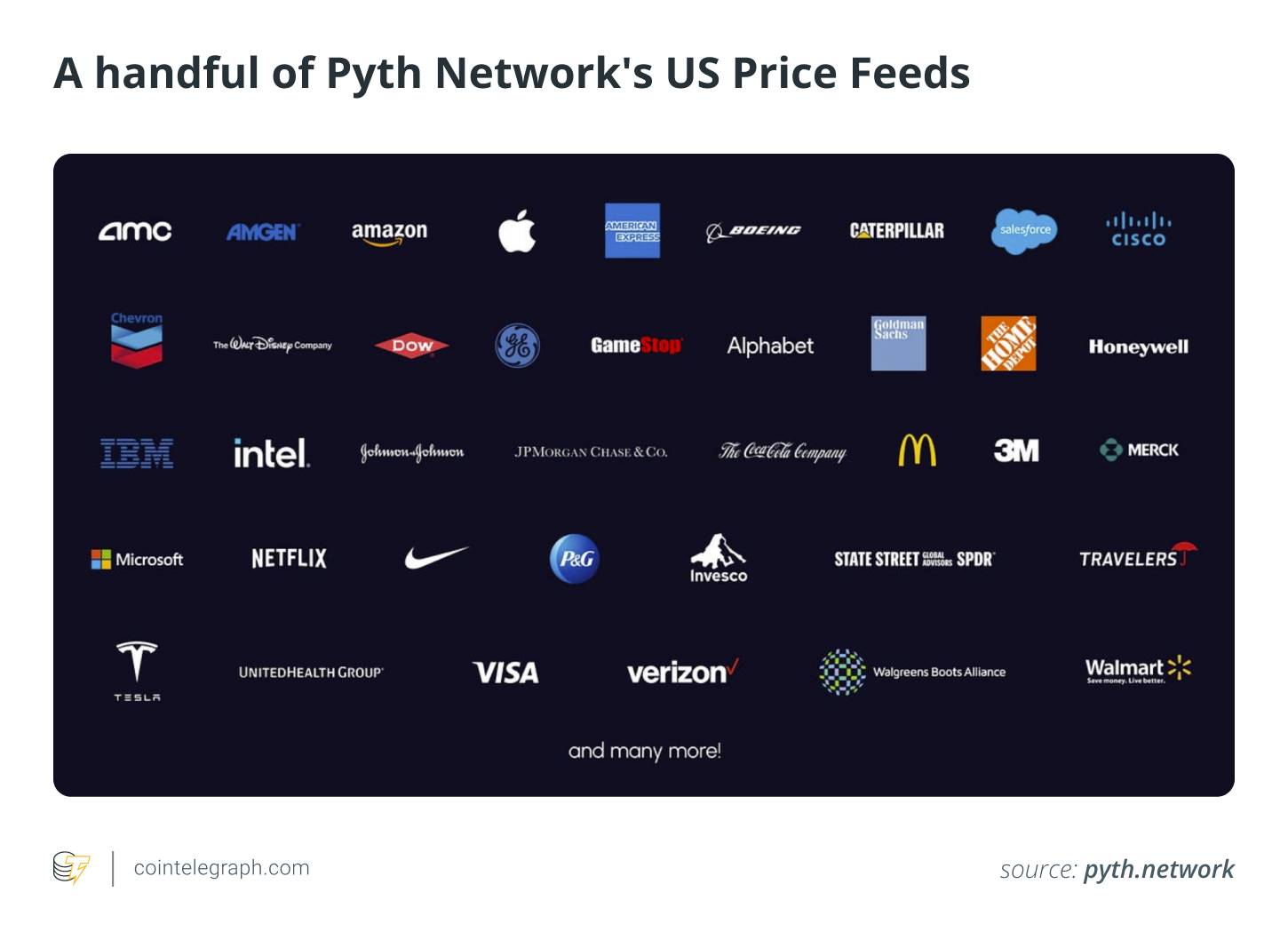
Rather than relying on intermediaries, Pyth obtains asset prices directly from first-party providers—including firms in both traditional finance and crypto markets. This enables decentralized applications (DApps) to access accurate, low-latency pricing information—critical for tools such as lending platforms, trading protocols, and asset tokenization systems.
What sets Pyth apart is its strong commitment to reliability and accuracy. Unlike many oracles, Pyth uses a unique data aggregation approach, gathering data points from multiple providers to generate a single, robust price feed resistant to market volatility or data manipulation. This is especially important in decentralized finance (DeFi), where any delay or inaccuracy in price data can lead to issues like incorrect liquidations or arbitrage opportunities that harm the market.
Did you know? Pyth Network publishes data on its own dedicated blockchain, Pythnet, enhancing transparency and security within the blockchain oracle space.
3. How Pyth Network Ensures Accuracy of Crypto Data
Pyth Network's accuracy stems from a robust validation process and aggregation model powered by its extensive network of data publishers.
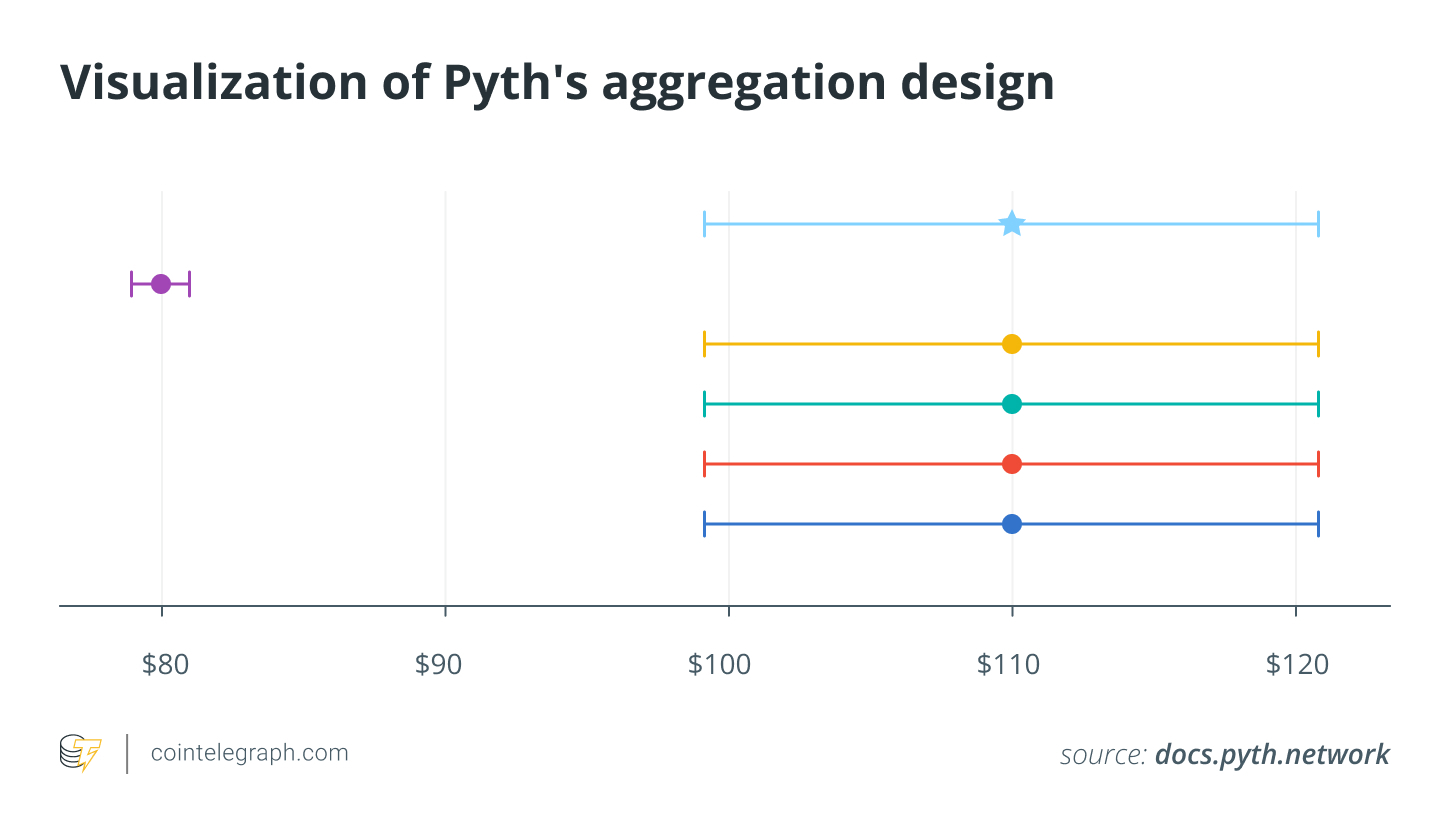
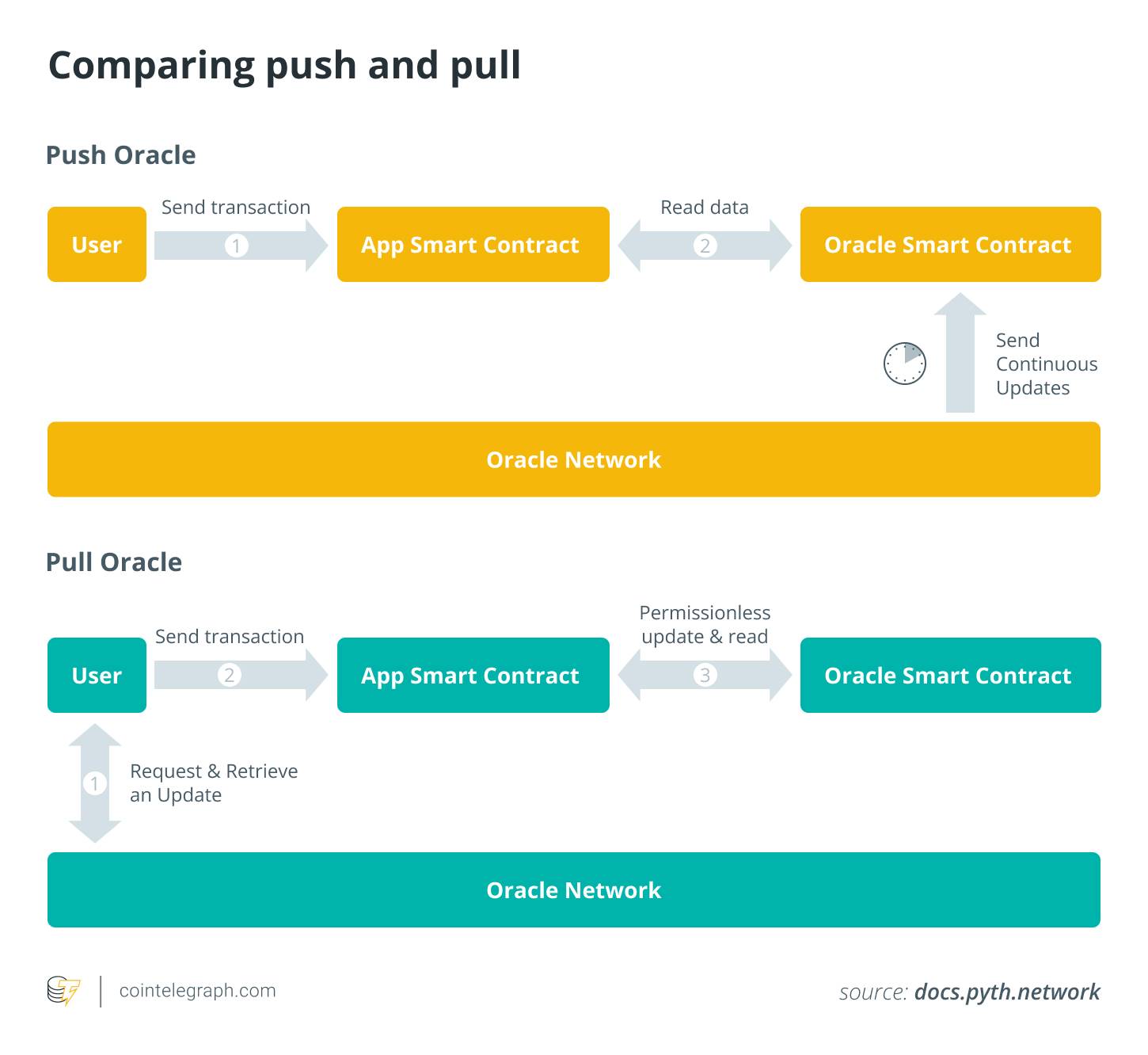
Each data provider—including trading platforms and financial institutions—submits asset prices to Pyth along with a confidence interval indicating the accuracy of their reported price. Pyth’s protocol aggregates these multiple data points into a single price feed for each asset, updating every 400 milliseconds. Thanks to its “pull-oracle” design, Pyth reduces blockchain congestion and lowers costs by updating data only when requested by users, rather than continuously pushing updates.
To ensure data integrity, Pyth employs a weighted aggregation method that filters out extreme outliers and assigns higher weights to more reliable sources. This significantly reduces the risk of data tampering or manipulation. The result is a secure and accurate system where asset prices are cross-verified across multiple independent sources, ensuring DeFi applications can depend on precise and stable data.
Did you know? The first blockchain oracle, Reality Keys, was developed to overcome the inherent limitations of smart contracts. While blockchain systems are self-contained and highly secure, they cannot natively access external information—such as market prices, weather conditions, or event outcomes—which is essential for many real-world applications.
4. Key Use Cases of Pyth Network
Pyth Network’s real-time data feeds significantly enhance the functionality of DeFi applications, including decentralized exchanges (DEXs), lending platforms, stablecoins, derivatives, and yield optimization.
By providing accurate and decentralized pricing, Pyth supports flexible trading, efficient liquidations, stablecoin pegging, risk-managed derivatives, and optimized yields—ensuring stability and transparency across the DeFi ecosystem. Let’s explore some specific use cases:
-
Decentralized Exchanges (DEXs): Pyth’s real-time data feeds support decentralized exchanges by enabling accurate price updates for assets traded across multiple chains. For example, Drift Protocol on Solana leverages Pyth’s low-latency data to maintain efficient price discovery and risk management. Drift uses Pyth’s rapid update capability to facilitate trading in perpetual futures and other derivatives, allowing traders to respond effectively to market volatility while maintaining transparency and security.
-
Lending Platforms: Accurate asset pricing is vital for DeFi lending protocols to maintain correct loan-to-value (LTV) ratios and enable automatic liquidations. By supplying real-time data to lending platforms, Pyth supports collateral valuation and liquidation processes, protecting lenders and maintaining platform stability. On ZKsync, ReactorFusion uses Pyth’s pricing mechanism to efficiently manage loan values, while on Solana, Solend relies on Pyth to monitor collateral risk and trigger automatic liquidations, minimizing losses during market fluctuations.
-
Stablecoins: Stablecoin platforms heavily depend on Pyth to anchor their value to currencies like the U.S. dollar or euro, and to commodities. Integration with Pyth allows stablecoins like Tether’s USDt USDT to maintain their value through frequent and accurate price data—critical for reserve stability and preventing users from facing depeg risks. This stable link to fiat or crypto-collateralized assets ensures smooth and trustworthy DeFi transactions even during market volatility.
-
Derivatives and Structured Products: In the derivatives market, Pyth enables platforms to develop complex financial instruments such as perpetuals, options, and structured product vaults. For instance, Kwenta and other Synthetix projects use Pyth’s data streams to offer exposure to digital and real-world markets, ensuring positions are well-hedged and reducing the risk of mismatched liquidations. Pyth’s high-frequency data also supports unique options products like leveraged positions, further expanding DeFi trading choices with decentralized price integrity.
-
Yield Optimization and Other DeFi Applications: Yield farming and liquidity protocols leverage Pyth’s price data to optimize reward mechanisms and manage risks associated with staking or providing liquidity. Yield farmers track asset performance via real-time data to maximize returns. Additionally, cross-chain ecosystem applications like Mantle’s Lendle integrate Pyth to support dynamic yield-bearing assets and liquidity pools, driving innovation and user engagement in DeFi.
Did you know? The largest project using Pyth Network on the Optimism blockchain is Synthetix, which relies heavily on Pyth’s low-latency price data to power its Synthetix Perpetuals (Perps) v2. This integration enabled Synthetix to launch 40 new perpetual markets, handle nearly $15 billion in trading volume, and generate substantial staking rewards for users.
5. Timeline: The Evolution of Pyth Network
Over the years, Pyth Network has remained committed to its mission of powering decentralized finance with data—continuously improving its infrastructure and advancing DeFi through precise, high-frequency market data feeds.
2021: Launch on Solana and First Price Data Release
In April 2021, Pyth Network was announced, initially backed by Jump Crypto. It officially launched in August on Solana’s high-performance blockchain, delivering fast, low-latency price data for over 30 crypto assets.
By year-end, Pyth was sourcing data from around 40 major financial institutions—including exchanges and market makers—supporting its goal of providing reliable real-time data for DeFi applications.
2022: Expansion via Pythnet and Cross-Chain Capabilities
In 2022, Pyth Network achieved significant growth by launching Pythnet, a proof-of-authority blockchain forked from Solana. Pythnet enables faster data aggregation and more frequent updates.
In August of that year, Pyth integrated with the Wormhole bridge, expanding to other blockchains and supporting price data on Ethereum, BNB Smart Chain, and others. This marked Pyth’s move into cross-chain expansion, aiming to deliver high-frequency data to a broader DeFi ecosystem.
2023: Governance Launch and PYTH Token Airdrop
In November 2023, Pyth launched its governance token, PYTH. To incentivize community participation, Pyth conducted an airdrop, distributing PYTH tokens to early users and active DeFi participants, enabling holders to vote on protocol changes and development.
This launch was a pivotal step toward decentralized governance, allowing the community to participate in decisions regarding fee structures, network upgrades, and ecosystem growth.
2024: Multi-Chain Growth and Institutional Adoption
Pyth continued its multi-chain expansion in 2024, strengthening partnerships with DeFi platforms like Drift Protocol and ReactorFusion and integrating price data across ecosystems.
By mid-2024, Pyth reported over $5 billion in total value secured and claimed nearly 10% market share among oracle networks—highlighting its growing role as a trusted source of real-time DeFi data across blockchain networks.
6. Pyth Network vs. Chainlink: What’s the Difference?
The choice between Pyth and Chainlink depends on project needs: Pyth excels in high-speed financial data for DeFi, while Chainlink suits broader use cases requiring data diversity and strong ecosystem support.
When it comes to oracles, you’re likely familiar with Chainlink, the most widely used decentralized oracle, supporting over 1,600 projects. So why do we need Pyth?
First, there’s a key difference in data sources. Pyth sources data directly from financial institutions, exchanges, and trading firms—ensuring information comes from organizations like Jane Street and Binance, guaranteeing high-quality, first-hand data. This contrasts with Chainlink, which typically relies on independent node operators who often pull data from aggregators like CoinMarketCap and BraveNewCoin.
This relay-based model gives Chainlink greater data diversity but may lack the consistency of Pyth’s direct data for high-frequency financial applications. There are several other key differences—let’s examine them closely.
Cost Efficiency and Data Update Model
Pyth uses an efficient pull-based model, allowing users to request data updates only when needed—significantly reducing transaction costs. As a result, Pyth delivers near-instantaneous updates with latency around 300–400 milliseconds, ideal for latency-sensitive DeFi applications.
In contrast, Chainlink typically uses a push-based model, updating prices periodically based on specific triggers such as price deviation or time intervals. This can be costlier and slower—for example, Chainlink might update every few seconds or minutes under preset conditions, suitable for applications where speed is less critical than reliability.
Target Audience and Use Cases
Pyth focuses specifically on DeFi and financial data applications—such as decentralized exchanges, lending, and derivatives platforms. Its data feeds are optimized for real-time financial trading, where precision and high frequency are paramount.
Chainlink, by comparison, supports a wider range of use cases beyond finance, including insurance, gaming, and supply chain—where diverse types of external data are required.
Transparency and Governance
Both have governance mechanisms, but Pyth better embodies Web3 principles.
Pyth is governed by a decentralized autonomous organization (DAO), actively incorporating community input into decisions about protocol changes and upgrades—ensuring transparency.
Chainlink also involves community participation, but concerns about centralization persist due to its multi-signature contract system, which grants significant control over data flows to a small group.
Pyth’s fully on-chain transparency further strengthens user trust in the authenticity of its data, whereas Chainlink’s data remains off-chain, requiring users to verify sources independently.
7. The Future of Pyth
Pyth Network’s development roadmap indicates a strong focus on expanding cross-chain compatibility, with plans to support over 50 blockchains—including Near and Arbitrum—to further extend its reach in DeFi.
By offering seamless, permissionless data feeds across chains, Pyth enhances interoperability for DeFi applications.
Future plans also include broadening asset coverage beyond cryptocurrencies to include commodities, equities, and foreign exchange—positioning Pyth as a versatile oracle for both digital and traditional finance.
Technical improvements are underway, aiming to reduce latency by 20% and increase the number of data providers per feed, enhancing data reliability for high-frequency trading and derivatives platforms.
Additionally, Pyth’s community-driven DAO model will empower stakeholders to guide strategic decisions on fees, data integrity, and network evolution.
These initiatives position Pyth as a foundational oracle for secure, real-time data solutions in DeFi and Web3—evolving alongside the industry’s growth.
Join TechFlow official community to stay tuned
Telegram:https://t.me/TechFlowDaily
X (Twitter):https://x.com/TechFlowPost
X (Twitter) EN:https://x.com/BlockFlow_News
 @Cointelegraph