Stablecoins deliver a knockout blow to US dollar dominance, and Backpack is betting on tokenized US stocks to play out the exact same script.
Author: Frictionless Capital
Compiled by: TechFlow
TechFlow Digest: The success of stablecoins has proven that moving the dollar on-chain is the most effective expansion of American financial hegemony yet. Now the same script is playing out in the U.S. stock market, and Backpack is betting on turning the entire U.S. capital market into an internet-native product—a signal that cannot be ignored for investors focused on asset issuance and trading infrastructure.

Backpack: The Engine of the Internet Capital Market
The United States is in the early stages of exporting its capital market via the internet. Over the past decade, we have already witnessed this process unfold with the dollar. We now believe that Backpack is the company best qualified to lead the charge in exporting the U.S. capital market.
On June 12, SpaceX went public. It was the largest IPO in history, raising $75 billion. Almost simultaneously, its tokenized shares, $SPCX, began trading on blockchain rails. Issued by Backpack, the token is redeemable 1:1 for real shares and accessible to anyone worldwide. Once traditional markets close, $SPCX becomes the primary price discovery tool, trading throughout the weekend when Nasdaq is closed. By Monday, SpaceX’s opening price on the NYSE was only a few basis points higher than Backpack’s tokenized SpaceX shares on-chain. In its first month, Backpack’s tokenized SpaceX shares generated $1.08 billion in trading volume. This is not a story about crypto or weekend trading; it is a story about America beginning to export its capital markets, just as it did with the dollar through stablecoins. We firmly believe Backpack is poised to become the global leader in this space.
Stablecoins: A Checkmate for Dollar Hegemony
Over the past five years, the U.S. has begun moving the dollar onto the internet through companies like Tether and Circle. Today, roughly 300 million people in developing nations use $300 billion in digital dollars as savings accounts because their local currencies perform worse. The genius of Tether and Circle lies in recognizing the intense global demand for the dollar; by controlling the minting and redemption gateway, they profit from issuing float.
Initially, the U.S. government viewed the tokenization and global circulation of the dollars on the internet with frankly heavy skepticism. But once they realized these entities were becoming some of the largest buyers of U.S. Treasuries, skepticism quickly turned into overwhelming support. Over the past five years, Circle also attempted to tokenize other currencies, with limited success, because users worldwide wanted dollars to hedge against inflation, and the dollar remains the most widely accepted currency. Over time, dollar-denominated stablecoins like USDT and USDC helped the U.S. capture the vast majority of the digital currency market share. In a short period, dollar stablecoins are growing at an astonishing pace.
99.4% market share of the stablecoin market
Purchased $33 billion in U.S. government debt, surpassing Japan and holding three times China’s position
$30 trillion in payment volume by 2025
The reality is that overseas users prefer holding dollars over their local currencies, as domestic money can be confiscated or devalued overnight through printing. In response to calls for a clear regulatory framework, the U.S. passed the Genius Act, legalizing stablecoins as long as they are fully backed 1:1 by real dollars held in domestic bank accounts. On August 17, 2026, Treasury Secretary Scott Bessent took it a step further, announcing that the Treasury has begun treating stablecoins as strategic dollar infrastructure, allowing them to expand dollar hegemony much like Eurodollars.
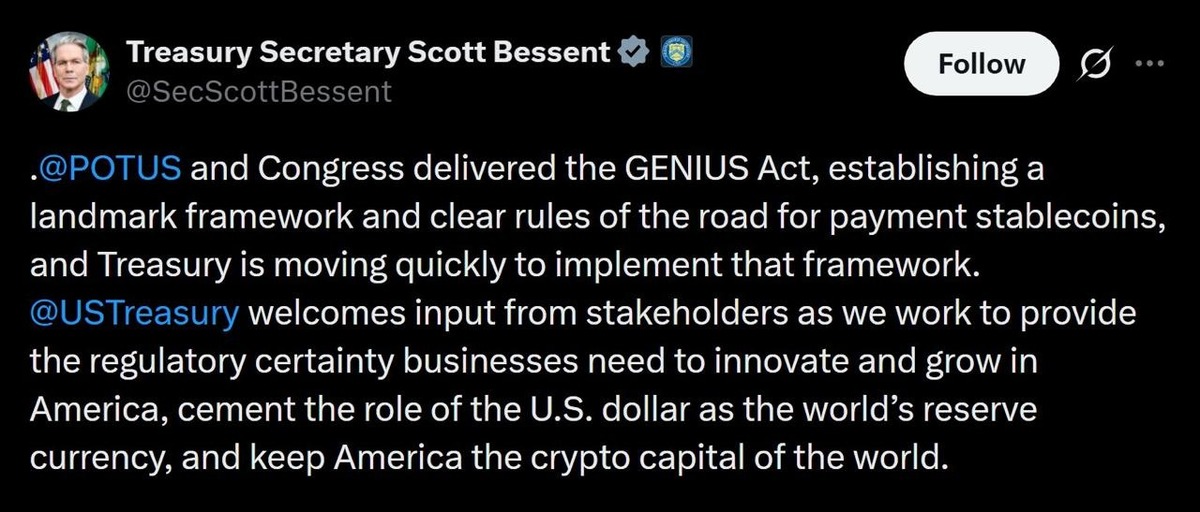
This marks the final step in dollarization regulation. With such successful dollar exports, the U.S. is now exporting a much larger product: capital markets, and a complete securities system starting with U.S. equities.
The Stablecoin Playbook is Rolling Out to U.S. Stocks via Tokenization
Just as people prefer holding digital dollars over local currencies, they generally also prefer holding tokenized U.S. stocks. Now, anyone with an internet connection has the opportunity to own the world’s best and fastest-growing companies. Stablecoins have already dollarized over 150 countries and more than 300 million people, who already hold dollar savings accounts ready to purchase stocks—which, of course, are dollar-denominated. The rationale for choosing U.S. equities is clear: American stocks contribute 52% of global profits and most of the growth, plus a historic wave of companies waiting for IPOs over the next 12 to 18 months, including major AI model firms like Anthropic and OpenAI, alongside related infrastructure and hardware businesses. Considering that China’s major brokerages like Futu, Longbridge, and Tiger Securities have effectively been banned from trading U.S. stocks, the ability to distribute equities globally via blockchain tokenization and capture this demand becomes even more compelling. Similar to capital controls on local currencies, demand for dollars and U.S. stocks won’t be eliminated; it will simply migrate to new rails, a trend that will only accelerate the adoption of tokenized stocks. This is the most significant expansion of U.S. financial power since SWIFT, and we are still in very early stages.
On the regulatory front, the groundwork and precursor to a Genius Act for equities is already in place. First, the SEC and CFTC merged their respective crypto efforts into unified action. The SEC approved Nasdaq’s tokenized trading pilot in March. On September 1, the SEC proposed allowing official records of stock ownership to be stored on-chain, marking the first major overhaul of these rules since the 1970s. On September 17, the SEC and CFTC relaxed regulations on tokenized stock trading, permitting these instruments to trade in permissionless liquidity pools on-chain, such as AMMs, and eased rules for proprietary AMMs and applications to register as exchanges or broker-dealers. These innovative exemptions effectively pave the way for at least five more years of U.S. stocks trading on-chain. The logic mirrors stablecoins: tokenized stocks never actually leave the U.S. U.S. equities must remain under U.S. broker-dealers, governed by New York law, and within the U.S. custodial system. Global buyers gain exposure, while the U.S. suddenly extends its capital market hegemony to over 150 countries it previously could not practically serve.
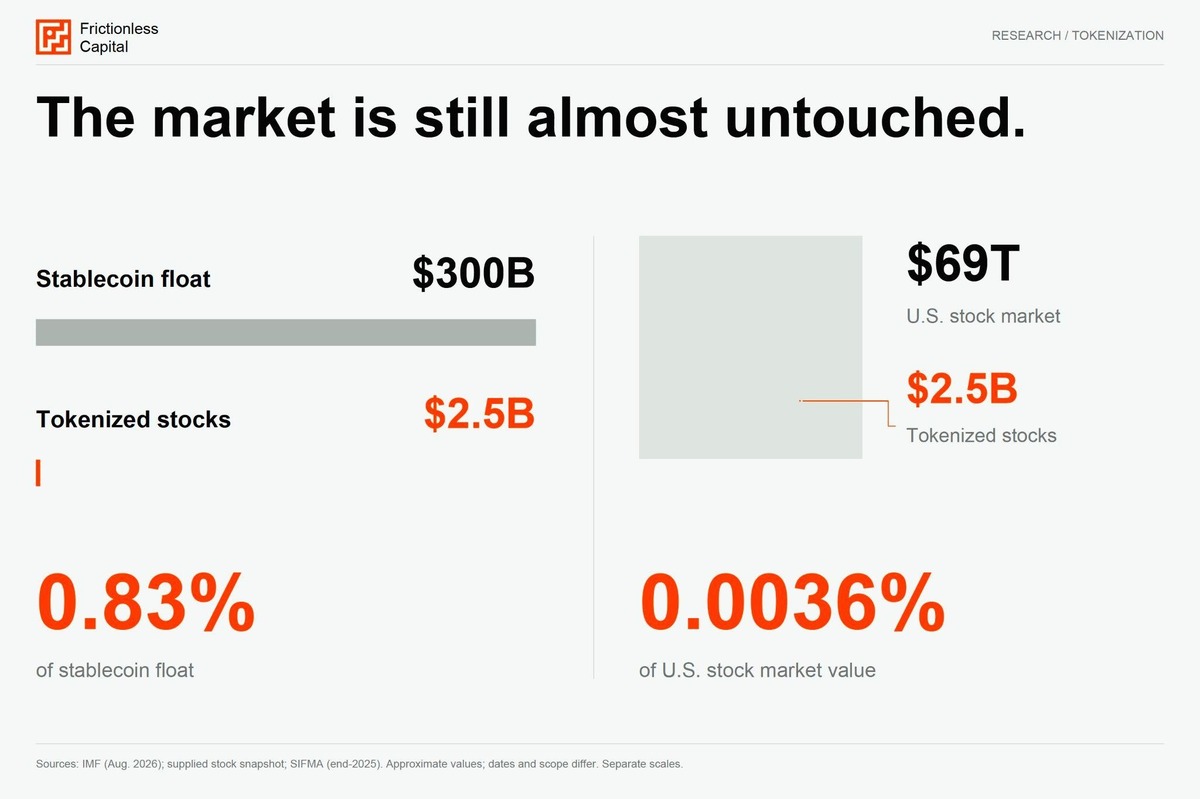
Digital dollars already minted: ~$300 billion. All tokenized stocks globally: ~$2.5 billion, less than 1% of the former. Total U.S. stock market cap: $69 trillion, with tokenized stocks comprising less than 0.01%!
So if this is the game, who are the players, and how do they win?
By creating a distribution channel scaled 100x larger for anyone with an internet connection, tokenized stocks are poised to become one of the biggest opportunities across the entire financial sector in the coming years. As we examine how the dollar won this race, Tether and Circle demonstrate that those reaping the most revenue are precisely the ones controlling the minting and redemption gates. Not traders, nor payers, but licensed players controlling the entry point. Positioning a company at the door where minting and redemption occur allowed Tether to become one of the most profitable per-capita companies in history. The asset export of equities will deliver identical results for any company mastering the equivalent gateway for U.S. stocks.
Today, Backpack leads the securities tokenization race. There are four reasons why Backpack is winning, and why it will continue to dominate the export of U.S. capital markets (one of the largest opportunities across the entire financial sector).
Backpack Tokenized Stocks Are Redeemable for Physical Shares
To date, all attempts at tokenized stocks have used cash settlement. Meaning, when you want to redeem a tokenized Nvidia share, you receive cash equivalent at current value, not Nvidia Class A common stock. This approach has several severe issues. First, if you cannot convert tokenized shares into actual stock, you do not truly own the shares; you merely hold a claim on an offshore SPV without full rights and representation. Second, cash redemptions are taxable events, whereas physical redemptions (pioneered by Backpack) trigger no tax liability, since you are not selling for cash but swapping tokenized shares for common stock. It may sound like legal semantics, but the impact on trading volume and market structure is immense.
Backpack (physical redemption) holds approximately 4% of all outstanding tokenized stocks yet generates 64% of the trading volume, with zero incentive allocations. Its largest competitor, xStocks (cash settlement), holds 68% of the shares but contributes less than half the volume.
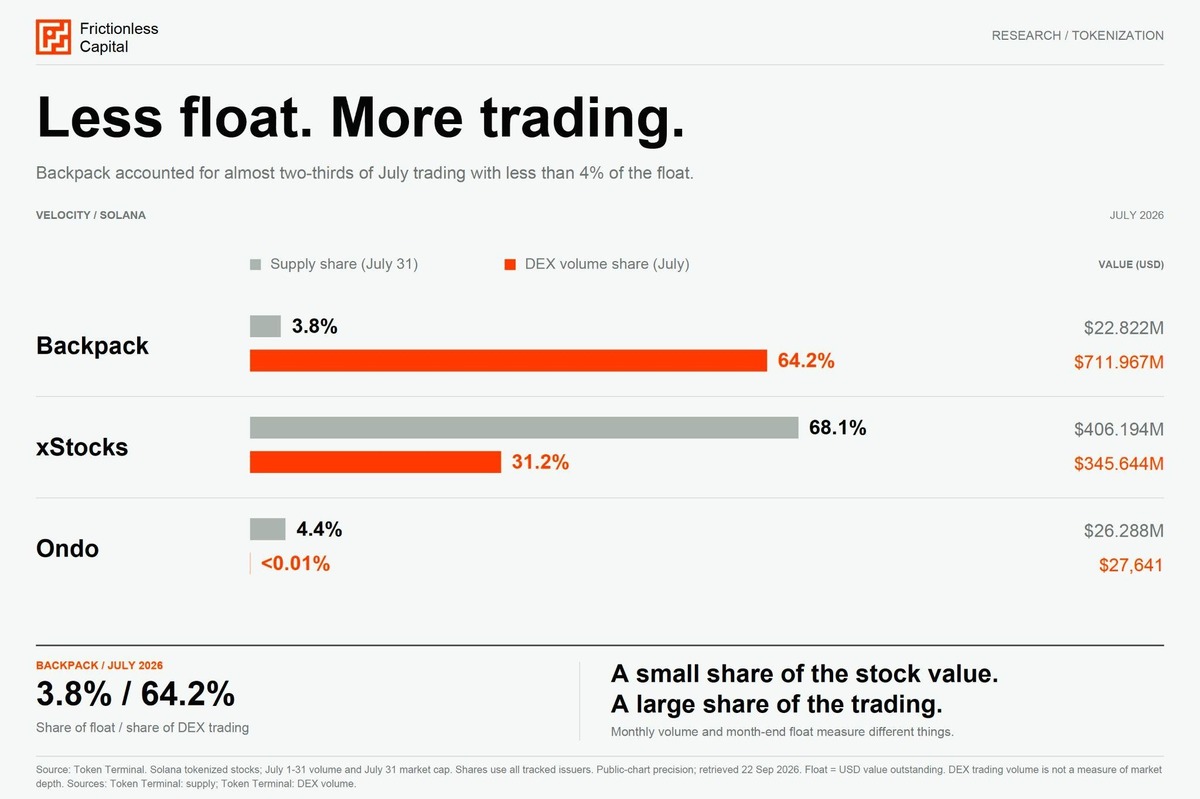
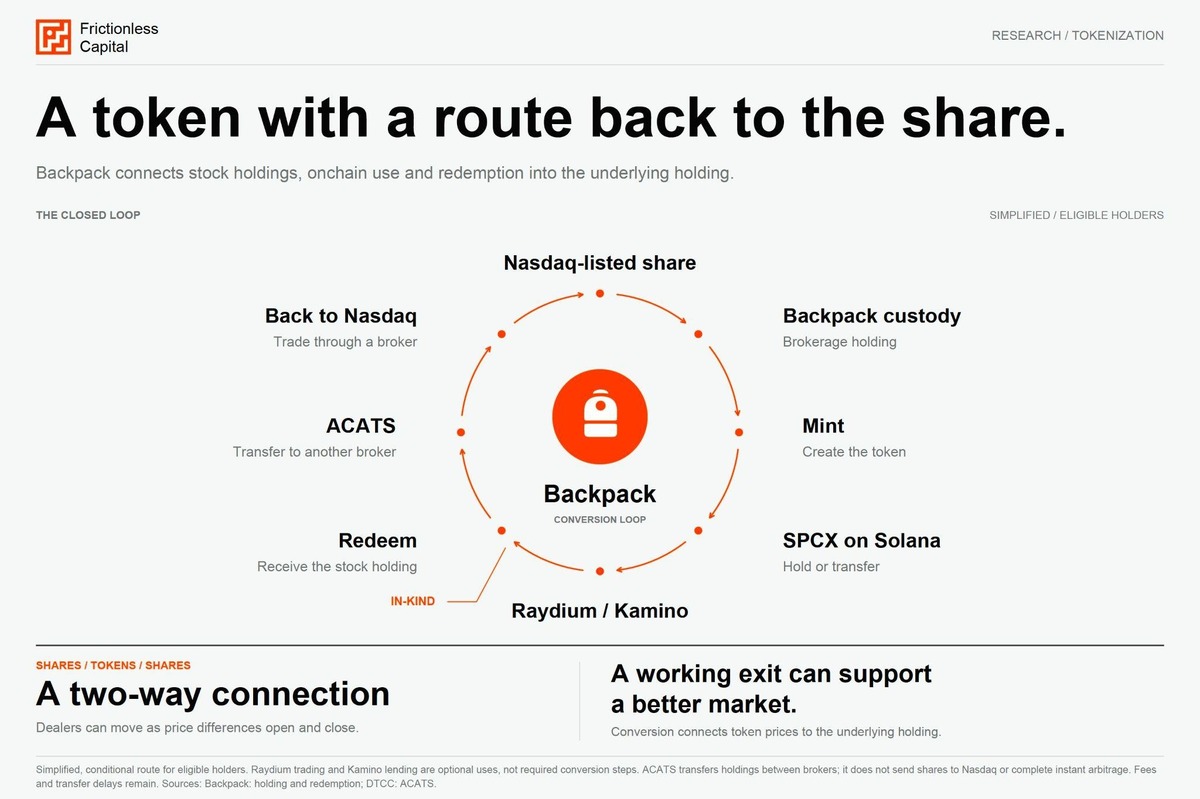
So why is every dollar in Backpack 30 to 1,000 times more efficient than at xStocks and Ondo? It starts with Backpack delivering physical shares rather than cash-settled receipts. Behind every Backpack SPCX token sits one genuine SpaceX share, held at a U.S.-regulated broker under New York state law, complete with dividends. Return the token, and you extract the actual shares, transferring them to another brokerage account without triggering a taxable event. Competitor SpaceX tokens only give you price exposure, nothing else, because your claim points to a shell entity in Jersey. You cannot transfer them to another broker because you do not own the underlying equity.
Before you observe its market impact, this might seem like a minor legal technicality. When you can swap tokens for real shares, you are no longer trapped holding paper that only redeems for a fixed amount of cash. Market makers already hold shares at brokerages, so providing them with a system to seamlessly move interchangeable risk units across total exposure allows them to quote tighter spreads and deeper liquidity without taking on massive adverse selection risk. In other words, when you can instantly swap tokens for physical shares during price deviations, redemption risk shrinks. On-chain prices cannot deviate far from Nasdaq because any deviation is free money for those holding exchange rights, and mature traders can mint and redeem to arbitrage, pulling prices back into alignment. This is why S&P 500 funds trade within a penny of their NAV.
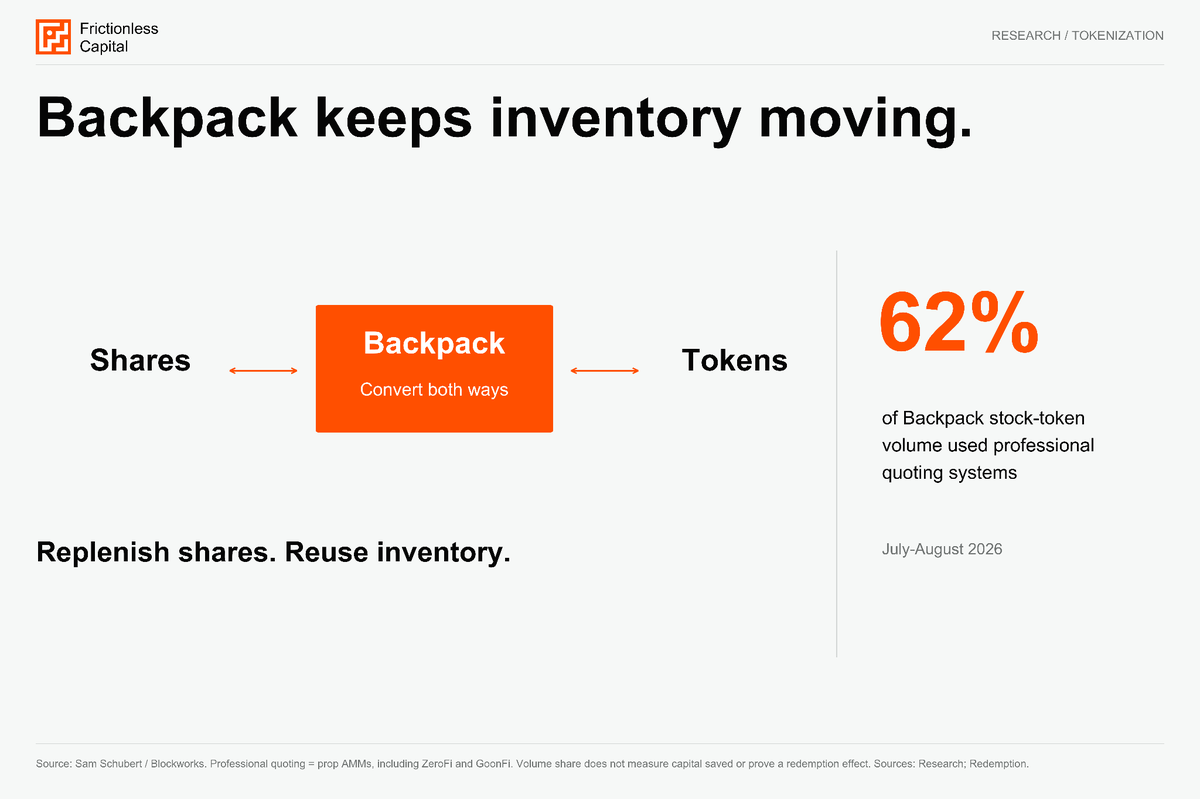
Thus, clean redemption mechanics and lower transaction costs drive volume, volume attracts more market makers, tighter spreads draw even more volume. This is the engine, compounding relentlessly. It explains why Backpack, holding just 4% of the shares, already processes two-thirds of the business. It appears straightforward, but it didn't happen overnight. Backpack secured U.S. brokerage licenses, followed compliance first, and built a product that executes this flawlessly.
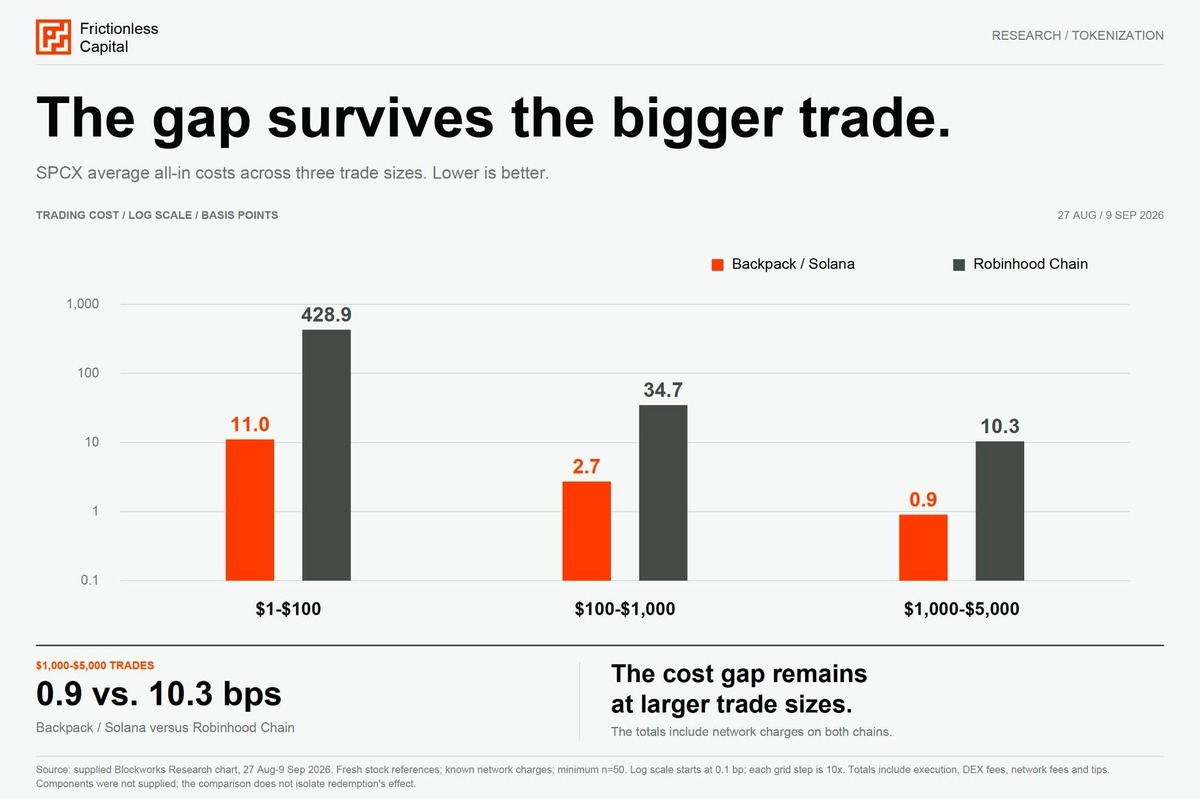
Looking at the full picture, the results are staggering. Trading tokenized stocks via Backpack Securities costs roughly 11x less than on-chain with Robinhood. Blockworks Research priced live orders over a two-week period in September. For a trade between $1,000 and $5,000, the cost on Backpack is 0.9 basis points, compared to 10.3 basis points on Robinhood’s native chain, where one basis point equals one-hundredth of a percent. On small orders, the gap widens to 11 bps (0.11%) versus 428.9 bps (4.29%).
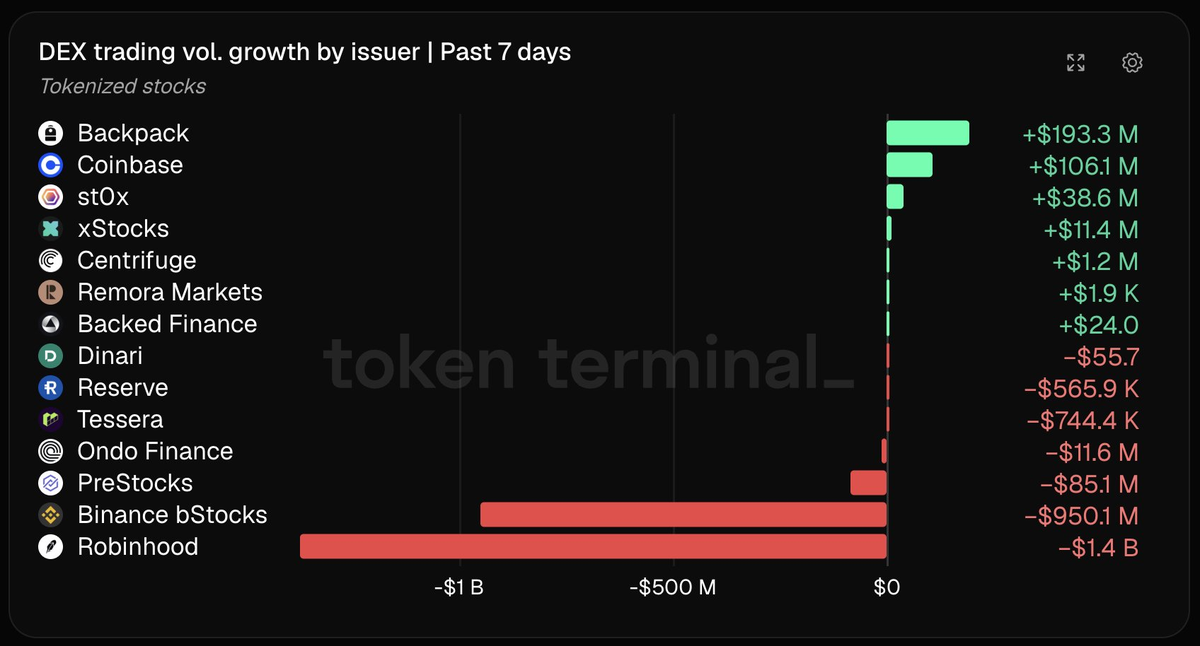
Capital notices these discrepancies, and markets rapidly shift along paths of least resistance and friction. In the past week (through Sept 18), Backpack gained $193 million in volume, while Robinhood lost $1.4 billion and the Binance version lost $950 million.
Yet, there is another reason Backpack leads tokenization, one that competitors find nearly impossible to replicate.
Backpack Offers Unified Margin Across All Assets, Including Equities
Minting and redeeming shares with the cleanest redemption architecture is one thing, but once equities exist, the question shifts: what else can you do with them beyond trading? On Backpack, you can use stocks as collateral to do much more, something unavailable anywhere else globally. If you open accounts almost anywhere else, your capital is siloed into separate boxes. Equities sit at brokers. Crypto lives on exchanges. Stablecoins reside in wallets. Futures occupy their own accounts funded with your own cash. Each box holds its own collateral and idle balances, moving capital between them takes days. In other words, your funds and assets are disconnected, forcing you to juggle five to seven apps to manage your finances.
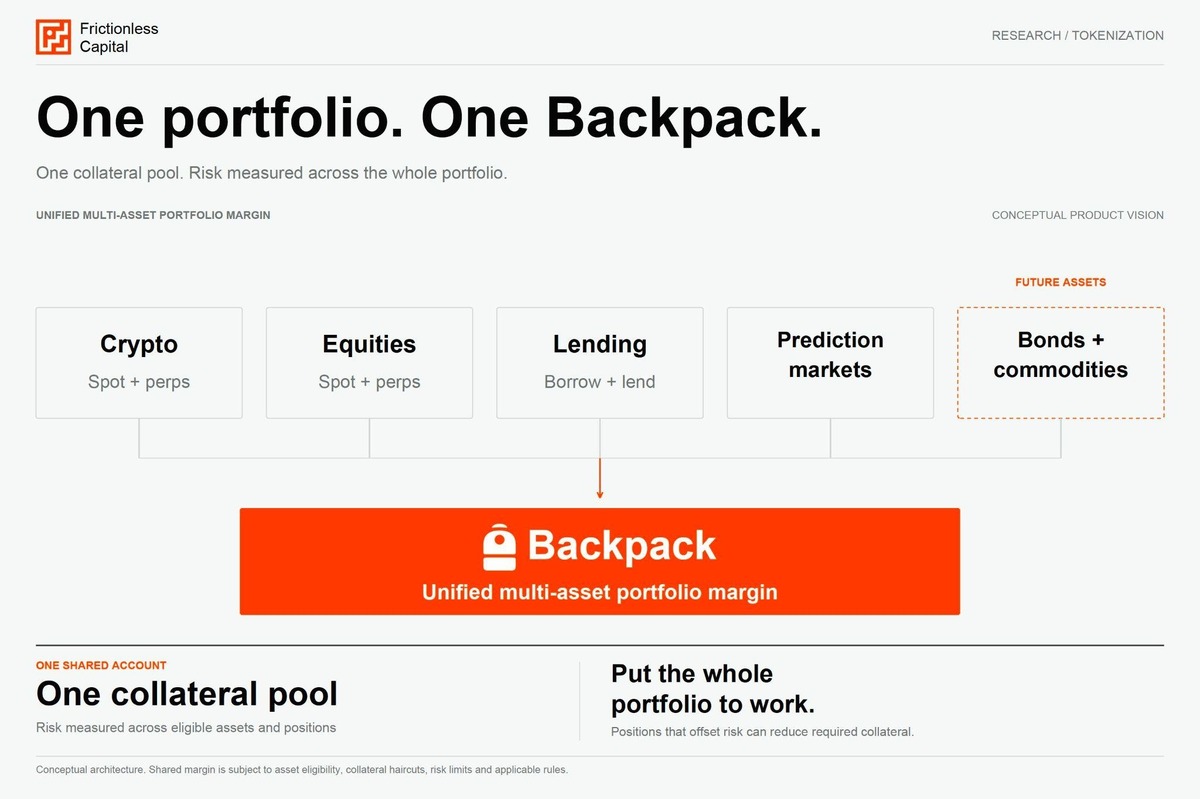
Conversely, Backpack operates a single account backed by a unified collateral pool. Your Nvidia shares act as margin for Bitcoin trades. Unrealized profits earn lending yields while positions remain open. Your stablecoins can be borrowed without being sold. Nothing needs to be sold, wrapped, or transferred before your next trade. No U.S. bank or brokerage can offer this, and there is a legal reason. U.S. law spent fifty years splintering these functions across exchanges, clearinghouses, vaults, transfer agents, and broker-dealers, each operating as separate regulated entities. Every legacy institution inherited these walls. Backpack builds from first principles, eliminating these barriers to deliver a superior net experience for users.
This same philosophy now targets liquidity. One Nvidia share trades in a New York pool, another in London, the tokenized version in a third on-chain pool, futures contracts elsewhere, each holding isolated capital unaware of the others. Backpack is funneling them into a unified global order book where equities, tokens, futures, and paying stablecoins all clear against the same collateral pool. Instead of splitting liquidity five ways, Backpack is building a hyper-scale tokenized complex boasting complete capital efficiency and asset control.
While competing exchanges play regulatory arbitrage games by delaying KYC for as long as possible, Backpack has consistently secured the necessary licenses to support capital market exports and serve a global audience. As the U.S. relaxes oversight of on-chain securities trading, this commitment to legal compliance grows increasingly vital, forming the core differentiator between Backpack and institutions attempting makeshift pivots to catch the wave.
Backpack Intentionally Chose Global Expansion Before Entering the U.S.
The brokerage and exchange landscape is fragmented among regional players. Robinhood, Coinbase, and Schwab are all U.S. companies expanding outward, carrying American rules globally. Binance is an offshore entity attempting to return to the U.S. Backpack’s approach is highly intentional: serving the majority of the globe first, then returning stateside. Backpack’s licenses were acquired in parallel rather than sequentially: purchasing FTX’s European subsidiary for $32.7 million to secure a MiFID II license (the standard authorization granting European banks stock trading rights), alongside a Dubai full-market license, Japanese exchange membership, an Australian license, and a U.S. brokerage license with direct access to American clearing systems.
Its 24/7 equity product serves over 150 countries and is deliberately withheld domestically in the U.S. This strategy yields several subtle advantages.
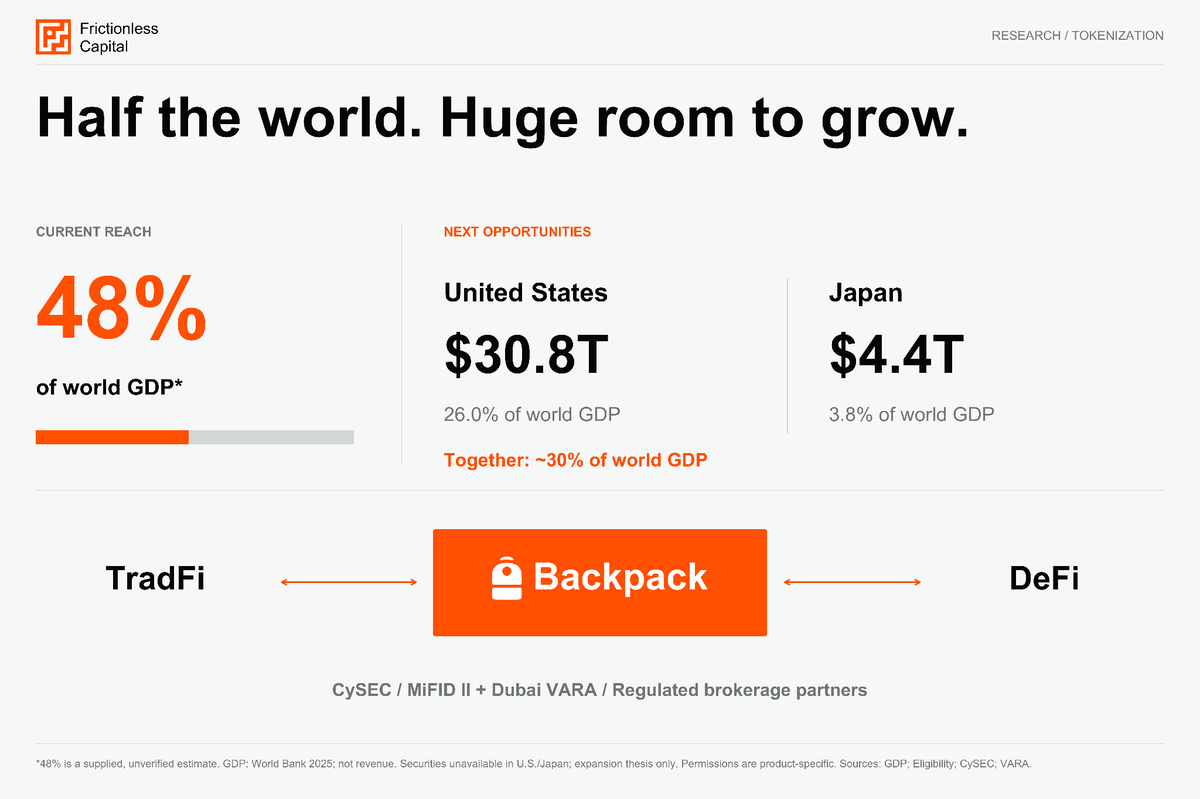
GDP-wise, Backpack currently services only 48% of the global market legally, but this figure will rise dramatically once the U.S. and Japan—the world’s two wealthiest economies—join.
Currently, 55% of tokenized stock trades occur outside regular U.S. market hours, meaning pricing happens continuously where no traditional exchange operates. This is a market that did not exist three years ago. Even if the NYSE transitions to 23/5 trading in the coming months, weekends still lack spot 1:1 trading products that allow investors to express views when markets are closed.
Backpack’s strategy of launching futures before tokenized equities proves crucial, as derivatives are what keep pricing active during off-hours. Futures contracts generate continuous prices, and round-the-clock pricing is exactly what a broker requires to value stock collateral at 2 AM on a Saturday. Today, listing a new stock futures contract automatically unlocks the corresponding underlying equity as eligible collateral. As of Sept 17, all 17 listed stocks qualify.
Backpack Has Built a Fully Integrated Tokenization Engine
One of the most critical distinctions among tokenized stock issuers lies in their chosen degree of vertical integration. Backpack consolidates security issuance and redemption, spot and futures exchanges, and self-custody wallets within a single ecosystem. This enables Backpack to issue tokens, provide trading venues, and control the interfaces customers use to trade and utilize those tokens. An order-of-operations moat exists here: without futures products, there is no reference pricing for the underlying asset after hours. Supporting a single tokenized stock end-to-end—from issuance to after-hours trading—in a unified spot-futures margin account is a unique offering in the market.
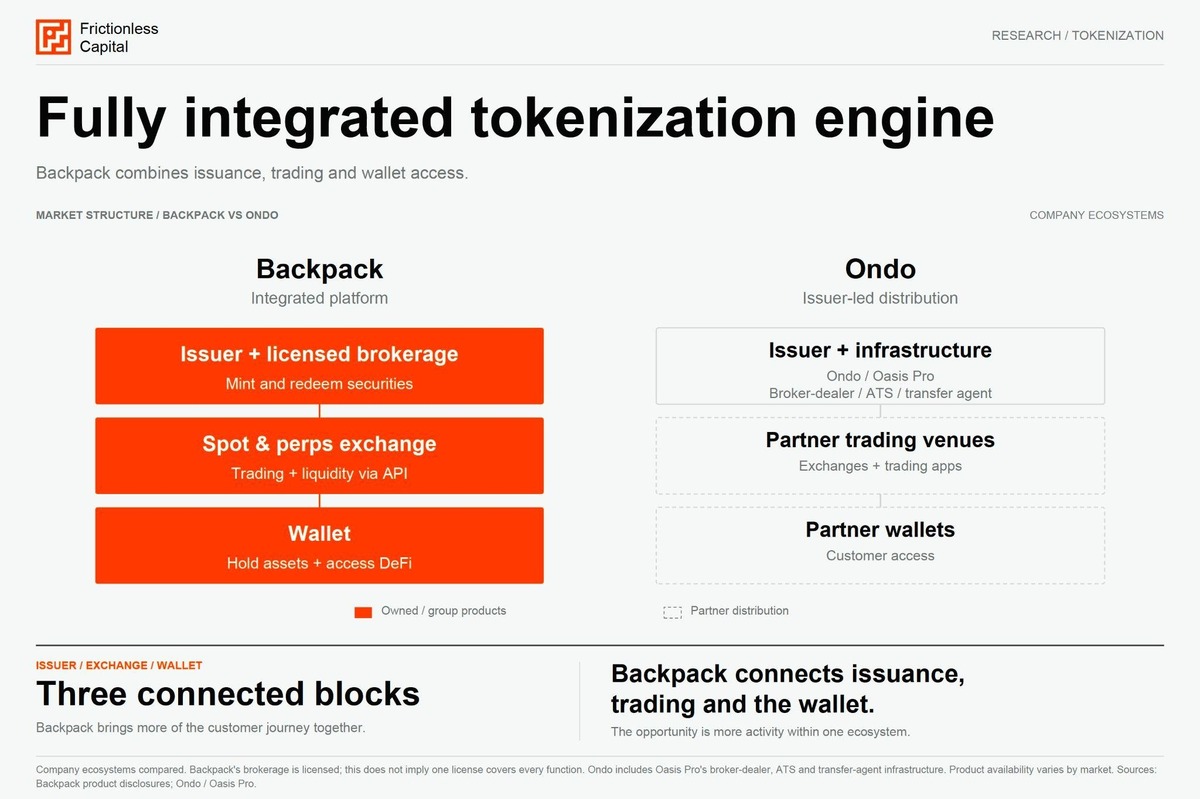
This advantage also shows in speed of integration and listings. On the day of the SpaceX launch, three issuers rolled out tokenized SpaceX sequentially within hours. Backpack generated $37 million in the first 7 hours and $108 million on day one, crossing 10,000 holders within six days—roughly double that of xStocks. This comes down to execution speed: Backpack required only a single listing decision. Ondo, by contrast, must make the decision, then coordinate with exchanges, DEXs, and wallet launch partners. In a launch-day environment where every hour matters, minimizing dependency chains is paramount.
Blockchain represents the final puzzle piece in this system and the only component Backpack chooses rather than builds from scratch. Solana boasts not only the most advanced market microstructure but also captures the vast majority of on-chain application revenue in the industry. This means companies like Phantom, Pump.fun, and Raydium can plug directly into Backpack’s minting and redemption APIs out of the box, scaling their own operations accordingly. As a platform, Solana’s real volume (excluding voting) exceeds the aggregate of all other networks combined. This infrastructure proved its resilience in January 2025 when $TRUMP launched, handling trading volume equivalent to 45% of a single NYSE session without downtime or median fee spikes. This battle-tested infrastructure tier is unmatched across rival networks, making it ideal for scaling tokenized equity distribution. High-performance networking combined with a regulated tokenized issuance and trading frontend, plus applications acquiring users through UGC flywheels creates an exceptionally potent combination that is being validated in real-time.
Where Does the Market Go From Here?
It is highly likely that two or three companies will ultimately secure the critical chokepoint for U.S. capital market securities, much like Tether and Circle eventually monopolized the dollar’s critical pathway. That layer operates as a toll road. It earns traffic fees rather than float interest, but undeniably, it compounds with every new asset that crosses it.
Backpack is currently positioned favorably to become one of them. Based on current evidence, it is already the largest in both price discovery and trading volume. Holding less than one-twentieth of the outstanding shares, it commands two-thirds of the volume, while licensing spans over 150 countries—jurisdictions inaccessible to incumbent giants unless they dismantle and rebuild themselves from the ground up.
If this sounds like a bold projection, consider recalling how the previous American export product unfolded (the dollar): stablecoins function as the new Eurodollars, scaling to $300 billion in float in under a decade. Tokenized equities represent the next leg of the journey, currently sitting at a $2.5 billion footprint today. You don’t need genius (no pun intended) to predict the trajectory. In fact, tokenized stocks are merely Backpack’s inaugural entry into the tokenization market; the licenses this company holds are sufficient to extend the concept far beyond equities into commodities, FX, fixed income (bonds), structured products, and even real estate. Dollarization is already accelerating, and equity valuations dwarf monetary supply, meaning the upcoming tokenization wave will likely dwarf stablecoin adoption in both scale and velocity.
In summary, Backpack is not merely participating in crypto, fintech, or RWA protocols. We stand at the dawn of exporting capital markets via the internet, and Backpack is positioning itself as the equity-equivalent of Tether or Circle, possessing the licenses and products to seamlessly tokenize all other securities. The winners of this era will not be those marketing themselves into trending narratives, but the player that scales, efficiently tokenizes, and distributes every Wall Street product globally. Backpack holds the licenses, compliances, and is producing the metrics to substantiate this claim. Reviewing the fintech landscape over the past fifteen years, most merely rebuilt regional capital markets on industrial-era rails using improved frontends. The opportunity now is exponentially larger. In the internet capital market era ushered in by evolving U.S. regulatory stances, Backpack is the first of its kind natively servicing global capital markets on internet rails, aimed at every individual with a smartphone. This segment of finance has never operated at a global tier. Cryptocurrency is the only technology capable of realizing a globally native internet finance era. It is a silent redraw of the board; a new game has begun, and we are investing in the most fascinating epoch in the history of finance and markets.
Join TechFlow official community to stay tuned
Telegram:https://t.me/TechFlowDaily
X (Twitter):https://x.com/TechFlowPost
X (Twitter) EN:https://x.com/BlockFlow_News
 @_Frictionless_