Under the SEC's new rules, can the crypto industry relearn how to create assets?
Author: Meng Yan
Compiled by: TechFlow
TechFlow Preview: The SEC’s newly released regulatory proposal on crypto assets outlines a concrete pathway for projects to raise capital legally from zero to one and ultimately escape the constraints of securities law. If the crypto industry continues to lose its capacity to create native assets, existing tokens along with Bitcoin and Ethereum will gradually lose vitality. This proposal may determine where the next round of crypto innovation and compliance dividends will begin.

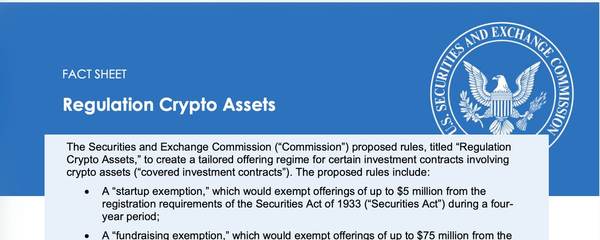
The SEC has just released a key proposal, Regulation Crypto Assets. This is not a principled declaration, but a complete set of specific rules attempting to answer one question: how exactly should a crypto project legally raise funds, grow, and ultimately detach from securities regulation from the ground up?
I quickly reviewed the datasheet on the SEC’s official website, summarized its main points, and offer the following commentary:
I. Main Content of the Proposal
The core of the proposal consists of two exemptions plus one safe harbor. First, the startup exemption, allowing up to $5 million in funding over four years. Second, the fundraising exemption, split into two tiers: Tier 1 allows up to $20 million within twelve months, and Tier 2 allows up to $75 million within twelve months. Third, the investment contract safe harbor, under which the SEC will determine that a project’s token no longer constitutes an investment contract once certain conditions are met, completely removing it from securities law jurisdiction.
The design logic behind the Startup Exemption is clear: it grants project teams a regulatory buffer period to complete the development work promised in their whitepaper. Conditions include a four-year term, single-use eligibility, a $5 million cap, public narrative disclosures on the official website, and filing Form NOR with the SEC. This path does not require financial statements, permits public solicitation, allows sales to retail investors, and imposes no resale restrictions on the tokens. Issuers can be individuals or teams, and there is even no requirement to register a legal entity, making this highly favorable for early-stage development teams with limited resources.
The Fundraising Exemption draws from the Regulation A framework but incorporates targeted adjustments. Issuers must file Form 1-CRYPTO on EDGAR, disclosing financial conditions and statements, with Tier 2 requiring an audit. In exchange, projects gain access to larger funding amounts alongside ongoing reporting obligations. The two exemptions are not mutually exclusive; a project can initially leverage the Startup Exemption before transitioning to the Fundraising Exemption to scale up.
The Safe Harbor represents the endpoint of this entire framework. Once a project completes or permanently abandons the core managerial efforts promised in its whitepaper, and ceases making new commitments, it may file Form TR accompanied by an analytical explanation. The SEC will thereby recognize that the investment contract has been extinguished and the token itself is no longer a security. The asset truly completes its transformation from a fundraising instrument to a freely tradable commodity.
II. Significance
This proposal warrants serious attention only when viewed against a broader timeline. Following the collapse of FTX in 2022, the crypto industry effectively lost its capacity to incubate high-quality new assets. Almost all top-ranked assets by market capitalization today were born prior to 2022. Regulatory uncertainty has de facto closed compliant financing pathways in the United States, forcing new projects either to relocate overseas or abandon compliance altogether.
If an asset market experiences prolonged stretches without new assets being born, older assets will gradually lose vitality. Liquidity will dry up, narratives will grow stale, and incremental capital will lack new vessels to absorb it. For a period after 2023, the crypto industry hoped to sidestep the challenge of creating new assets by layering novel mechanics onto established ones, but the bear market persisting since late 2025 has already vetoed this approach. Unless the crypto industry can itself generate new assets more attractive and dynamic than traditional stocks, legacy crypto-native assets like Bitcoin and Ethereum will continue to wane.
The Clarity Act delineates responsibilities at the market structure level, while the SEC’s proposal provides a concrete pathway at the financing level. Both converge on a single objective: rebuilding the channel to incubate new assets from zero to one.
III. Industry Background
To add a more sobering backdrop: the entire crypto industry is undergoing an unprecedented great filter, with widespread industry expectation that over 95% of projects will eventually go to zero. Meanwhile, RWA has quietly emerged as the primary driver of on-chain trading growth. Behind this data lies an uncomfortable truth: the industry is acknowledging that its ability to create high-quality native assets has dried up, pivoting instead to attach itself to traditional assets and operating as a leveraged ancillary market.
This should not be crypto’s destiny. This positioning fails to leverage the technical and economic advantages inherent to crypto and tokenomics. Tokenization should never merely amount to coating real-world assets with an on-shell veneer. The industry must regain its capacity to create native assets—that is precisely where the true value of this proposal lies, as it at minimum reopens this door at the institutional level.
If this path proves viable and the crypto industry eventually regains its capacity to create new assets, we can envision many emerging projects—including those in AI and robotics—launching via crypto mechanisms. They would build a solid foundation under regulatory oversight, complete the asset creation process, and once the fundamental quality of the assets is proven, scale up on platforms such as Coinbase, Binance, and OKX. The overall standardization of the industry would improve, reducing fraud, though speculative activity may not necessarily decline.
IV. Hypothetical Pathway for a Startup
Consider a hypothetical startup, Xyz, and examine which pathways it could pursue once the proposal takes effect.
Stage Zero: The team first publishes principle-based disclosures modeled after a whitepaper on its official website. This step must be completed prior to any token distribution.
Path One: Leverage the Startup Exemption. Submit Form NOR, committing to complete the promised development work within four years, with cumulative funding capped at $5 million (including airdrops, staking rewards, and testing fees). Financial statements are not required, public solicitation is permitted, direct sales to retail investors are allowed, and tokens face no resale restrictions. This path can only be used once, and upon expiration of the four-year term, Form TR must be filed to conclude the process.
Path Two: Leverage the Fundraising Exemption. If Xyz requires larger-scale capital or wishes to bypass the seed stage for direct scalable fundraising, it can file Form 1-CRYPTO to access the Tier 1 $20 million limit or Tier 2 $75 million limit. Tier 2 requires audited financials, and projects may conduct test-the-waters evaluations to gauge interest prior to fundraising. The two paths can be sequenced: start with the Startup Exemption, then transition to the Fundraising Exemption to scale operations after product-market fit is achieved.
Destination: Safe Harbor. Once Xyz has genuinely completed its promised development work, or voluntarily and permanently abandons commitments to further development, it files Form TR accompanied by an analytical statement. Upon the SEC’s determination that the investment contract is extinguished, the token transforms into a standard non-security crypto asset, eliminating the need for registration and ongoing reporting. Secondary market transactions will also be exempt from state securities law registration requirements due to the definition of qualified purchasers.
V. Impact of the Clarity Act
Finally, consider the implications of the Clarity Act. In early August, the bill cleared procedural voting to move the motion into formal debate, but the final floor vote was postponed until mid-September, leaving its ultimate passage uncertain.
If the Clarity Act ultimately passes, it will establish a spot market regulatory framework for mature digital commodities at the CFTC level, complementing the SEC’s proposal through clear division of labor. The SEC’s rules address the journey of tokens from zero to one, covering fundraising through to the detachment of securities attributes, while the Clarity Act resolves how mature tokens circulate in regulated trading venues. The two function as a relay race rather than an overlap. Should the Clarity Act remain shelved, projects can still complete fundraising and reach the safe harbor using the SEC’s proposal alone, but the regulatory jurisdiction for secondary markets and trading venues will remain in a gray area.
Join TechFlow official community to stay tuned
Telegram:https://t.me/TechFlowDaily
X (Twitter):https://x.com/TechFlowPost
X (Twitter) EN:https://x.com/BlockFlow_News
 Yan Meng