Under the SEC's New Regulations, Can the Crypto Industry Relearn How to Create Assets?
By: Meng Yan
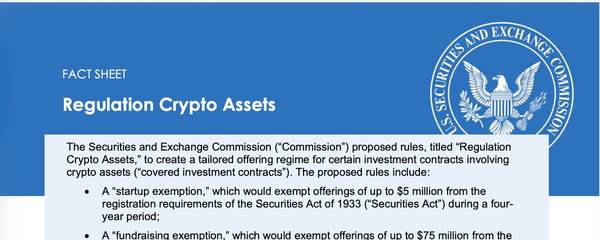
The SEC has just released a key proposal, Regulation Crypto Assets. This is not a statement of principles, but a complete set of specific rules attempting to answer a question: How should a crypto project legally finance, grow from zero to one, and ultimately escape the scope of securities regulation?
I quickly read the datasheet on the SEC official website, summarized its main content, and commented as follows:
I. Main Content of the Proposal
The core of the proposal is two exemptions plus one safe harbor. First, startup exemption, raising up to $5 million within a four-year period. Second, fundraising exemption, divided into two tiers, Tier 1 up to $20 million within twelve months, Tier 2 up to $75 million within twelve months. Third, investment contract safe harbor, after the project meets the conditions, the SEC determines that its tokens no longer constitute an investment contract, completely escaping securities law jurisdiction.
The design logic of the startup exemption is clear: give the project team a regulatory buffer period to complete the development work promised in the whitepaper. Conditions include a four-year term, one-time use, a $5 million cap, public principled narrative disclosure on the official website, and filing Form NOR with the SEC. This path does not require financial statements, allows public solicitation, allows sales to retail investors, and tokens are not subject to resale restrictions. The issuer can be an individual, a team, or even does not need to register an entity, which is quite friendly to development teams with limited resources in the early stage.
The fundraising exemption references the framework of Regulation A, but with targeted adjustments. Issuers need to submit Form 1-CRYPTO on EDGAR, disclosing financial conditions and financial statements, with Tier 2 requiring an audit. In exchange, there is a larger financing quota and ongoing reporting obligations. The two exemptions are not mutually exclusive; projects can start with startup exemption and later use fundraising exemption to scale up.
The safe harbor is the endpoint of the entire system. Once the project completes or permanently abandons the core managerial efforts promised in the whitepaper, and no longer makes new commitments, it can submit Form TR with an analytical explanation. The SEC thereby determines that the investment contract has been extinguished, and the tokens themselves are no longer securities. The asset truly completes the transformation from a fundraising target to a freely tradable commodity.
II. Significance
This proposal is worth taking seriously only when viewed on a longer timeline. After the FTX collapse in 2022, the crypto industry essentially lost the ability to incubate high-quality new assets. Almost all assets ranking high in market cap today were born before 2022. Regulatory uncertainty effectively closed compliant financing paths in the US; new projects were either forced to go overseas or simply gave up on compliance.
If an asset market has no new assets born for a long time, old assets will gradually lose vitality. Liquidity will dry up, narratives will become outdated, and incremental funds will have no new objects to absorb them. For a period after 2023, the crypto industry once hoped to evade the challenge of creating new assets by overlaying new gameplay on old assets, but the bear market lasting from the end of 2025 to the present has vetoed this. If the crypto industry itself cannot create new assets more attractive and vibrant than stocks, old-school crypto native assets like Bitcoin and Ethereum will also decline day by day.
The Clarity Act divides rights and responsibilities at the market structure level, while this SEC proposal provides specific paths at the financing level; both point to the same goal: reopening the channel for incubating new assets from zero to one.
III. Industry Background
Adding a sterner background. The entire crypto industry is undergoing an unprecedented great filter, with industry consensus expecting over 95% of projects to eventually go to zero. Meanwhile, RWA has quietly become the mainstream driver of on-chain transaction growth. Behind this data is an uncomfortable fact: the industry is admitting that its ability to create native high-quality assets has dried up, turning instead to relying on traditional assets to make a leveraged side market.
This should not be the fate of crypto. This positioning does not leverage the technical and economic advantages that crypto and tokenomics should possess; tokenization should not just be adding an on-chain shell to real-world assets. The industry must regain the ability to create native assets; this is where this proposal is truly worth attention, as it at least reopens this door at the institutional level.
If this path works out and the crypto industry restores its ability to create new assets in the future, then we can envision that many new projects, including AI, robotics, etc., can launch using crypto methods, build a solid foundation under regulation, complete asset creation, and then scale up on platforms like Coinbase, Binance, OKX, etc., after the asset's basic quality passes muster. The standardization level of the entire industry will be improved, reducing fraud, but not necessarily reducing speculation.
IV. Path Envisioned for a Startup
Envision a startup company Xyz, and see which paths it can take after the proposal is implemented.
Phase Zero, the team first hangs the whitepaper-style principled disclosure on the official website; this step must be completed before any token distribution.
Path One, take the startup exemption. Submit Form NOR, promise to complete the promised development work within four years, cumulative financing not exceeding $5 million, including airdrops, staking rewards, and testing fees. No financial statements required, public solicitation allowed, can be sold to retail investors, tokens have no resale restrictions. This path can only be used once, and Form TR must be submitted to close the project upon expiration of the four-year term.
Path Two, take the fundraising exemption. If Xyz needs larger-scale funds, or wants to skip the seed stage and do scaled financing directly, it can submit Form 1-CRYPTO, going for Tier 1's $20 million or Tier 2's $75 million quota, Tier 2 requires audited statements, and before financing, it can also do test the waters to gauge interest. The two paths can be used in combination sequentially: start with startup exemption, then use fundraising exemption to scale up after the product is proven.
The endpoint is safe harbor. When Xyz truly completes the promised development work, or voluntarily and permanently abandons the commitment to continue development, submit Form TR with an analytical explanation. The SEC determines the investment contract is extinguished, tokens become ordinary non-security crypto assets, no longer requiring registration and ongoing reporting, and secondary market transactions are also exempt from state securities law registration requirements due to the definition of qualified purchasers.
V. Impact of the Clarity Act
Finally, adding the impact of the Clarity Act. The Clarity Act completed the procedural vote for the motion to enter the legislative procedure in early August, but the final floor vote was postponed to mid-September, and whether it can pass remains uncertain.
If Clarity is ultimately passed, it will establish a spot market regulatory framework for mature digital commodities at the CFTC level, forming a division of labor with this SEC proposal. SEC rules solve the process of tokens from zero to one, from fundraising to escaping securities attributes; Clarity solves the problem of circulation in regulated trading venues after tokens mature; the two are a relay rather than an overlap. If Clarity continues to be shelved, projects can still rely on this SEC proposal to complete financing and enter safe harbor, but regulatory attribution at the secondary market and trading venue level will continue to be in a gray area.
Join TechFlow official community to stay tuned
Telegram:https://t.me/TechFlowDaily
X (Twitter):https://x.com/TechFlowPost
X (Twitter) EN:https://x.com/BlockFlow_News
 Yan Meng