SEC Opens Legal Pathway for Crypto Projects to Issue Tokens: Will Not Make Investment Judgments for Investors, Only Requires Full Disclosure
Author: Byron Gilliam
Translated by: TechFlow
TechFlow Summary: The U.S. Securities and Exchange Commission has finally released its proposed rules for crypto asset regulation. At 402 pages long, the core principles are not complicated: let project teams clarify their terms, lay out the risks, and leave the rest to investors to decide. For crypto entrepreneurs, this may represent the first clear path to legally raise capital by selling tokens in the United States; for investors, disclosure standards will become a key tool for screening projects.
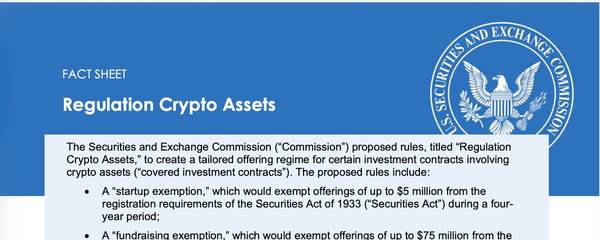
The Crypto Asset Regulation proposal is finally here. All 402 pages.
Luckily, you don't have to read it all.
The executive summary states: “The proposed issuance regime aims to facilitate capital formation and adapt to innovation in the crypto asset market, while ensuring investors receive adequate protection and the information necessary to make informed investment decisions.”
To “adapt to innovation,” the SEC has proposed two exemptions that allow new crypto projects to issue tokens to users and investors without violating securities laws.
This will be the part under the most scrutiny: crypto founders can finally raise funding by selling tokens. And they can do it in the United States!
To ensure U.S. investors “receive adequate protection,” the SEC proposes that anti-fraud provisions remain in effect regardless of whether an exemption applies, barring “bad actors” from participating.
That’s pretty straightforward: an exemption under securities law does not equal an exemption from other laws. Fraud remains fraud.
To provide investors with “the information necessary to make informed investment decisions,” the SEC proposes that issuers relying on either exemption must publicly provide “principles-based narrative disclosure.”
This is almost entirely the SEC’s mandate: ensure investors are fully informed, and then (most of the time) step aside.
Or at least, that should be its mandate.
Below is an excerpt from President Franklin D. Roosevelt’s message to Congress during the 1933 debates on how the federal government should regulate securities:
Of course, the federal government cannot and should not take any action that could be construed as approving or guaranteeing the soundness of newly issued securities—meaning guaranteeing that their value will be maintained or that the assets they represent will yield a profit.
However, we are obligated to insist that every new security sold across state lines must come with full public disclosure, and no material element related to the issuance may be withheld from the purchasing public.
This proposal builds upon the ancient principle of “caveat emptor” (let the buyer beware) by adding “seller responsibility.” It places the burden of telling the whole truth on the seller. It is intended to foster honest trading in the securities markets and thereby restore public confidence.
I recommend this legislation for the purpose of protecting the public while interfering as little as possible with honest enterprise.
In short, Roosevelt told Congress that the SEC should be built on the principle of “disclosure-based regulation”: it should primarily protect investors by ensuring they have the information needed to make informed decisions.
However, that was not the only approach at the time. Most states took the opposite route: “substantive regulation”—where regulators evaluated securities based on their perceived quality as investments.
For example, in Texas and Wisconsin, regulators could—and often did—block proposed securities offerings because they deemed them overpriced or otherwise unfair to investors.
In contrast, the SEC evaluates proposed offerings solely based on the quality and completeness of disclosures.
This light-touch approach was inspired by legal scholar Louis Brandeis. Writing in 1914, he argued that securities should be regulated like food. He explained that the Federal Pure Food and Drug Act does not guarantee food quality or price, but instead empowers consumers to judge quality themselves by requiring ingredient disclosure.
He believed the same applied to securities, provided the information is readily accessible:
To be effective, facts must truly reach the investor. The best way to achieve this is by requiring these facts to be stated in clear and conspicuous type in every notice, pamphlet, letter, and advertisement inviting investors to purchase. Compliance with this requirement should also be mandatory and non-waivable by the investor.
“Sunlight is said to be the best disinfectant,” he added, “electricity the most efficient policeman.”
When the SEC was established twenty years later, its first chairman, Joseph Kennedy, explained that it would follow Brandeis’s guidance:
Gentlemen, now, the Securities Act does not make the Government a judge of values. It gives no advice; it indicates no approval. You may ask: What does it do? The Act establishes a department where company executives must file information in response to prescribed questions. Before anyone asks you to invest in an enterprise, Washington must have a record of material facts that can guide your judgment.
Yet, the SEC has not always adhered to this founding principle.
In a 2024 speech, SEC Commissioner Hester Peirce accused the agency of straying from its original mandate to regulate through disclosure:
However, since the turn of the century, as we have expanded the rulebook at a record pace, the Commission’s regulatory approach has become increasingly prescriptive. Some of these prescriptions come from statute, but many are products of SEC discretion. Public companies face a growing list of disclosure rules. Some requirements seem intended to change how companies operate rather than elicit substantive disclosure.
She added: “Congress did not design the SEC to be a substantive regulator.” She concluded by urging the agency to return to its original disclosure-centric mandate.
Now, it is back.
The Crypto Asset Regulation proposal represents a return to the SEC’s founding principle: disclosure enables investors to assess risks for themselves.
Setting the Standard
The SEC’s proposal requires crypto projects selling tokens under the exemptions to provide disclosures, but does not mandate exactly how those disclosures must be structured.
It remains unclear whether the final rules will include specifications on how disclosures should be made. The Commission may opt to recognize standards developed by a trade organization, much as it does in accounting and compliance rules.
Either way, the Commission has an evolving industry initiative to draw from: Blockworks’ Token Transparency Framework (TTF)—the first open-source disclosure standard for digital assets.
Since its launch in June 2025, 75 protocols have voluntarily submitted standardized disclosure documents to the TTF.
TTF’s “B-1” is a one-time filing submitted around the time a token begins trading for the first time, similar to how companies file an S-1 before an IPO.
(In the photo above, Bob Woodward and Carl Bernstein are seen reviewing some B-1 filings.)
The B-2, meanwhile, is a filing submitted to keep information current, analogous to a company’s 10-K filing.
(“B-K” might sound too much like a burger code, I guess?)
69 industry participants—exchanges, custodians, and asset managers—have joined the Transparency Alliance. The group works with Blockworks to develop universal disclosure standards for digital assets.
Perhaps more importantly, these participants collectively hold a market capitalization exceeding $400 billion. They have already integrated TTF documents as a core input into their due diligence processes.
For asset managers, these documents are merely the starting point of the investment process. They still need to conduct their own research (as the saying goes).
Blockworks explains: “Each document assesses completeness, not quality.”
FDR would say this is exactly what we really need.
Join TechFlow official community to stay tuned
Telegram:https://t.me/TechFlowDaily
X (Twitter):https://x.com/TechFlowPost
X (Twitter) EN:https://x.com/BlockFlow_News
 Blockworks