Court Rules 3-0: Kalshi Sports Contracts Are Gambling; Renaming Makes No Difference
Author: Byron Gilliam
Compiled by: TechFlow
TechFlow Summary: Kalshi has consistently attempted to wrap sports prediction contracts under the guise of “swaps” to fit them into a federal regulatory framework, but the Ninth Circuit Court blew through this wordplay with a unanimous 3-0 ruling. If the decision stands, Kalshi’s core growth business will face state licensing requirements, taxes, and operational bans, significantly squeezing the regulatory arbitrage space for the entire prediction market industry. This case will determine whether “event contracts” are classified as financial derivatives or gambling.
Does renaming a bet make it something other than gambling?
On Friday, a panel of judges on the Ninth Circuit Court ruled unanimously 3-0 that Kalshi’s event contracts tied to sports constitute a form of sports betting.
This is almost an open-and-shut case. What else could buying an event contract on the total score of a football game be if not gambling?
Kalshi itself seems to agree:

In upholding Nevada’s ruling, the Ninth Circuit Court opened its opinion by citing the aforementioned post from Kalshi’s Facebook page. Judge Ryan Nelson wrote: “KalshiEX, LLC claims to be ‘the first legal sports betting app across all 50 states.’”
If there’s a case that can be decided in a single sentence, this seems to be it. Sports betting is regulated by individual states, and Kalshi claims to offer sports betting in all 50 U.S. states. Therefore, Nevada, as one of those states, has the authority to regulate Kalshi.
Case closed!
Jokes aside. The stakes for both sides are far too high for this to be the final word.
If Kalshi acknowledges that its sports-related event contracts constitute gambling, it will need to obtain licenses in each state, comply with varying state regulations, and pay state taxes. It would also have to halt operations in the 20 states where online sports betting remains illegal.
This poses an existential crisis for Kalshi: to date, its sports segment accounts for 72% of its total volume.
The stakes for Nevada are equally significant. The state imposes no personal or corporate income tax, with gaming taxes and fees accounting for approximately 17% of state revenue. The broader hotel-casino industry contributes an estimated 37%.
The average temperature in Las Vegas in July is 107 degrees Fahrenheit (approximately 41.7 degrees Celsius). No one would want to endure this hellish weather if they also had to pay income tax.
Therefore, whether sports betting on prediction platforms is merely sports betting, as the Ninth Circuit ruled, matters immensely.
Despite how tautological this sounds, the Third Circuit disagreed.
In April, the Third Circuit Court (located much farther from Nevada) sided with Kalshi’s argument that its event contracts qualify as “swaps”—financial derivatives exclusively regulated by the U.S. Commodity Futures Trading Commission (CFTC).
The Commodity Exchange Act defines swaps as “any agreement, contract, or transaction… contingent upon the occurrence, non-occurrence, or extent of the occurrence of an event or contingency… relating to a potential financial, economic, or commercial consequence.”
Take the game winner: Kalshi argues that the Seahawks winning the Super Bowl is a realized event.
Or the point spread. The Seahawks winning the Super Bowl by 15 points represents the “extent of the event’s occurrence.”
Thus, Kalshi contends that event contracts surrounding sports outcomes fall under swaps and should logically be regulated by the CFTC.
The Ninth Circuit responded that this defies common sense.
Judge Nelson wrote that in everyday language, the Super Bowl itself is the “event.” The Seahawks’ victory is the “outcome” of that event. (Winning by 15 points is a different outcome.)
The court ruled that contracts tied to event outcomes are wagers, regardless of what you call them.
Nelson wrote: “The sports event contracts offered on Kalshi’s designated contract markets (DCMs) are, in substance, sports wagering, regardless of whether Kalshi labels them as swaps.” (And he invoked Shakespeare’s rose.)
Real swaps serve a function beyond gambling: they hedge risk against events with real-world financial consequences—such as rising interest rates or falling stock prices.
In contrast, Nelson wrote that Kalshi’s event contracts “do not help institutions or investors hedge risk,” but instead “primarily create risks for retail consumers that did not previously exist.”
Creating risk where none existed before is precisely the definition of gambling—and what distinguishes it from investing, insurance, or hedging.
Kalshi notes that sports results do carry economic consequences beyond speculation. For example, a soccer team might bet against itself to hedge against the financial risk of relegation; similarly, a bar might bet on the Knicks to hedge against the risk of a beverage promotion flopping.
I can think of other examples, such as hotels hedging against the risk of the local team missing the playoffs.
But no business is naturally exposed to the financial risk of a team winning by 15 points rather than 10. Nor is it exposed to whether Taylor Swift attends the game or how long the national anthem lasts.
If Kalshi appeals the Ninth Circuit’s ruling, I suspect its defense will have to hinge on parsing the specific wording of the Commodity Exchange Act.
If so, some of the world’s most prominent judges may soon find themselves debating the distinction between an “outcome” and an “event.”
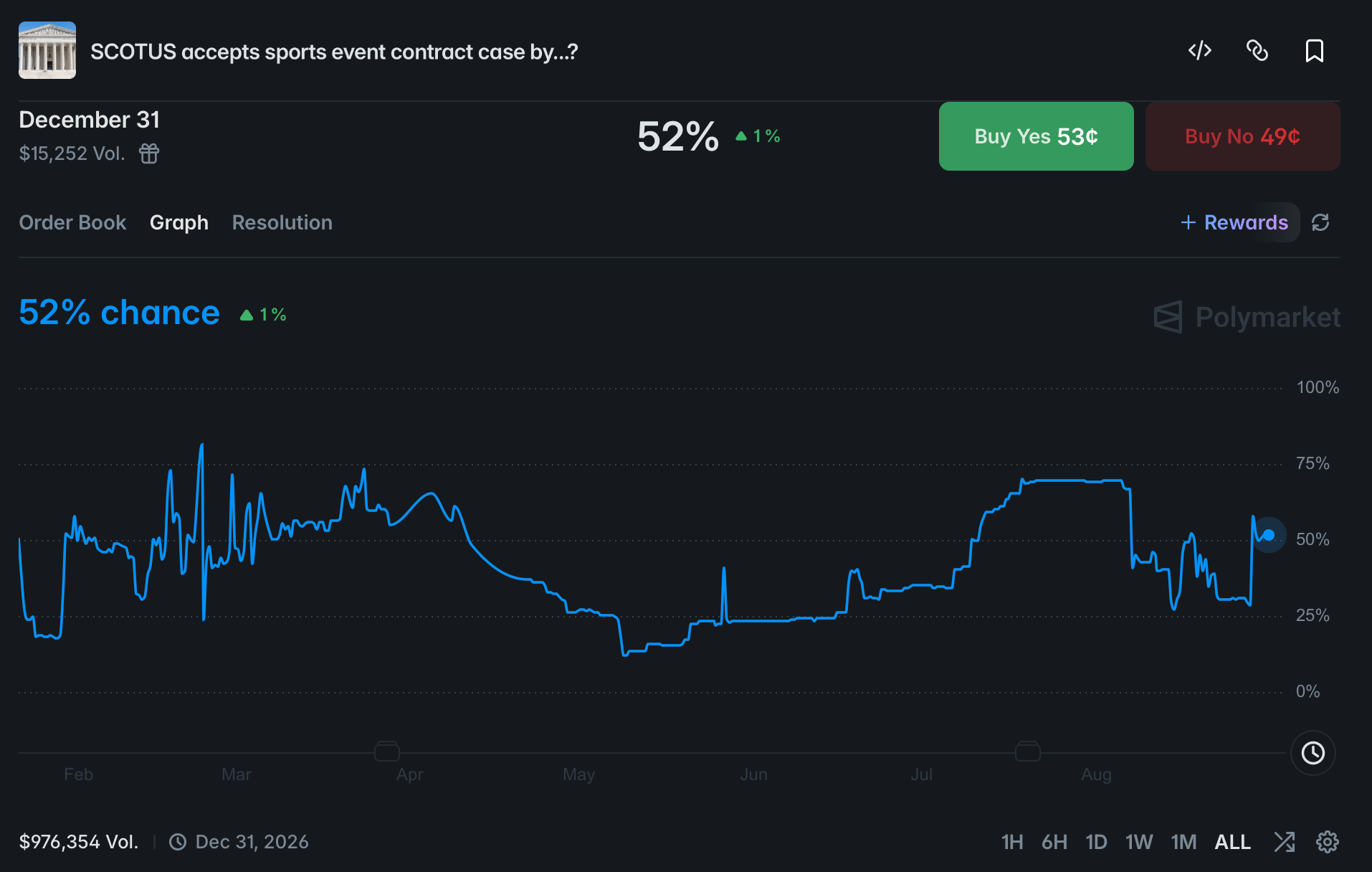
Odds on Polymarket indicate a 52% probability of this happening by the end of the year.
That’s what a swap really is.
(Kalshi doesn’t offer this.)
— Byron Gilliam
Join TechFlow official community to stay tuned
Telegram:https://t.me/TechFlowDaily
X (Twitter):https://x.com/TechFlowPost
X (Twitter) EN:https://x.com/BlockFlow_News
 Blockworks