Shenyu After Getting Obsessed With AI: Still Bullish on Bitcoin, Ethereum, and Tesla
Editor | PANEWS et al.
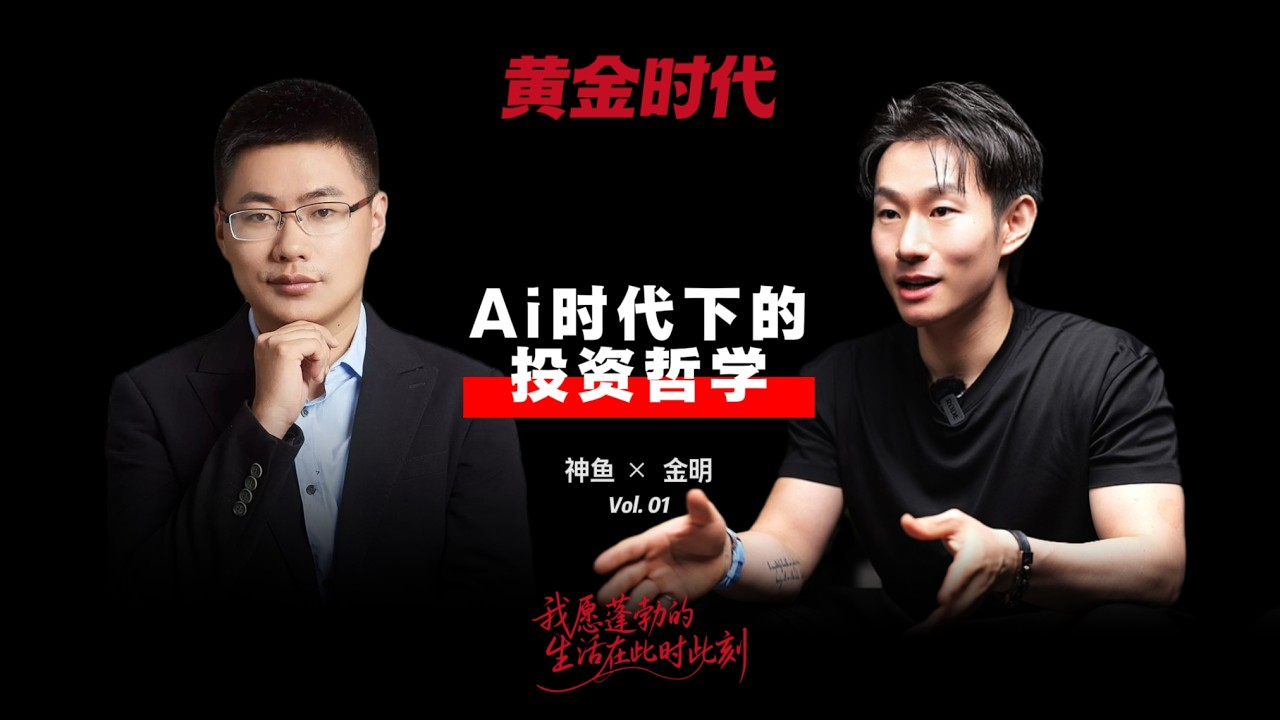
Recently, Cobo co-founder Shen Yu and Jilian Technology founder Jin Ming engaged in an in-depth dialogue covering AI, entrepreneurship, investment, Bitcoin, Web3, Agents, and life mission.
Shen Yu is an early participant in the crypto industry who entered the cryptocurrency field in 2011 and is among China’s earliest Bitcoin evangelists and practitioners; Jin Ming is a member of the Chinese national free-diving team and the founder of Jilian Technology, with years of focus on video AI technology R&D and commercial applications.
The following is an edited transcript of the interview:
Jin Ming: Your last interview was ten years ago, back in 2017. At that time, you famously said, “I had so much money, I didn’t know how to spend it at first.”
Shen Yu: Now I do. Essentially, I feel that human volition is becoming increasingly important. With the arrival of the AI era, many things that once required massive time and cost can now be built quickly as long as you have an idea. This shift is enormous. Things we wouldn’t have dared imagine ten or twenty years ago are now highly executable if you just have an idea, because backend execution costs have plummeted and many deliverables can be shipped rapidly. In the past, you’d have a seed of an idea or a dream, but it might remain nothing more than a dream. Now, with backend costs dropping so fast and AI compressing and structuring vast amounts of human knowledge into easily accessible capabilities, I feel like entire spaces of possibility have suddenly opened up.
Jin Ming: Are you satisfied with your current state of life? Do you feel happy and fulfilled on a daily basis?
Shen Yu: It’s okay, but there’s still some degree of uncertainty. Unlike when I first started my journey, when my sense of mission was incredibly strong. Lately, I’ve actually drifted into a more chaotic state: you see AI unlocking countless possibilities and think this is the best of times, yet you don’t see a particularly clear path forward. Whether it’s a guiding mission or a concrete business roadmap, I haven’t fully figured either out. So right now, I’m mostly exploring and focusing on self-improvement.
Jin Ming: When you first started your career, how did you define your sense of mission?
Shen Yu: Back then, recognizing a window of opportunity triggers a very strong creative impulse. You feel like if you don’t pursue this, you’ll regret it for the rest of your life. There’s almost a force pushing you forward that you can’t resist, so you just step out and do it. It actually started way back in 2013, centered around the computing power problem. Mining initially took place in the U.S. before gradually shifting to China. When China first began manufacturing ASIC miners, the machines still had to connect to U.S.-based mining pools to operate. There were two core issues here: first, network problems—international internet latency and packet loss severely hampered mining efficiency; second, the settlement methods across the mining industry were fundamentally flawed. What we did was solve both of these problems. Fundamentally, you spot a market gap—a niche with unmet demand—and realize you have the capability to fill it. That creates an overwhelming urge to build it.
Jin Ming: After all this time and reflection, what do you see as your mission now?
Shen Yu: I still believe it’s about building things. I’ve always defined myself as a Builder. Since the AI era began, I’ve put together quite a few tools and dashboards of varying scales, but I haven’t yet found something truly large-scale and systematic—I’m still observing. Actually, deep into entrepreneurship, being on the front lines and shipping so many things inevitably breeds confusion and doubt. So you’re forced to catch up on vast stretches of human history: How have similar phenomena unfolded before? How do philosophers approach these questions? All of this circles back to shape your perspective. Standing here and now, you can see numerous future possibilities unfolding, but you haven’t pinpointed the exact path yet.
Jin Ming: During my talk yesterday, I touched on “purpose awareness,” or a sense of life direction. I compared it to a scale. Many people start off wanting to create something big and leave a legacy; on the other end of the scale are experience and happiness. If placed on that scale, where would you say you are right now?
Shen Yu: I don’t feel a strong desire to leave anything behind, nor do I heavily prioritize experiential pleasure. I’ve even used AI to deconstruct various psychoanalytic frameworks, but at my core, I’m simply wired with an internal drive to construct things. I just want to build. Once I put something out into the world, I feel deeply satisfied. I want to manifest certain things because, in a sense, living means that through our existence, we slightly expand the range of possibilities in this world.
Jin Ming: A potential psychological trait of Builders is susceptibility to anxiety. Because your life purpose revolves around constant building. When you aren’t actively moving forward or building, it’s easy to fall into an anxious state. Have you experienced this? How do you typically resolve it?
Shen Yu: Definitely to some extent, but I know how to switch gears now. Since childhood, I’ve had ways to mentally decompress, like caring for animals or pursuing hobbies. So I basically cycle into that state every week. You have to allow yourself to truly zone out and reset.
Jin Ming: What channels do you currently rely on to consume information daily?
Shen Yu: Almost exclusively AI. As soon as I open my eyes, it tells me everything it read from yesterday. Right now, I run three AI Agents. One operates with instrumental rationality, telling you what action to take next; another has a softer, more feminine temperament, digging into what resonates deep within you; and the third cross-references what you did yesterday to highlight blind spots. For instance, it might say: There’s a notable historical book where a specific chapter tackles an issue that ancient thinkers also grappled with, which aligns closely with your current mindset. Want to spend 15 minutes reading that chapter? Then all three prompts pop up simultaneously for you to dive straight in.
Additionally, I use a personal note-taking system. It applies evolutionary thinking to link topics I’ve previously followed with things relevant to my life. In a way, my attention functions like a “god,” determining which ideas or propositions survive. Each day, AI “crossbreeds” a batch of new concepts, filters them down, and presents one to me: Here’s an article worth reading. As a result, I rarely consume raw content directly anymore. There are also AI-curated daily digests and long-form articles that get processed first before reaching me. I usually condense them rapidly into slide decks to skim.
Jin Ming: But that approach primarily processes existing information. Much of today’s news happens in real time, and getting that through AI might lack immediacy.
Shen Yu: Honestly, I don’t really care. The most critical information will find its way to you regardless—you’ll definitely see it. I also don’t engage in highly short-term trading. I realized early on that this isn’t my strength. Making straightforward decisions comes easily, but I’m likely better suited for longer-term horizons.
The actual turning point for my investing journey came after diving into DeFi. Exploring DeFi essentially helped me patch my understanding of financial history. We traced the lineage from underground central banks to see how traditional finance was invented, covering two centuries of evolution. Throughout that process, countless questions arise, prompting you to study history and finance systematically. Only at that stage did I begin taking investing seriously.
I was just lucky on day one; somehow, I landed on a solid methodology and walked a reasonably sound path without fully understanding why. But only after fully experiencing the DeFi wave did I start building my own knowledge structure and investment framework. Before that, I genuinely lacked a complete framework. I didn’t even consider myself an investor at the time. I just had a faint intuition: maybe hold some Bitcoin, combined with a basic grasp of position sizing.
As an ISTJ personality type, many of my insights emerge through practical application. I draft initial frameworks, train my intuition against them, generate new questions along the way, and then abstract deeper frameworks. My investment philosophy formed this way, slowly and iteratively.
Jin Ming: Very few investors actually derive their frameworks from DeFi. Because DeFi often boils down to farming, selling, and withdrawing—which operates on entirely different logic than traditional investing.
Shen Yu: But what matters is examining what functional utility these financial products actually provide and how they satisfy market needs. Essentially, DeFi reconstructs a financial market from scratch on-chain. I focus on observing that foundational process rather than just chasing arbitrage or yield farming. I view those tactical moves more as muscle memory and intuitive reactions. Yet throughout that process, you accumulate invaluable lived experiences; simultaneously, you amass countless questions, which are equally precious. Initially, you might not understand why anyone needs these mechanisms, but once you crack that code and look backward at history, everything starts clicking into place.
Jin Ming: So this round of tokenized RWA and the onboarding of U.S. equities onto chains essentially extends your DeFi-honed understanding of financial products into traditional finance.
Shen Yu: Exactly. It basically forces U.S. equities back into your face, compelling you to decode the underlying logic. Ten years ago during my mining days, people would even borrow from me to trade stocks, and I barely grasped why at the time. I’d just call it luck that I happened to walk a reasonably sound path. Back then, I was largely clueless and hadn’t pieced it together. Later, as countless questions emerged—and coincidentally alongside the rise of AI—my learning curve accelerated dramatically. I could rapidly digest hundreds of books and papers, then retroactively comprehend why certain events unfolded.
Jin Ming: You’ve been engaged with Bitcoin for over a decade now. How has your view on BTC evolved?
Shen Yu: Not much. It remains digital gold. Among all assets globally, few can be held peer-to-peer without intermediaries; everything else rests under at least one, two, or sometimes three layers of institutional friction. BTC’s true value precisely crystallizes during extreme scenarios. So it’s completely normal for markets not to care about it during bull runs. Quality assets don’t require narratives, and the longer they endure, the more they validate themselves.
Jin Ming: Do you agree with the perspective that BTC significantly amplifies the capacity of sovereign individuals under classical liberal ideology?
Shen Yu: A core pillar of the sovereign individual concept is asset disposability. AI augments personal capability, while BTC serves as a foundational asset optimizing how sovereign individuals manage wealth. Both are critically important.
Jin Ming: Some friends around me were fully bought in early on and held strong conviction. But it feels like after this cycle wraps up, many are starting to feel there aren’t fresh narratives emerging.
Shen Yu: Quality assets don’t need narratives.
Jin Ming: I’d say the two most significant narratives this round are Ethena’s cross-asset arbitrage model and the tokenization of RWA. But honestly, both are still quite early stage. Frankly, I feel like Web3’s true breakout consumer-facing applications haven’t materialized yet.
Shen Yu: I’ve held a viewpoint for a long time: ecosystems like Ethereum may ultimately serve Agents rather than humans. They’re evolving into infrastructural networks where humans might not be the ideal terminal users. Today, dApps demand excessively high technical proficiency and security awareness from everyday users. Direct human adoption carries a steep learning curve. But if Agents act as the middleware layer, they could unlock vastly superior user experiences. Right now, I’m monitoring one specific inflection point: whether Agents can achieve mass adoption within ecosystems like Ethereum. If that threshold is crossed, it could mark a genuine paradigm shift.
Jin Ming: I believe Web3 holds an undervalued dimension. From 1.0 to 2.0 to 3.0—read, write, own—it potentially restructures societal wealth distribution at its core. One of Web3’s fundamental values lies in aligning ownership with participation. You aren’t just a user; you’re a stakeholder.
Shen Yu: I believe it’s coming. Data dynamics in the AI era, for instance, could inherently spawn similar incentive architectures. The pathway for technological diffusion has already been opened. Mass adoption might still require solving several bottlenecks and allowing time to mature, but the trajectory exists. We’re already seeing successful pilot demos in niche use cases; we just haven’t scaled them into mainstream applications yet.
Jin Ming: Where do you stand on physical gold?
Shen Yu: I don’t pay much attention to that space. Bitcoin is superior gold.
Jin Ming: Their shared foundation is consensus, but the coalitions differ. Bitcoin cultivates consensus among sovereign individuals, whereas gold commands stronger consensus among nation-states, particularly central banks.
Shen Yu: Fundamentally, you can split the camp into two camps: one anchored in “digital currency + AI” led by Bitcoin, and the other rooted in traditional “gold + industrial manufacturing capacity.” If mapped along a spectrum, we tend to lean slightly toward the left side.
Jin Ming: If you want to enjoy the stock market’s so-called “free lunch” and achieve proper diversification, you should hold more low-correlation or even negatively correlated assets. What’s your take?
Shen Yu: I don’t believe truly negative-asset correlations actually exist. Under normal conditions, portfolios certainly spread risk and maintain low correlation, but every asset shares several foundational macro constraints. When core market variables undergo systemic shifts and stress events trigger broad liquidation, nearly every asset class behaves identically. Therefore, what truly demands hedging is tail-risk. Frequently, assets you assume move inversely fail to protect you precisely during black swan events. Consequently, I’m less committed to classic diversification theory and more inclined toward concentrated positioning. Human cognitive bandwidth is limited; trying to decipher dozens of unrelated complex systems is futile. If the underlying mechanics aren’t fully grasped, I’d rather allocate capital heavily toward a handful of assets whose logic I genuinely understand.
Jin Ming: Some sectors don’t require total mastery. Take gold: even without studying it extensively, it has already cemented decades-long consensus among major central banks.
Shen Yu: Volatility psychologically impacts your state of mind. The simplest antidote to emotional disruption is non-ownership. Bitcoin drops won’t panic you or trigger severe psychological swings—but only if you possess conviction. And authentic conviction requires substantial groundwork ahead of deployment.
Jin Ming: Ultimately, top performers are invariably those who engineer investment systems intrinsically aligned with their personalities and strengths.
Shen Yu: It loops back to cultivating a sustainable trading lifestyle. Personality dictates investment philosophy and structural preferences, which in turn dictate position sizing and emotional regulation. Our methodology operates across three tiers. First, spotting the anomaly: identifying a company that stands out as distinct. We avoid heavy initial exposure, typically capping entry at ≤2%, or merely 0.X% as a watchlist position. We invest time dissecting the thesis. If validated logically, we scale incrementally—from fractional percentages to single-digit allocations—but cap strategic bets around 10%.
Moving from ~10% to ~20% core concentration demands a conceptual leap akin to installing conviction. Deep positional commitment relies less on pure fundamentals and deductive reasoning, and more on quasi-belief structures. Investors must identify expansive visions supporting massive TAMs paired with robust unit economics and structural moats. Summarizing our operating doctrine: monopoly plus growth. Top-tier holdings require exponentially large addressable markets pulled forward by visionary trajectories. Without that scale dynamic, institutional capital allocation becomes mathematically unjustifiable.
Jin Ming: Under this framework, what currently constitute your highest-conviction holdings?
Shen Yu: Right now, our core anchors are Bitcoin, Ethereum, and Tesla. SpaceX is still in observation and timing phases, not yet added. Ethereum remains included, but we’re recently debating whether to downgrade it from this tier. Our core thesis hinges on Agents potentially migrating to Ethereum in the future. Of course, that premise hasn’t been disproven yet.
Jin Ming: But why couldn’t Agents run on Base? Or Solana?
Shen Yu: They can absolutely run anywhere. But Ethereum’s ecosystem arguably aligns better. It sits atop a vast base of decentralized infrastructure. Even though concrete products took time to materialize, the foundation has actively pushed initiatives in this direction—like building registries and ecological primitives for Agents. While nothing monumental has launched just yet, foundational work is underway, offering the market tangible reasons for optimism.
Join TechFlow official community to stay tuned
Telegram:https://t.me/TechFlowDaily
X (Twitter):https://x.com/TechFlowPost
X (Twitter) EN:https://x.com/BlockFlow_News
 PANews