Derivatives Begin to Drive Spot Prices: Pricing Power for Korean Assets Is Shifting Abroad
Author: Tiger Research
Translated by: AididiaoJP, Foresight News
Crypto exchanges are entering traditional assets such as equities and commodities through perpetual contracts. Perpetual contracts linked to Korean stocks have reached trading volumes of 307 trillion KRW within a few months. This report outlines the rise of offshore liquidity and the conditions South Korea must meet to participate in this market.
Key Takeaways
- Crypto exchanges are rapidly entering traditional assets like equities and commodities through perpetual contracts.
- Perpetual contracts linked to Korean stocks saw approximately 307 trillion KRW in trading volume over several months, marking a clear rise in the importance of the offshore market.
- South Korea must open up access for companies to domestic crypto exchanges, establish a formal derivatives framework, and bolster won-denominated stablecoin infrastructure.
Crypto Exchanges Are Entering Traditional Markets
Crypto exchanges are no longer limited to digital assets. Bitcoin and Ethereum once dominated trading volumes on these platforms, but products linked to traditional assets such as equities and commodities are now growing rapidly.
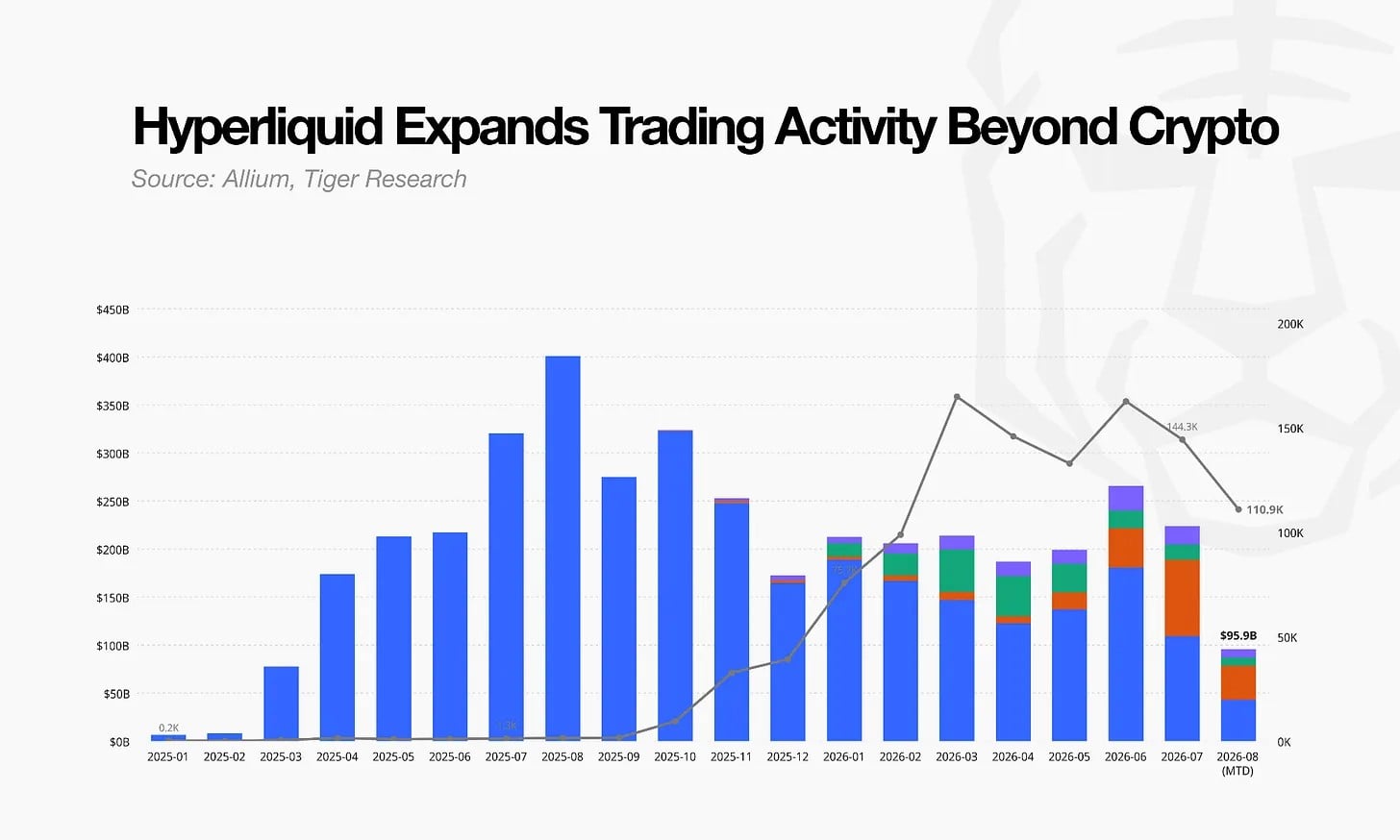
At the decentralized exchange Hyperliquid, the share of traditionally asset-linked products in its 2026 trading structure continues to rise, and the number of users trading these products is also increasing. Infrastructure originally built for crypto trading is evolving into a new venue for traditional financial markets.
This shift is driven by perpetual contracts. These derivatives allow investors to gain price exposure without holding the underlying asset. Unlike traditional futures, they have no expiration date and do not require physical delivery.
Because of this, exchanges can relatively easily list products linked to equities and commodities, giving crypto exchanges a viable path to expand from digital assets into traditional markets.
South Korea Is No Exception: Korean Stock Trading Flows Offshore
South Korea is already at the center of this shift. Offshore crypto exchanges are actively trading perpetual contracts linked to core Korean equities such as Samsung Electronics and SK Hynix. These products can be traded nights and weekends and offer high leverage, providing Korean investors and global capital with a new way to gain exposure to Korean stocks. An offshore market that allows direct trading of Korean stock price movements without being constrained by local trading hours is rapidly taking shape.
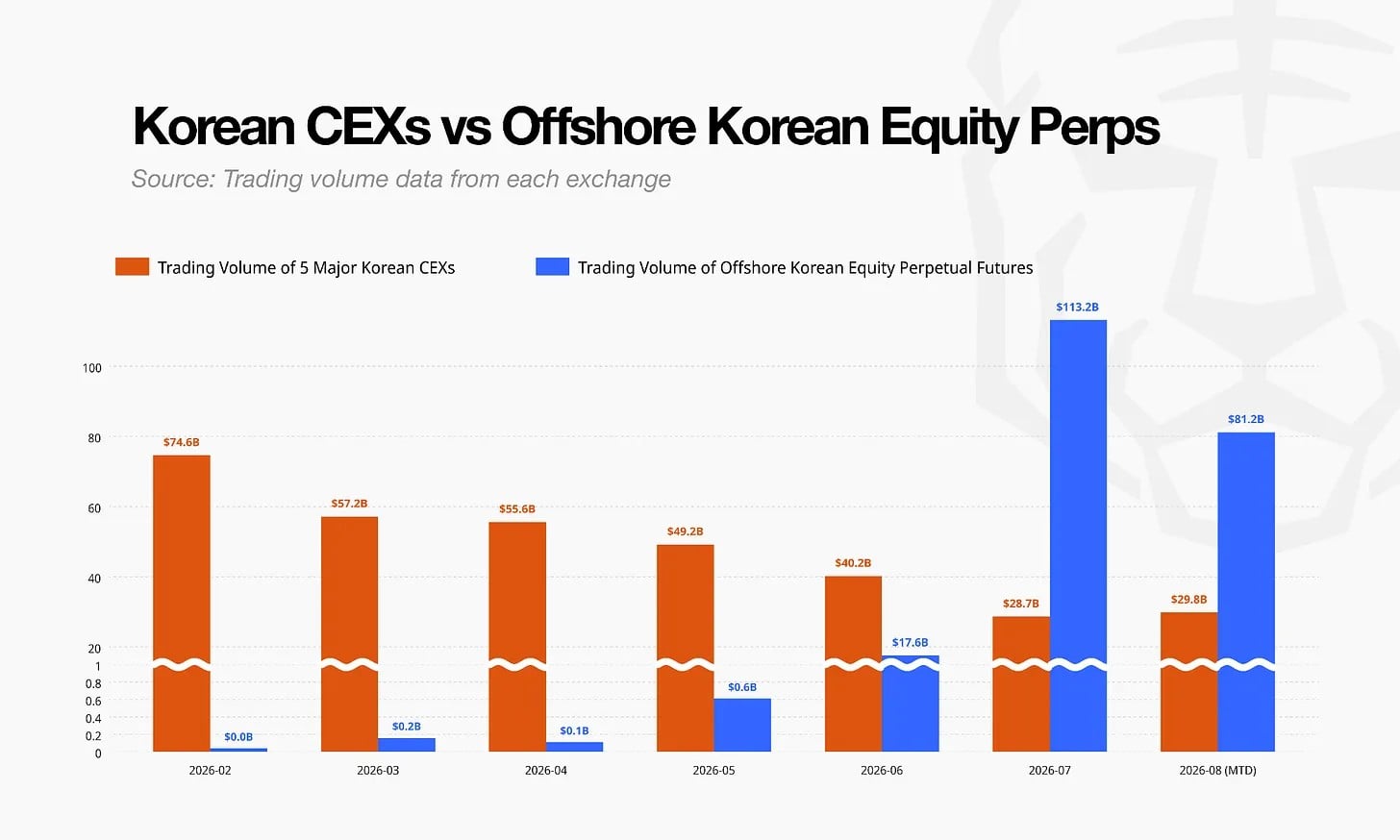
The scale has grown rapidly. From February to August 2026, cumulative trading volume for perpetual contracts linked to Korean stocks reached approximately 307 trillion KRW. August alone accounted for 166 trillion KRW, nearly four times the 42 trillion KRW in trading volume across South Korea's top five crypto exchanges during the same period. In just a few months, offshore perpetual markets for Korean stocks have surpassed the volume of South Korea's major domestic crypto exchanges.
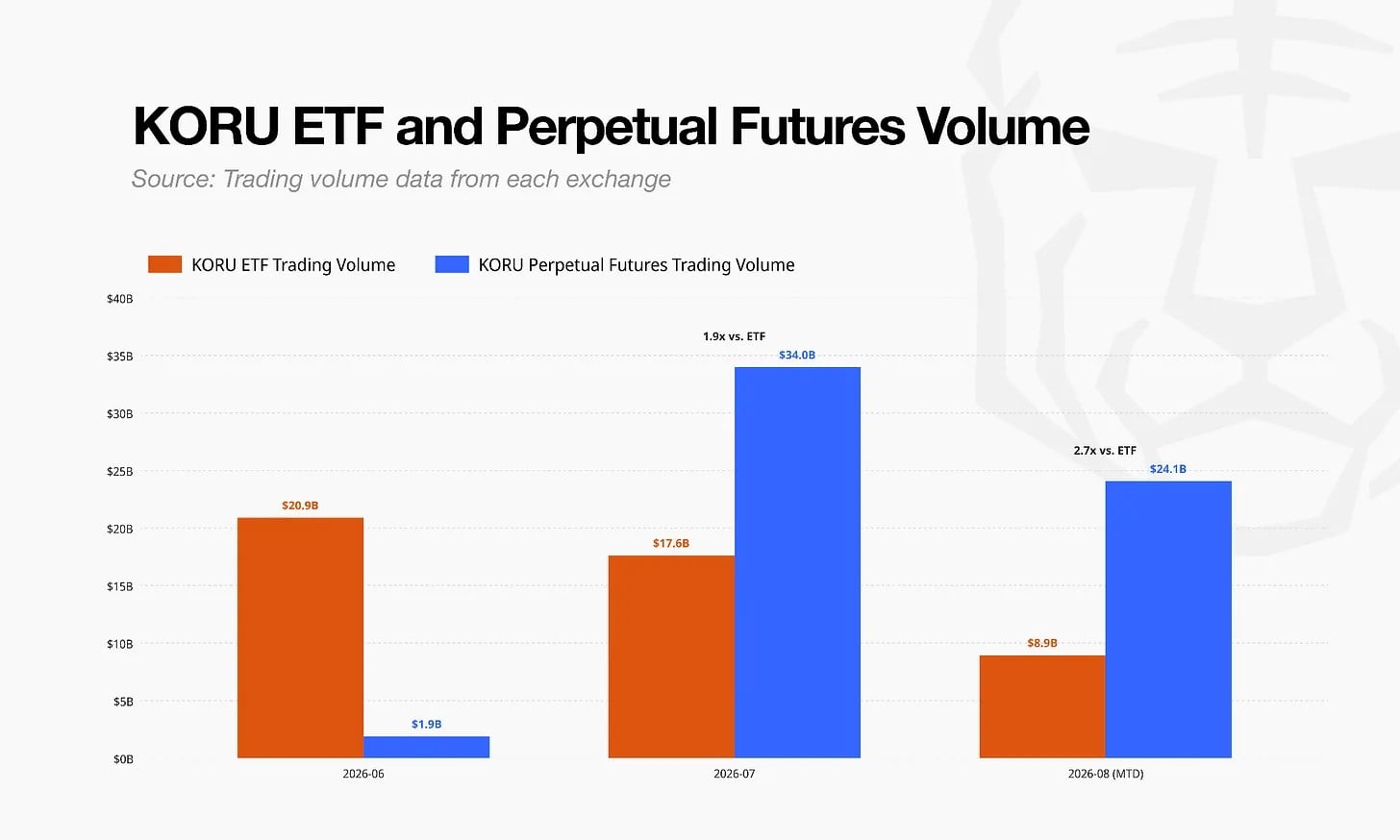
For certain products, perpetual contract volumes have already far exceeded their corresponding ETFs. In August 2026, perpetual contracts linked to the US-listed 3x leveraged Korean ETF (KORU) traded approximately $24.1 billion, while KORU ETF itself traded $8.9 billion, making the former roughly 2.7 times larger than the latter. In other words, derivative trading has overtaken the ETF itself. Once derivative volumes surpass the underlying market, offshore venues may play a larger role in price discovery.
More critically, the offshore derivatives market also flows back into the spot market. Market makers providing liquidity for perpetual contracts hedge their exposure by buying and selling relevant stocks or ETFs. The higher the derivative volume, the more frequent these hedging trades become, amplifying during periods of sharp price swings. These capital flows ultimately transmit to spot prices.
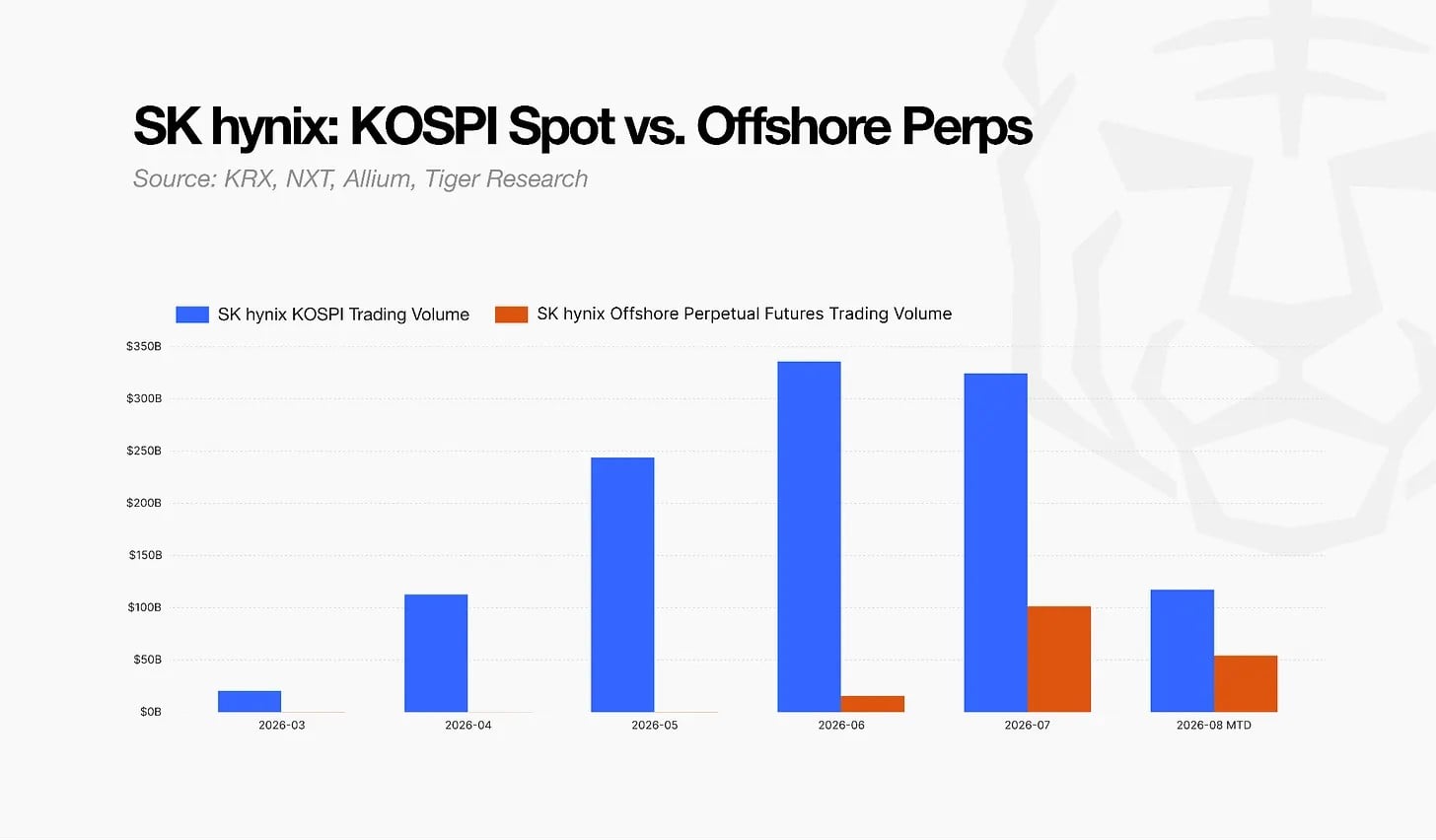
This structure risks creating a scenario where "the tail wags the dog": rather than spot markets driving derivatives, derivatives begin to drive spot prices. For large-cap stocks like SK Hynix, spot trading volume remains significantly larger, so the impact is currently limited. However, the gap between derivative and spot volumes is narrowing rapidly, a trend that warrants close monitoring.
Global Markets Are Shifting as Liquidity Goes Offshore
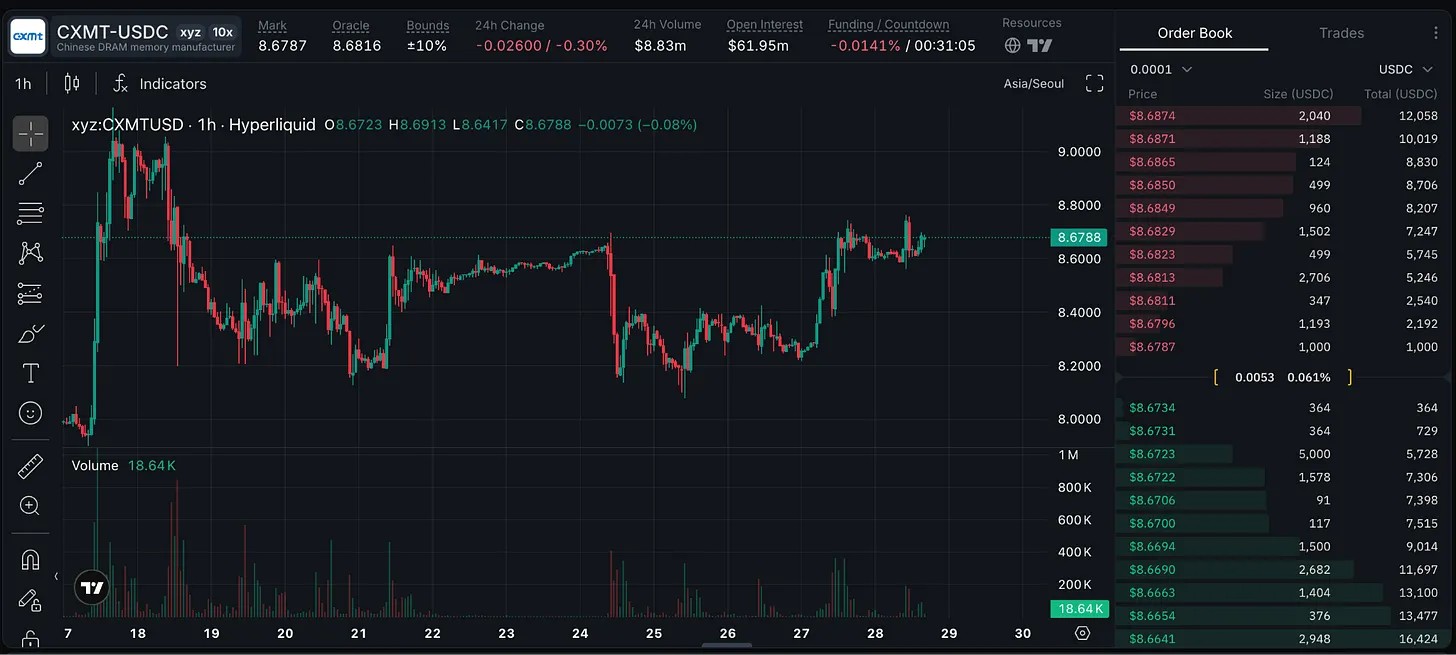
Offshore trading of Korean stocks is not unique to South Korea. Perpetual contracts are rapidly expanding across equities and indices in South Korea, Japan, China, and elsewhere, extending beyond publicly listed companies. Offshore venues have already launched perpetual contracts linked to unlisted firms like Anthropic, as well as products tied to China's yet-to-be-listed memory chip maker CXMT. Assets that were previously difficult to trade through traditional securities markets are entering the perpetual contract space. The boundaries of what investors can trade are quickly blurring.
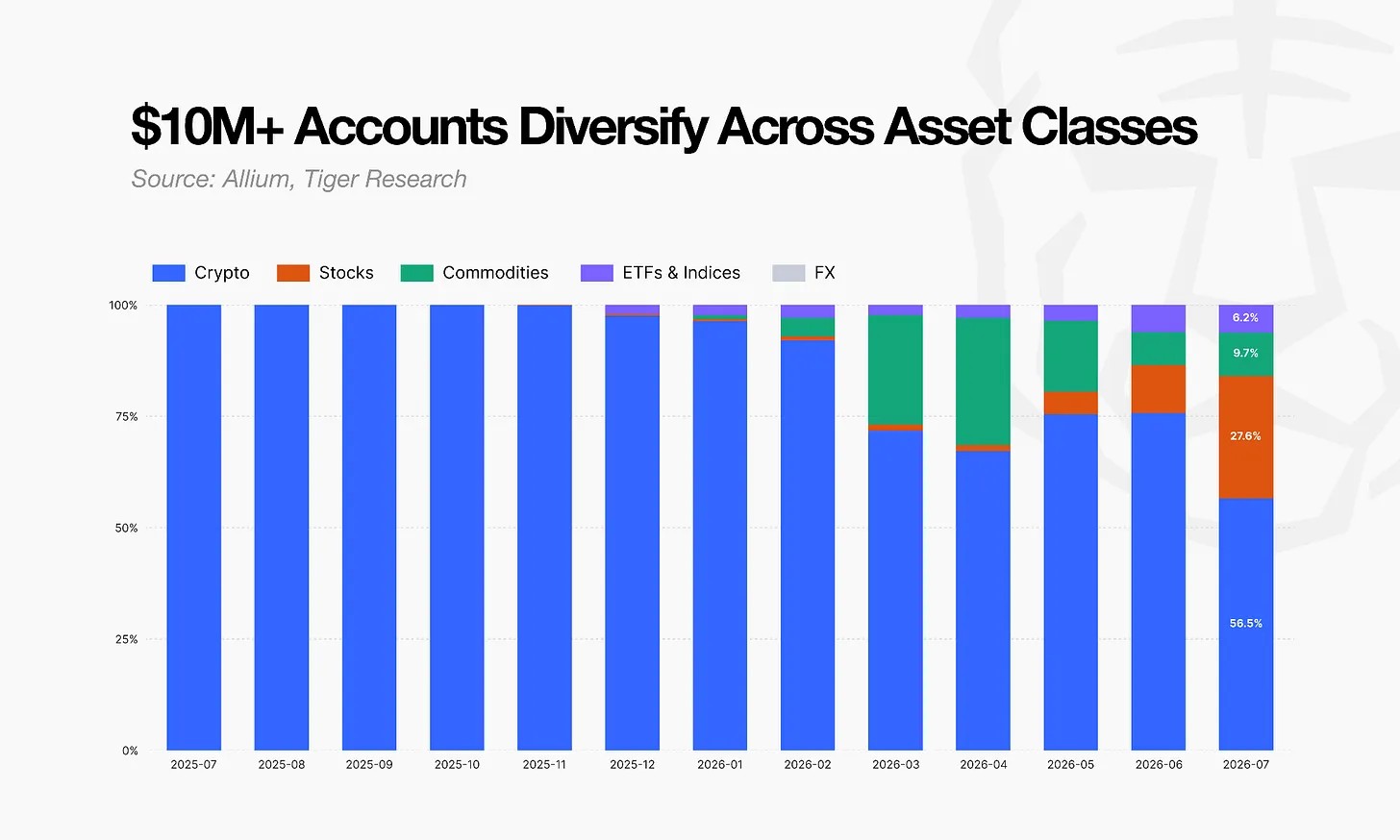
Participants are also changing. Among accounts on Hyperliquid holding over $10 million, the proportion trading traditional assets like equities and commodities is rising quickly. The Wall Street Journal also reported that Wall Street professional traders use perpetual contracts outside regular trading hours and on weekends. Initially dominated by crypto investors, this market is now attracting professional traders and institutions managing large pools of capital.
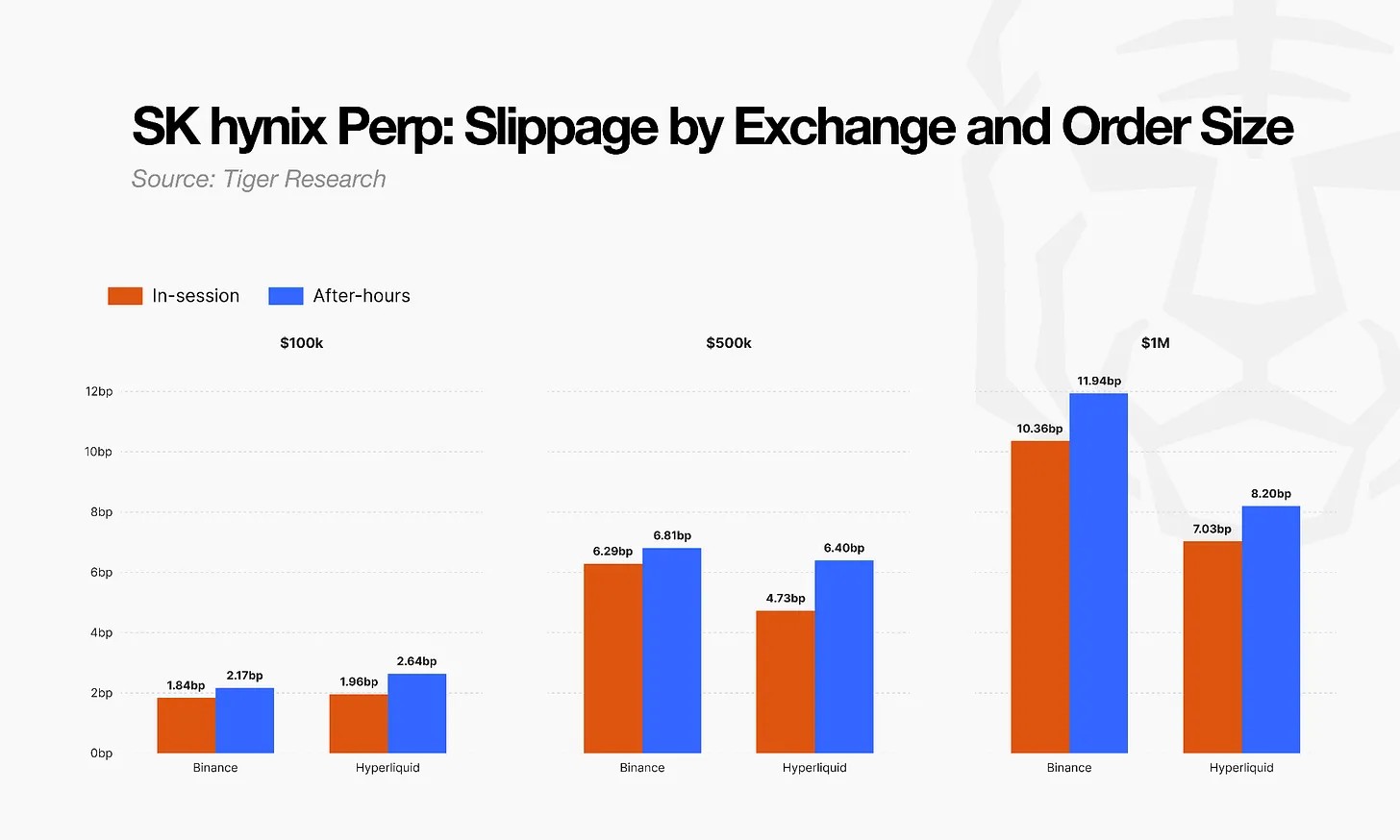
Liquidity itself is also notable. Based on a recent 15-day average, trading $1 million on an SK Hynix perpetual contract incurs slippage of only single-digit basis points. Even outside regular trading hours, slippage remains relatively low. This means the market has sufficient depth to absorb large orders even when the Korean stock exchange is closed. Perpetual contracts are no longer just about "extending trading hours"; they are developing their own organic liquidity.
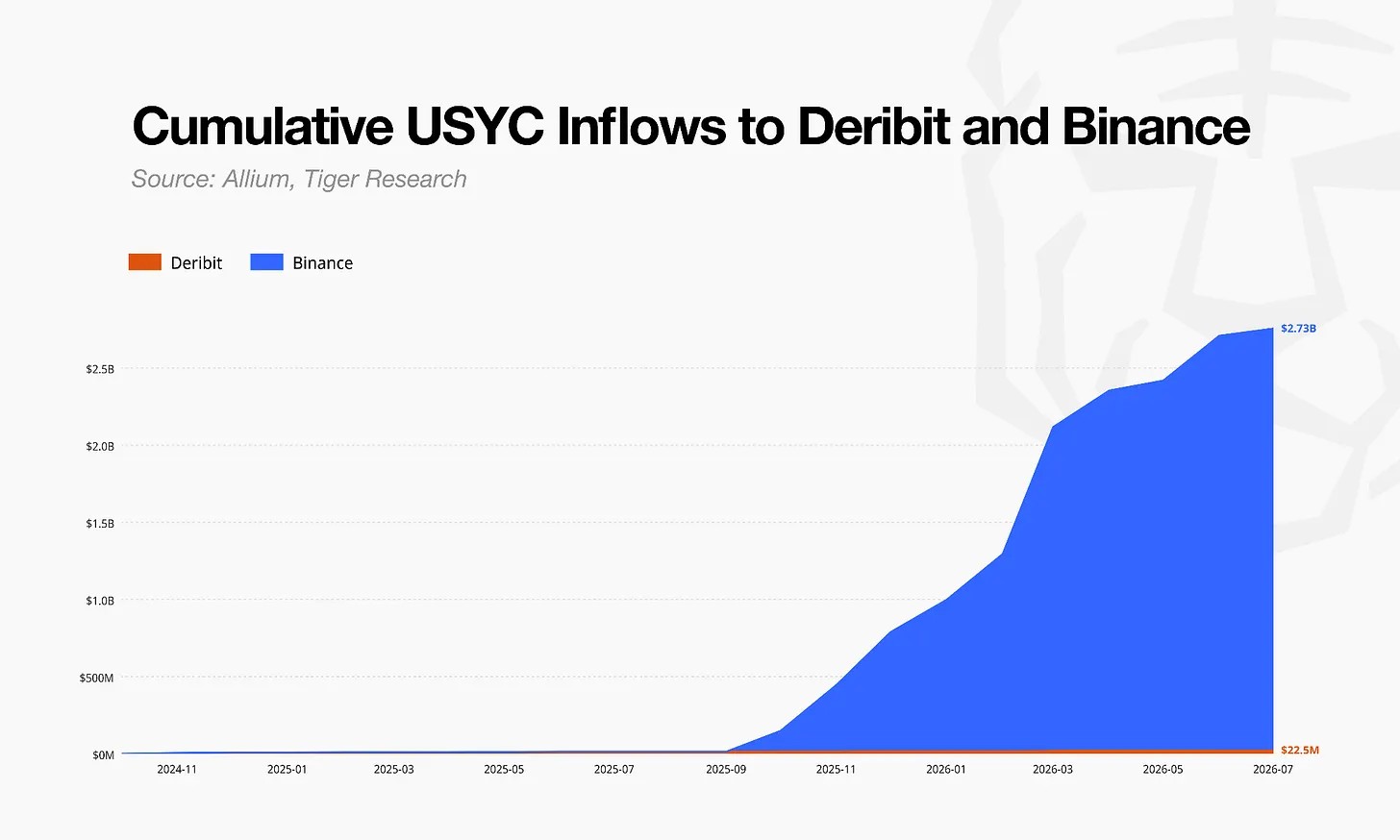
The capital used for trading is also changing. Several global exchanges have accepted tokenized US Treasuries as collateral, including BlackRock's BUIDL and Hashnote's USYC. Over the past year, cumulative USYC inflows to exchanges reached approximately $2.75 billion. Not all of it serves as derivative collateral, but institutions can hold familiar treasury-backed assets and deploy them as trading margin when needed. Traditional financial assets are beginning to serve as collateral for these new markets, forging a fresh capital channel between traditional finance and emerging trading venues.
What we see today is not merely the expansion of the crypto market into traditional assets. An offshore market that enables trading Korean stock prices without passing through the won, domestic brokers, or the Korea Exchange is rapidly maturing. Tokenized US Treasuries serve as collateral here, while professional traders and large asset managers have already entered. The transformation goes beyond just the traded assets; participants and capital structures are being rewritten.
Perpetual contracts linked to Korean stocks reached 307 trillion KRW in trading volume within a few months. This figure illustrates how rapid the change has been. However, 307 trillion KRW does not represent the scale of a mature market; it is simply the current size of an evolving ecosystem. If more assets become tradable and institutional capital enters at scale, offshore liquidity could continue to expand. The long-standing market structure divided by national borders and trading hours, along with the mechanics of cross-market capital flows, could all be fundamentally rewritten.
As Offshore Markets Grow, What Role Can South Korea's Financial Sector Play?
South Korea can restrict its domestic investors from trading these products, but it struggles to curb the growth of the offshore market itself. Some global exchanges, including Binance, limit perpetual contract trading for accounts identified as Korean users through KYC. Nevertheless, the market for Korean stock-linked derivatives can still expand through foreign investors and global capital. In reality, South Korean regulations primarily restrict domestic investors and financial institutions rather than the offshore market as a whole. Even if domestic demand is suppressed, trading and liquidity will likely continue to flourish overseas.
Therefore, South Korea should not focus solely on blocking this trend but should instead harness the growth of the new market as an opportunity for its domestic financial sector. South Korea is not starting from scratch: its domestic crypto exchanges already possess valuable foundations. While they cannot directly list stock-linked perpetual contracts in the short term, they already have experience operating 24-hour digital asset markets and a substantial user base. These conditions can support expansion into new markets. As global crypto exchanges rapidly enter traditional assets, South Korea should also evaluate the regulatory frameworks and market structures required to support this transition.
Trading infrastructure alone is insufficient. South Korea also needs mechanisms allowing corporate market access, a formal regulatory framework for derivatives, and won-denominated payment and settlement infrastructure. Corporate accounts can bring in the specialized capital required for market making, hedging, and arbitrage, thereby supplementing liquidity. Only a formal framework for derivatives like perpetual contracts can support products linked to a broader range of assets. Payment and settlement tools such as won-backed stablecoins would lower entry barriers for foreign investors and facilitate capital flows. These are not isolated regulatory issues but interconnected prerequisites for market functionality.
What South Korea needs is an integrated framework that allows these components to work in synergy, rather than piecemeal fixes. Only then can domestic crypto exchanges move beyond simple crypto trading and connect a wider range of assets with global liquidity. Trading linked to Korean assets is already growing rapidly offshore. The real question is not how to stop this growth, but how much of this market South Korea's financial sector can capture.
Join TechFlow official community to stay tuned
Telegram:https://t.me/TechFlowDaily
X (Twitter):https://x.com/TechFlowPost
X (Twitter) EN:https://x.com/BlockFlow_News
 @tiger_research