The gap between South Korea and the global crypto market is wider than it was four years ago.
By: 100y_eth
Compiled by: AididiaoJP, Foresight News
The golden age of the Korean crypto market seems to have passed. But for global protocols, South Korea remains a market worth paying attention to.
It’s true that during the most recent prolonged bear market, trading volumes at exchanges like Upbit and Bithumb plummeted. Yet, the moment market sentiment shows any signs of warming up, trading volume can rebound 2.5 to 3 times over in a short period. This points to one fact: retail liquidity in the Korean crypto market recovers very quickly.
But the industry itself is another story.
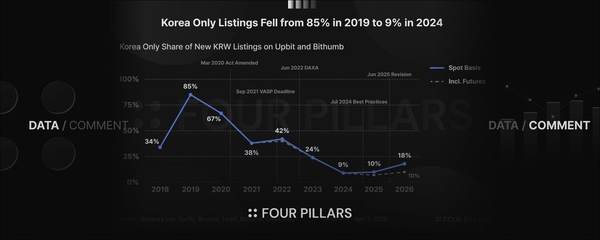
Compared to the past, the Korean crypto ecosystem has lost much of its appeal. During the bull market of 2021, South Korea was certainly a presence in the global crypto scene: a solid investor base, an active community, with companies and projects emerging in waves ranging from public chains, DeFi, blockchain gaming, and NFTs to infrastructure and wallets.
Everything changed after the Terra collapse in 2022.
The On-Chain World Is Heading Toward Two Extremes
While the Korean crypto industry slows down, the global blockchain sector has charted a rather interesting path.
Bitcoin's peak in 2025 was nearly double its high in 2021. Yet, those native on-chain products that exploded in 2021 and 2022 are nowhere near keeping up with that growth.
The overall market size has clearly expanded. The question is: who is actually capturing this upside?
The answer is actually quite simple—one driven by speculative demand, and the other integrating crypto with the real economy.
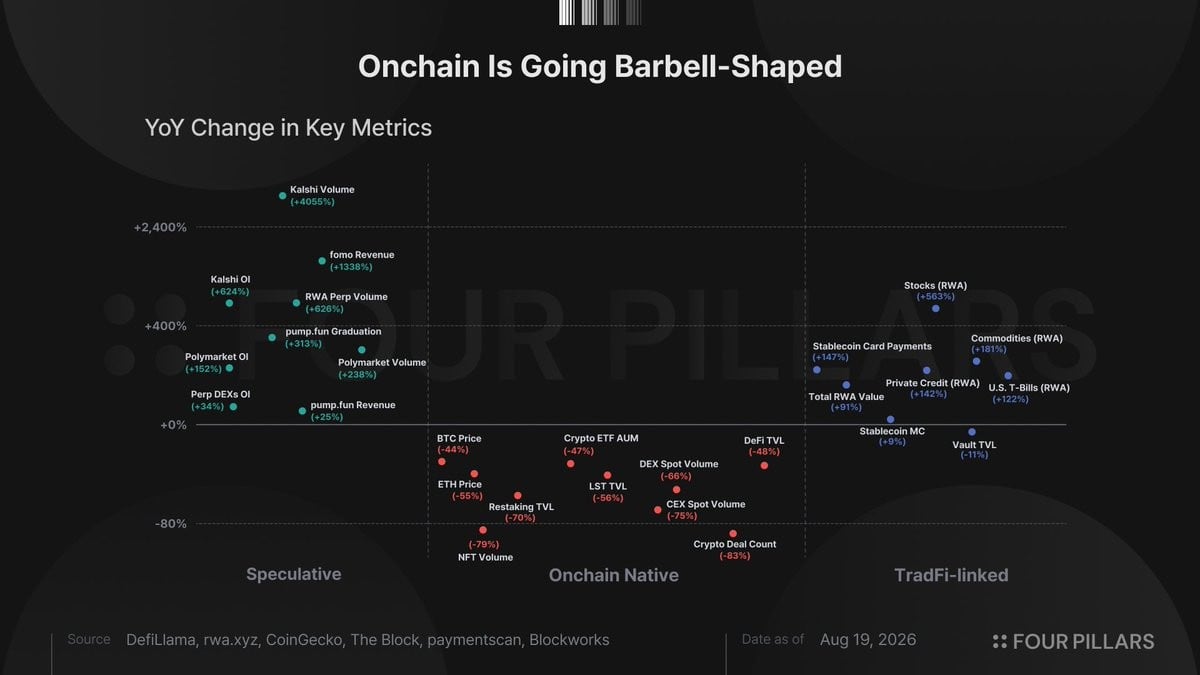
While the market was recently hovering at low levels, year-over-year data told the story clearly: DeFi TVL dropped significantly, along with spot trading volumes on DEXs and CEXs, liquid staking token TVL, NFT trading volume, and the number of crypto funding rounds, all saw noticeable declines.
In other words, the decline in those native on-chain products that once defined the market looks even worse than Bitcoin's drawdown, which serves as the de facto market benchmark.
On the flip side: even in such a tough market, a few sectors are still exploding.
Perpetual contracts (Perps) and prediction markets feed on speculative demand; stablecoins and RWAs connect crypto to the real economy.
So, while the blockchain industry is indeed growing this cycle, the shape of that growth matters more—it has evolved into a dumbbell: one end is speculation, the other is integration with the real economy.
South Korea's Blockchain Industry Is Falling Behind
Perpetual contracts, prediction markets, stablecoins, and RWAs are precisely the four hottest directions for growth in the global blockchain industry this cycle.
What about South Korea? How many of these four tracks can truly take root domestically?
Zero.
At present, there is not a single legal pathway for the Korean blockchain industry to operate legitimately across these four areas.
Perpetual Contracts: South Korea does not have explicit laws banning perpetual contracts. However, the Financial Services Commission takes a highly conservative stance on credit provision related to digital assets. Under the current legal framework, there is no basis for officially operating crypto derivatives business domestically.
Prediction Markets: In South Korea, prediction markets are generally treated as illegal gambling. Recently, the Korea Communications Standards Commission also blocked domestic access to Polymarket.
Stablecoins: The Digital Assets Basic Act, expected to bring stablecoins under regulation, has been delayed repeatedly. Currently, there is still no legal basis for enterprises to issue and circulate stablecoins.
RWAs: While South Korea has an STO framework, it is heavily tied to fractionalized investment products, which differs significantly from what the global market typically refers to as RWAs. South Korea currently lacks a regulatory framework specifically for RWAs. Regulators recently indicated that issuing tokens backed by Korean securities overseas and selling them exclusively to foreign investors would be hard to classify as a violation of the Electronic Securities Act. However, restrictions remain clear for Korean institutional investors looking to genuinely invest in RWA products.
Perpetual contracts are trading innovations born directly from the crypto market. The Singapore Exchange has already launched BTC and ETH perpetual futures, and the US Commodity Futures Trading Commission has also approved KalshiEX's BTC perpetual futures.
Prediction markets represent another type of innovation—they can essentially turn almost any event in the world into a tradable interface. Recently, they have also begun showing their potential as a hedging venue, and even as next-generation insurance products.
Stablecoins and RWAs are different again. They have decoupled from crypto market sentiment, independently achieved product-market fit, and are becoming the foundational infrastructure for next-generation finance.
Almost none of these innovations have truly taken off in South Korea.
This creates a strange paradox: the gap between South Korea and the global market today is actually wider than it was in 2021.
This doesn't mean nothing is happening. While the regulatory framework remains unclear, financial institutions are already preparing stablecoin businesses; regarding RWAs, some participants have chosen to launch products overseas first.
South Korea still holds a distinct advantage: once the regulatory environment is in place, the speed at which this market can build out the industry may surpass most other countries.
Hopefully, South Korea will soon provide a clear regulatory framework for perpetual contracts, prediction markets, stablecoins, RWAs, and related sectors. Only then will it truly open up new growth space for the Korean blockchain industry.
Join TechFlow official community to stay tuned
Telegram:https://t.me/TechFlowDaily
X (Twitter):https://x.com/TechFlowPost
X (Twitter) EN:https://x.com/BlockFlow_News
 @100y_eth