Asian Stock Market Plunge: A Predicted Rout
On October 15, just five minutes after the Seoul market opened, the SIDECAR circuit breaker was triggered. Programmatic sell orders were forcibly halted.
The KOSPI plummeted more than 7% that day, touching intraday levels near -8%. It marked the sixth consecutive bearish candle.
Samsung Electronics fell 9.4%, and SK Hynix dropped over 11%. The combined market value erased by these two companies accounted for one-quarter of the Korean stock market's gains for the year.
In Tokyo, the Nikkei 225 fell 5.12%. Kioxia plunged 13%, and SoftBank dropped 8.5%.
The Hang Seng Index fell 1.1%, the Shanghai Composite declined 1.75%, and the CSI 300 dropped 1.4%.
The Financial Services Commission of Korea hastily convened an emergency four-party meeting. The Finance Minister, the Central Bank Governor, the Financial Regulatory Commission Chair, and the Financial Supervision Agency Head were all present, delivering a four-word conclusion: “Any tool available.”
The last time such a high-level emergency response was deployed was during the global flash crash triggered by the yen carry trade unwind in August 2024.
But that lasted one day; this has spanned five days. Calculated from the June peak, the KOSPI has already fallen 30%, and the Philadelphia Semiconductor Index has declined for six consecutive trading sessions.
What exactly happened?
October 10: The CXMT 4F² Bombshell
CXMT President Cao Kanyu announced at the Shanghai Semiconductor Forum that its 4F² architecture DRAM had made "critical progress," with DDR5 server memory modules to be launched by the end of 2026.
4F² is the next-generation memory cell architecture for DRAM, theoretically allowing 50% more memory cells to be packed onto the same silicon wafer.
Samsung’s mass production timeline is set for 2028, but CXMT claims it is cutting two years off that schedule.
How much exaggeration is there? Nobody knows. With no yield data and no customer validation, one fact remains clear: Counterpoint Research data shows CXMT’s global DRAM market share skyrocketed from 4% in Q2 2025 to 10% in Q2 2026.
The following day, SK Group chairman Choi Tae-won publicly stated that China is "catching up at an astonishing pace."
South Korea’s technological lead in semiconductors has narrowed from five years to just one year for NAND, two years for DRAM, and three years for HBM.
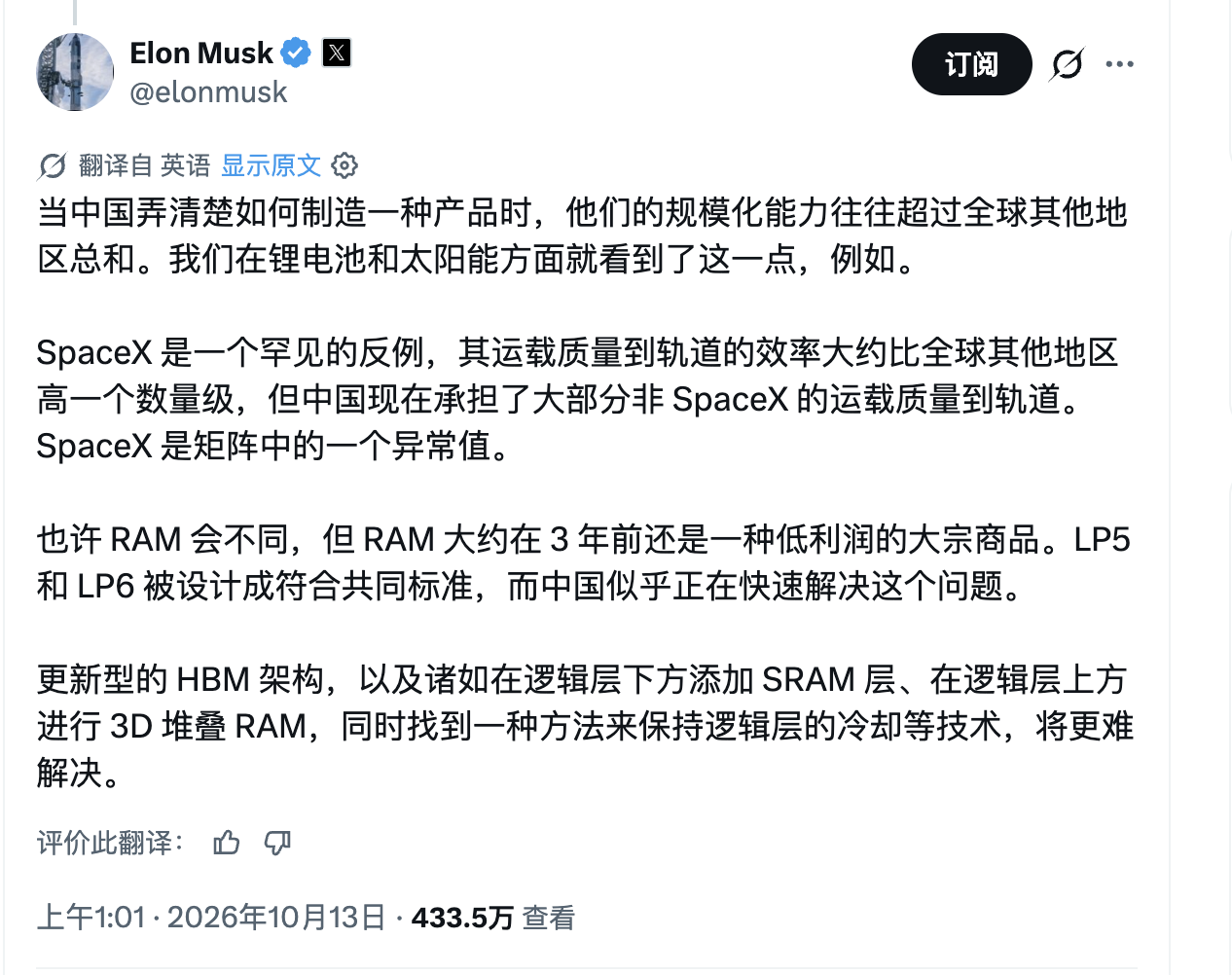
Elon Musk even weighed in, commenting that once China masters the manufacturing technology for a given product, its scaled production capacity usually exceeds the combined total of the rest of the world, as evidenced by the lithium battery and solar industries.
For a country where 20% of its GDP hinges on semiconductor exports, this is a stark alarm.
October 12: Broadcom CEO Says “You’re in a Casino”
On Monday, Broadcom CEO Hock Tan delivered some unsettling remarks in Singapore.
His point was that many AI investors “have no idea what they’re investing in,” holding “extreme expectations,” only to realize “they’re basically in a casino.” He likened companies testing AI applications to “kids spending tokens in an arcade.”
Such words carry weight regardless of who says them, but coming from the Broadcom CEO, the weight doubles. Broadcom itself projects AI chip sales will grow from $58 billion this year to $230 billion by 2028. Someone raking in massive profits is openly warning others not to bet too heavily.
Micron fell 3.88% that day, and the Philadelphia Semiconductor Index dropped 2.67%.
A quieter signal emerged: CoreWeave, Nvidia-backed AI compute company, saw its stock fall 17% from its peak. Bonds issued four months ago traded at 78 cents on the secondary market.
Bonds from an “AI infrastructure” company traded at 78 cents on the dollar.
October 14: The CPI Kill Shot
U.S. September CPI came in at 3.7% year-over-year, above expectations of 3.6% and previous readings of 3.4%. Core CPI rose 2.6% YoY, also beating expectations.
The narrative that “inflation has been tamed” was shattered.
The Fed’s benchmark interest rate sits at 3.75%-4.00%. Following the CPI release, the probability of a rate hike in October jumped from single digits to 31.6%. The S&P 500 recorded its largest single-day decline since late July, while Nasdaq fell 1.88%.
Emirates NBD analyst Daniel Richards put it succinctly: “The expectation of higher rates is back center stage, risk-off sentiment has spread from Wall Street to Asia, resulting in steeper declines in Japan and South Korea.”
Kyle Rodda of Capital.com added context: “It’s not just a deep pullback in AI stocks, but tighter financial conditions. Higher yields, a stronger dollar, intensifying competition in chip stocks, and concerns about peak profit growth have all collided.”
Massive Foreign Capital Exodus: 199 Trillion Won in Selling Pressure
A couple of days of negative catalysts wouldn’t be enough to drag the KOSPI to these levels.
The real structural pressure comes from foreign capital having fled for over half a year.
From January to the present of 2026, foreign investors have net sold 199.1 trillion KRW, roughly $145 billion. 87% of that went into just two tickers: Samsung and SK Hynix.
Foreign ownership in Samsung dropped to 46.37%, the lowest since January 2008. Foreign stakes in SK Hynix breached below 50%.
Global capital is systematically reducing exposure to Korean semiconductors. Chinese competitors are eroding tech premiums, uncertainty around AI returns is dampening growth expectations, and a strong dollar is suppressing emerging market assets—all three lines pulling simultaneously.
Samsung and SK Hynix together account for nearly one-third of the KOSPI’s total market capitalization. When 199 trillion won in selling pressure concentrates on just these two stocks, any negative news gets multiplied exponentially.
The Final Line of Defense Has Fallen
South Korea wasn’t unprepared. The 55 trillion KRW buyback plan launched earlier this year did indeed hold things together in the first half.
But by mid-October, 80% of the ammunition was spent. Samsung’s buyback program was fully executed. The market’s largest buyer force had exited.
Retail investors are also pulling back. Margin balances dropped from a peak of 38.6 trillion KRW to 33 trillion KRW, with leveraged longs actively or passively liquidating positions.
With buybacks exhausted and retail de-leveraging, both support lines broke simultaneously. This coincided perfectly with a window of better-than-expected CPI data and questioning of the semiconductor narrative.
Five events, five days, viewed together:
Supply-side competitive threat (CXMT) + Demand-side valuation skepticism (Broadcom CEO) + Macro liquidity tightening (CPI) + Deteriorating capital structure (foreign capital flight) + Market defense collapse (buybacks exhausted) = The KOSPI’s 30% rout.
Same day, the IMF released a report, serving as a footnote to this crash.
The report’s core judgment: AI tech boom is an “important hedging force” for East Asian economies, but the path for AI investment “remains highly uncertain.” If AI-related valuations correct, “Asia will face disproportionate shocks.”
To translate: The U.S. has Microsoft, Google, Amazon, and other AI application giants to diversify risk, whereas Asia has bet almost entirely on the hardware supply chain. When the AI narrative weakens, Asia takes a heavier hit.
Investors are the hardest hit: enduring hardship and devastation only to realize their ultimate goal was simply breaking even—a reality they held from the start.
Join TechFlow official community to stay tuned
Telegram:https://t.me/TechFlowDaily
X (Twitter):https://x.com/TechFlowPost
X (Twitter) EN:https://x.com/BlockFlow_News
 深潮TechFlow