摩根士丹利研报解读:贵金属等待催化,ETF 买盘决定金银上行空间
By Rita
TechFlow Overview
Central banks are buying, ETFs are selling, and gold prices are stuck at the $4,000 mark.
Morgan Stanley's latest precious metals report delivers a clear verdict: for gold prices to rise, ETF inflows must return. In 2025, ETFs purchased approximately 800 tons of gold, representing the strongest driver of price appreciation. That momentum evaporated in the first half of 2026, with global ETF outflows hitting 74 tons in June; North America was the primary region for these sales.
Meanwhile, central bank gold purchases are accelerating. China bought 14.9 tons of gold in June, marking its largest single-month increase since October 2023, with consecutive purchases for the 20th straight month. Year-to-date cumulative purchases have already surpassed last year's full-year total.
Morgan Stanley's economics team believes inflation has begun to decelerate, and the Fed will not hike rates this year. If this assessment holds, ETF buying could return as early as Q4, with gold targets rising to $4,450 and silver to $65.
Central Banks Are Buying, With China Leading the Charge
Turkey was the largest gold seller in H1 2026. Following the outbreak of conflict in the Middle East, the Turkish central bank sold roughly 60 tons of gold to defend the lira. Russia sold 34.2 tons, surpassing its full-year pace from last year.
However, buying interest is stronger. China purchased 14.9 tons in June, bringing YTD accumulation to 40.1 tons, exceeding last year's full-year total. Poland bought 63.6 tons, accelerating beyond last year's pace. Uzbekistan acquired 32.7 tons, compared to just 7.8 tons for the entire previous year.
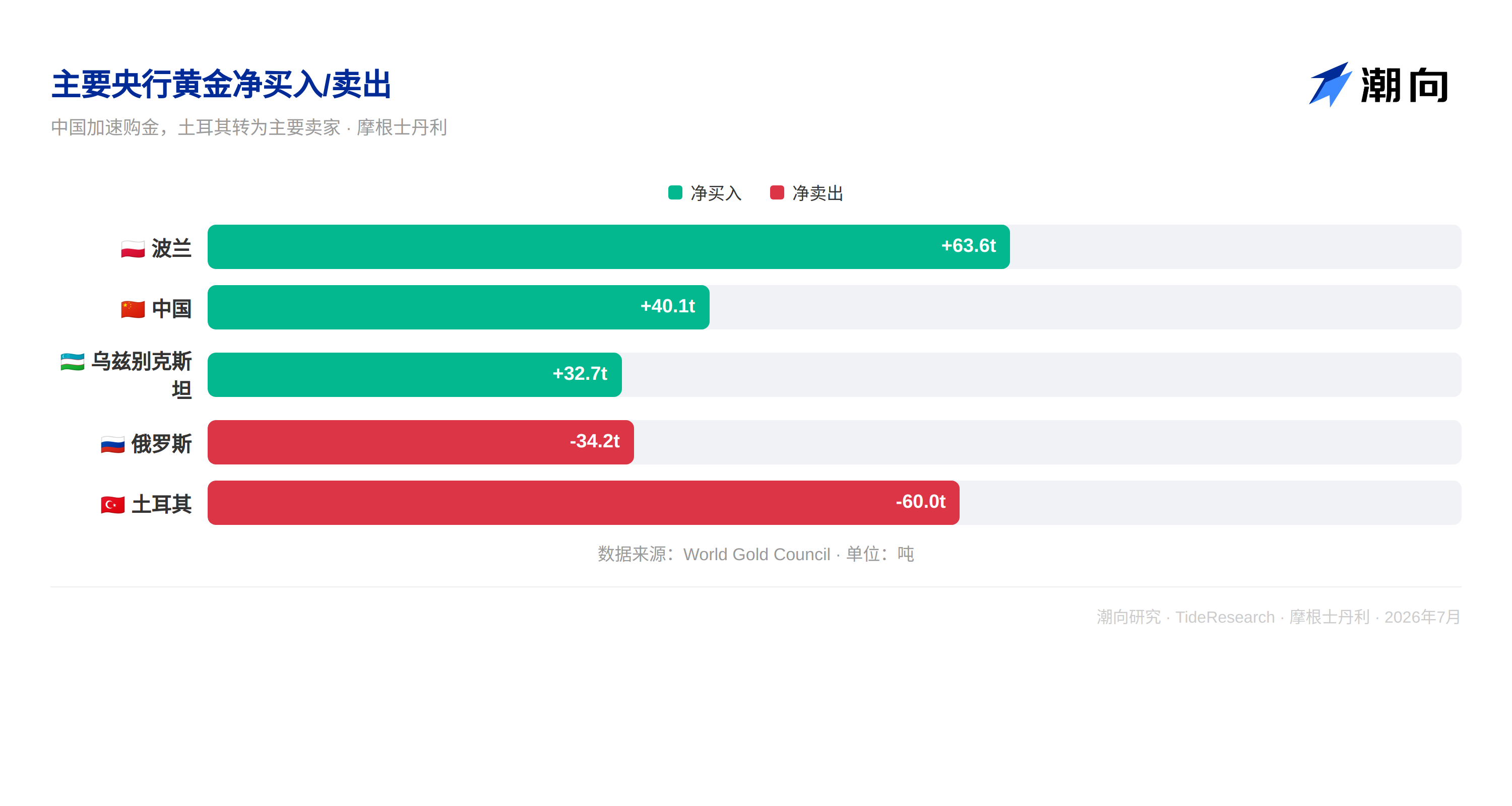
Global central bank net purchases bottomed in March and rebounded monthly, reaching 21.5 tons in April and 41.2 tons in May. Central bank buying provides a floor, but alone it cannot drive higher gold prices.
ETF Flows Remain the Biggest Variable
ETFs purchased approximately 800 tons of gold in 2025, serving as the primary catalyst for price appreciation. In H1 2026, this driver vanished. Global gold ETF outflows reached 74 tons in June, with North America accounting for 42 tons. YTD net sales from North American ETFs stand at 60.5 tons.
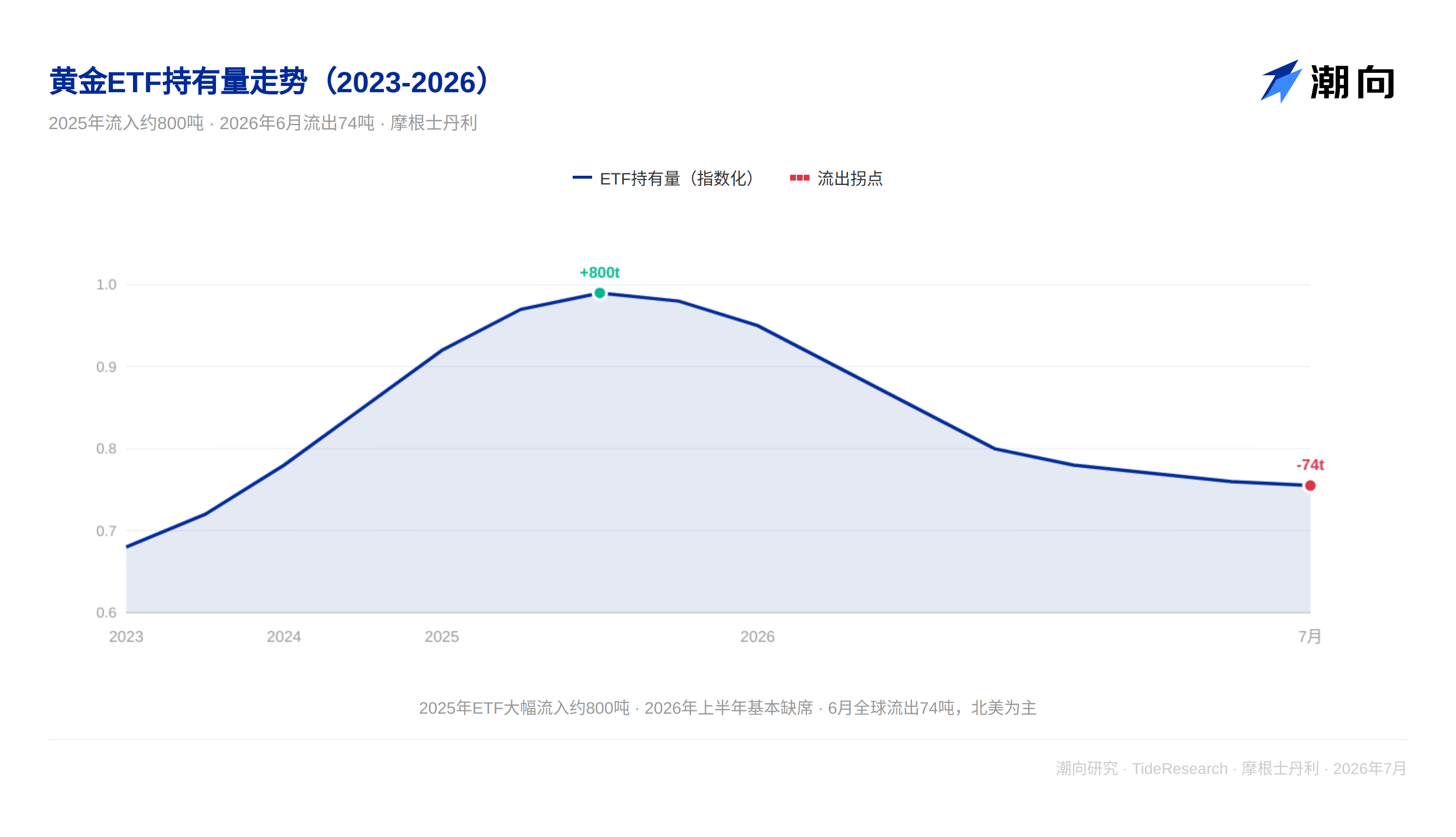
Rate hike expectations have weighed on gold's attractiveness. ETF buyers need to see the Fed "at least hold rates steady, preferably begin pivoting toward rate cuts." This requires further data confirmation, likely waiting until Q4.
Silver Faces an Additional Headwind
Silver has fallen roughly 23% year-to-date, significantly outpacing gold's 8% decline. ETFs are offloading positions while industrial demand weakens.
Photovoltaics account for 17% of silver demand, but solar-related silver consumption dropped 6% in 2025 and is projected to fall another 19% in 2026. China's solar cell production declined 2% year-over-year, with installations dropping 70%. High silver prices are driving substitution; China's largest PV manufacturer, Longi, has already begun replacing silver with copper.
The correlation between silver and copper has plummeted from 95% to near zero. Morgan Stanley argues that copper has narratives around grid upgrades and data centers, while silver only faces headwinds from declining PV demand. For silver to stage a rebound, two conditions must align simultaneously: a return of ETF flows and stabilization in industrial demand.
What Is the Market Waiting For?
Morgan Stanley's year-end 2026 price forecasts call for gold at $4,450 (approx. +11%) and silver at $65 (approx. +16%). There is only one prerequisite: the Fed does not raise rates this year.
MS's economists believe inflation has started to retreat, a view supported by June CPI showing a flat 0.0% month-on-month change. This divergence contradicts market pricing for roughly 1.4 rate hikes over the remainder of the year.
Should inflation continue to ease and the Fed remain on hold, ETF inflows will return. Conversely, if geopolitical tensions push oil prices higher, inflation resurges, and the Fed is forced to hike again, downside risks for gold will reopen.
TechFlow Perspective
The core thesis of Morgan Stanley's report hinges on a timing mismatch: central bank buying is already accelerating, while ETF inflows have yet to return. Gold is caught in the middle, leaving short-term direction unclear.
The experience of 2025, when ETFs purchased 800 tons, demonstrates that these flows carry immense elasticity; once they return, they act like a bulldozer. MS projects ETF flows will return no later than Q4, contingent on the Fed holding rates steady.
The situation for silver is more complex. A return of ETF flows would provide upside elasticity, but headwinds from the PV sector have not fully blown over. Once both variables turn positive, silver's elasticity will likely exceed gold's, given it has fallen further this year. Until then, silver remains on pause.

Disclaimer
This article is compiled and interpreted by TechFlow Research based on a third-party brokerage research report (Morgan Stanley, July 20, 2026). The ratings, target prices, earnings forecasts, and related assessments cited herein reflect the views of that brokerage's analysts, represent solely their institution's stance, do not represent TechFlow Research's opinions, and do not constitute any investment advice.
Markets involve risk, and decisions should be made independently. This article should not serve as the basis for buying or selling any securities.
Join TechFlow official community to stay tuned
Telegram:https://t.me/TechFlowDaily
X (Twitter):https://x.com/TechFlowPost
X (Twitter) EN:https://x.com/BlockFlow_News
 @chaoxiangooo