BofA's Hartnett: U.S. Dollar Is 'Destroying Everything,' Stay Defensive Ahead of a Drop
Authors: Bao Yilong, Ye Zhen, Wallstreetcn
Soaring US dollars are tightening global liquidity, transforming into a “ball of destruction” in financial markets, suppressing global risk assets and commodities, leaving little room for risk assets to enter for now.
This is the view of Michael Hartnett, Chief Global Investment Strategist at Bank of America, in his latest “Flow Show” report. He argues that the current market faces three contradictions: the Fed’s tightening cycle is far from over, government support erects bearish barriers, and the wealth effect of high-net-worth consumers underpins the economy. This means risk assets are currently neither worth chasing higher nor safe to short.
Hartnett has pushed back his “finish line” for year-end bullishness once again. Originally expecting a year-end rally to begin after the midterm elections but before Thanksgiving, data showing employment numbers beating expectations, inflation heating up for three straight months, and Fed officials hinting at a 50-basis-point rate hike have completely disrupted that rhythm. Only when oil prices, US Treasury yields, and the dollar move lower in tandem will there be a signal to add positions, and that wait may extend into next spring.
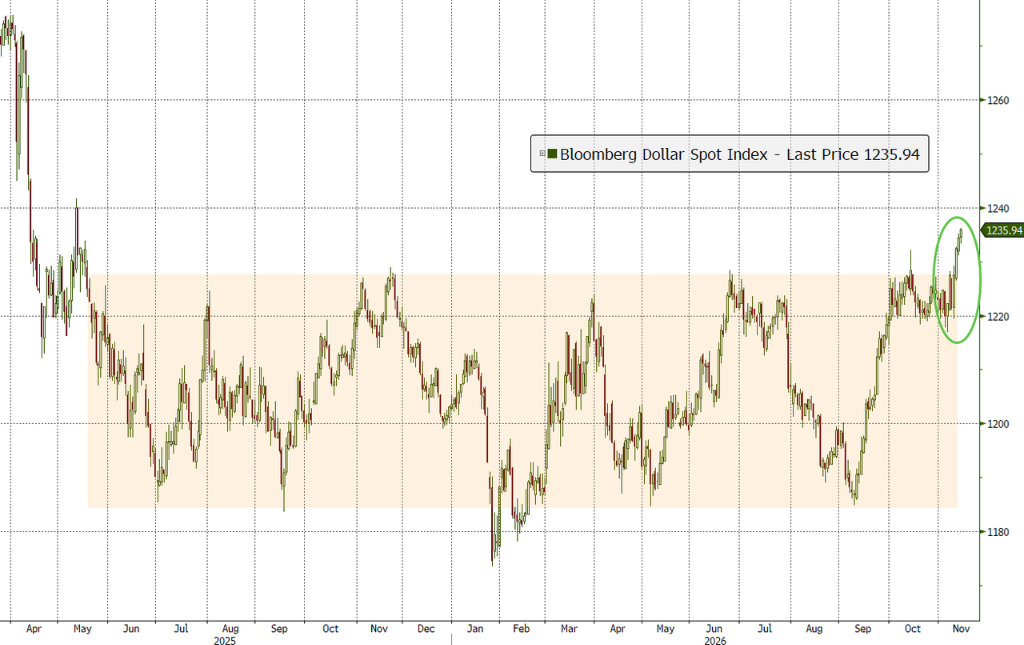
Last Friday, the Dollar Index closed at 103.42, an intraday high for the year. Hartnett labels it a “ball of destruction” for global liquidity; combined with gold breaking below $4,000, his framework indicates global liquidity is contracting.
Against this backdrop, he delays the end of the global rate-hiking cycle to the Fed’s April meeting next year, extending his bearish stance on risk assets until after the dollar peaks in early next year.
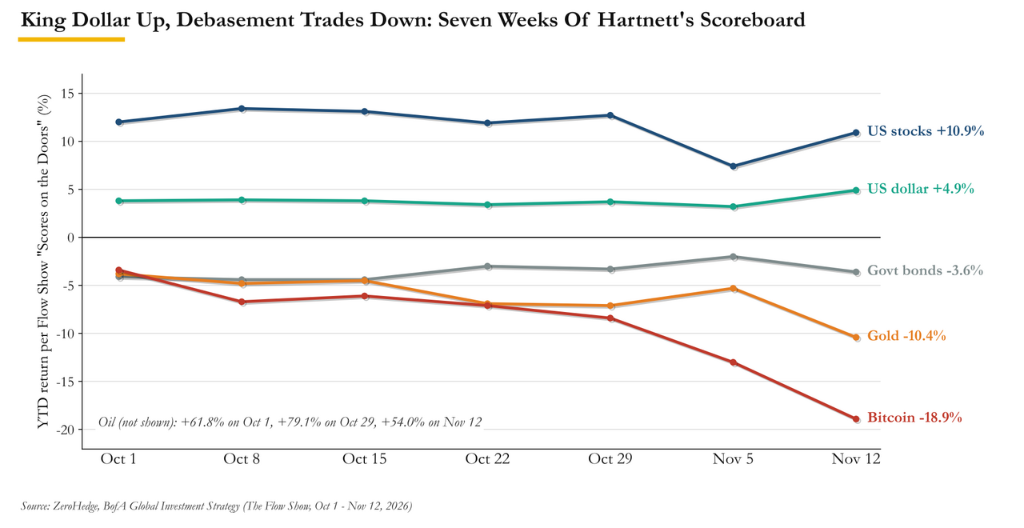
In terms of market impact, this wave of strong-dollar has clearly hit multiple asset classes: year-to-date, gold has fallen 10.4%, Bitcoin dropped 18.9%, government bonds declined 3.6%, and emerging-market bonds saw $1.5 billion in weekly outflows.
The Dollar Becomes a “Ball of Destruction,” Global Liquidity Contracts Broadly
The dollar’s strength is the core market variable this week.
After surging for four straight trading days, the Dollar Index closed Friday at an intrayear high of 103.42. The yen touching the 160 mark sparked verbal intervention from Tokyo authorities. Gold fell 4.7% for the week to roughly $3,874, closing below $4,000 for the first time in months, while Bitcoin slipped under $70,000.
Hartnett’s logic is simple and direct: a skyrocketing dollar plus gold falling below $4,000 equals a retreat signal for global liquidity.
He had already used this as a benchmark when advising clients to begin adding bonds on Oct. 3, clearly stating a risk-averse posture until the dollar tops. Six weeks later, the dollar did not fall but rose instead, and he now pushes the expected dollar peak to February or March of next year.
This assessment aligns closely with Goldman Sachs’ FX team forecasts. Per Bloomberg, Goldman strategists Kamakshya Trivedi and Michael Cahill, in their 2027 outlook, project EUR/USD will drop to 1.08 within three months before rebounding to 1.15 by late 2027, noting the trade-weighted dollar is currently overvalued by roughly 13% relative to its mean.
Both firms agree the dollar’s destructive trajectory will precede any relief.
All Three Entry Conditions Fall Short, Turning Point Delayed to Next Spring
Hartnett established three prerequisites for rotating back into risk appetite: oil prices (WTI) dipping below $70, 10-year Treasury yields falling under 4.5%, and the dollar beginning to decline. None of the three criteria were met at Friday’s close.
On oil, WTI needs another ~21% drop to breach the $70 threshold, which itself was lowered from $80 last week. Brent crude briefly broke under $90 earlier this week but rebounded on geopolitical rhetoric, with WTI settling near $89 over the weekend.
On Treasuries, the 10-year yield closed at 5.15% last Friday, climbing roughly 28 basis points on the week, standing just a step shy of multi-year highs, with yield tails reported across the 3-year, 10-year, and 30-year auctions. Achieving a 65-basis-point yield decline under the current backdrop of the Fed debating a 25- or 50-basis-point hike in December is exceedingly difficult.
As for the dollar, current trends run diametrically opposite to entry conditions, hitting an intrayear high with peak expectations delayed to February or March of next year.
Meanwhile, inflation continues to press. Fed Governor Wall hinted at a 50-basis-point rate hike in December, Goldman Sachs folded a March hike into its base-case forecast, and the October NFIB survey showed the share of small businesses planning price hikes leaped to its highest since July 2022—historical data links this closely to inflation rates of at least 3% to 4%.
Hartnett also highlights that the Fed’s 2% inflation target was last satisfied in February 2021, fully 67 months ago.
Why Equities Stay Resilient: Wealth Effect and Policy Backstop
Despite a fraught macro environment, the S&P 500 index sustains its upward march.
Hartnett explains the market’s refusal to decline along two dimensions. First is “why aren’t they saving.” BofA data mapping shows US household stock wealth has grown by $19 trillion since January 2025, totaling $74 trillion. With consumption accounting for 70% of US GDP, the high spending propensity of affluent households controlling vast stock assets makes it difficult for the economy to plunge into a deep recession.
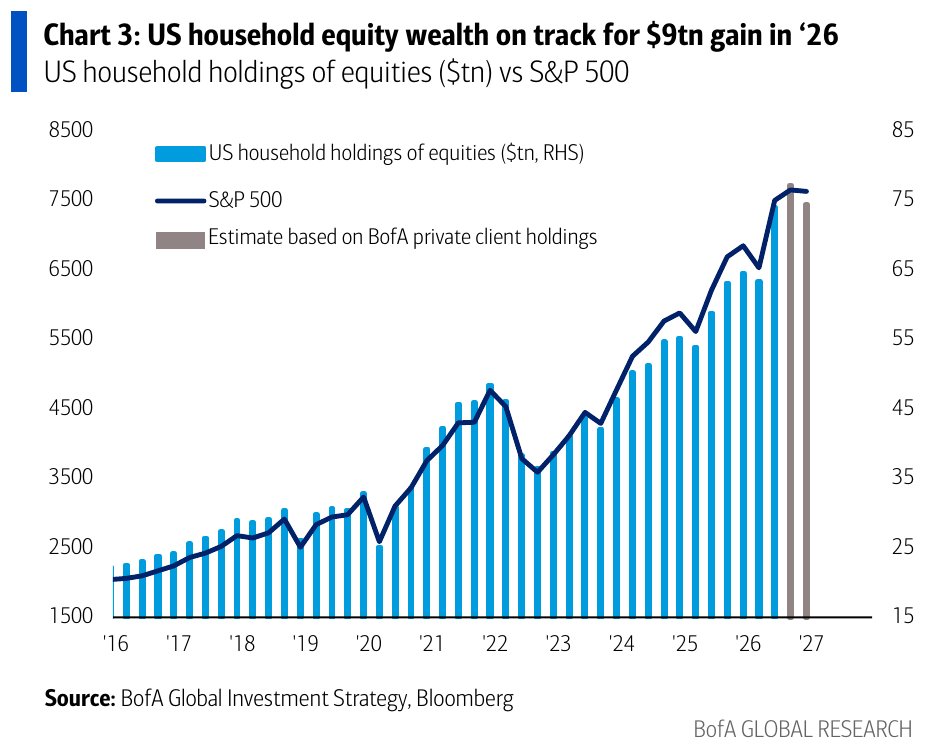
Second is “why aren’t they shorting.”
Recent volatility in Asian markets has spurred multiple national governments into substantive intervention. Reports indicate regulators rolled out measures restricting short selling, halting margin rules, and setting up $15 billion stabilization funds, while equity funds in China recorded a record five-week consecutive inflow of $88 billion. Authorities treating the stock market as “too big to fail” bolsters retail bid demand in tech stocks.
“Prosperity” Expectations Remain the Last Line of Defense
Hartnett notes that market consensus in May collectively wagered on “no landing, no rate hikes, no AI capex cuts, Democrats not sweeping,” with nearly all four calls missing. The last remaining bull belief surviving in the market today is the expectation of “prosperity”—namely, 5% to 6% nominal GDP growth in 2027, with S&P 500 earnings growth surpassing 15% to 18%.
He warns this expectation carries downside revision risk. Goldman Sachs Chief Equity Strategist Peter Oppenheimer projects S&P 500 earnings growth next year at just 11% in his 2027 outlook, far below the market consensus of 18%. Valuing this gap against a current ~19.5x P/E implies an index level of roughly 7,100 points, sitting right near Hartnett’s 7,000-point bear-market trigger band.
Goldman itself still holds an $8,700 target price, but that requires earnings delivery and further multiple expansion, both of which are visibly constrained by the current 5.15% 10-year Treasury yield.
Hartnett views the BofA November Global Fund Manager Survey releasing Nov. 17 as a critical observation window:
- If “prosperity” expectations crash sharply and cash allocations climb above 4.2%, sentiment will cease to hinder buying;
- If “prosperity” expectations stay elevated while cash allocations slip below 3.7%, the market hasn’t built enough panic and entry conditions remain unmet.
Hartnett has mapped a clear two-way scenario framework for the S&P 500. At 7,562 points, the current index sits exactly halfway between the two trigger levels.
If the index breaches 8,000 points, drivers include persistent dip-buying flows, the “equities beat bonds” signal sent by the equal-weight S&P 500 reclaiming historical highs, and technical support as junk bonds, the S&P 500 index, brokerage stocks, and TSMC all defend their 200-day moving averages.
He also flags the Shenzhen APEC Summit on Nov. 18 as a potential catalyst, suggesting that meetings between US, Chinese, and Russian leaders could confirm a top in oil prices.
If the index breaks below 7,000 points, core risks stem from liquidity crunches triggered by a sudden dollar surge, plus policy blunders by central banks pushing rates higher amid slowing growth. The most fragile assets include high-yield bonds, US and emerging-market equities, energy and healthcare sectors, and mega-cap consumer stocks.
If his risk-averse thesis proves wrong, assets most poised to surge in the coming eight weeks include gold, investment-grade tech bonds, Japanese and European equities benefiting from a strong dollar and low oil, Chinese tech stocks, mid- and small-cap equities, semiconductors, discretionary consumer plays, and homebuilder names.
Join TechFlow official community to stay tuned
Telegram:https://t.me/TechFlowDaily
X (Twitter):https://x.com/TechFlowPost
X (Twitter) EN:https://x.com/BlockFlow_News