On the Eve of the On-Chain Options Boom
TechFlow Selected TechFlow Selected
On the Eve of the On-Chain Options Boom
Options are becoming the new anchor of the cryptocurrency market.
 Navigating Web3 tides with focused insights
By: Delphi Digital
Translated by: AididiaoJP, Foresight News
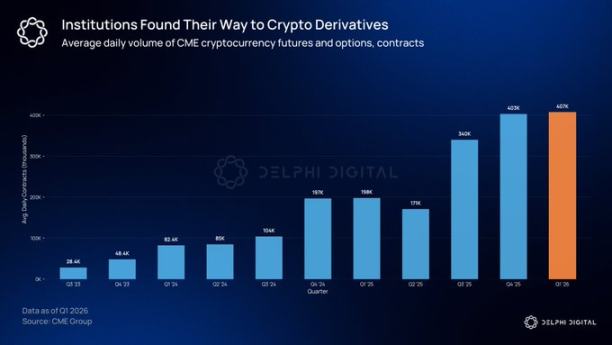
The scale of the cryptocurrency options market far exceeds most people’s perception. Trading volume in cryptocurrency derivatives at the Chicago Mercantile Exchange (CME) is up 46% compared to last year’s record high. Institutional investors require clear risk-management tools to hedge large positions—and options are the only crypto-native instrument that delivers this capability.
Reshaping the Landscape
By mid-2025, total open interest in Bitcoin options reached $65 billion—surpassing futures open interest for the first time. Futures are leveraged instruments, whereas options allow funds to cap losses on a $500 million Bitcoin position by paying a premium. This inflection point signals that instruments with defined risk profiles are gradually displacing purely leveraged tools.
This growth is concentrated on two platforms. Deribit has long been the dominant platform for crypto options trading; its acquisition by Coinbase for $2.9 billion in 2025 conferred institutional-grade credibility. Meanwhile, IBIT options—launched at the end of 2024—have brought traditional financial capital into this space. The options market is expanding rapidly, yet the vast majority of trading still requires intermediaries.
Onchain Options Remain in Their Infancy
The market share of decentralized derivatives has climbed from 2% to over 10% within two years. Hyperliquid has demonstrated that decentralized exchanges (DEXs) can match centralized exchanges in speed and transparency. Yet no comparable flagship project has emerged for onchain options.
@DeriveXYZ remains the leading onchain options protocol, recording over $700 million in notional options volume over the past 30 days. Originally launched in August 2021 as Lyra—an options automated market maker (AMM)—the protocol underwent a full rebuild following the bear market and now operates a gas-free central limit order book built atop its proprietary OP Stack Layer 2.
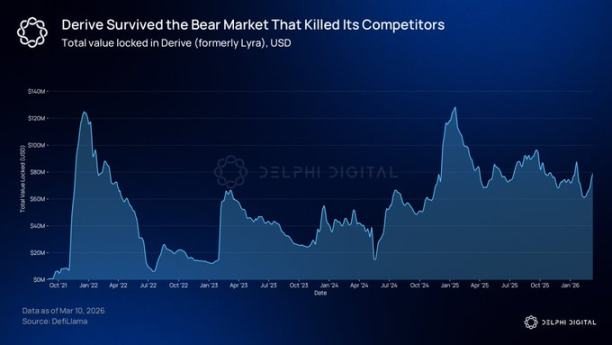
This rebuild completely transformed the pricing mechanism. Market makers now quote directly on the order book—tightening spreads, improving price accuracy, and enabling larger trades. Traders enjoy zero gas fees and sub-second execution speeds.
Its portfolio margining system has also drawn institutional attention. The system evaluates overall position risk via scenario analysis. For example, if a trader holds both a long call and a short put on the same underlying asset, the system does not charge margin separately for each leg.
The collateral required for hedged positions is less than the simple sum of individual leg margins—a standard logic used across traditional finance derivatives desks. Derive also offers perpetual contracts and lending services on the same Layer 2, supporting cross-product cross-margining.
@KyanExchange is advancing toward the same goal—but through a different approach. The platform integrates an order-book matching engine with onchain portfolio margining, enabling multi-leg strategies to be executed atomically in a single transaction. Traders can deploy iron condor strategies in just a few clicks.
Kyan’s liquidation mechanism also differs from most DeFi protocols. When margin thresholds are breached, the platform does not liquidate the entire account. Instead, it performs partial liquidations—closing only the minimal number of positions required to restore the account’s margin compliance. Kyan is currently in the Arbitrum testnet phase, with mainnet launch imminent.
Who Needs Options?
Asset management firms building structured products urgently need the clearly defined risk-return profiles that options provide. Take J.P. Morgan’s Equity Premium Income ETF as an example: built on a covered-call strategy, it ranks among the world’s largest actively managed funds. The total assets under management (AUM) for derivatives-based income products now exceed $100 billion. As more institutional capital flows onchain, corresponding hedging demand will follow.
Today, an increasing number of institutional investors already hold—or plan to allocate to—digital assets in the near term. Open interest in IBIT options has already surpassed that of gold ETF GLD. In 2025, CME processed $3 trillion in notional value of cryptocurrency derivatives trading.
Timing Is Ripe
Most early onchain options protocols failed to survive—primarily due to regulatory uncertainty. For instance, Opyn was penalized by the CFTC for operating a derivatives exchange without proper licensing. At the time of product development, teams had no way of knowing whether their product would be deemed illegal in the next quarter.
That situation is now improving. In September 2025, the U.S. Securities and Exchange Commission (SEC) and the Commodity Futures Trading Commission (CFTC) jointly issued a statement permitting regulated exchanges to conduct spot crypto-asset trading. The CLARITY Act has passed the House of Representatives, proposing to assign regulation of digital commodity spot markets to the CFTC. The Senate version remains under negotiation and is currently stalled. CME Group will launch around-the-clock cryptocurrency options trading on May 29. While this doesn’t guarantee victory for onchain protocols, the broader environment has undergone a substantive shift.
Join TechFlow official community to stay tuned
Telegram:https://t.me/TechFlowDaily
X (Twitter):https://x.com/TechFlowPost
X (Twitter) EN:https://x.com/BlockFlow_News
 Delphi Digital