DeFi Deposits Drop 15%, While RWA Deposits Rise to $7.4 Billion: On-Chain Finance Is Becoming Wall Street's New Pipeline
By: Xiao Bing
A report jointly released by CoinShares and Token Terminal on August 6 provided a set of data.
In Q2 2026, total DeFi deposits decreased by approximately 15% year-over-year. During the same period, on-chain Real World Asset (RWA) deposits surged from $2.33 billion to $7.44 billion, a year-over-year increase of over 200%. Total DEX spot trading volume plummeted by about 70% year-over-year, while RWA spot trading volume grew counter-trend by approximately 220%.
The shrinking part of DeFi consists of crypto-native assets, while the growing part almost entirely comes from traditional financial assets on-chain: US Treasury bonds, money market funds, private credit, gold, crude oil, stock index futures.
This is the current state of crypto finance.
DeFi is Contracting, RWA is Expanding
DeFi TVL continued to decline in 2026. It fell steadily from about $115 billion at the beginning of the year, touching a year-to-date low of $69.4 billion in early June, with a drop nearing 40%. Ethereum DeFi base fell by 43%, Arbitrum fell by 55%, and Plasma fell by nearly 75%.
The factors driving the decline are clear: BTC entered a downward cycle from its all-time high of over $122,000 in October 2025, driving deleveraging across the entire crypto market; declining yields led to the unwinding of arbitrage cycles and recursive lending positions; plus 121 hacker attacks had already occurred in 2026, with cumulative losses of about $942 million. After Kelp DAO suffered a theft of $293 million on April 18, Aave users withdrew about $15 billion in deposits within four days.
Confidence is eroding, leverage is being unwound, and speculative capital is exiting; this is the "crypto-native" side of DeFi's contraction.
In sharp contrast to crypto-native DeFi is the explosion of RWA deposits.
Report data shows that the main composition of RWA deposits is: tokenized Treasury bond funds (represented by BlackRock's BUIDL, with AUM reaching about $2.87 billion by mid-July, making it the largest single tokenized Treasury product), yield-bearing stablecoins (Sky Protocol's sUSDS led this category in Q2), multi-strategy funds, and private credit. The common characteristic of these assets is that they come with yields; while being used as on-chain collateral and lending targets, they still generate interest, meaning investors do not need to give up the yields of the underlying assets to obtain on-chain liquidity.
Lending protocols such as Aave, Morpho, and Kamino are increasingly accepting RWA as collateral. Users can use tokenized Treasuries to borrow stablecoins, rather than having to collateralize ETH or BTC as before. The latter's price volatility often reaches 30%, while the former's volatility is nearly zero. For lending protocols, this means less liquidation risk; for borrowers, this means higher capital efficiency.
Ethereum accounts for nearly 70% of the share of RWA lending collateral.
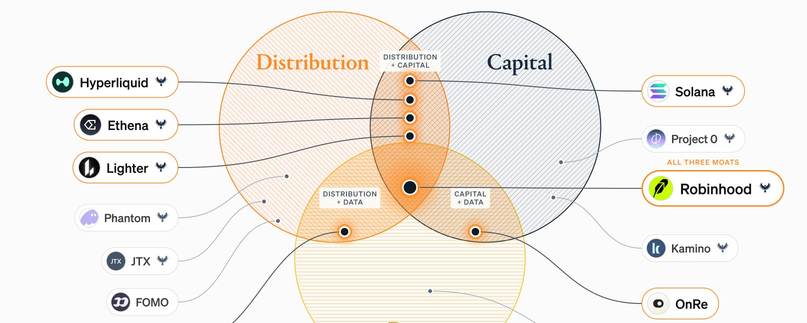
CoinShares explains that both lenders and borrowers prefer markets with deep liquidity, and Ethereum still has no rival in large-value transactions and institutional-level capital inflows and outflows. Solana is growing faster on the spot trading side, while Hyperliquid has emerged rapidly on the derivatives side.
By mid-2026, the total value of on-chain RWA (excluding stablecoins) had reached about $37.89 billion, with nearly 789,000 holder addresses. The tokenized US Treasury category has grown from less than $1 billion at the beginning of 2025 to over $15 billion, with BlackRock controlling about 40% of the share.
Derivatives Explosion
If deposit data reflects "assets on-chain," then derivatives data reflects "trading on-chain."
RWA perpetual contracts went from a category that barely existed to one of the main forces in on-chain trading in less than six months. Quarterly trading volume surged from $12.37 billion in Q4 2025 to $202.7 billion in Q2 2026, an increase of about 16 times. Data from DWF Ventures at the end of July shows that RWA perpetual contracts once accounted for 37% of the total trading volume of all market perpetual contracts.
TradeXYZ on Hyperliquid is the biggest player in this field, with cumulative trading volume reaching $350.7 billion, far exceeding Binance's $42.1 billion. Hyperliquid's RWA perpetual contracts open interest reached a historical high of $2.65 billion in May, doubling within two months. Trading targets are concentrated in commodities (accounting for 70-95%), but equity perpetual contracts surged 121% month-over-month in May, with S&P 500, Nasdaq 100, and tech stocks becoming the fastest-growing categories.
What does this mean?
A decentralized exchange built on crypto-native infrastructure has nearly half of its trading volume coming from crude oil, gold, the S&P 500 index, and Nvidia stock, having nothing to do with cryptocurrency. Hyperliquid is no longer just a DeFi protocol; it is becoming a global financial asset trading venue operating 24/7.
After seeing these data, Circle co-founder Jeremy Allaire stated: The crypto market is shifting from "speculation on endogenous digital commodities" to the external world.
Not Replacement, but Embedding
Piecing these data together, the picture is clear.
On-chain finance is growing, but the source of growth has quietly changed. The on-chain boom in 2021 was a liquidity mining cycle driven by token incentives: protocols issue tokens → users deposit assets to earn tokens → tokens rise → more people come to deposit; essentially an internal cycle of crypto assets. This cycle collapses rapidly when the market turns cold; the decline in DeFi TVL in 2026 is a continuation of this collapse.
The drivers for on-chain growth in 2026 are completely different. BlackRock moving US Treasuries onto Ethereum values that on-chain settlement is faster, cheaper, and operates 24/7 compared to traditional settlement. Institutional investors use tokenized Treasuries for collateralized lending on Aave, aiming to achieve both 4.5% Treasury yields and on-chain liquidity simultaneously. Traders trade crude oil perpetual contracts on Hyperliquid because when geopolitical events explode on Sunday nights, traditional markets are closed, but on-chain markets are not.
CoinShares CEO Jean-Marie Mognetti gave a judgment in the report: When an asset class grows counter-trend during the downward cycle of its host ecosystem, it indicates that demand is driven by financial utility and is unrelated to market cycles.
RWA growth does not depend on a crypto bull market, does not depend on token incentives, and does not depend on speculative sentiment. It depends on real improvements in settlement efficiency, 24/7 liquidity, and capital efficiency.
A set of numbers is enough to illustrate the gap. The global stock market size exceeds $100 trillion, while the currently tokenized portion on-chain is about $2.2 billion, with a penetration rate of 0.002%. CoinShares compares the current stage to stablecoins in 2019; the concept has been validated, infrastructure has just been laid, but mass adoption still requires time.
The GENIUS Act was signed into law in July 2025, providing a federal-level regulatory framework for stablecoins, and the OCC has already issued national trust bank licenses to companies such as Circle and Paxos. Regulatory clarity is releasing institutional capital that was previously on the sidelines. BlackRock applied to the SEC for two new tokenized funds in May, plus on-chain shares of a $7 billion money market fund. This company, managing over $10 trillion in assets, is already upgrading tokenization from an experimental project to a product line.
$7.44 billion in RWA DeFi deposits, compared to the total on-chain RWA volume of $37.89 billion, means DeFi has absorbed only about 20% of on-chain real assets. The report believes that RWA currently deployed in DeFi lending is about $2.5 billion; compared to a tokenized asset base of over $30 billion, there is 12 times room for expansion, provided that technical and regulatory barriers continue to be eliminated.
The growth narrative of on-chain finance is being rewritten.
In the previous cycle, the story told by the crypto industry was that DeFi would replace banks. Data from this cycle indicates that replacement has not occurred. What is happening is that bank assets are beginning to choose blockchain as the settlement layer.
Blockchain has not replaced Wall Street; it is becoming Wall Street's new pipeline.
Join TechFlow official community to stay tuned
Telegram:https://t.me/TechFlowDaily
X (Twitter):https://x.com/TechFlowPost
X (Twitter) EN:https://x.com/BlockFlow_News
 深潮TechFlow