Why Only Dollar-Cost Averaging Can Capture Bitcoin’s Long-Term Dividends?
TechFlow Selected TechFlow Selected
Why Only Dollar-Cost Averaging Can Capture Bitcoin’s Long-Term Dividends?
Entry timing affects the level of returns, but long-term holding is the key determinant of return magnitude.
 Navigating Web3 tides with focused insights
By: Cointelegraph
Translated by: AididiaoJP, Foresight News
Both backtested data and forward-looking models suggest that dollar-cost averaging (DCA) is the optimal strategy for investing in Bitcoin (BTC). But will this approach still work in the next bull market?
Bitcoin has plunged 50% over the past five months. Savvy investors adjust their strategies during such bear markets and corrections. This strategy—known as dollar-cost averaging—involves investing a fixed amount at regular intervals, regardless of market conditions.
Using historical market cycle data and forward-looking BTC price simulations, we can better assess how this robust investment method performs across different entry points and investment horizons.
Five-Year BTC DCA Yields Strong Net Returns
Starting in January 2021, investing $250 weekly into Bitcoin for five years results in a total investment of $67,500. According to DCA simulation data, this strategy accumulates 1.65097905 BTC at an average purchase price of $40,884.
At Bitcoin’s current price near $71,000, this holding is worth approximately $120,500—a profit of $53,000 (76% gain). If Bitcoin reaches $100,000, the position would be worth roughly $165,000; at the cycle peak near $126,000 projected for October 2025, its value would reach $208,000.
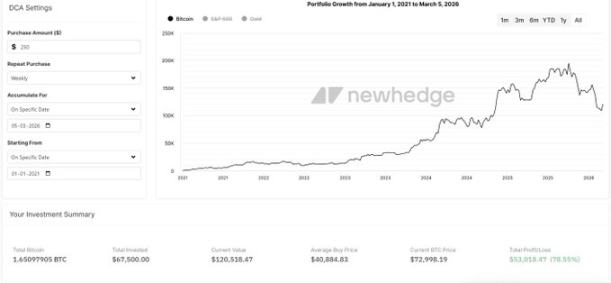
BTC DCA Cycle, 2021–2026. Source: Newhedge
Now consider a shorter investment horizon to examine how entry timing affects early returns. Starting weekly DCA of $250 in January 2024 yields a total investment of $28,500, accumulating 0.36863166 BTC at an average purchase price of $77,312.
At Bitcoin’s current price of $71,000, this holding is worth approximately $26,909—a paper loss of 6%. At $100,000, its value rises to $36,863; at the cycle peak of $126,000, it reaches $46,448.
In February this year, Swan Bitcoin analyst Adam Livingston compared five-year DCA returns for BTC versus the S&P 500 Index on X. Investing $100 weekly yielded $42,508 for BTC and $37,470 for the S&P 500, representing returns of 62.9% and 43.6%, respectively.
Livingston noted that although Bitcoin’s price is highly volatile, historical data shows long-term returns are actually higher when DCA is maintained through downturns.
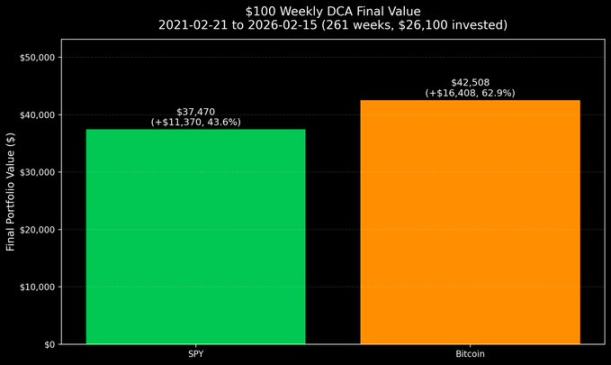
Weekly $100 DCA: BTC vs. S&P 500. Source: Adam Livingston/X
Long-Term Models: Time Is the Key Factor
Forward-looking simulation studies also tested DCA performance beginning in 2026. Starting $250 weekly DCA in January 2026 through March 2030 yields a total investment of approximately $54,250.
Price projections are based on Bitcoin’s long-term power-law growth curve—which tracks historical BTC prices against time on a logarithmic scale. This model generates an upward-sloping support band and a median trend line, broadly aligning with prior market cycles.
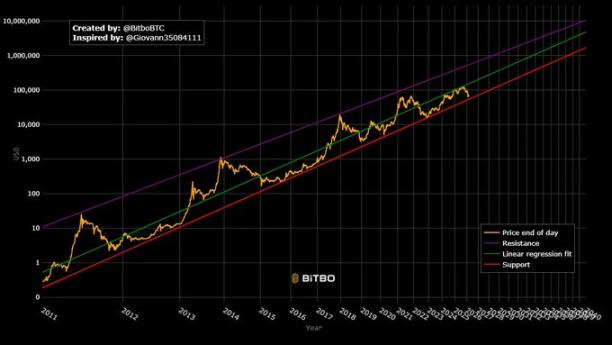
Bitcoin Power-Law Growth Curve. Source: Bitbo.io
According to this model, analysts estimate the long-term trend support level may break above $100,000 by 2028—forming the foundational assumption for future DCA modeling. Bitcoin Well’s simulation projects a median price of approximately $430,000 by March 2030.
Accounting for potential price deviation, the model also incorporates upper and lower bounds of the power-law channel, yielding a low-case projection (~$274,000) and a high-case projection (~$900,000).
Based on these assumptions, four years of DCA would accumulate roughly 0.30 BTC:
- If BTC reaches $274,000, the position is worth ~$82,200.
- If BTC reaches $430,000 (median projection), the position is worth ~$129,000.
- If BTC reaches $900,000, the position is worth ~$270,000.
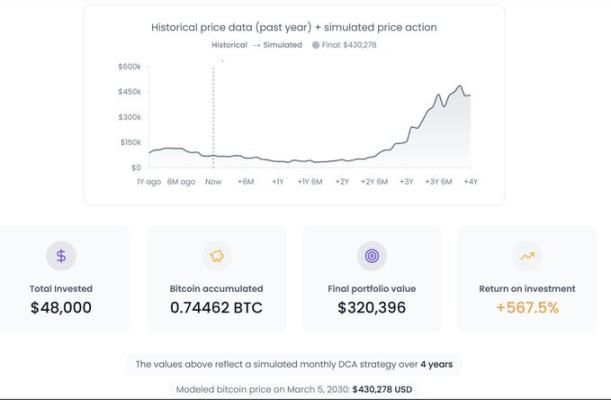
DCA Investment Results Through March 2030. Source: Bitcoin Well
In November 2025, Bitcoin researcher Sminston With conducted a study using a similar predictive model to test how entry timing impacts long-term returns. The results showed that even if the purchase price were 20% higher than the then-current $94,000 level—and the sale price 20% lower than the projected 2035 median—the remaining holdings would still yield nearly a 300% return after ten years.
In this simulation, the final total asset value was 7.7 times the initial investment.
The study concludes: Entry timing affects the magnitude of returns, but long-term holding remains the decisive factor in determining overall profitability.
Join TechFlow official community to stay tuned
Telegram:https://t.me/TechFlowDaily
X (Twitter):https://x.com/TechFlowPost
X (Twitter) EN:https://x.com/BlockFlow_News
 @Cointelegraph