

Recently, a large number of DeFi protocols have shut down—yet they all share one common trait.
TechFlow Selected TechFlow Selected
Recently, a large number of DeFi protocols have shut down—yet they all share one common trait.
Compared to the outright exit with stolen funds in 2022, the industry has learned to die responsibly.
 Navigating Web3 tides with focused insights
By Ignas
Translated by Chopper, Foresight News
Over the past two months, at least 10 crypto protocols have announced shutdowns—not exit scams, but closures due to lack of users, lack of funding, or both.
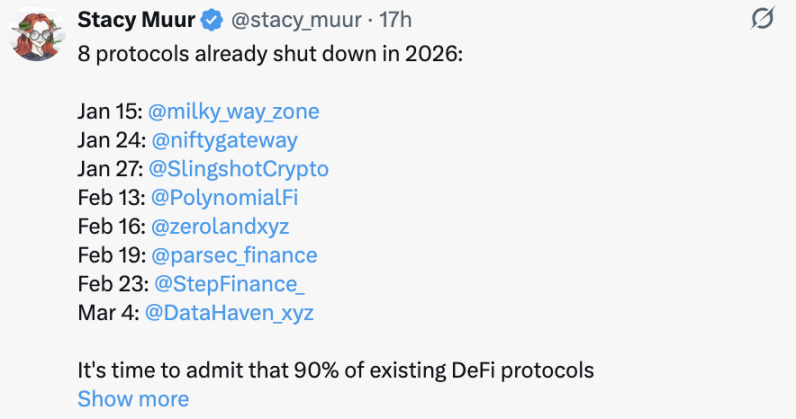
Not to mention mining firms like BlockFills and lending platforms freezing withdrawals. Just yesterday, Angle announced (https://x.com/AngleProtocol/status/2029161525580112263) the phased shutdown of its EURA and USDA stablecoins—even though they once held $250 million in total value locked (TVL) and had strong business partnerships.
In its announcement, Angle stated bluntly: “The decentralized stablecoin landscape has fundamentally changed. Today’s yield-bearing stablecoins are essentially just branded wrappers atop existing treasuries and lending protocols—there’s no longer any need to maintain a separate, standalone infrastructure.”
Nearly all these shuttered projects had fully functional products:
- Polynomial accumulated $4 billion in trading volume across more than 70 markets
- MilkyWay reached a peak TVL of $250 million
- Step Finance hit a high of 300,000 monthly active users
I’ve personally used—or at least tried—all of these products. Technically, they worked fine—but no one was willing to pay the fees required to keep them alive.
MilkyWay is a textbook example: four pivots in under two years. It began with Celestia liquid staking, then shifted to restaking, real-world asset (RWA) tokenization, and finally an encrypted debit card for rent payments—each pivot chasing the latest market trend.
Its description of restaking (https://x.com/milky_way_zone/status/2011770175566332325) hits hard: “We spotted the restaking opportunity early, designed the system, scaled TVL to $250 million, completed security audits, and were ready to launch—only for the market to abandon restaking faster than anyone anticipated.”
Ultimately, it admitted that funds ran out before it could achieve product-market fit.
Polynomial’s team gave an exceptionally candid explanation of why it failed, delivering a sobering lesson for all perpetual contract projects: “In derivatives, technical excellence is irrelevant. We improved execution speed, optimized UX, and built innovative infrastructure—but none of it mattered. Traders go where liquidity is, and we didn’t have it. Everything else was just flashy window dressing.”
Their conclusion was even harsher: “Liquidity is the only moat in derivatives. You cannot beat liquidity with innovation, marketing, or development.”
ZeroLend’s shutdown serves as a warning to decentralized applications attempting to launch across multiple blockchains. It bet on niche chains—including Manta, Zircuit, and Xlayer—to support its project, but when the market turned bearish, those chains lost liquidity entirely—and oracle providers stopped servicing them.
Ultimately, prolonged operational losses made continuation unsustainable.
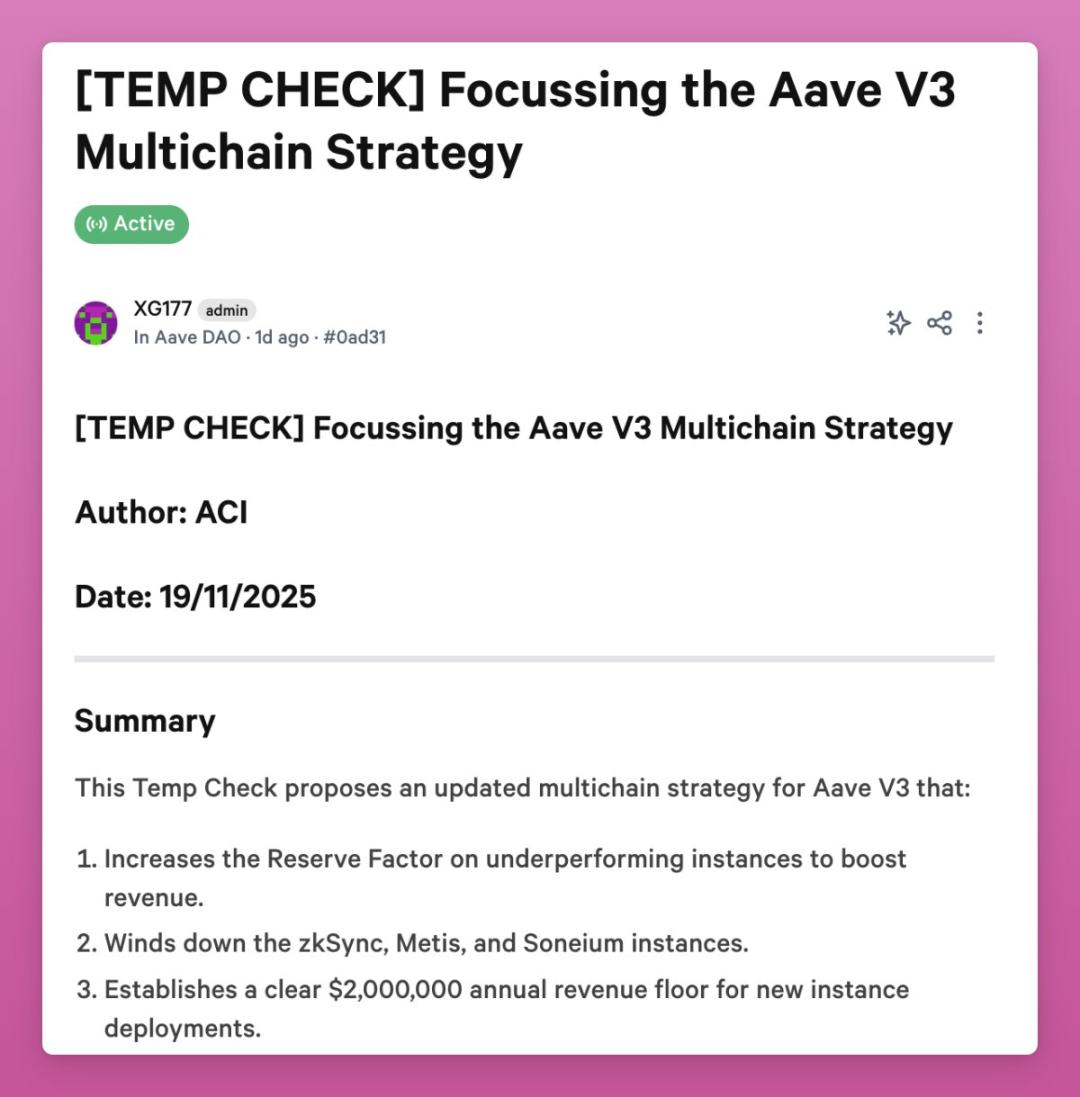
Aave recently voted to shut down services on several chains, citing unprofitable operations as the reason.
Then there’s Parsec—the once legendary on-chain analytics tool relied upon during Terra’s collapse, the 3AC implosion, and the stETH depeg. Yet the team admitted: “After the FTX collapse, DeFi spot, lending, and leveraged trading never returned to their former state. The market changed. On-chain behavior changed. And we failed to truly understand it.”
Put simply: the market moved on—while we stayed put. Markets are brutal.
Slingshot shut down completely after being acquired. Eden cut 80% of its unprofitable products, retaining only its core business.
As they put it: “The 80/20 rule has become reality—we spent 80% of our costs on products generating just 20% of revenue.”
Step Finance stands apart: it was hacked for $26 million on January 31 and effectively declared dead. “We tried fundraising and acquisition talks—neither succeeded.”
What do these failed projects have in common? They failed to adapt to a rapidly shifting market—and lacked sufficient capital to pivot again.
Each team bet on explosive growth within a particular ecosystem—but either growth was too slow, or never materialized at all. Celestia-based DeFi never truly took off; on-chain derivatives struggle to compete with Hyperliquid—even established platforms like dYdX and GMX face mounting challenges.
Meanwhile, expanding into new chains and narrative domains carries prohibitively high costs.
For players like me, moving funds from one platform to another is effortless—and cheap. But apps must invest significantly more time and capital to prepare for potential new user bases.
The good news? These are “graceful deaths.” All projects gave users ample time to withdraw funds; teams did not rug pull or dump tokens to loot users. Compared to the outright exit scams of 2022, the industry has indeed learned how to die responsibly.
Join TechFlow official community to stay tuned
Telegram:https://t.me/TechFlowDaily
X (Twitter):https://x.com/TechFlowPost
X (Twitter) EN:https://x.com/BlockFlow_News
 Ignas | DeFi Research















