AI as the Villain: DeFi Insurance Needs a Stress Test
Author: jrdothoughts
Translated by: AididiaoJP, Foresight News
The Blind Spots of DeFi Insurance: Never Having Failed Doesn't Mean It's Safe
Let's start with a darkly humorous sales pitch: "Our new aircraft is absolutely safe; it has never crashed."
"How long has it been flying?"
"…About twice."
Replace the aircraft with a DeFi vault, and the story becomes familiar: six months of smooth withdrawals, no hacks, decent yields. That is, of course, evidence. But during those six months, did it encounter collateral depegging during network congestion, LPs rushing to withdraw, or oracle failures without updates? Probably not.
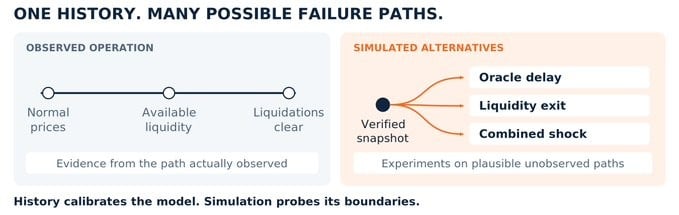
A clean history only shows what a system has endured. Underwriting must ask: what might it run into next?
This is the opportunity Firelight sees: pricing based on how losses form, rather than just whether they have occurred. History provides the anchor, simulations explore alternative scenarios, AI identifies vulnerabilities, and capital backs the commitments.
History Is a Snapshot, But Systems Change
Historical loss data is a snapshot of a machine operating under one set of conditions. Once the machine changes, the snapshot must be re-evaluated.
A vault adds new collateral types, switches oracles, and increases leverage. The name hasn't changed, the logo is the same, but the risk profile is vastly different. The borrowers, liquidators, and LPs inside are not static numbers on a spreadsheet. They react to incentives, and when things go wrong, they all try to flee through the same exit door.
It’s like a traffic map drawn based on a typical Tuesday commute. It looks accurate most days, but once the main bridge closes, it’s useless. The map itself isn't wrong; the road conditions have simply changed.
So for Firelight, the real question isn't just "has this protocol ever been hacked," but rather: what permissions exist? Which dependencies are truly critical? When everyone rushes out simultaneously, which liquidation paths remain viable? Firelight’s published framework separates technical exploits from economic fragility, rather than blending them into a single security score.
Underwriting targets a system’s current architecture and dependencies, not the brand name it has carried so far.
Catastrophe Insurance Has Already Written the Playbook
Traditional insurers haven't abandoned modeling uncertainty. Catastrophe insurers have consistently done one thing: simulate how disasters unfold, which assets are exposed, how fragile the structures are, and how much contracts will ultimately pay out. Hurricanes that have struck in the past cannot represent every hurricane that may occur in the future.
DeFi also needs its own catastrophe model. Only here, the disaster shifts from hurricanes to oracle failures, the exposed assets shift from buildings to lending positions, and fragility shifts from structural integrity to collateral buffers and liquidation design, before payouts are calculated according to coverage terms.
Catastrophe models ask: what happens when a hurricane sweeps through a city? DeFi models ask: what happens when a single failure cascades along the dependency graph?
Firelight has publicly discussed combining risk decomposition, historical calibration, Monte Carlo simulations, language models, and reinforcement learning into a financial crash-test laboratory. To clarify, this is a proposed direction, not a claim that every component is already live.
One more point to note: Firelight defines its product as protocol-based coverage rather than traditional insurance contracts. The use of insurance analogies here refers solely to underwriting discipline, and does not imply any legal classification of the product.
How to Build a Financial Crash-Test Laboratory
Step one: lock down the initial state to ensure reproducibility. Contract versions, balances, collateral positions, oracle configurations, liquidation rules, and market liquidity must all be fixed. Otherwise, mismatched simulation results could simply stem from different starting points, meaning you aren't testing the same system.
Step two: separate execution from assumptions. Blockchain forks can execute real contract logic, but they cannot conjure tomorrow's liquidity, off-chain prices, or human behavior out of thin air. These must be explicitly modeled. Fork-based, agent-driven testing already has precedents in DeFi research.
Step three: populate the simulation environment with various actors. Borrowers, liquidators, depositors, and LPs each have capital constraints and incentives. But no one gets a protagonist halo: liquidators cannot make money-losing trades just to force a tidy conclusion. Roles don’t all need large language models; simple, transparent rules are often better, faster, and easier to reproduce. Technical failures still rely on fuzzing, code audits, and fault injection; these methods run parallel to, not instead of, economic simulations.
Step four: introduce stress. Test price gaps, oracle update delays, liquidity evaporation, and execution halts. Vary not only the magnitude but also the sequence. Liquidity pulled by an LP before a price shock versus after can yield completely different outcomes.
What a simulation should ultimately yield is not a vague security score, but a loss chain: which position fails first, how much gets recovered, and how the shortfall cascades. With that chain, you can determine coverage limits and capital requirements, or simply issue a "not covered" verdict.
Put AI in the "Villain Seat", But Don't Let It Rewrite Physics
The most straightforward use of AI is reading code and documentation. Language models can map dependencies, explain upgrades, and propose failure scenarios. But a plausible narrative doesn't equal a discovered vulnerability; it still requires evidence.
A more interesting application is letting AI actively hunt for possible scenarios. Monte Carlo sampling draws from predefined distributions, which is useful; but truly catastrophic combinations may be too rare, leaving random sampling to repeatedly discover average cases.
Adaptive stress testing flips this: agents within the simulator choose perturbations, actively seeking credible failure paths. Reinforcement learning has already demonstrated this approach in autonomous driving testing. An agent can change the weather, but it cannot rewrite the laws of physics.
In Firelight’s proposed setup, agents adjust oracle delays, liquidity withdrawal rates, and liquidator response times within realistic bounds. They are rewarded for finding destructive paths and penalized for cheating. A villain with infinite capital and god-mode privileges makes for a useless underwriting model.
Then let AI cluster failure trajectories and select the next batch of experiments that best reduce uncertainty. Hundreds of seemingly different disasters may share a single liquidation bottleneck. That is where actionable value lies.
Speed matters too. Low-cost approximation methods filter vast scenario pools first, while expensive execution tests replay key scenarios across multiple independent environments. But shortcuts must be validated. Accelerating a flawed simulator just lets it make confident mistakes faster.
AI plays the driver in adversarial testing, not the safety referee. It points out what needs investigation, but the execution engine, domain experts, and evidence determine whether a finding holds up.
From Loss Trajectories to Coverage Terms
Imagine a hypothetical lending vault: collateral prices drop, LPs withdraw en masse, and oracle updates lag. Liquidators enter the fray, but slippage consumes recovery value, leaving borrowers owing more than their collateral can actually sell for.
Run control groups: price drops alone; liquidity drained alongside price drops; several factors combined. Only then can you isolate whether the true weakness lies in pricing, market depth, or their interaction.
Suppose a sample run generates $2 million in eligible losses, with a $500,000 retention and a $1 million coverage limit. The retention layer absorbs $500,000, the coverage pays $1 million, leaving the remaining $500,000 outside the limit.
These are fictional example terms, not quotes from Firelight, nor actual simulation results. Eligibility, recovery mechanics, exclusions, and overlapping coverage still require clarification.
The key point is: economic loss does not automatically trigger a payout. A simulation is only truly useful if it influences underwriting decisions—such as lowering coverage limits, demanding stricter risk controls, holding more capital, or outright denial. Beautiful disaster animations do not constitute financial decisions.
Finding Failure Paths Does Not Equal Calculating Probability
Suppose an adversarial agent breaches the system in 30% of tests. Does that mean the system has a 30% failure probability? Not at all. This agent was specifically designed to find vulnerabilities.
Discovering failures answers "how it could break and how bad it could get." Estimating probabilities answers "how frequently these conditions would occur during the coverage period." Conflating the two manufactures false precision.
Conceptually, expected payout is the sum of payout amounts across each scenario multiplied by that scenario’s probability. These probabilities require evidentiary support, and assumptions must be explicitly stated. If credible estimates are unavailable, use ranges, conservative caps, and stress constraints rather than fabricating precise decimal figures.
Expected payout does not equal total premium. Capital must also cover tail risk, operational costs, and uncertainty, and tail risks are often particularly nasty. At a portfolio level, shared dependencies could trigger simultaneous payouts across multiple contracts.
Firelight’s published capital framework already accounts for concentration and collateral drawdowns. Simulations should stress both ends simultaneously: surging claims on one side, and synchronous depreciation—or even illiquidity—of underlying assets on the other. If capital shrinks precisely when a major disaster strikes, the coverage pool cannot be estimated merely by average losses.
Who Stress-Tests the "Stress Tester"?
A simulator can be logically consistent yet arrive at entirely wrong conclusions. Running unrealistic liquidator parameters a million times just repeats the same error a million times. More runs reduce sampling error, but they do not automatically shrink the model’s inherent bias.
A credible lab does four things: reviews known events, validates with out-of-sample data, compares models built independently by different teams, and adjusts assumptions about participant behavior. Snapshots, random seeds, and run logs must be archived so key findings can be reproduced. Constant vigilance is required: ask repeatedly, "Did the AI find a protocol weakness, or just a simulator bug?"
No test suite can prove it has uncovered every possible disaster path. Precisely because unknown dependencies and unprecedented behaviors exist, capital buffers, exclusions, and underwriting discipline are essential.
Contract boundaries must also be clearly defined. New evidence can inform future pricing and capacity, but it shouldn't turn existing coverage into a moving target. Firelight’s published framework separates continuous risk monitoring from fixed premiums during the coverage period. Continuous learning and honoring commitments can coexist; rewriting promises once danger emerges cannot.
Conclusion: Learn Before Losses Occur
The greater value lies in embedding underwriting into the development lifecycle. Major system changes trigger corresponding tests; test results inform new coverage decisions; real-world events refine the next model version. Better engineering eventually translates directly into better coverage pricing and accessibility.
Historical claims patch things up retrospectively. Simulation allows Firelight to anticipate upfront how a system might fail.
AI expands the search space, evidence constrains its conclusions, and capital backs the commitments. The goal is not to predict every disaster, but to deploy capital strategically after understanding potential threats, ensuring readiness to absorb unavoidable losses.
Join TechFlow official community to stay tuned
Telegram:https://t.me/TechFlowDaily
X (Twitter):https://x.com/TechFlowPost
X (Twitter) EN:https://x.com/BlockFlow_News
 @jrdothoughts