Polygon's New Token Upgrade Approaches: Is It Worth Staking MATIC?
TechFlow Selected TechFlow Selected
Polygon's New Token Upgrade Approaches: Is It Worth Staking MATIC?
In the initial phase following the token upgrade, POL will serve as the gas fee and staking token for Polygon PoS.
 Navigating Web3 tides with focused insights
Author: 1912212.eth, Foresight News
In the early hours of August 22, news that Coinbase had added Polygon Ecosystem Token (POL) to its listing roadmap finally brought Polygon—long forgotten by the market—back into the spotlight. MATIC surged over 6% within four hours, breaking above 0.5 USDT.
POL is the migration token for Polygon (MATIC). Polygon's mainnet upgrade is scheduled for September 4 this year. After receiving community approval, its native token will transition from MATIC to POL.
MATIC, once a hundred-bagger during the previous bull run, led the market when competitors like Arbitrum and OP had not yet launched their mainnets. It enjoyed strong investor enthusiasm and capital inflows, prompting even Dragonfly partners to write about their excitement for Rollups while worrying they might arrive too late to be appreciated.
Times have changed. Ethereum Layer 2 solutions have not received overwhelming attention, and MATIC’s price has gained just over 1x in the past year. Can this rebranding revive MATIC’s lackluster performance?
MATIC Token Auto-Upgrade on Polygon Mainnet
In the crypto industry, some established projects opt to refresh their brand name or token symbol to revitalize their image and strengthen brand alignment. This time, Polygon’s token upgrade primarily involves changing the token name to POL. The token upgrade proposal was introduced and approved in September 2023 but has not been implemented until now—September 4 marks the official upgrade date.
MATIC tokens on Polygon PoS do not require any user action and will be automatically converted to POL after the mainnet upgrade. MATIC tokens on Ethereum, Polygon zkEVM, and various exchanges will be migrated later. Additionally, MATIC on Ethereum can be exchanged via certain DEX aggregators such as Kyber and CowSwap.
POL will replace MATIC on a 1:1 basis, with an initial supply of 10 billion POL and an annual emission rate of 2% (adjustable based on community consensus). To incentivize validators and ensure network security, 1% of the total POL supply will be allocated as staking rewards for validators. The remaining 1% of annual emissions will go to the community treasury, which aims to support the development and expansion of the Polygon ecosystem. Managed by the community, the treasury will fund initiatives such as protocol development, research, ecosystem grants, and adoption incentives.
Initially, POL will serve as the gas fee and staking token on Polygon PoS. After the upgrade, according to PIP-42, validators on Polygon PoS must stake to earn protocol rewards and transaction fees.
Why Has the 'Swiss Army Knife' Been Invisible for So Long?
Polygon’s aggressive stance and actions in Ethereum scaling once amazed the industry. After establishing its flagship product, the sidechain Polygon PoS, in the last cycle, it quickly developed or acquired open-source zk-Rollup products such as Polygon zkEVM, the zk-OPRollup client Polygon Miden, and Polygon SDK to build zero-knowledge proof L2s on Ethereum. Earlier this year, it launched Agglayer, a cross-chain focused product.
Reviewing its full product suite, the breadth and density of its offerings truly set it apart from other protocols. However, over the past two years, as Arbitrum and OP—the two leading OP Rollup platforms—took center stage, Polygon PoS faced growing skepticism about its legitimacy, often being labeled merely a sidechain rather than a true L2. In the ZK space, ZKSync has firmly secured the dominant position, unmatched by others. Meanwhile, cross-chain protocols like Wormhole and LayerZero have alternately captured market attention. This "full-stack" strategy has revealed weaknesses due to a lack of focus.
Personnel losses have also had negative impacts. At the beginning of 2023, Polygon spun off its modular blockchain project Avail into an independent entity. Anurag Arjun, co-founder of Polygon, left Polygon and took over Avail, followed by Prabal Banerjee, head of research at Polygon, who also departed to join Avail. In October, Jaynti Kanani, another co-founder, announced his exit from day-to-day operations to pursue new ventures. Additionally, Michael Blank, COO of Polygon Labs since March 2022, announced his departure in April 2024.
The exits of multiple core executives and co-founders have raised market concerns about Polygon’s growth potential falling short of expectations.
Undervalued Compared to Competitors?
In June, Grayscale even removed MATIC from its fund holdings. Is MATIC still worth buying today? Let’s compare key L2 metrics. Take Arbitrum and OP as examples: MATIC currently has a market cap of $5.3 billion, with nearly fully circulating supply and an annual inflationary pressure of 2%. ARB has a current market cap of around $2 billion and an FDV of $5.7 billion. OP has a market cap of $1.8 billion and an FDV of $6.7 billion. Both competitors significantly surpass Polygon in FDV.
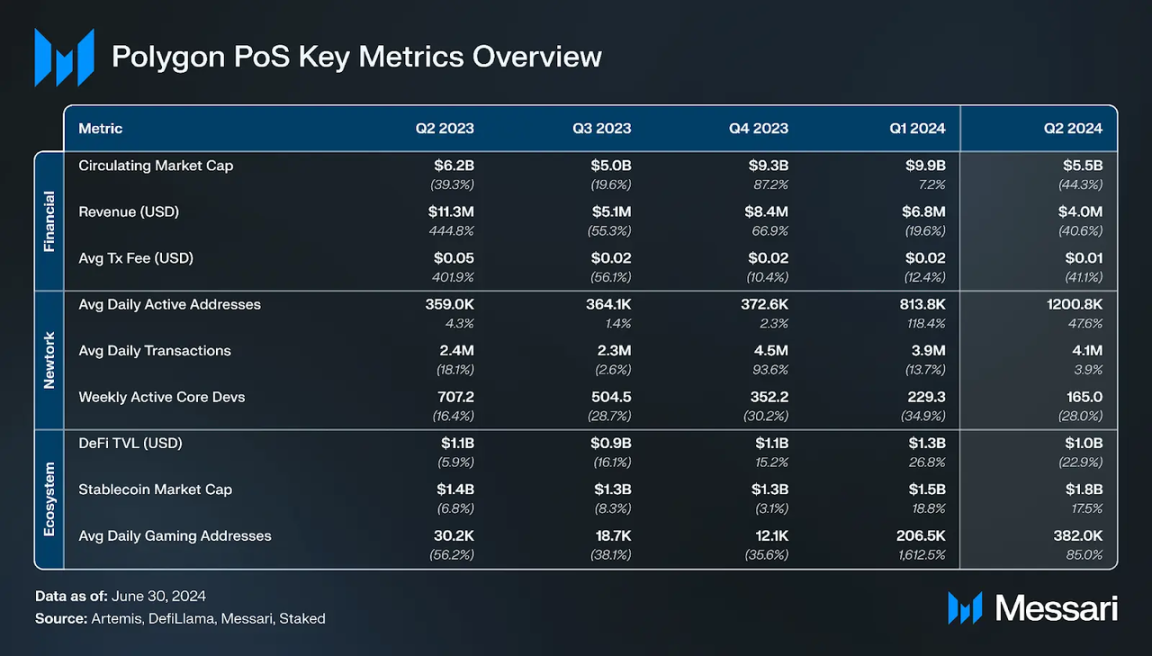
Data from Messari shows that by the end of Q2 this year, the average transaction fee on Polygon PoS dropped to $0.01, down 41.1% quarter-on-quarter. Daily active addresses reached 1.2 million (+47.6% QoQ), with an average of 4.1 million daily transactions (+3.9% QoQ).
In terms of average daily transactions, Arbitrum recorded 2 million (half of Polygon’s), while OP saw 400,000 (one-fifth of Polygon’s).
In stablecoin market cap, Arbitrum stands at $4 billion, OP at $1.2 billion, and Polygon at $1.8 billion—surpassing OP but trailing behind Arbitrum.
Judging by daily active addresses and average daily transaction volume, Polygon clearly holds a significant advantage, along with relatively low future selling pressure. Given its first-mover advantage in the last bull market, its current valuation of over $5 billion—just twice that of Arbitrum—falls within a reasonable range.
Moreover, under such transparent bullish catalysts as a token rebranding, whenever broader market trends turn upward, the token price typically fluctuates higher until the news is fully priced in, then declines.
Additionally, the modular blockchain Avail remains deeply integrated with Polygon, with airdrop eligibility mainly targeting MATIC stakers, greatly boosting users’ willingness to stake. Its products zkEVM and the cross-chain protocol Agglayer have not yet issued airdrops. As market热度 heats up again, they may regain attention through future airdrops.
On the macro front, the Fed is likely to cut interest rates, continuing to drive capital inflows into risk assets. Although L2s have been quiet for some time, during sector rotations, tokens backed by solid products and ecosystems will still attract investor interest.
Summary
MEMEs aren’t eternal—the era of "value investing" may be returning. With its official token upgrade and enhanced tokenomics utility, Polygon stands poised to regain vitality once broader market conditions improve.
Join TechFlow official community to stay tuned
Telegram:https://t.me/TechFlowDaily
X (Twitter):https://x.com/TechFlowPost
X (Twitter) EN:https://x.com/BlockFlow_News
 Foresight News