Bank of America warns: Falling US stocks could force the Fed to end rate hikes early
Author: Zhu Yu, Jinshi Data
With the US stock market continuing to decline, Wall Street has begun reassessing whether the Federal Reserve can continue tightening monetary policy amid market stress.
In the latest issue of his Flow Show report, Bank of America Chief Investment Strategist Michael Hartnett pointed out that the fastest way to halt Federal Reserve rate hikes may be for the US stock market to completely give up its cumulative gains from 2026.
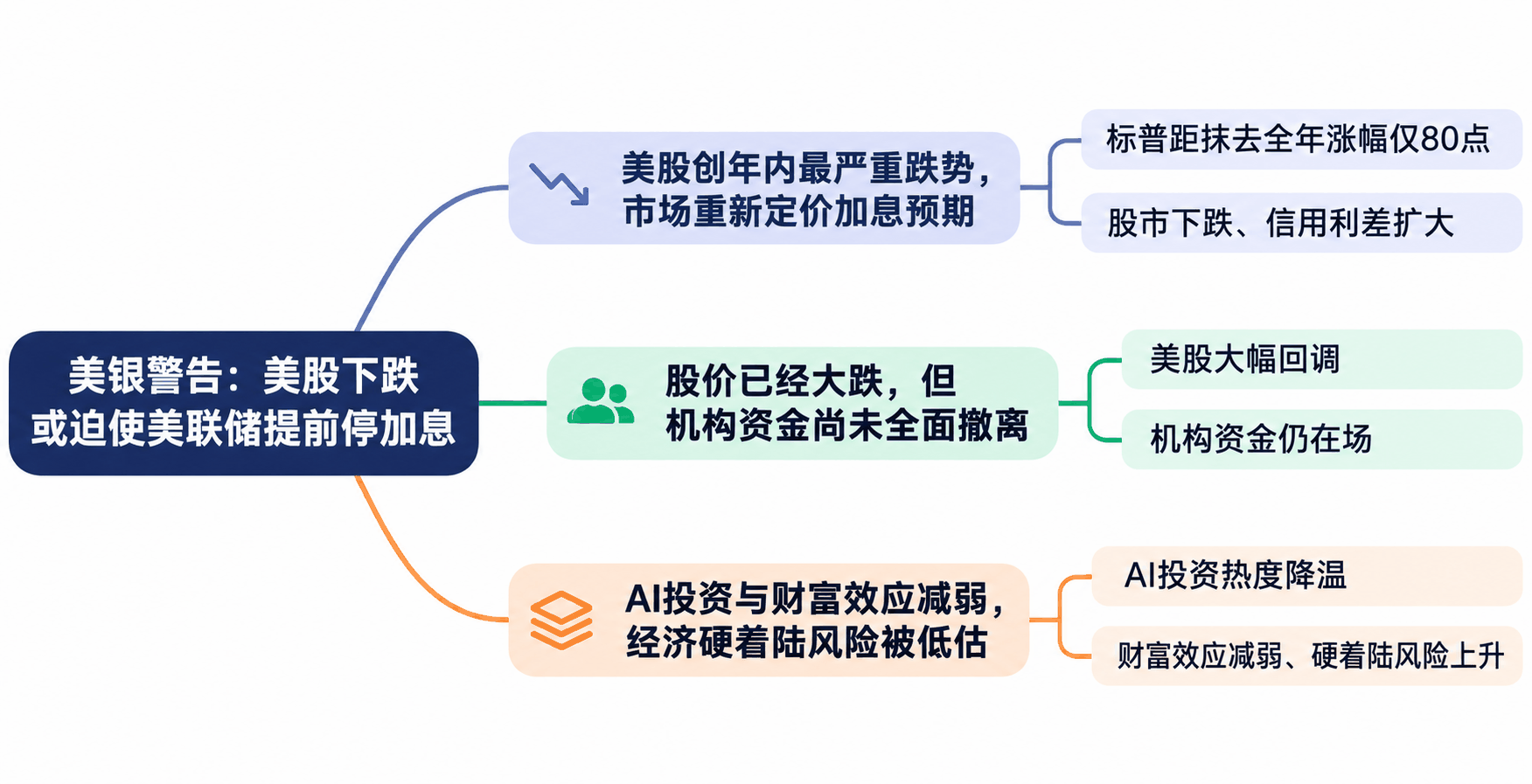
According to a November 22 report by ZeroHedge, the S&P 500 index closed at 6,925 on Friday (November 20), only 80 points higher than the 6,845 level recorded at the end of last year, meaning that a further decline of approximately 1.2% would erase all gains since the beginning of this year.
Hartnett believes that if the Fed continues to place high priority on financial market stability, a further drop in equities alongside widening credit spreads could prompt policymakers to bring forward the conclusion of this rate-hiking cycle.
However, this is merely a conditional scenario proposed by Bank of America and does not imply that a break below 6,845 in the S&P 500 will automatically trigger a Fed policy pivot.
US Stocks Post Year-to-Date Worst Decline as Market Begins Repricing Rate Hike Expectations
Over the past week, US equities have suffered intense selling pressure.
The S&P 500 index fell for seven consecutive trading days, finishing the week down 8.4%, marking its worst performance since market volatility was triggered by US tariff policies in April 2025.
The Nasdaq 100 index has dropped 19.8% cumulatively from its historic peak in October, sitting just one step away from the typical 20% threshold defining a technical bear market. The VIX index, which gauges market fear, briefly surged past 39.
Previously hawkish policy signals from the Federal Reserve are now intertwining with downward momentum in the stock market.
Fed Governor Waller had previously suggested that a one-time 50-basis-point hike in December might be necessary to break market expectations of persistent high inflation.
Yet, following the sharp adjustment in equities, bets on aggressive rate hikes have cooled considerably. On Friday, traders no longer fully priced in the probability of a December rate increase, and the previously highlighted 50-basis-point hike proposal has clearly lost market traction.
Hartnett identifies two potential policy paths ahead.
If the Fed remains inclined to adjust policy under severe stress on financial markets, a break below 6,845 in the S&P 500 combined with investment-grade credit default swap (IG CDX) spreads widening beyond 80 basis points could prompt an early end to the rate-hiking cycle.
But if the Fed more resolutely prioritizes inflation control, the market may not start assessing whether this rate-hiking cycle is nearing its end until around the March 18 or April 28, 2027 FOMC meetings.
In the latter scenario, the risk of a hard economic landing driven by sustained rate hikes will rise further.
Equities Have Plunged, But Institutional Capital Has Not Fully Exited
Despite the pronounced recent correction in the stock market, Hartnett maintains caution toward risk assets.
He observes that while concentrated selling has already materialized at the price level, investor portfolios have not yet been fully rebalanced.
The Bank of America November Global Fund Manager Survey reveals that surveyed fund managers hold an average cash allocation of just 3.6%, a historic low.
Meanwhile, only 3% of respondents anticipate a hard landing for the US economy, 50% forecast a soft landing, and another 42% expect no discernible landing at all.
Cash flow data also indicates that investors continue to steadily increase equity allocations.
Over the past four weeks, global equity funds and ETFs have drawn a cumulative inflow of approximately $310 billion, setting a new record.
In just the week ending November 18 alone, equity funds received $66.6 billion in net inflows, whereas bond funds saw outflows of $7.4 billion, marking the first weekly net capital outflow since April 2025.
This sharply contrasts with the persistently deteriorating market performance.
Hartnett notes that while certain hedge funds have drastically trimmed equity exposure, broader asset allocators still maintain elevated stock positions.
Should forthcoming economic data deteriorate further, institutional investors may be compelled to lower equity allocations, subjecting the market to additional sell-side pressure.
Weakening AI Investments and Wealth Effects, Undervalued Risk of Economic Hard Landing
Beyond monetary policy, Hartnett also questions two foundational drivers supporting US economic growth: household stock wealth and artificial intelligence capital expenditure.
Based on his report's estimates, US household stock wealth has contracted by roughly $5 trillion this quarter, even though cumulative wealth growth for 2026 remains around $8 trillion.
The erosion of stock assets may weaken the household wealth effect, subsequently impacting consumer spending.
Conversely, major US cloud computing firms plan to deploy approximately $1.3 trillion in capital expenditure in 2027, surpassing the projected $822 billion for 2026 and $412 billion for 2025.
However, as investment scales expand rapidly, the combined free cash flow of these companies is projected to flip from a positive $191 billion in 2025 to a negative $61 billion in 2026, widening further to a negative $283 billion in 2027.
This signifies that AI infrastructure buildout will become increasingly reliant on external financing.
Hartnett argues that if the contraction in stock wealth coincides with decelerating AI investment, the previously self-reinforcing cycle of rising equity markets, wealth accumulation, consumption expansion, and corporate capex could mutate into a vicious cycle of mutual drag.
He highlights that initial jobless claims exceeding 250,000 and investment-grade credit spreads widening beyond 100 basis points are key recession risk signals warranting close attention.
If these metrics worsen further, the market may move beyond merely adjusting tech sector valuations and begin repricing the outlook for the broader US economy and corporate earnings.
Short-Term Rally Remains Possible, Sustained Recovery Requires Additional Catalysts
Maintaining a cautious stance, Hartnett has not ruled out the possibility of a short-term stock market bounce.
Bank of America's global market breadth indicator shows that approximately 68% of global equity indices have simultaneously broken below both their 50-day and 200-day moving averages.
Historically, when this ratio hits 88%, the indicator typically flashes a contrarian buy signal.
Hartnett suggests that as oversold conditions intensify, the market could stage a temporary rebound post-Thanksgiving.
He concurrently stresses that a short-term bounce differs fundamentally from a sustained uptrend.
In a soft-landing scenario, valuation appeal improves once the S&P 500 dips below 7,000.
Nevertheless, to catalyze a more durable rally, he believes it requires the US 10-year Treasury yield to fall below 4.5%, WTI crude prices to drop beneath $70 per barrel, and a turning point in the dollar's appreciation.
As of November 20, the US 10-year Treasury yield hovered around 4.91%, and WTI crude prices stood near $83.41 per barrel, indicating that the requisite conditions have not yet been fully satisfied.
Hartnett also cautions investors that following the 2000 dot-com bubble burst, the Nasdaq index endured 12 rallies exceeding 10% within a protracted bear market, none of which ultimately reversed the long-term downtrend.
For the current landscape, the paramount question extends beyond when the Fed will pause rate hikes, to whether the US economy will have demonstrably slowed by the time the tightening cycle concludes.
If monetary policy pivots arrive only after recession risks have materially increased, halting rate hikes may not instantly stem equity declines.
Consequently, the fact that US stocks sit merely 80 points away from erasing their full-year gains primarily reflects financial markets approaching a critical psychological and policy-expectation threshold, rather than confirming a predetermined Fed rate-hike terminal point.