The Hidden Giant Behind Tokenized US Stocks: Alpaca Controls Nearly 90% of Underlying Stocks, Used by Binance, Coinbase, and Ondo
Author: Stein
Translated by: TechFlow
TechFlow Preview: Facing the friction between decentralization ideals and real-world regulation, tokenized US equities have charted an unexpected path: nearly 94% of the underlying real US stock assets backing top issuers like Binance, Coinbase, Ondo, and Kraken are custodied and cleared by a single regulated broker, Alpaca.
From building a millisecond-level spot-to-token exchange network to partnering with DTCC to enter Wall Street's clearing core, Alpaca is leading a multi-billion-dollar new wave. However, the lack of final SIPC insurance and highly overlapping shareholder interest structures also reveal hidden potential risks in this sector.
In an ideal design, tokenized US equities should have completely eliminated the layered intermediaries traditionally present when purchasing stocks through brokers. That is, Tesla stock would be deployed directly on the blockchain, allowing anyone with a crypto wallet to hold it anytime, anywhere, without going through any Wall Street broker.
But reality has taken a dramatic turn: today, almost all the underlying real spot stocks backing the vast majority of tokenized US equities circulating in the market are held at a single regulated Wall Street broker, @AlpacaHQ.
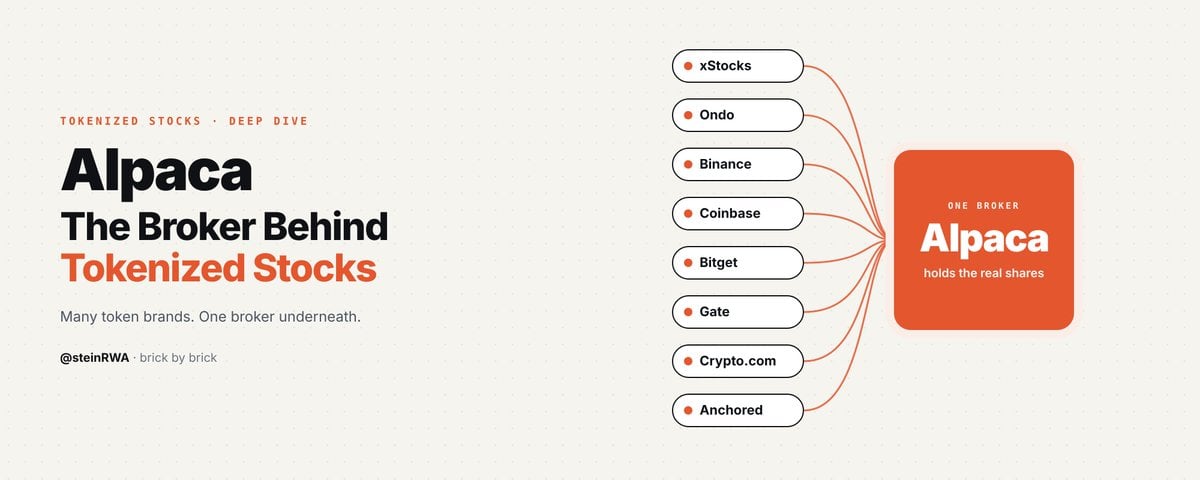
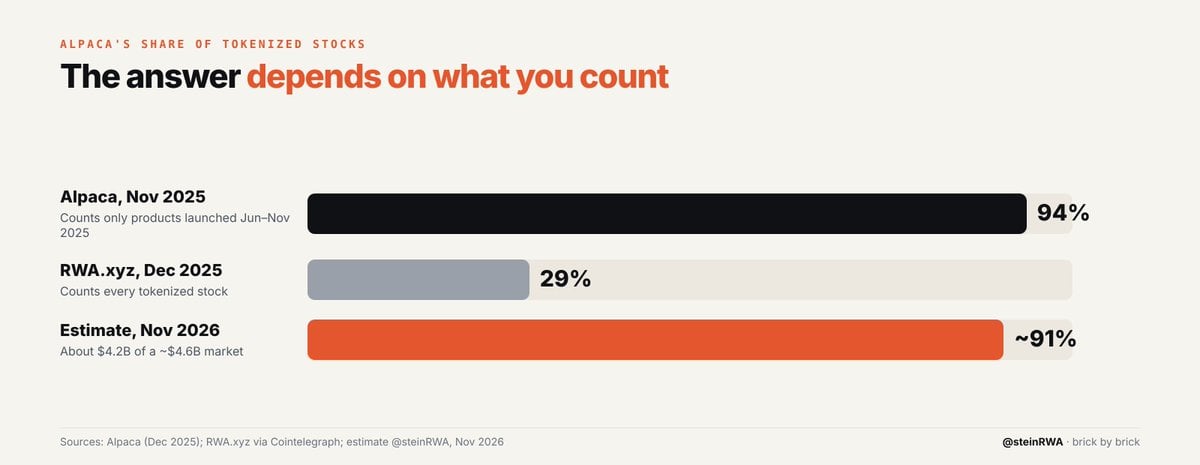
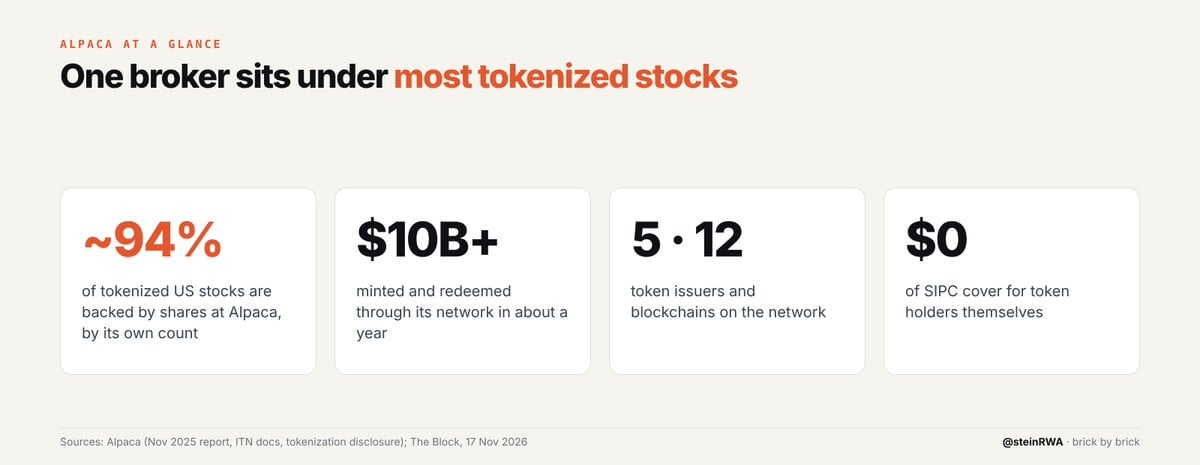
Platforms such as xStocks, Ondo, Binance, Coinbase, Bitget, Gate, and Crypto.com have all issued their own equity tokens. But underneath, most platforms rely on Alpaca to purchase and custody the real spot stocks. According to official Alpaca statistics, the real stocks they custody account for approximately 94% of the total market volume.
This article will comprehensively break down who Alpaca really is, how its tokenization system operates, which institutions use and pay for it, and the potential risk vulnerabilities behind it.
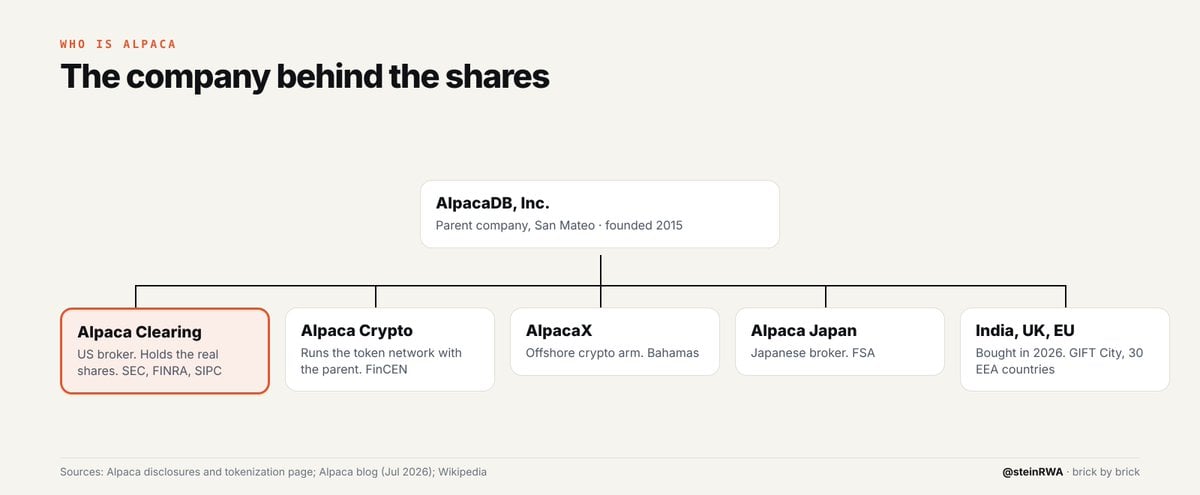
Who is Alpaca?
Alpaca is a US-based fintech company co-founded in 2015 by Yoshi Yokokawa (CEO) and Hitoshi Harada. Initially focused on trading data technology, the company pivoted to become a broker in 2018, allowing various other applications to seamlessly integrate with its trading backend via APIs.
Most retail investors may never have directly interacted with Alpaca, but it already provides foundational infrastructure support in the background for over 300 applications, banking institutions, and cryptocurrency exchanges across more than 40 countries worldwide.
The most critical entity is Alpaca Clearing (legally registered as Alpaca Securities LLC). As a financially regulated US broker, it serves as the actual custody location for all real spot stocks. Since 2025, it has directly connected with the core US stock settlement system, DTCC, to clear its own trades without any third-party intermediary involvement.
It is important to note that Alpaca itself does not issue any tokens. Alpaca is solely responsible for the custody and transfer of spot stocks; token products on-chain are consistently issued independently by other partner issuers.
How the Token Network Operates
Before October 2025, minting a new equity token was a slow and cumbersome process. Market makers had to first sell their spot stocks for fiat cash, remit that cash to the token issuer, and wait for the issuer to repurchase the stocks in the secondary market. This consumed significant time and capital costs and often caused severe decoupling spreads between the token price and the stock's real market value.
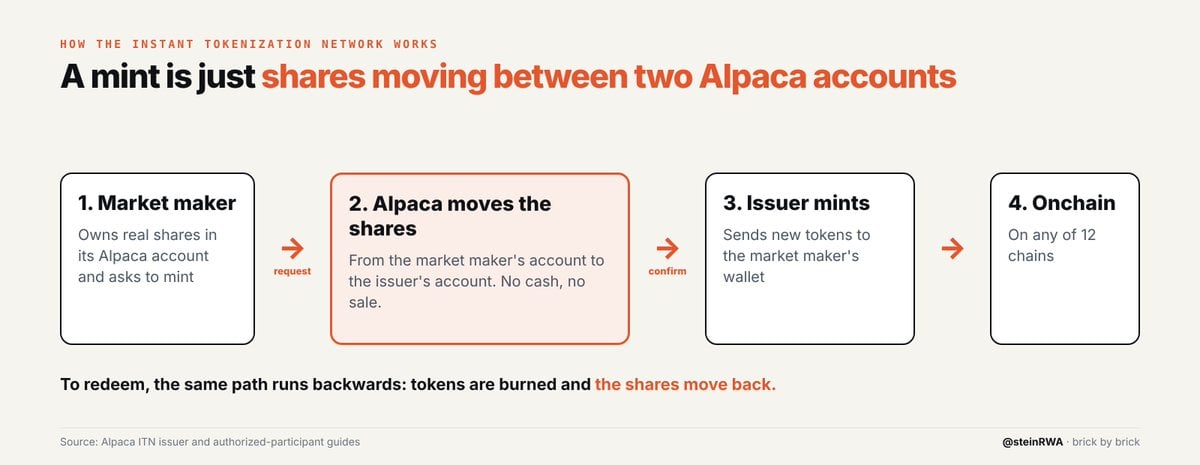
To address this pain point, Alpaca launched the "Instant Tokenization Network" (ITN), whose operational mechanism closely mirrors the creation and redemption process of traditional ETFs.
1. Market makers hold real spot stocks within their designated Alpaca accounts.
2. The market maker requests Alpaca to convert these holdings into tokens.
3. Alpaca internally transfers these stocks directly to the token issuer's Alpaca account.
4. The issuer then instantly sends the newly minted tokens to the market maker's on-chain wallet.
For redemptions, the market maker simply returns the tokens to the issuer, which burns the tokens, while the corresponding spot stocks are routed back internally to the market maker's account within Alpaca.
Since all spot transfers occur on the same broker's internal ledger, the entire process is extremely fast. Even during weekends when traditional US stock markets are closed, this exchange network continues to operate without interruption.
Three key details here warrant closer inspection:
• Cross-protocol liquidity: Market makers can redeem xStocks for spot stocks and immediately mint the same batch of stocks as Ondo tokens. While on-chain tokens are independent of each other, the underlying spot stocks can flow freely between different issuers.
• Remarkable scale: According to co-founder Hitoshi Harada, Alpaca has processed over $10 billion in token minting and redemption business in just about a year.
• Multi-chain and issuers: Alpaca's developer guide lists five core issuers (Binance, Coinbase, Ondo, st0x, xStocks) and supports 12 blockchains, including Solana, Ethereum, Base, BNB Chain, Arbitrum, Tron, TON, and Robinhood Chain, among others.
Who Uses Alpaca
Institutions using Alpaca fall into two main camps:
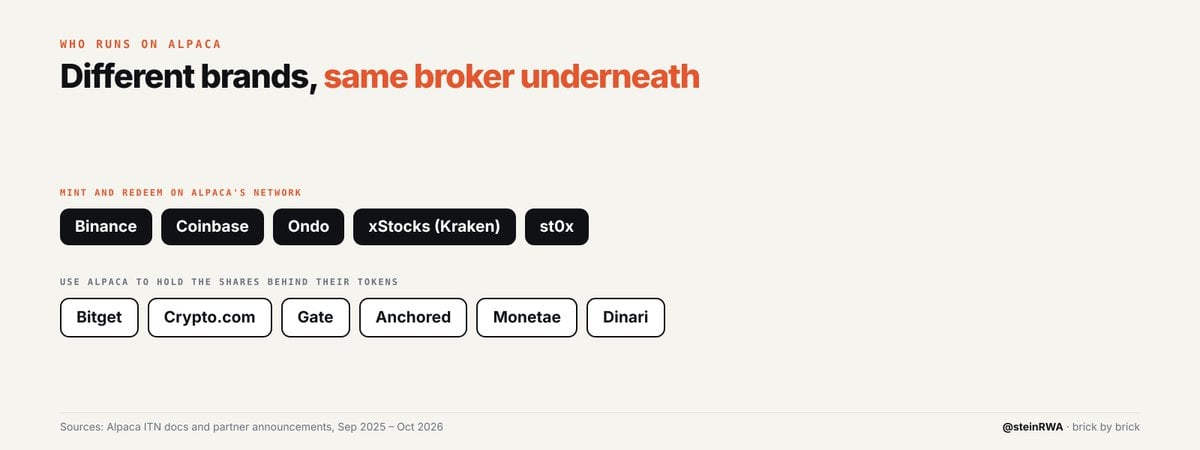
First camp: Institutions that directly execute token minting and redemption/burning on the Alpaca network, including Binance, Coinbase, Ondo, xStocks (affiliated with Kraken), and st0x.
Second camp: Institutions that utilize Alpaca to purchase and custody underlying spot stocks for their proprietary tokens, including Bitget, Crypto.com, Gate, Anchored, Monetae, and Dinari.
A few notable points:
• Near-full coverage of top brands: Almost all mainstream industry leaders have integrated into this network.
• A few exceptions chose other intermediaries: Securitize and Backpack opted for another clearing broker named RQD Clearing.
• Dual custody overlap: Kraken, Binance, Gate, and Bybit also provide conventional US stock trading services through Alpaca. This means your exchange may be holding both your actual Tesla stock and Tesla tokens at the same broker.
• Token rights are not equivalent: Not all tokens provide identical rights mapping.
How Large is Alpaca Now
The tokenized underlying spot stock assets custodied by Alpaca are experiencing exponential growth:
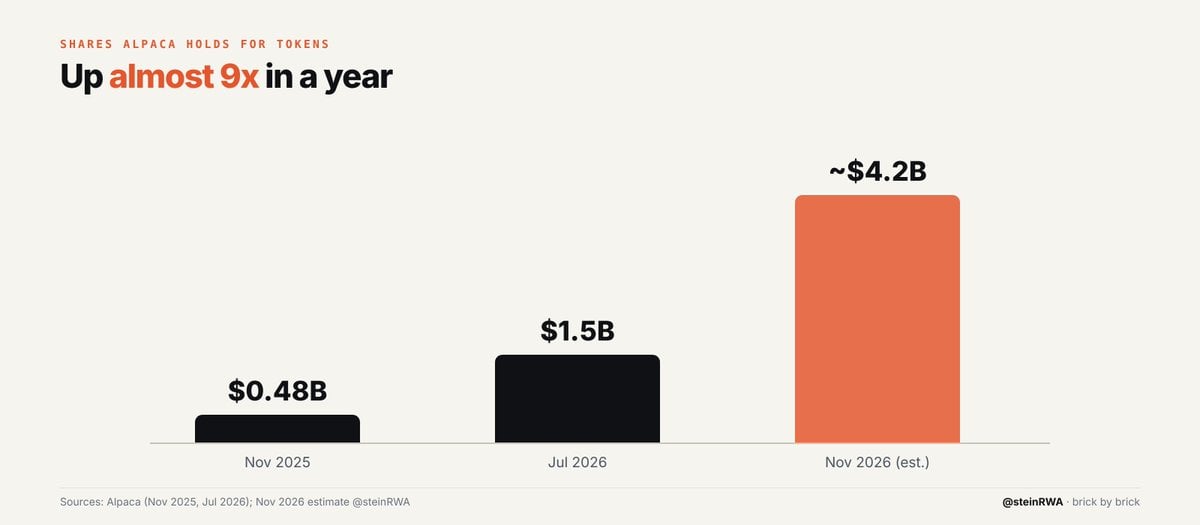
• November 2025: ~$480 million
• July 2026: Over $1.5 billion
• November 2026: Estimated to reach ~$4.2 billion
Alpaca's official data only covers tokenized products listed between June and November 2025; data firm @RWA_xyz counted all tokenized stocks in the market and pegged Alpaca's market share at 29% in December 2025; while based on my own calculations, by November 2026, within the ~$4.6 billion total tokenized US equity market, Alpaca's actual share has climbed to approximately 91%.
Therefore, objectively speaking, Alpaca completely dominates the current wave of new growth driven by next-generation tokenization products like xStocks, Ondo, and Binance, but has not absorbed all the legacy on-chain stock inventory that was previously migrated onto blockchains.
Breaking into the Wall Street Core
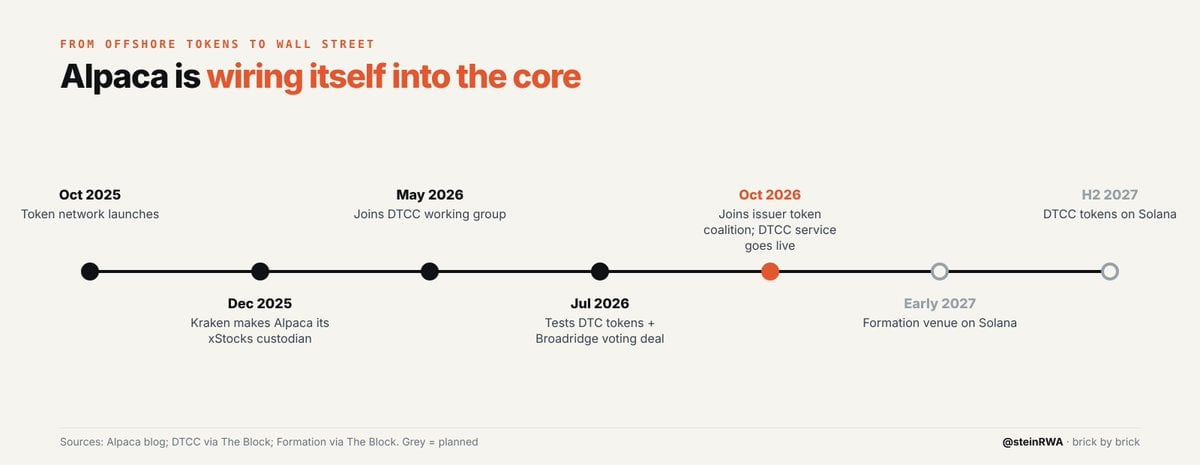
Entering 2026, Alpaca began fully integrating with mainstream US financial clearing systems. Once the tokenized stock wave achieves full compliance and rolls out domestically in the US, it aims to firmly secure first-mover advantage.
• DTCC: As the core hub of the US stock settlement system, DTCC partnered with Alpaca in July 2026 to conduct the initial round of DTC token tests (using SPY and Circle stocks). When DTCC's tokenization service officially launched on October 28, Alpaca was among the first licensed brokers to integrate. These tokens come with full shareholder rights, far from being mere price exposures.
• Broadridge: This partnership allows some token holders to participate in shareholder voting decisions for public companies via ProxyVote.com, provided the token issuer enables this feature.
• Issuer-sponsored tokens: Alpaca joined an alliance led by Bullish and Equiniti to push public companies to directly issue tokens representing their own equity on-chain. This will make tokens true original shares, directly registered by the public company's Transfer Agent. On-chain transfer agents like Securitize, Superstate, and Fairmint have already adopted this operational model. Alpaca stated that such tokens will soon be integrated into its network.
• Formation: Formation plans to launch a compliant tokenized stock trading venue on Solana in early 2027, with Alpaca serving as one of the core access gateways for investors to enter the platform.
Alpaca is making a dual-hedge bet: if tokenized assets remain in the offshore market long-term, it will continue securely operating in the background hosting stocks; if business flows back to the compliant domestic US market, it aims to become the core official minting and conversion broker.
Who is Investing in Alpaca
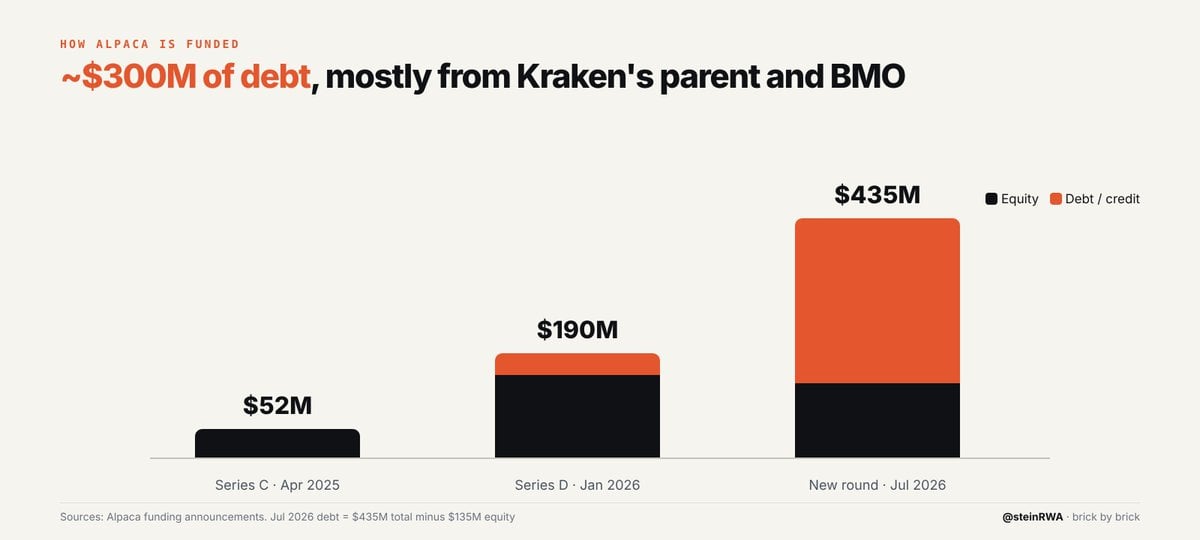
Since 2025, Alpaca has completed three rounds of financing. The latest round included approximately $300 million in debt financing, primarily from Payward (Kraken's parent company) and Bank of Montreal (BMO).
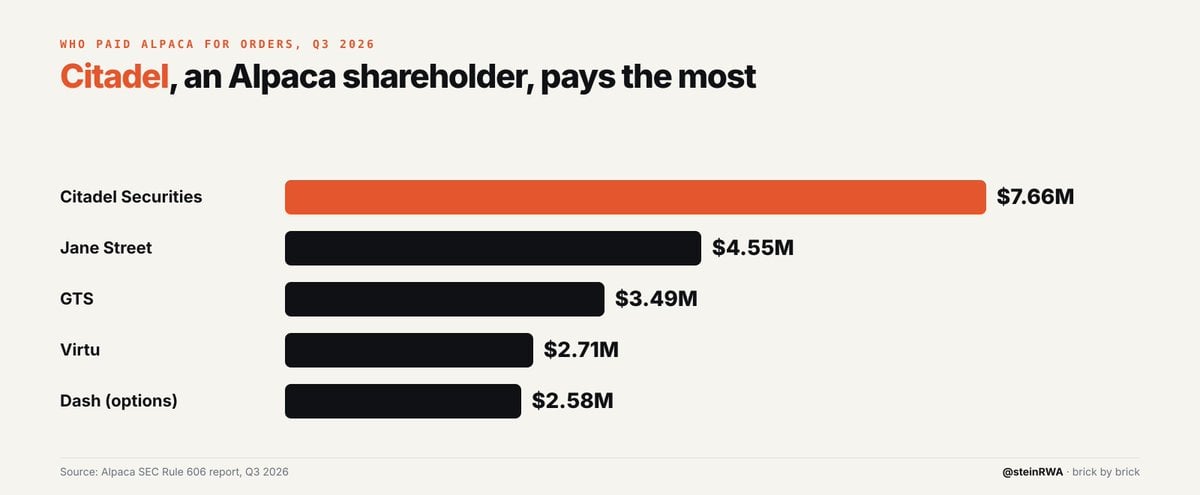
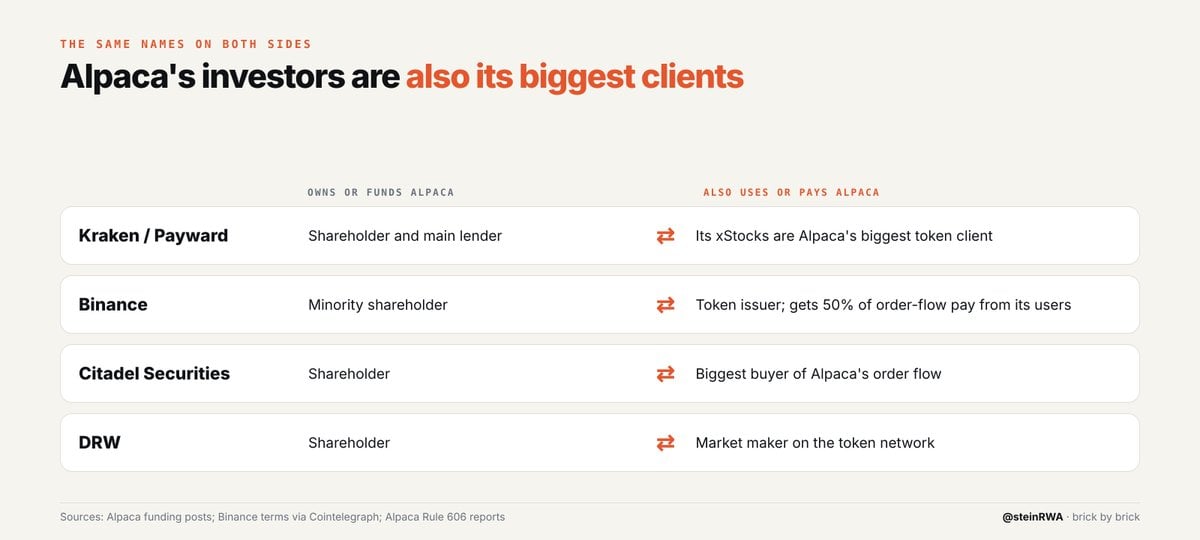
Most interestingly, many of Alpaca's core investors happen to also be its largest business clients.
• Kraken: Holds a portion of Alpaca's equity, provides credit funding for it, and operates its largest token client, xStocks.
• Binance: Holds a small stake in Alpaca. It not only issues tokens through Alpaca but also receives half of the Payment for Order Flow (PFOF) profits that Alpaca earns from Binance users, along with 65% of the profits generated from lending those user stocks.
• Citadel Securities: Holds equity in Alpaca and is the largest buyer of its customer orders.
• DRW: Holds equity in Alpaca and actively engages in market-making trading on its token network.
How Alpaca Earns Money Through Order Flow
When customers buy or sell stocks, Alpaca routes the orders to market-making institutions, which in turn compensate Alpaca for these orders, commonly known in the industry as "Payment for Order Flow" (PFOF).
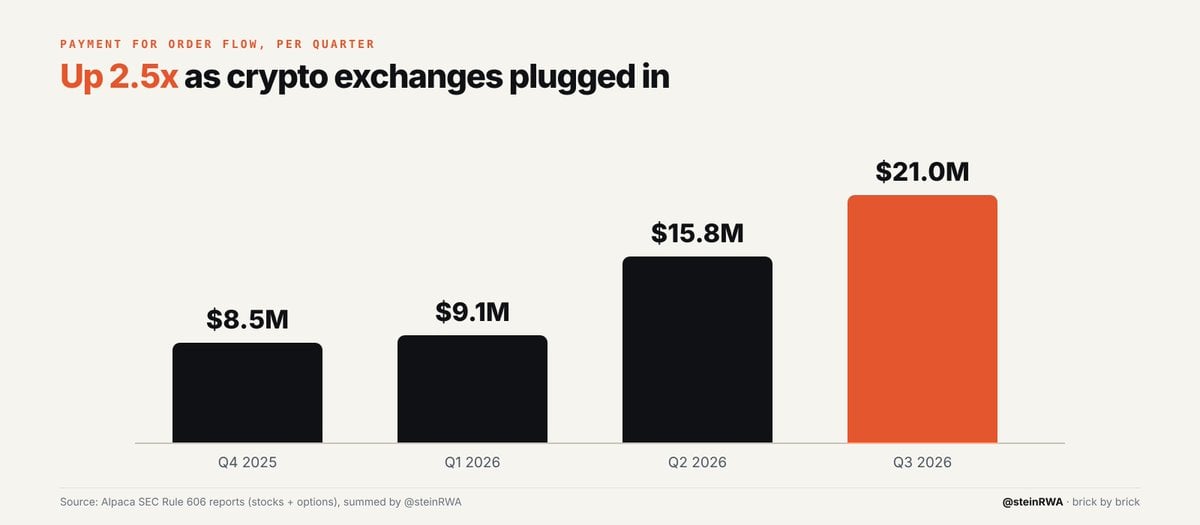
Alpaca's publicly filed documents show that with the continuous influx of major cryptocurrency exchanges, this order flow revenue surged 2.5 times in just one year.
In the latest quarter, Citadel Securities ranked first in paid order flow amounts, and Citadel itself is indeed a major shareholder of Alpaca.
Are the Underlying Stocks Actually Safe?
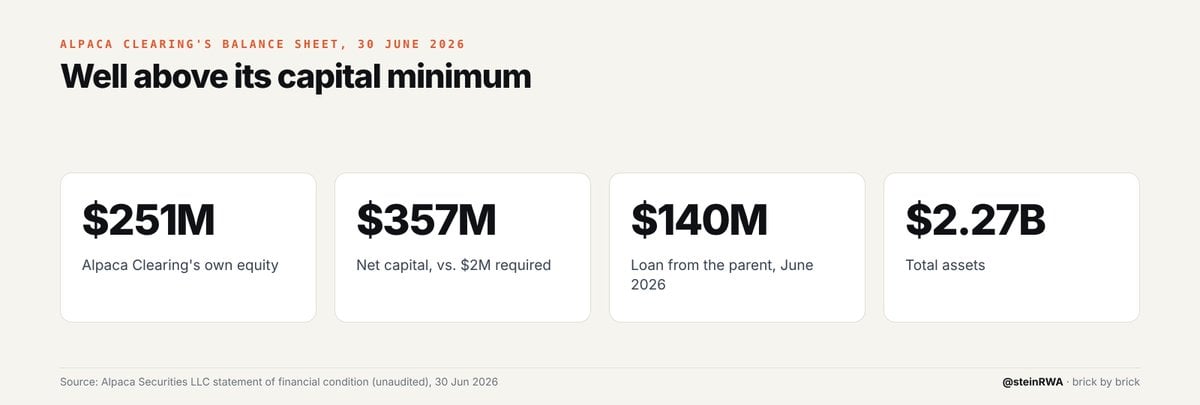
From a financial perspective, Alpaca Clearing is quite robust. As of the end of June 2026, its net capital significantly exceeds the minimum regulatory threshold.
However, in terms of investor insurance, the situation is entirely different:
• Account ownership differences: Ownership of the underlying stocks belongs to the token issuers, not individual end investors. Ondo or Binance are direct clients of Alpaca, while regular retail investors are merely clients of the issuers.
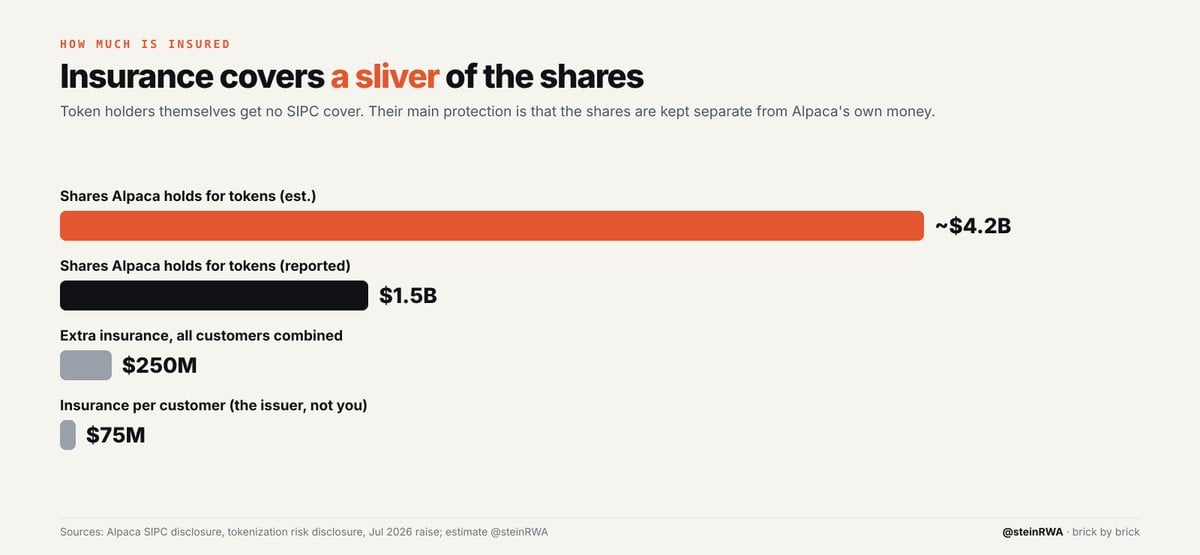
• Insurance limits and caps: The statutory payout cap for the traditional Securities Investor Protection Corporation (SIPC) is $500,000 per client. Although the additional commercial insurance purchased by Alpaca raises the single-account cap to $75 million, the cumulative total payout cap for all clients is only $250 million.
• Zero coverage for tokens: According to Alpaca's official risk disclosures, on-chain tokens themselves fall completely outside the scope of SIPC insurance coverage.
An investor's true safety barrier lies in the regulatory requirement for strict segregation of broker accounts, mandating that brokers must strictly separate client stock assets from proprietary funds. Even if Alpaca undergoes bankruptcy liquidation, the underlying stocks should be returned in full to the token issuers. However, whether end holders ultimately recover their funds depends entirely on the legal architecture and bankruptcy isolation mechanisms designed by their respective token issuers.
Alpaca's Regulatory History
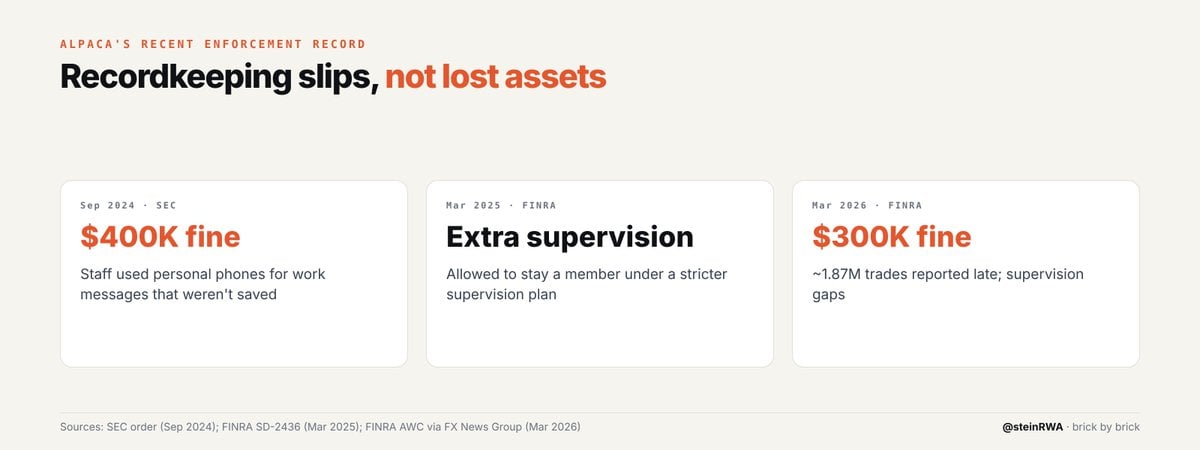
Alpaca has recently faced two regulatory penalties, neither involving token business or client fund losses:
• In 2024, the US Securities and Exchange Commission (SEC) fined Alpaca $400,000 after employees used unmonitored personal phones to communicate work-related information. Consequently, the Financial Industry Regulatory Authority (FINRA) currently subjects it to a stricter special supervisory program.
• In 2026, FINRA fined Alpaca $300,000 due to delayed reporting for approximately 1.87 million trades.
Notably, at least at this stage, Alpaca's tokenization services have not yet been opened to domestic US investors.
Key Observations for 2027
• Which company will become the first to directly issue and tokenize its own equity on the Alpaca network.
• Official DTCC tokens are expected to officially launch on Solana in the second half of 2027.
• Formation plans to formally launch its compliant trading venue on Solana in early 2027.
• Whether Alpaca will publicly disclose Proof of Reserves for its underlying position stocks.
• Whether more mainstream issuing institutions and emerging blockchain networks will join the ecosystem.
• Expansion progress in European and Indian markets, where Alpaca has already obtained local financial licenses.
Sources
Data in this article is based on a comprehensive review of Alpaca's official blog (22 articles related to tokenization published between April 2025 and November 2026), its developer documentation, risk disclosure agreements, the June 2026 balance sheet, and order flow filing documents from Q4 2025 to Q3 2026. The total PFOF figures mentioned in the text were independently calculated and summarized by the author based on its original filings.
Thank you for reading.
Stein.
Join TechFlow official community to stay tuned
Telegram:https://t.me/TechFlowDaily
X (Twitter):https://x.com/TechFlowPost
X (Twitter) EN:https://x.com/BlockFlow_News
 @steinRWA